Thank you for visiting SNEWPapers!
Sign up free
Literary
November 30, 1848
Green Mountain Freeman
Montpelier, Washington County, Vermont
What is this article about?
John S. C. Abbott's biographical essay on Alphonse de Lamartine explores his sensitive, spiritual nature shaped by family ruin from the French Revolution, his devout mother's influence via Bible teachings, monastic education, intense love for Elvira whose death inspired his poetic 'Meditations,' a bestseller capturing universal melancholy and emotion.
Clipping
OCR Quality
97%
Excellent
Full Text
Biographical.
From the New-York Evangelist.
LAMARTINE. NO. I.
BY JOHN S. C. ABBOTT.
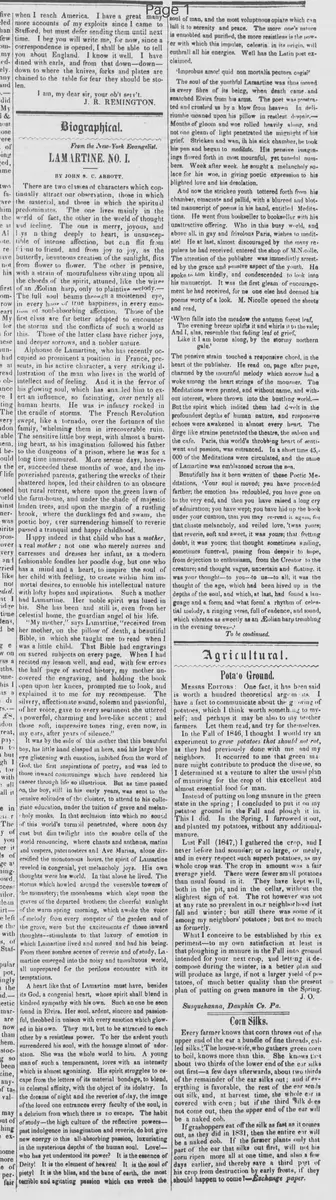
There are two classes of characters which continually attract our observation, those in which the material, and those in which the spiritual predominates. The one lives mainly in the world of fact, the other in the world of thought and feeling. The one is merry, joyous, and takes nothing deeply to heart, is insusceptible of intense affection, but can flit from friend to friend, and from joy to joy, as the butterfly, beauteous creation of the sunlight, flits from flower to flower. The other is pensive, with a strain of mournfulness vibrating upon all the chords of the spirit, attuned, like the wires of an Æolian harp, only to plaintive melody.—The full soul beams through a moistened eye, in every hour of true happiness, in every emotion of soul-absorbing affection. Those of the first class are far better adapted to encounter the storms and the conflicts of such a world as this. Those of the latter class have richer joys, and deeper sorrows, and a nobler nature.
Alphonse de Lamartine, who has recently occupied so prominent a position in France, presents, in his active character, a very striking illustration of the man who lives in the world of intellect and of feeling. And it is the fervor of his glowing soul, which has enabled him to exert an influence, so fascinating, over nearly all human hearts. He was in infancy rocked in the cradle of storms. The French Revolution swept, like a tornado, over the fortunes of the family, 'whelming them in irrecoverable ruin. The sensitive little boy wept, with almost a bursting heart, as his imagination followed his father to the dungeons of a prison, where he was for a long time immured. More serene days, however, succeeded these months of woe, and the impoverished parents, gathering the wrecks of their shattered hopes, led their children to an obscure but rural retreat, where upon the green lawn of the farm-house, and under the shade of majestic linden trees, and upon the margin of a rustling brook, where the ducklings fed and swam, the poetic boy, ever surrendering himself to reverie parsed a tranquil and happy childhood.
Happy indeed is that child who has a mother a real mother; not one who merely nurses and caresses and dresses her infant, as a modern fashionable fondles her poodle dog, but one who has a mind and a heart, to inspire the soul of her child with feeling, to create within him immortal desires, to ennoble his intellectual nature with lofty hopes and aspirations. Such a mother had Lamartine. Her noble spirit was fused in his. She has been and still is, even from her celestial home, the guardian angel of his life.
"My mother," says Lamartine, "received from her mother, on the pillow of death, a beautiful Bible, in which she taught me to read when I was a little child. That Bible had engravings on sacred subjects on every page. When I had recited my lesson well, and read, with few errors the half page of sacred history, my mother uncovered the engraving, and holding the book open upon her knees, prompted me to look, and explained it to me for my recompense. The silvery, affectionate sound, solemn and passionful, of her voice, gave to every sentiment she uttered powerful, charming and love-like accent; and those soft, impressive tones ring, even now, in my ears, after years of silence.'
It was by the side of this mother that this beautiful boy, his little hand clasped in hers, and his large blue eye glistening with emotion, imbibed from the word of God, the first inspirations of poetry, and was led to those inward communings which have rendered his career through life so illustrious. But as time passed on, the boy, still in his early years, was sent to the pensive solitudes of the cloister, to attend to his collegiate education, under the tuition of grave and melancholy monks. In that seclusion into which no sound of this world's turmoil penetrated, where noon day cast but dim twilight into the sombre cells of the world renouncing, where chants and anthems, matins and vespers, paternosters and Ave Marias, alone diversified the monotonous hours, the spirit of Lamartine reveled in congenial, yet melancholy joys. His own thoughts were his world. In that alone he lived. The storms which howled around the venerable towers of the monastery; the moonbeams which slept upon the graves of the departed brothers; the cheerful sunlight of the warm spring morning, which awoke the voice of melody from every songster of the garden and of the grove, were but the excitements of those inward thoughts—stimulants to that luxury of emotion in which Lamartine lived and moved and had his being.
From these sombre scenes of reverie and of study, Lamartine emerged into the noisy and tumultuous world, all unprepared for the perilous encounter with its temptations.
A heart like that of Lamartine must have, besides its God, a congenial heart, whose spirit shall blend in kindred sympathy with his own. Such an one he soon found in Elvira. Her soul, ardent, sincere and passionate, throbbed in unison with every emotion which glowed in his own. They met, but to be attracted to each other by a resistless power. To her the ardent youth surrendered his soul, with the homage almost of adoration. She was the whole world to him. A young man of such a temperament, loves with an intensity which is almost agonizing. His spirit struggles to escape from the fetters of its material bondage, to blend in celestial affinity, with the object of its idolatry. In the dreams of night and the reveries of day, the image of the loved one entrances every faculty of the soul, in a delirium from which there is no escape. The habit of study—the high culture of the reflective powers—past indulgence in imagination and reverie, do but give new energy to this all-absorbing passion, luxuriating in the mysterious depths of the human soul. Love!—who has yet understood its power? It is the essence of Deity! It is the element of heaven! It is the soul of piety! It is the bliss, and the bane of earth, the most terrible and agitating passion which can wreck the soul of man, and the most voluptuous opiate which can lull it to serenity and peace. The more one's nature is ennobled and purified, the more resistless is the power with which this impulse, celestial in its origin, will enthrall all his energies. Well has the Latin poet exclaimed.
'Improbus amor! quid non mortalia pectora cogis?'
The soul of the youthful Lamartine was thus moved in every fibre of its being, when death came, and snatched Elvira from his arms. The poet was prostrated and crushed as by a blow from heaven. In delirium he moaned upon his pillow in restless despair.—Months of gloom and woe rolled heavily along, and not one gleam of light penetrated the midnight of his grief. Stricken and wan, in his sick chamber, he took his pen and began to meditate. His pensive imagings flowed forth in most mournful, yet tuneful numbers. Week after week, he sought a melancholy solace for his woe, in giving poetic expression to his blighted love and his desolation.
And now the stricken youth tottered forth from his chamber, emaciate and pallid, with a blurred and blotted manuscript of poems in his hand, entitled Meditations. He went from bookseller to bookseller with his unattractive offering. Who in this busy world, and above all, in gay and frivolous Paris, wishes to meditate! He at last, almost discouraged by the many repulses he had received, entered the shop of M. Nicolle. The attention of the publisher was immediately arrested by the grace and pensive aspect of the youth. He spoke to him kindly, and condescended to look into his manuscript. It was the first gleam of encouragement he had received, for no one else had deemed his poems worthy of a look. M. Nicolle opened the sheets and read,
'When falls into the meadow the autumn forest leaf.
The evening breeze uplifts it and whirls it to the vale;
And I, alas, resemble that fading leaf of grief.
Like it I am borne along, by the stormy northern gale.'
The pensive strain touched a responsive chord, in the heart of the publisher. He read on, page after page, charmed by the mournful melody which sorrow had awoke among the heart strings of the mourner. The Meditations were printed, and without name, and without interest, were thrown into the bustling world.—But the spirit which indited them had dwelt in the profoundest depths of human nature, and responsive echoes were awakened in almost every heart. The dirge-like strains penetrated the theatre, the saloon and the cafe. Paris, this world's throbbing heart of sentiment and passion, was entranced. In a short time 45,000 of the Meditations were circulated, and the name of Lamartine was emblazoned across the sea.
Beautifully has it been written of these Poetic Meditations, 'Your soul is moved; you have proceeded farther: the emotion has redoubled, you have gone on to the very end, and then you have raised a long cry of admiration; you have wept; you have hid up the book under your cushion, that you may re-read it again, for that chaste melancholy, and veiled love, 'twas yours; that reverie, soft and sweet, it was yours; that fretting doubt, it was yours; that thought sometimes smiling, sometimes funereal, passing from despair to hope, from dejection to enthusiasm, from the Creator to the creature; and thought vague, uncertain and floating, it was your thought—to you—to us—to all, it was the thought of the age, which had been hived up in the depths of the soul, and which, at last, had found a language and a form; and what form! a rhythm of celestial melody, a ringing verse, full of cadence, and sound, which vibrates as sweetly as an Eolian harp trembling in the evening breeze.'
To be continued.
From the New-York Evangelist.
LAMARTINE. NO. I.
BY JOHN S. C. ABBOTT.
There are two classes of characters which continually attract our observation, those in which the material, and those in which the spiritual predominates. The one lives mainly in the world of fact, the other in the world of thought and feeling. The one is merry, joyous, and takes nothing deeply to heart, is insusceptible of intense affection, but can flit from friend to friend, and from joy to joy, as the butterfly, beauteous creation of the sunlight, flits from flower to flower. The other is pensive, with a strain of mournfulness vibrating upon all the chords of the spirit, attuned, like the wires of an Æolian harp, only to plaintive melody.—The full soul beams through a moistened eye, in every hour of true happiness, in every emotion of soul-absorbing affection. Those of the first class are far better adapted to encounter the storms and the conflicts of such a world as this. Those of the latter class have richer joys, and deeper sorrows, and a nobler nature.
Alphonse de Lamartine, who has recently occupied so prominent a position in France, presents, in his active character, a very striking illustration of the man who lives in the world of intellect and of feeling. And it is the fervor of his glowing soul, which has enabled him to exert an influence, so fascinating, over nearly all human hearts. He was in infancy rocked in the cradle of storms. The French Revolution swept, like a tornado, over the fortunes of the family, 'whelming them in irrecoverable ruin. The sensitive little boy wept, with almost a bursting heart, as his imagination followed his father to the dungeons of a prison, where he was for a long time immured. More serene days, however, succeeded these months of woe, and the impoverished parents, gathering the wrecks of their shattered hopes, led their children to an obscure but rural retreat, where upon the green lawn of the farm-house, and under the shade of majestic linden trees, and upon the margin of a rustling brook, where the ducklings fed and swam, the poetic boy, ever surrendering himself to reverie parsed a tranquil and happy childhood.
Happy indeed is that child who has a mother a real mother; not one who merely nurses and caresses and dresses her infant, as a modern fashionable fondles her poodle dog, but one who has a mind and a heart, to inspire the soul of her child with feeling, to create within him immortal desires, to ennoble his intellectual nature with lofty hopes and aspirations. Such a mother had Lamartine. Her noble spirit was fused in his. She has been and still is, even from her celestial home, the guardian angel of his life.
"My mother," says Lamartine, "received from her mother, on the pillow of death, a beautiful Bible, in which she taught me to read when I was a little child. That Bible had engravings on sacred subjects on every page. When I had recited my lesson well, and read, with few errors the half page of sacred history, my mother uncovered the engraving, and holding the book open upon her knees, prompted me to look, and explained it to me for my recompense. The silvery, affectionate sound, solemn and passionful, of her voice, gave to every sentiment she uttered powerful, charming and love-like accent; and those soft, impressive tones ring, even now, in my ears, after years of silence.'
It was by the side of this mother that this beautiful boy, his little hand clasped in hers, and his large blue eye glistening with emotion, imbibed from the word of God, the first inspirations of poetry, and was led to those inward communings which have rendered his career through life so illustrious. But as time passed on, the boy, still in his early years, was sent to the pensive solitudes of the cloister, to attend to his collegiate education, under the tuition of grave and melancholy monks. In that seclusion into which no sound of this world's turmoil penetrated, where noon day cast but dim twilight into the sombre cells of the world renouncing, where chants and anthems, matins and vespers, paternosters and Ave Marias, alone diversified the monotonous hours, the spirit of Lamartine reveled in congenial, yet melancholy joys. His own thoughts were his world. In that alone he lived. The storms which howled around the venerable towers of the monastery; the moonbeams which slept upon the graves of the departed brothers; the cheerful sunlight of the warm spring morning, which awoke the voice of melody from every songster of the garden and of the grove, were but the excitements of those inward thoughts—stimulants to that luxury of emotion in which Lamartine lived and moved and had his being.
From these sombre scenes of reverie and of study, Lamartine emerged into the noisy and tumultuous world, all unprepared for the perilous encounter with its temptations.
A heart like that of Lamartine must have, besides its God, a congenial heart, whose spirit shall blend in kindred sympathy with his own. Such an one he soon found in Elvira. Her soul, ardent, sincere and passionate, throbbed in unison with every emotion which glowed in his own. They met, but to be attracted to each other by a resistless power. To her the ardent youth surrendered his soul, with the homage almost of adoration. She was the whole world to him. A young man of such a temperament, loves with an intensity which is almost agonizing. His spirit struggles to escape from the fetters of its material bondage, to blend in celestial affinity, with the object of its idolatry. In the dreams of night and the reveries of day, the image of the loved one entrances every faculty of the soul, in a delirium from which there is no escape. The habit of study—the high culture of the reflective powers—past indulgence in imagination and reverie, do but give new energy to this all-absorbing passion, luxuriating in the mysterious depths of the human soul. Love!—who has yet understood its power? It is the essence of Deity! It is the element of heaven! It is the soul of piety! It is the bliss, and the bane of earth, the most terrible and agitating passion which can wreck the soul of man, and the most voluptuous opiate which can lull it to serenity and peace. The more one's nature is ennobled and purified, the more resistless is the power with which this impulse, celestial in its origin, will enthrall all his energies. Well has the Latin poet exclaimed.
'Improbus amor! quid non mortalia pectora cogis?'
The soul of the youthful Lamartine was thus moved in every fibre of its being, when death came, and snatched Elvira from his arms. The poet was prostrated and crushed as by a blow from heaven. In delirium he moaned upon his pillow in restless despair.—Months of gloom and woe rolled heavily along, and not one gleam of light penetrated the midnight of his grief. Stricken and wan, in his sick chamber, he took his pen and began to meditate. His pensive imagings flowed forth in most mournful, yet tuneful numbers. Week after week, he sought a melancholy solace for his woe, in giving poetic expression to his blighted love and his desolation.
And now the stricken youth tottered forth from his chamber, emaciate and pallid, with a blurred and blotted manuscript of poems in his hand, entitled Meditations. He went from bookseller to bookseller with his unattractive offering. Who in this busy world, and above all, in gay and frivolous Paris, wishes to meditate! He at last, almost discouraged by the many repulses he had received, entered the shop of M. Nicolle. The attention of the publisher was immediately arrested by the grace and pensive aspect of the youth. He spoke to him kindly, and condescended to look into his manuscript. It was the first gleam of encouragement he had received, for no one else had deemed his poems worthy of a look. M. Nicolle opened the sheets and read,
'When falls into the meadow the autumn forest leaf.
The evening breeze uplifts it and whirls it to the vale;
And I, alas, resemble that fading leaf of grief.
Like it I am borne along, by the stormy northern gale.'
The pensive strain touched a responsive chord, in the heart of the publisher. He read on, page after page, charmed by the mournful melody which sorrow had awoke among the heart strings of the mourner. The Meditations were printed, and without name, and without interest, were thrown into the bustling world.—But the spirit which indited them had dwelt in the profoundest depths of human nature, and responsive echoes were awakened in almost every heart. The dirge-like strains penetrated the theatre, the saloon and the cafe. Paris, this world's throbbing heart of sentiment and passion, was entranced. In a short time 45,000 of the Meditations were circulated, and the name of Lamartine was emblazoned across the sea.
Beautifully has it been written of these Poetic Meditations, 'Your soul is moved; you have proceeded farther: the emotion has redoubled, you have gone on to the very end, and then you have raised a long cry of admiration; you have wept; you have hid up the book under your cushion, that you may re-read it again, for that chaste melancholy, and veiled love, 'twas yours; that reverie, soft and sweet, it was yours; that fretting doubt, it was yours; that thought sometimes smiling, sometimes funereal, passing from despair to hope, from dejection to enthusiasm, from the Creator to the creature; and thought vague, uncertain and floating, it was your thought—to you—to us—to all, it was the thought of the age, which had been hived up in the depths of the soul, and which, at last, had found a language and a form; and what form! a rhythm of celestial melody, a ringing verse, full of cadence, and sound, which vibrates as sweetly as an Eolian harp trembling in the evening breeze.'
To be continued.
What sub-type of article is it?
Essay
What themes does it cover?
Love Romance
Death Mortality
Religious
What keywords are associated?
Lamartine Biography
Early Life
Mother Influence
Elvira Love
Meditations Poetry
Grief Sorrow
French Revolution
Monastic Education
What entities or persons were involved?
By John S. C. Abbott.
Literary Details
Title
Lamartine. No. I.
Author
By John S. C. Abbott.
Subject
Biographical Sketch Of Alphonse De Lamartine's Early Life And Poetic Development
Key Lines
"My Mother," Says Lamartine, "Received From Her Mother, On The Pillow Of Death, A Beautiful Bible, In Which She Taught Me To Read When I Was A Little Child. That Bible Had Engravings On Sacred Subjects On Every Page. When I Had Recited My Lesson Well, And Read, With Few Errors The Half Page Of Sacred History, My Mother Uncovered The Engraving, And Holding The Book Open Upon Her Knees, Prompted Me To Look, And Explained It To Me For My Recompense. The Silvery, Affectionate Sound, Solemn And Passionful, Of Her Voice, Gave To Every Sentiment She Uttered Powerful, Charming And Love Like Accent; And Those Soft, Impressive Tones Ring, Even Now, In My Ears, After Years Of Silence.'
'When Falls Into The Meadow The Autumn Forest Leaf.
The Evening Breeze Uplifts It And Whirls It To The Vale;
And I, Alas, Resemble That Fading Leaf Of Grief.
Like It I Am Borne Along, By The Stormy Northern Gale.'
Love!—Who Has Yet Understood Its Power? It Is The Essence Of Deity! It Is The Element Of Heaven! It Is The Soul Of Piety! It Is The Bliss, And The Bane Of Earth, The Most Terrible And Agitating Passion Which Can Wreck The Soul Of Man, And The Most Voluptuous Opiate Which Can Lull It To Serenity And Peace.
'Improbus Amor! Quid Non Mortalia Pectora Cogis?'