Thank you for visiting SNEWPapers!
Sign up free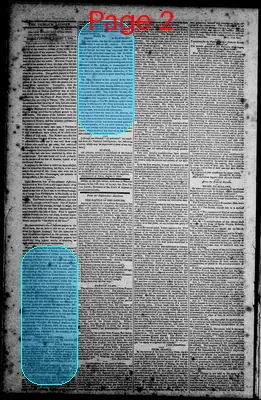
Editorial
August 7, 1809
Norfolk Gazette And Publick Ledger
Norfolk, Virginia
What is this article about?
Editorial condemns indecencies in American press against British minister Mr. Jackson, refuting false claims of his involvement in the 1804 Duke of Enghien conspiracy and denunciation by France, citing historical facts and timeline errors to defend diplomatic respect.
Clipping
OCR Quality
75%
Good
Full Text
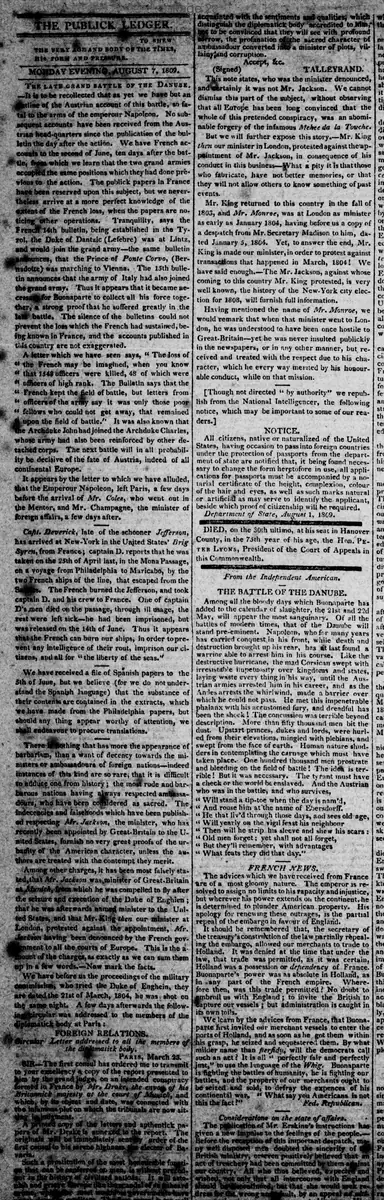
There is nothing that has more the appearance of barbarism, than a want of decency towards the ministers or ambassadors of foreign nations—indeed instances of this kind are so rare, that it is difficult to adduce one from history; the most rude and barbarous nations having always respected ambassadours who have been considered as sacred. The indecencies and falsehoods which have been published respecting Mr. Jackson, the minister, who has recently been appointed by Great-Britain to the United States, furnish no very great proofs of the urbanity of the American character, unless the authors are treated with the contempt they merit.
Among other charges, it has been most falsely stated that Mr. Jackson was minister of Great-Britain at Paris from which he was compelled to fly after the seizure and execution of the Duke of Enghien; that he was afterwards named minister to the United States, and that Mr King then our minister at London, protested against the appointment, Mr. Jackson having been denounced by the French government to all the courts of Europe. This is the amount of the charges, as exactly as we can sum them up in a few words. Now mark the facts.
We have before us the proceedings of the military commission who tried the Duke of Enghien, they are dated the 21st of March, 1804, he was shot on the same night. A few days afterwards the following circular was addressed to the members of the Diplomati ck body at Paris:
FOREIGN RELATIONS
Circular Letter addressed to all the members of the diplomati ck body.
Paris, March 23.
SIR: The first consul has ordered me to transmit to your excellency a copy of the report presented to him by the grand judge, on an intended conspiracy formed in France by Mr. Drake the envoy of his Britannick majesty, at the court of Munich. Sand bit object and date, was connected with the infamous plot on which the tribunals are now sitting. A. meht printd of the letter and authentick pa- pery of Mr: Drake is annexed to the report. The orlg!nvi I be immediately sent by order of the first consul to his serene highness the elector of Ba such Atithtio ofho wot hion thaitPoan yithout pretad ot in the hisxo 3 0n42e 4villzea ntosse- It uill tatQ: n nrex
acquainted with the sentiments and qualities, which distinguish the diplomatick body accredited to him, not to be convinced that they will see with profound sorrow, the profanation of the sacred character of an ambassador converted into a minister of plots, villainy and corruption.
Accept, &c.
(Signed) TALLEYRAND.
This note states, who was the minister denounced, and certainly it was not Mr. Jackson. We cannot dismiss this part of the subject, without observing that all Europe has been long convinced that the whole of this pretended conspiracy, was an abominable forgery of the infamous Mehee de la Touche.
But we will further expose this story.—Mr. King then our minister in London, protested against the appointment of Mr. Jackson, in consequence of his conduct in this business. What a pity it is that those who fabricate, have not better memories, or that they will not allow others to know something of past events.
Mr. King returned to this country in the fall of 1803, and Mr. Monroe, was at London as minister as early as January 1804, having before us a copy of a despatch from Mr. Secretary Madison to him, dated January 5, 1804. Yet, to answer the end, Mr. King is made our minister, in order to protest against transactions that happened in March, 1804! We have said enough.—The Mr. Jackson, against whose coming to this country Mr. King protested, is very well known, the history of the New-York city election for 1808, will furnish full information.
Having mentioned the name of Mr. Monroe, we would remark that when that minister went to London, he was understood to have been once hostile to Great-Britain—yet he was never insulted publickly in the newspapers, or in any other manner, but received and treated with the respect due to his character, which he every way merited by his honourable conduct, while on that mission.
Among other charges, it has been most falsely stated that Mr. Jackson was minister of Great-Britain at Paris from which he was compelled to fly after the seizure and execution of the Duke of Enghien; that he was afterwards named minister to the United States, and that Mr King then our minister at London, protested against the appointment, Mr. Jackson having been denounced by the French government to all the courts of Europe. This is the amount of the charges, as exactly as we can sum them up in a few words. Now mark the facts.
We have before us the proceedings of the military commission who tried the Duke of Enghien, they are dated the 21st of March, 1804, he was shot on the same night. A few days afterwards the following circular was addressed to the members of the Diplomati ck body at Paris:
FOREIGN RELATIONS
Circular Letter addressed to all the members of the diplomati ck body.
Paris, March 23.
SIR: The first consul has ordered me to transmit to your excellency a copy of the report presented to him by the grand judge, on an intended conspiracy formed in France by Mr. Drake the envoy of his Britannick majesty, at the court of Munich. Sand bit object and date, was connected with the infamous plot on which the tribunals are now sitting. A. meht printd of the letter and authentick pa- pery of Mr: Drake is annexed to the report. The orlg!nvi I be immediately sent by order of the first consul to his serene highness the elector of Ba such Atithtio ofho wot hion thaitPoan yithout pretad ot in the hisxo 3 0n42e 4villzea ntosse- It uill tatQ: n nrex
acquainted with the sentiments and qualities, which distinguish the diplomatick body accredited to him, not to be convinced that they will see with profound sorrow, the profanation of the sacred character of an ambassador converted into a minister of plots, villainy and corruption.
Accept, &c.
(Signed) TALLEYRAND.
This note states, who was the minister denounced, and certainly it was not Mr. Jackson. We cannot dismiss this part of the subject, without observing that all Europe has been long convinced that the whole of this pretended conspiracy, was an abominable forgery of the infamous Mehee de la Touche.
But we will further expose this story.—Mr. King then our minister in London, protested against the appointment of Mr. Jackson, in consequence of his conduct in this business. What a pity it is that those who fabricate, have not better memories, or that they will not allow others to know something of past events.
Mr. King returned to this country in the fall of 1803, and Mr. Monroe, was at London as minister as early as January 1804, having before us a copy of a despatch from Mr. Secretary Madison to him, dated January 5, 1804. Yet, to answer the end, Mr. King is made our minister, in order to protest against transactions that happened in March, 1804! We have said enough.—The Mr. Jackson, against whose coming to this country Mr. King protested, is very well known, the history of the New-York city election for 1808, will furnish full information.
Having mentioned the name of Mr. Monroe, we would remark that when that minister went to London, he was understood to have been once hostile to Great-Britain—yet he was never insulted publickly in the newspapers, or in any other manner, but received and treated with the respect due to his character, which he every way merited by his honourable conduct, while on that mission.
What sub-type of article is it?
Foreign Affairs
Moral Or Religious
What keywords are associated?
Diplomatic Decency
Press Falsehoods
Jackson Appointment
Enghien Conspiracy
Drake Denunciation
American Urbanity
What entities or persons were involved?
Mr. Jackson
Duke Of Enghien
Mr. Drake
Talleyrand
Mr. King
Mr. Monroe
Mehee De La Touche
Great Britain
United States
France
Editorial Details
Primary Topic
Defense Against False Charges On British Minister Mr. Jackson
Stance / Tone
Strong Condemnation Of Press Indecencies And Refutation Of Falsehoods
Key Figures
Mr. Jackson
Duke Of Enghien
Mr. Drake
Talleyrand
Mr. King
Mr. Monroe
Mehee De La Touche
Great Britain
United States
France
Key Arguments
Indecency Towards Foreign Ministers Is Barbaric And Rare Even Among Rude Nations.
Mr. Jackson Was Not The British Minister Denounced By France After Enghien's Execution; It Was Mr. Drake.
The Enghien Conspiracy Was A Forgery By Mehee De La Touche.
Timeline Error: Mr. King Left London Before The 1804 Events, So Could Not Protest Jackson's Appointment.
Mr. Monroe, Despite Anti British Views, Was Treated Respectfully In London.