Thank you for visiting SNEWPapers!
Sign up free
Literary
December 5, 1855
Spirit Of The Age
Raleigh, Wake County, North Carolina
What is this article about?
A Northerner's vivid description of Oakwood, a southern girls' boarding school run by Dr. and Mrs. ___, portraying its scenic setting, holiday outings, Sabbath observances, daily routines, educational offerings, and family life, ending with a 1855 birthday poem to Mrs. Dr. J. W. N. by T. E. S.
Clipping
OCR Quality
95%
Excellent
Full Text
Written for the Spirit of the Age.
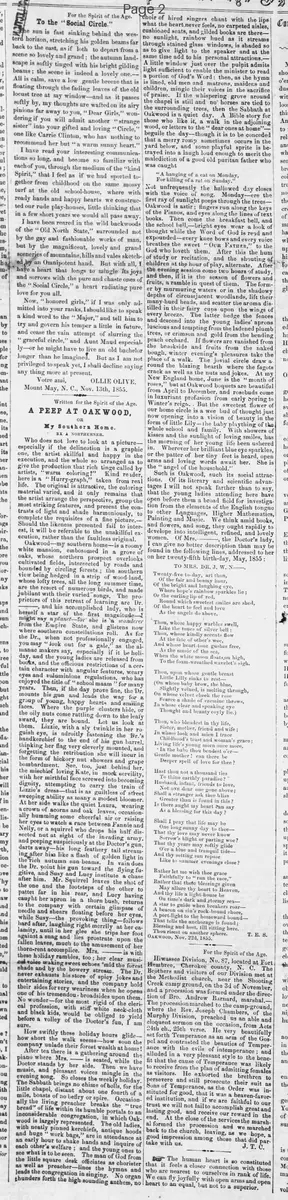
A PEEP AT OAKWOOD,
OR
My Southern Home.
BY A NORTHERNER.
Who does not love to look at a picture - especially if the delineation is a graphic one, the artist skillful and happy in the execution, and the whole so arranged as to give the production that rich tinge called by artists, "warm coloring?" Kind reader, here is a "Hurry-graph," taken from real life. The original is attractive, the coloring material varied, and it only remains that the artist arrange the perspective, group the most striking features, and present the contrasts of light and shade harmoniously, to complete the requisites of a fine picture. - Should the likeness presented fail to interest, it will be referable to the unskillful execution, rather than the faultless original.
Oakwood - my southern home - is a roomy white mansion, embosomed in a grove of oaks, whose northern prospect overlooks cultivated fields, intersected by roads and bounded by circling forests; the southern view being hedged in a strip of wood-land, whose lofty trees, all the long summer time, are the resort of numerous birds, and made jubilant with their varied songs. The proprietors of this retreat of learning are Dr. ___, and his accomplished lady, who is herself a star of the first magnitude - might say a planet - for she is a wanderer from the Empire State, and glistens now where southern constellations roll. As for the Dr., when not professionally engaged, you may "look out for a gale," as the almanac makers say, especially if it be holiday, and the young ladies are released from books, and the officious restrictions of a certain character with angular features, weary eyes and voluminous regulations, who has enjoyed the title of "school ma'am" for many years. Then, if the day prove fine, the Dr. mounts his gun and leads the way for a group of young, happy hearts and smiling faces. Where the purple clusters hide, or the oily nuts come rattling down to the leafy sward, they are bound. Let us look at them. Lizzie, with a sly twinkle in her roguish eye, is adroitly fastening the Dr.'s handkerchief to the end of his gun barrel, thinking her flag very cleverly mounted, and forgetting the retribution she will incur in the form of hickory nut showers and grape bombardment. See, too, just behind her the mischief loving Kate, in mock servility, with her mirthful face screwed into becoming dignity, attempting to carry the train of Lizzie's dress - that is as guiltless of street sweeping ability as many a modest bloomer. At her side walks the quiet Laura, wearing a crown of acorns and oak leaves, occasionally humming some cheerful air or raising her eyes to watch a race between Fannie and Nelly, or a squirrel who drops his half dissected nut at sight of the invading army, and peeping suspiciously at the Doctor's gun, darts away - his long feathery tail streaming after him like a flash of golden light in the rich autumn sun beams. In vain does the Dr. point his gun toward the flying fugitive, and Susy and Lucy institute a chase after him. Mr. Squirrel leaves the shot of the one and the footsteps of the other to patter far in his rear, and Lucy having caught her apron in a thorn bush, returns to the company with certain glimpses of needle and shears floating before her eyes, while Susy - the provoking thing - follows hard after, laughing right merrily at her calamity, until in her glee she trips her foot against a snag and lies prostrate upon the fallen leaves, much to the amusement of her thorn-rent accomplice. Mrs. ___ is with these holiday rambles, too; her clear musical voice waking sweet echoes 'mid the forest shade and by the bowery stream. The Dr. never exhausts his store of spicy jokes and entertaining stories, and the company hold their sides for very weariness when he opens one of his tremendous broadsides upon them. No wonder - for the most rigid of the clerical profession, with stiff white neck-cloth and black kids, would be obliged to yield before a volley of the Doctor's fun, I am sure.
How swiftly these holiday hours glide - how short the walk seems - how soon the company unlade their forest wealth at home! After tea there is a gathering around the piano where Mrs. ___ is seated, while the Doctor stands by her side. Then we have music, and pleasant voices mingle in the evening song. So closes the weekly holiday.
The Sabbath brings no chime of bells, for the little chapel, distant about one fourth of a mile, boasts of no belfry or spire. Occasionally the living preacher breaks the "true bread" of life within its humble portals to an inconsiderable congregation, in which Oakwood is largely represented. The old ladies, with neatly pinned kerchiefs, antique hoods and huge "work bags," are in attendance at an early hour to shake hands and inquire of each other's welfare; and the young ones to see what is to be seen. The man of God from the little square desk officiates as chorister as well as preacher - lines the hymns and leads the congregation in singing. No organ thunders forth the high sounding anthem, no choir of hired singers chant with the lips what the heart never feels, no carpeted aisles, cushioned seats, and gilded books are there - no sunlight, rainbow hued as it streams through stained glass windows, is shaded so as to give light to the speaker and at the same time add to his personal attractions. - A little window just over the pulpit admits light sufficient to enable the minister to read a portion of God's Word: then, as the hymn is lined, old men and matrons, maidens and children, mingle their voices in the sacrifice of praise. If the whispering grove around the chapel is still and no horses are tied to the surrounding trees, then the Sabbath at Oakwood is a quiet day. A Bible story for those who like it, a walk in the adjoining wood, or letters to the "dear ones at home" beguile the day - though it is to be conceded that a merry romp sometimes occurs in the yard below, and some playful sprite is betrayed into a laugh loud enough to merit the malediction of a good old puritan father who was caught
"A hanging of a cat on Monday,
For killing of a rat on Sunday."
Not unfrequently the hallowed day closes with the voice of song. Monday - ere the first ray of sunlight peeps through the trees - Oakwood is astir; fingers run along the keys of the Pianos, and eyes along the lines of text books. Then come the breakfast bell, and the school bell, - bright eyes wear a look of thought while the Word of God is read and expounded - every knee bows and every voice breathes the sweet "Our Father," to the God who loveth them. After this the hum of study or recitation, and the shouting of children at the hour of play, alternate. After the evening session come two hours of study, and then, if it is the season of flowers and fruits, a ramble in quest of them. The former by murmuring waters or in the shadowy depths of circumjacent woodlands, lift their many-hued heads, and scatter the aroma distilled in their fairy cups upon the wings of every breeze. The latter hedge the fences and descend into the young ladies' aprons luscious and tempting from the laden plumb trees, or crimson and gold from the bending peach orchard. If flowers are vanished from the brookside and fruits from the naked bough, winter evening's pleasures take the place of a walk. The jovial circle draw around the blazing hearth where the fagots crack as well as the nuts and jokes. At my New England home, June is the "month of roses," but at Oakwood bouquets are beautiful from April to December, and rosebuds come in luxuriant profusion from early spring to Winter's reign. But the sweetest flower of our home circle is a wee bud of thought just now opening into a vision of beauty in the form of little Lily - the baby plaything of the whole school and family. With showers of kisses and the sunlight of loving smiles, has the morning of her young life been ushered in. Wherever her brilliant blue eye sparkles, or the patter of her tiny feet is heard, open arms and loving words await her. She is the "angel of the household."
Such is Oakwood, such its social attractions. Of its literary and scientific advantages I will not speak farther than to say, that the young ladies attending here have open before them a broad field for investigation from the elements of the English tongue to other Languages, Higher Mathematics, Painting and Music. We think amid books, and flowers, and song, they ought rapidly to develope into intelligent, refined, and lovely women.
Of Mrs. ___, the Doctor's lady,
I can give no better description than may be found in the following lines, addressed to her on her twenty-fifth birth-day, May, 1855:
TO MRS. DR. J. W. N.
Twenty-five to-day, art thou,
Of the fair and beamy hour,
Of the bright and laughing eye,
Where hope's rainbow sparkles lie;
Or the curling lip of red,
Round which sweetest smiles are shed,
Of the heart to feel and love
As the angels do above.
Thou, whose happy warbles swell
Like the tones of silver bell;
Thou, whose kindly accents flow
At the fate of other's woe,
And whose heart-tone gushes free,
As the music of the sea,
When the white moon floats on high,
To the foam-wreathed wavelet's sigh.
Thou, upon whose gentle breast
Little Lilly sinks to rest -
(On whose baby brow, the blue,
Slightly veined, is melting through,
On whose velvet cheek the rose
Scarce a shade of carmine throws,
In whose clear and speaking eye
Thought and beauty coyly lie.)
Thou, who blendest in thy life,
Sister, mother, friend and wife;
In whose look and mien I trace
Childhood's trust and woman's grace;
Living life's young morn once more,
In the babe thou bendest o'er -
Gentle mother! can there be
Deeper spell of love for thee?
Hast thou not a thousand ties
To thine earthly paradise?
Husband, infant, friends to love,
Not one dear one gone above;
Shall a stranger ask thee bliss
Greater than is found in this?
Is there aught my heart can say
As a blessing for this day?
Shall I pray that life may be
One long sunny day to thee -
That thy love may never know
Sorrow's blight or parting woe?
That thy years may softly glide
O'er a blue and tranquil tide -
And thy setting sun repose
Like to summer evenings close?
Rather let me wish thee grace
Faithfully to "run the race,
Rather that these blessings given
May allure thy heart to Heaven,
And thy life a light-house be
On time's dark and stormy sea -
A star to guide when breakers roar -
A beacon on sin's rock-bound shore,
A port-light to the homeward bound
That tells the anchorage is found;
Blessing and best, till sitting here,
Thou risest on another sphere.
T. E. S.
Oakwood, Nov. 22d, 1855.
A PEEP AT OAKWOOD,
OR
My Southern Home.
BY A NORTHERNER.
Who does not love to look at a picture - especially if the delineation is a graphic one, the artist skillful and happy in the execution, and the whole so arranged as to give the production that rich tinge called by artists, "warm coloring?" Kind reader, here is a "Hurry-graph," taken from real life. The original is attractive, the coloring material varied, and it only remains that the artist arrange the perspective, group the most striking features, and present the contrasts of light and shade harmoniously, to complete the requisites of a fine picture. - Should the likeness presented fail to interest, it will be referable to the unskillful execution, rather than the faultless original.
Oakwood - my southern home - is a roomy white mansion, embosomed in a grove of oaks, whose northern prospect overlooks cultivated fields, intersected by roads and bounded by circling forests; the southern view being hedged in a strip of wood-land, whose lofty trees, all the long summer time, are the resort of numerous birds, and made jubilant with their varied songs. The proprietors of this retreat of learning are Dr. ___, and his accomplished lady, who is herself a star of the first magnitude - might say a planet - for she is a wanderer from the Empire State, and glistens now where southern constellations roll. As for the Dr., when not professionally engaged, you may "look out for a gale," as the almanac makers say, especially if it be holiday, and the young ladies are released from books, and the officious restrictions of a certain character with angular features, weary eyes and voluminous regulations, who has enjoyed the title of "school ma'am" for many years. Then, if the day prove fine, the Dr. mounts his gun and leads the way for a group of young, happy hearts and smiling faces. Where the purple clusters hide, or the oily nuts come rattling down to the leafy sward, they are bound. Let us look at them. Lizzie, with a sly twinkle in her roguish eye, is adroitly fastening the Dr.'s handkerchief to the end of his gun barrel, thinking her flag very cleverly mounted, and forgetting the retribution she will incur in the form of hickory nut showers and grape bombardment. See, too, just behind her the mischief loving Kate, in mock servility, with her mirthful face screwed into becoming dignity, attempting to carry the train of Lizzie's dress - that is as guiltless of street sweeping ability as many a modest bloomer. At her side walks the quiet Laura, wearing a crown of acorns and oak leaves, occasionally humming some cheerful air or raising her eyes to watch a race between Fannie and Nelly, or a squirrel who drops his half dissected nut at sight of the invading army, and peeping suspiciously at the Doctor's gun, darts away - his long feathery tail streaming after him like a flash of golden light in the rich autumn sun beams. In vain does the Dr. point his gun toward the flying fugitive, and Susy and Lucy institute a chase after him. Mr. Squirrel leaves the shot of the one and the footsteps of the other to patter far in his rear, and Lucy having caught her apron in a thorn bush, returns to the company with certain glimpses of needle and shears floating before her eyes, while Susy - the provoking thing - follows hard after, laughing right merrily at her calamity, until in her glee she trips her foot against a snag and lies prostrate upon the fallen leaves, much to the amusement of her thorn-rent accomplice. Mrs. ___ is with these holiday rambles, too; her clear musical voice waking sweet echoes 'mid the forest shade and by the bowery stream. The Dr. never exhausts his store of spicy jokes and entertaining stories, and the company hold their sides for very weariness when he opens one of his tremendous broadsides upon them. No wonder - for the most rigid of the clerical profession, with stiff white neck-cloth and black kids, would be obliged to yield before a volley of the Doctor's fun, I am sure.
How swiftly these holiday hours glide - how short the walk seems - how soon the company unlade their forest wealth at home! After tea there is a gathering around the piano where Mrs. ___ is seated, while the Doctor stands by her side. Then we have music, and pleasant voices mingle in the evening song. So closes the weekly holiday.
The Sabbath brings no chime of bells, for the little chapel, distant about one fourth of a mile, boasts of no belfry or spire. Occasionally the living preacher breaks the "true bread" of life within its humble portals to an inconsiderable congregation, in which Oakwood is largely represented. The old ladies, with neatly pinned kerchiefs, antique hoods and huge "work bags," are in attendance at an early hour to shake hands and inquire of each other's welfare; and the young ones to see what is to be seen. The man of God from the little square desk officiates as chorister as well as preacher - lines the hymns and leads the congregation in singing. No organ thunders forth the high sounding anthem, no choir of hired singers chant with the lips what the heart never feels, no carpeted aisles, cushioned seats, and gilded books are there - no sunlight, rainbow hued as it streams through stained glass windows, is shaded so as to give light to the speaker and at the same time add to his personal attractions. - A little window just over the pulpit admits light sufficient to enable the minister to read a portion of God's Word: then, as the hymn is lined, old men and matrons, maidens and children, mingle their voices in the sacrifice of praise. If the whispering grove around the chapel is still and no horses are tied to the surrounding trees, then the Sabbath at Oakwood is a quiet day. A Bible story for those who like it, a walk in the adjoining wood, or letters to the "dear ones at home" beguile the day - though it is to be conceded that a merry romp sometimes occurs in the yard below, and some playful sprite is betrayed into a laugh loud enough to merit the malediction of a good old puritan father who was caught
"A hanging of a cat on Monday,
For killing of a rat on Sunday."
Not unfrequently the hallowed day closes with the voice of song. Monday - ere the first ray of sunlight peeps through the trees - Oakwood is astir; fingers run along the keys of the Pianos, and eyes along the lines of text books. Then come the breakfast bell, and the school bell, - bright eyes wear a look of thought while the Word of God is read and expounded - every knee bows and every voice breathes the sweet "Our Father," to the God who loveth them. After this the hum of study or recitation, and the shouting of children at the hour of play, alternate. After the evening session come two hours of study, and then, if it is the season of flowers and fruits, a ramble in quest of them. The former by murmuring waters or in the shadowy depths of circumjacent woodlands, lift their many-hued heads, and scatter the aroma distilled in their fairy cups upon the wings of every breeze. The latter hedge the fences and descend into the young ladies' aprons luscious and tempting from the laden plumb trees, or crimson and gold from the bending peach orchard. If flowers are vanished from the brookside and fruits from the naked bough, winter evening's pleasures take the place of a walk. The jovial circle draw around the blazing hearth where the fagots crack as well as the nuts and jokes. At my New England home, June is the "month of roses," but at Oakwood bouquets are beautiful from April to December, and rosebuds come in luxuriant profusion from early spring to Winter's reign. But the sweetest flower of our home circle is a wee bud of thought just now opening into a vision of beauty in the form of little Lily - the baby plaything of the whole school and family. With showers of kisses and the sunlight of loving smiles, has the morning of her young life been ushered in. Wherever her brilliant blue eye sparkles, or the patter of her tiny feet is heard, open arms and loving words await her. She is the "angel of the household."
Such is Oakwood, such its social attractions. Of its literary and scientific advantages I will not speak farther than to say, that the young ladies attending here have open before them a broad field for investigation from the elements of the English tongue to other Languages, Higher Mathematics, Painting and Music. We think amid books, and flowers, and song, they ought rapidly to develope into intelligent, refined, and lovely women.
Of Mrs. ___, the Doctor's lady,
I can give no better description than may be found in the following lines, addressed to her on her twenty-fifth birth-day, May, 1855:
TO MRS. DR. J. W. N.
Twenty-five to-day, art thou,
Of the fair and beamy hour,
Of the bright and laughing eye,
Where hope's rainbow sparkles lie;
Or the curling lip of red,
Round which sweetest smiles are shed,
Of the heart to feel and love
As the angels do above.
Thou, whose happy warbles swell
Like the tones of silver bell;
Thou, whose kindly accents flow
At the fate of other's woe,
And whose heart-tone gushes free,
As the music of the sea,
When the white moon floats on high,
To the foam-wreathed wavelet's sigh.
Thou, upon whose gentle breast
Little Lilly sinks to rest -
(On whose baby brow, the blue,
Slightly veined, is melting through,
On whose velvet cheek the rose
Scarce a shade of carmine throws,
In whose clear and speaking eye
Thought and beauty coyly lie.)
Thou, who blendest in thy life,
Sister, mother, friend and wife;
In whose look and mien I trace
Childhood's trust and woman's grace;
Living life's young morn once more,
In the babe thou bendest o'er -
Gentle mother! can there be
Deeper spell of love for thee?
Hast thou not a thousand ties
To thine earthly paradise?
Husband, infant, friends to love,
Not one dear one gone above;
Shall a stranger ask thee bliss
Greater than is found in this?
Is there aught my heart can say
As a blessing for this day?
Shall I pray that life may be
One long sunny day to thee -
That thy love may never know
Sorrow's blight or parting woe?
That thy years may softly glide
O'er a blue and tranquil tide -
And thy setting sun repose
Like to summer evenings close?
Rather let me wish thee grace
Faithfully to "run the race,
Rather that these blessings given
May allure thy heart to Heaven,
And thy life a light-house be
On time's dark and stormy sea -
A star to guide when breakers roar -
A beacon on sin's rock-bound shore,
A port-light to the homeward bound
That tells the anchorage is found;
Blessing and best, till sitting here,
Thou risest on another sphere.
T. E. S.
Oakwood, Nov. 22d, 1855.
What sub-type of article is it?
Essay
Poem
What themes does it cover?
Nature
Social Manners
Religious
What keywords are associated?
Oakwood School
Southern Home
Holiday Rambles
Sabbath Chapel
Girls Education
Family Life
Birthday Poem
What entities or persons were involved?
By A Northerner.
Literary Details
Title
A Peep At Oakwood, Or My Southern Home.
Author
By A Northerner.
Subject
Description Of Oakwood Southern School And Home Life.
Form / Style
Descriptive Prose Essay With Included Birthday Poem.
Key Lines
Oakwood My Southern Home Is A Roomy White Mansion, Embosomed In A Grove Of Oaks...
The Sabbath Brings No Chime Of Bells, For The Little Chapel...
Such Is Oakwood, Such Its Social Attractions.
Twenty Five To Day, Art Thou, Of The Fair And Beamy Hour...
Rather Let Me Wish Thee Grace Faithfully To "Run The Race...