Thank you for visiting SNEWPapers!
Sign up free
Editorial
March 6, 1920
The Catholic Bulletin
Saint Paul, Ramsey County, Minnesota
What is this article about?
Editorial argues against anti-Catholic prejudice in U.S. politics, asserting that Catholics are loyal citizens capable of holding high office, including the presidency, despite voter biases rooted in religious intolerance.
Clipping
OCR Quality
98%
Excellent
Full Text
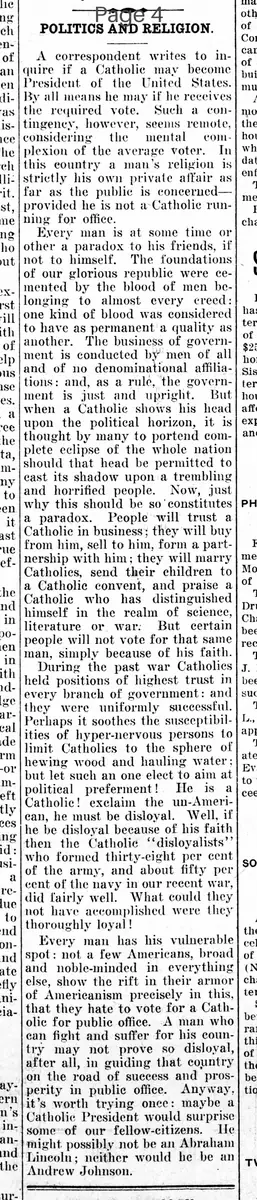
POLITICS AND RELIGION
A correspondent writes to inquire if a Catholic may become President of the United States. By all means he may if he receives the required vote. Such a contingency, however, seems remote, considering the mental complexion of the average voter. In this country a man's religion is strictly his own private affair as far as the public is concerned—provided he is not a Catholic running for office.
Every man is at some time or other a paradox to his friends, if not to himself. The foundations of our glorious republic were cemented by the blood of men belonging to almost every creed: one kind of blood was considered to have as permanent a quality as another. The business of government is conducted by men of all and of no denominational affiliations: and, as a rule, the government is just and upright. But when a Catholic shows his head upon the political horizon, it is thought by many to portend complete eclipse of the whole nation should that head be permitted to cast its shadow upon a trembling and horrified people. Now, just why this should be so constitutes a paradox. People will trust a Catholic in business; they will buy from him, sell to him, form a partnership with him: they will marry Catholics, send their children to a Catholic convent, and praise a Catholic who has distinguished himself in the realm of science, literature or war: But certain people will not vote for that same man, simply because of his faith.
During the past war Catholics held positions of highest trust in every branch of government: and they were uniformly successful. Perhaps it soothes the susceptibilities of hyper-nervous persons to limit Catholics to the sphere of hewing wood and hauling water: but let such an one elect to aim at political preferment! He is a Catholic! exclaim the un-American, he must be disloyal. Well, if he be disloyal because of his faith then the Catholic "disloyalists" who formed thirty-eight per cent of the army, and about fifty per cent of the navy in our recent war, did fairly well. What could they not have accomplished were they thoroughly loyal!
Every man has his vulnerable spot: not a few Americans, broad and noble-minded in everything else, show the rift in their armor of Americanism precisely in this, that they hate to vote for a Catholic for public office. A man who can fight and suffer for his country may not prove so disloyal, after all, in guiding that country on the road of success and prosperity in public office. Anyway, it's worth trying once: maybe a Catholic President would surprise some of our fellow-citizens. He might possibly not be an Abraham Lincoln: neither would he be an Andrew Johnson.
A correspondent writes to inquire if a Catholic may become President of the United States. By all means he may if he receives the required vote. Such a contingency, however, seems remote, considering the mental complexion of the average voter. In this country a man's religion is strictly his own private affair as far as the public is concerned—provided he is not a Catholic running for office.
Every man is at some time or other a paradox to his friends, if not to himself. The foundations of our glorious republic were cemented by the blood of men belonging to almost every creed: one kind of blood was considered to have as permanent a quality as another. The business of government is conducted by men of all and of no denominational affiliations: and, as a rule, the government is just and upright. But when a Catholic shows his head upon the political horizon, it is thought by many to portend complete eclipse of the whole nation should that head be permitted to cast its shadow upon a trembling and horrified people. Now, just why this should be so constitutes a paradox. People will trust a Catholic in business; they will buy from him, sell to him, form a partnership with him: they will marry Catholics, send their children to a Catholic convent, and praise a Catholic who has distinguished himself in the realm of science, literature or war: But certain people will not vote for that same man, simply because of his faith.
During the past war Catholics held positions of highest trust in every branch of government: and they were uniformly successful. Perhaps it soothes the susceptibilities of hyper-nervous persons to limit Catholics to the sphere of hewing wood and hauling water: but let such an one elect to aim at political preferment! He is a Catholic! exclaim the un-American, he must be disloyal. Well, if he be disloyal because of his faith then the Catholic "disloyalists" who formed thirty-eight per cent of the army, and about fifty per cent of the navy in our recent war, did fairly well. What could they not have accomplished were they thoroughly loyal!
Every man has his vulnerable spot: not a few Americans, broad and noble-minded in everything else, show the rift in their armor of Americanism precisely in this, that they hate to vote for a Catholic for public office. A man who can fight and suffer for his country may not prove so disloyal, after all, in guiding that country on the road of success and prosperity in public office. Anyway, it's worth trying once: maybe a Catholic President would surprise some of our fellow-citizens. He might possibly not be an Abraham Lincoln: neither would he be an Andrew Johnson.
What sub-type of article is it?
Moral Or Religious
Partisan Politics
What keywords are associated?
Catholic President
Religious Bias
Political Discrimination
American Paradox
Catholic Loyalty
Voter Prejudice
What entities or persons were involved?
Catholics
Average Voter
Abraham Lincoln
Andrew Johnson
Editorial Details
Primary Topic
Anti Catholic Bias In Presidential Elections
Stance / Tone
Critical Of Religious Prejudice In Politics, Advocating For Catholic Eligibility
Key Figures
Catholics
Average Voter
Abraham Lincoln
Andrew Johnson
Key Arguments
Religion Should Be Private, But Catholics Face Bias In Politics
Founding Of Republic Involved Diverse Creeds, Government Run By Various Faiths
Catholics Trusted In Business, Marriage, Education, Arts, But Not Voting
Catholics Held High Government Positions And Succeeded In Recent War
Catholic Service In Army (38%) And Navy (50%) Disproves Disloyalty Claims
Americans Show Paradox In Tolerating Catholics Except In Public Office
Suggest Trying A Catholic President To Challenge Biases