Thank you for visiting SNEWPapers!
Sign up free
Literary
May 13, 1819
Daily National Intelligencer
Washington, District Of Columbia
What is this article about?
Detailed account from Blackwood's Edinburgh Magazine (Feb 1819) of the Automaton Chess Player invented by Wolfgang de Kempelen in 1769. Describes its construction, exhibition in London, mechanical features, and gameplay mechanics, including how it plays chess and demonstrates knight's tour.
Clipping
OCR Quality
98%
Excellent
Full Text
Extract from Blackwood's Edinburgh Magazine, for February, 1819.
Account of an Automaton Chess Player, now exhibited at Spring Garden, London.
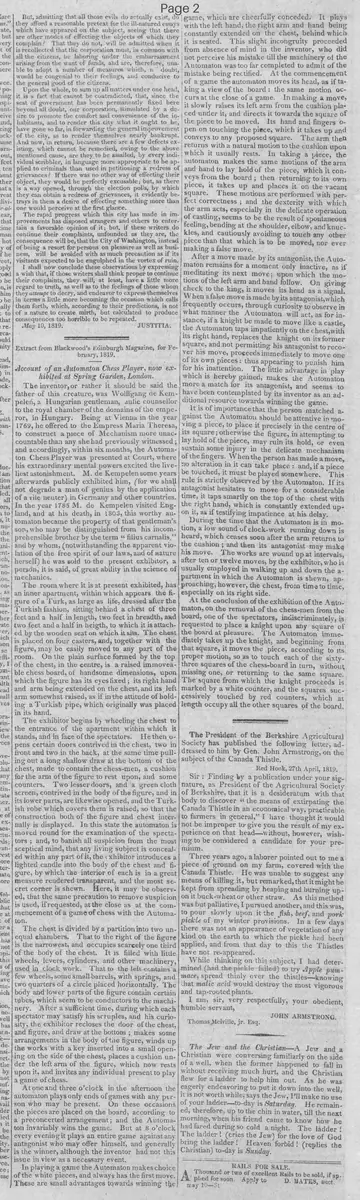
The inventor, or rather it should be said the father of this creature, was Wolfgang de Kempelen, a Hungarian gentleman, aulic counsellor to the royal chamber of the domains of the emperor, in Hungary. Being at Vienna in the year 1769, he offered to the Empress Maria Theresa, to construct a piece of Mechanism more unaccountable than any she had previously witnessed; and accordingly, within six months, the Automaton Chess Player was presented at Court, where his extraordinary mental powers excited the liveliest astonishment. M. de Kempelen some years afterwards publicly exhibited him, (for we shall not degrade a man of genius by the application of a vile neuter) in Germany and other countries.
In the year 1785 M. de Kempelen visited England, and at his death, in 1803, this worthy automaton became the property of that gentleman's son, who may be distinguished from his incomprehensible brother by the term "filius carnalis." and by whom, (notwithstanding the apparent violation of the free spirit of our laws, and of nature herself) he was sold to the present exhibitor, a person, it is said, of great ability in the science of mechanics.
The room where it is at present exhibited, has an inner apartment, within which appears the figure of a Turk, as large as life, dressed after the Turkish fashion, sitting behind a chest of three feet and a half in length, two feet in breadth, and two feet and a half in height, to which it is attached by the wooden seat on which it sits. The chest is placed on four casters, and, together with the figure, may be easily moved to any part of the room. On the plain surface formed by the top of the chest, in the centre, is a raised immovable chess board, of handsome dimensions, upon which the figure has its eyes fixed; its right hand and arm being extended on the chest, and its left arm somewhat raised, as if in the attitude of holding a Turkish pipe, which originally was placed in its hand.
The exhibitor begins by wheeling the chest to the entrance of the apartment within which it stands, and in face of the spectators. He then opens certain doors contrived in the chest, two in front and two in the back, at the same time pulling out a long shallow draw at the bottom of the chest, made to contain the chess-men, a cushion for the arm of the figure to rest upon, and some counters. Two lesser doors, and a green cloth screen, contrived in the body of the figure, and in its lower parts, are likewise opened, and the Turkish robe which covers them is raised, so that the construction both of the figure and chest internally is displayed. In this state the automaton is moved round for the examination of the spectators; and, to banish all suspicion from the most sceptical mind, that any living subject is concealed within any part of it, the exhibitor introduces a lighted candle into the body of the chest and figure, by which the interior of each is in a great measure rendered transparent, and the most secret corner is shewn. Here, it may be observed, that the same precaution to remove suspicion is used, if requested, at the close as at the commencement of a game of chess with the Automaton.
The chest is divided by a partition into two unequal chambers. That to the right of the figure is the narrowest, and occupies scarcely one third of the body of the chest. It is filled with little wheels, levers, cylinders, and other machinery, used in clock work. That to the left contains a few wheels, some small barrels, with springs, and two quarters of a circle placed horizontally. The body and lower parts of the figure contain certain tubes, which seem to be conductors to the machinery. After a sufficient time, during which each spectator may satisfy his scruples, and his curiosity, the exhibitor recloses the door of the chest, and figure, and draw at the bottom; makes some arrangements in the body of the figure, winds up the works with a key inserted into a small opening on the side of the chest, places a cushion under the left arm of the figure, which now rests upon it, and invites any individual present to play a game of chess.
At one and three o'clock in the afternoon the automaton plays only ends of games with any person who may be present. On these occasions the pieces are placed on the board, according to a preconcerted arrangement; and the Automaton invariably wins the game. But at 8 o'clock every evening it plays an entire game against any antagonist who may offer himself, and generally is the winner, although the inventor had not this issue in view as a necessary event.
In playing a game the Automaton makes choice of the white pieces, and always has the first move. These are small advantages towards winning the game, which are cheerfully conceded. It plays with the left hand, the right arm and hand being constantly extended on the chest, behind which it is seated. This slight incongruity proceeded from absence of mind in the inventor, who did not perceive his mistake till the machinery of the Automaton was too far completed to admit of the mistake being rectified. At the commencement of a game the automaton moves its head, as if taking a view of the board: the same motion occurs at the close of a game. In making a move, it slowly raises its left arm from the cushion placed under it, and directs it towards the square of the piece to be moved. Its hand and fingers open on touching the piece, which it takes up and conveys to any proposed square. The arm then returns with a natural motion to the cushion upon which it usually rests. In taking a piece, the automaton makes the same motions of the arm and hand to lay hold of the piece, which it conveys from the board; then returning to its own piece, it takes up and places it on the vacant square. These motions are performed with perfect correctness; and the dexterity with which the arm acts, especially in the delicate operation of castling, seems to be the result of spontaneous feeling, bending at the shoulder, elbow, and knuckles, and cautiously avoiding to touch any other piece than that which is to be moved, nor ever making a false move.
After a move made by its antagonist, the Automaton remains for a moment only inactive, as if meditating its next move; upon which the motions of the left arm and hand follow. On giving check to the king, it moves its head as a signal. When a false move is made by its antagonist, which frequently occurs, through curiosity to observe in what manner the Automaton will act, as for instance, if a knight be made to move like a castle, the Automaton taps impatiently on the chest, with its right hand, replaces the knight on its former square, and not permitting his antagonist to recover his move, proceeds immediately to move one of its own pieces: thus appearing to punish him for his inattention. The little advantage in play which is hereby gained, makes the Automaton more a match for its antagonist, and seems to have been contemplated by its inventor as an additional resource towards winning the game.
It is of importance that the person matched against the Automaton should be attentive in moving a piece, to place it precisely in the centre of its square; otherwise the figure, in attempting to lay hold of the piece, may ruin its hold, or even sustain some injury in the delicate mechanism of the fingers. When the person has made a move, no alteration in it can take place: and, if a piece be touched, it must be played somewhere. This rule is strictly observed by the Automaton. If its antagonist hesitates to move for a considerable time, it taps smartly on the top of the chest with the right hand, which is constantly extended upon it, as if testifying impatience at his delay.
During the time that the Automaton is in motion, a low sound of clock-work running down is heard, which ceases soon after the arm returns to the cushion; and then its antagonist may make his move. The works are wound up at intervals, after ten or twelve moves, by the exhibitor, who is usually employed in walking up and down the apartment in which the Automaton is shewn, approaching, however, the chest, from time to time, especially on its right side.
At the conclusion of the exhibition of the Automaton, on the removal of the chess-men from the board, one of the spectators, indiscriminately, is requested to place a knight upon any square of the board at pleasure. The Automaton immediately takes up the knight, and beginning from that square, it moves the piece, according to its proper motion, so as to touch each of the sixty-three squares of the chess-board in turn, without missing one, or returning to the same square. The square from which the knight proceeds is marked by a white counter, and the squares successively touched by red counters, which at length occupy all the other squares of the board.
Account of an Automaton Chess Player, now exhibited at Spring Garden, London.
The inventor, or rather it should be said the father of this creature, was Wolfgang de Kempelen, a Hungarian gentleman, aulic counsellor to the royal chamber of the domains of the emperor, in Hungary. Being at Vienna in the year 1769, he offered to the Empress Maria Theresa, to construct a piece of Mechanism more unaccountable than any she had previously witnessed; and accordingly, within six months, the Automaton Chess Player was presented at Court, where his extraordinary mental powers excited the liveliest astonishment. M. de Kempelen some years afterwards publicly exhibited him, (for we shall not degrade a man of genius by the application of a vile neuter) in Germany and other countries.
In the year 1785 M. de Kempelen visited England, and at his death, in 1803, this worthy automaton became the property of that gentleman's son, who may be distinguished from his incomprehensible brother by the term "filius carnalis." and by whom, (notwithstanding the apparent violation of the free spirit of our laws, and of nature herself) he was sold to the present exhibitor, a person, it is said, of great ability in the science of mechanics.
The room where it is at present exhibited, has an inner apartment, within which appears the figure of a Turk, as large as life, dressed after the Turkish fashion, sitting behind a chest of three feet and a half in length, two feet in breadth, and two feet and a half in height, to which it is attached by the wooden seat on which it sits. The chest is placed on four casters, and, together with the figure, may be easily moved to any part of the room. On the plain surface formed by the top of the chest, in the centre, is a raised immovable chess board, of handsome dimensions, upon which the figure has its eyes fixed; its right hand and arm being extended on the chest, and its left arm somewhat raised, as if in the attitude of holding a Turkish pipe, which originally was placed in its hand.
The exhibitor begins by wheeling the chest to the entrance of the apartment within which it stands, and in face of the spectators. He then opens certain doors contrived in the chest, two in front and two in the back, at the same time pulling out a long shallow draw at the bottom of the chest, made to contain the chess-men, a cushion for the arm of the figure to rest upon, and some counters. Two lesser doors, and a green cloth screen, contrived in the body of the figure, and in its lower parts, are likewise opened, and the Turkish robe which covers them is raised, so that the construction both of the figure and chest internally is displayed. In this state the automaton is moved round for the examination of the spectators; and, to banish all suspicion from the most sceptical mind, that any living subject is concealed within any part of it, the exhibitor introduces a lighted candle into the body of the chest and figure, by which the interior of each is in a great measure rendered transparent, and the most secret corner is shewn. Here, it may be observed, that the same precaution to remove suspicion is used, if requested, at the close as at the commencement of a game of chess with the Automaton.
The chest is divided by a partition into two unequal chambers. That to the right of the figure is the narrowest, and occupies scarcely one third of the body of the chest. It is filled with little wheels, levers, cylinders, and other machinery, used in clock work. That to the left contains a few wheels, some small barrels, with springs, and two quarters of a circle placed horizontally. The body and lower parts of the figure contain certain tubes, which seem to be conductors to the machinery. After a sufficient time, during which each spectator may satisfy his scruples, and his curiosity, the exhibitor recloses the door of the chest, and figure, and draw at the bottom; makes some arrangements in the body of the figure, winds up the works with a key inserted into a small opening on the side of the chest, places a cushion under the left arm of the figure, which now rests upon it, and invites any individual present to play a game of chess.
At one and three o'clock in the afternoon the automaton plays only ends of games with any person who may be present. On these occasions the pieces are placed on the board, according to a preconcerted arrangement; and the Automaton invariably wins the game. But at 8 o'clock every evening it plays an entire game against any antagonist who may offer himself, and generally is the winner, although the inventor had not this issue in view as a necessary event.
In playing a game the Automaton makes choice of the white pieces, and always has the first move. These are small advantages towards winning the game, which are cheerfully conceded. It plays with the left hand, the right arm and hand being constantly extended on the chest, behind which it is seated. This slight incongruity proceeded from absence of mind in the inventor, who did not perceive his mistake till the machinery of the Automaton was too far completed to admit of the mistake being rectified. At the commencement of a game the automaton moves its head, as if taking a view of the board: the same motion occurs at the close of a game. In making a move, it slowly raises its left arm from the cushion placed under it, and directs it towards the square of the piece to be moved. Its hand and fingers open on touching the piece, which it takes up and conveys to any proposed square. The arm then returns with a natural motion to the cushion upon which it usually rests. In taking a piece, the automaton makes the same motions of the arm and hand to lay hold of the piece, which it conveys from the board; then returning to its own piece, it takes up and places it on the vacant square. These motions are performed with perfect correctness; and the dexterity with which the arm acts, especially in the delicate operation of castling, seems to be the result of spontaneous feeling, bending at the shoulder, elbow, and knuckles, and cautiously avoiding to touch any other piece than that which is to be moved, nor ever making a false move.
After a move made by its antagonist, the Automaton remains for a moment only inactive, as if meditating its next move; upon which the motions of the left arm and hand follow. On giving check to the king, it moves its head as a signal. When a false move is made by its antagonist, which frequently occurs, through curiosity to observe in what manner the Automaton will act, as for instance, if a knight be made to move like a castle, the Automaton taps impatiently on the chest, with its right hand, replaces the knight on its former square, and not permitting his antagonist to recover his move, proceeds immediately to move one of its own pieces: thus appearing to punish him for his inattention. The little advantage in play which is hereby gained, makes the Automaton more a match for its antagonist, and seems to have been contemplated by its inventor as an additional resource towards winning the game.
It is of importance that the person matched against the Automaton should be attentive in moving a piece, to place it precisely in the centre of its square; otherwise the figure, in attempting to lay hold of the piece, may ruin its hold, or even sustain some injury in the delicate mechanism of the fingers. When the person has made a move, no alteration in it can take place: and, if a piece be touched, it must be played somewhere. This rule is strictly observed by the Automaton. If its antagonist hesitates to move for a considerable time, it taps smartly on the top of the chest with the right hand, which is constantly extended upon it, as if testifying impatience at his delay.
During the time that the Automaton is in motion, a low sound of clock-work running down is heard, which ceases soon after the arm returns to the cushion; and then its antagonist may make his move. The works are wound up at intervals, after ten or twelve moves, by the exhibitor, who is usually employed in walking up and down the apartment in which the Automaton is shewn, approaching, however, the chest, from time to time, especially on its right side.
At the conclusion of the exhibition of the Automaton, on the removal of the chess-men from the board, one of the spectators, indiscriminately, is requested to place a knight upon any square of the board at pleasure. The Automaton immediately takes up the knight, and beginning from that square, it moves the piece, according to its proper motion, so as to touch each of the sixty-three squares of the chess-board in turn, without missing one, or returning to the same square. The square from which the knight proceeds is marked by a white counter, and the squares successively touched by red counters, which at length occupy all the other squares of the board.
What sub-type of article is it?
Essay
What keywords are associated?
Automaton
Chess Player
Wolfgang De Kempelen
Turkish Figure
Mechanical Chess
Spring Garden
Knight Tour
Maria Theresa
What entities or persons were involved?
Extract From Blackwood's Edinburgh Magazine, For February, 1819.
Literary Details
Title
Account Of An Automaton Chess Player, Now Exhibited At Spring Garden, London.
Author
Extract From Blackwood's Edinburgh Magazine, For February, 1819.
Subject
Description Of The Automaton Chess Player Invented By Wolfgang De Kempelen.
Form / Style
Descriptive Prose Account Of A Mechanical Invention.
Key Lines
The Inventor, Or Rather It Should Be Said The Father Of This Creature, Was Wolfgang De Kempelen, A Hungarian Gentleman, Aulic Counsellor To The Royal Chamber Of The Domains Of The Emperor, In Hungary.
Being At Vienna In The Year 1769, He Offered To The Empress Maria Theresa, To Construct A Piece Of Mechanism More Unaccountable Than Any She Had Previously Witnessed;
In Playing A Game The Automaton Makes Choice Of The White Pieces, And Always Has The First Move.
The Automaton Immediately Takes Up The Knight, And Beginning From That Square, It Moves The Piece, According To Its Proper Motion, So As To Touch Each Of The Sixty Three Squares Of The Chess Board In Turn,