Thank you for visiting SNEWPapers!
Sign up free
Editorial
March 24, 1927
The Daily Worker
Chicago, Cook County, Illinois
What is this article about?
Editorial discusses imperialist powers' dilemma over holding Shanghai's foreign settlement after Kuomintang victory, advocating boycotts and strikes by Chinese workers to force peaceful handover without war, emphasizing the revolution's mass base.
Clipping
OCR Quality
95%
Excellent
Full Text
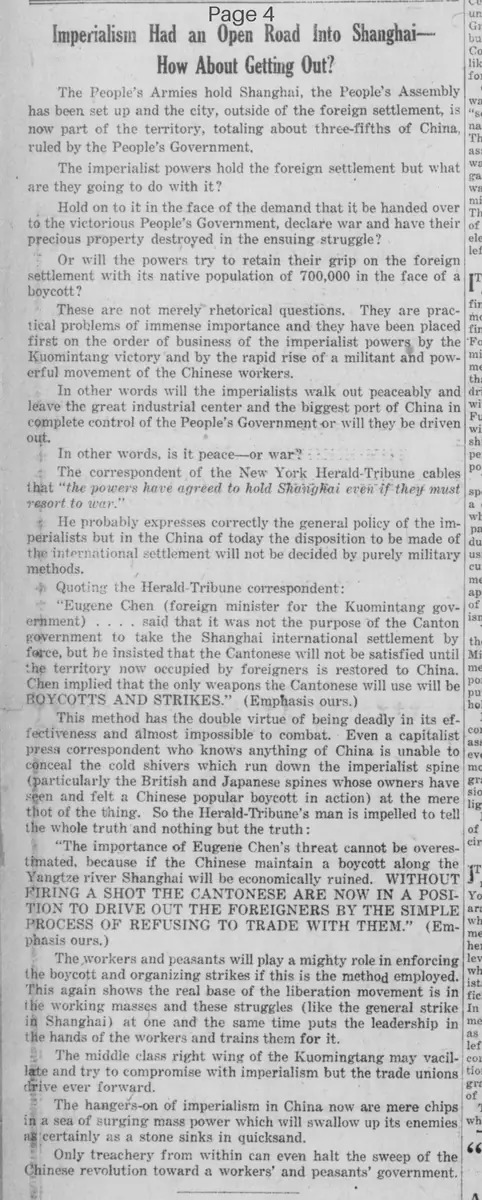
Imperialism Had an Open Road Into Shanghai—
How About Getting Out?
The People's Armies hold Shanghai, the People's Assembly has been set up and the city, outside of the foreign settlement, is now part of the territory, totaling about three-fifths of China, ruled by the People's Government.
The imperialist powers hold the foreign settlement but what are they going to do with it?
Hold on to it in the face of the demand that it be handed over to the victorious People's Government, declare war and have their precious property destroyed in the ensuing struggle?
Or will the powers try to retain their grip on the foreign settlement with its native population of 700,000 in the face of a boycott?
These are not merely rhetorical questions. They are practical problems of immense importance and they have been placed first on the order of business of the imperialist powers by the Kuomintang victory and by the rapid rise of a militant and powerful movement of the Chinese workers.
In other words will the imperialists walk out peaceably and leave the great industrial center and the biggest port of China in complete control of the People's Government or will they be driven out.
In other words, is it peace—or war?
The correspondent of the New York Herald-Tribune cables that "the powers have agreed to hold Shanghai even if they must resort to war."
He probably expresses correctly the general policy of the imperialists but in the China of today the disposition to be made of the international settlement will not be decided by purely military methods.
Quoting the Herald-Tribune correspondent:
"Eugene Chen (foreign minister for the Kuomintang government) . . . . said that it was not the purpose of the Canton government to take the Shanghai international settlement by force, but he insisted that the Cantonese will not be satisfied until the territory now occupied by foreigners is restored to China.
Chen implied that the only weapons the Cantonese will use will be BOYCOTTS AND STRIKES." (Emphasis ours.)
This method has the double virtue of being deadly in its effectiveness and almost impossible to combat. Even a capitalist press correspondent who knows anything of China is unable to conceal the cold shivers which run down the imperialist spine (particularly the British and Japanese spines whose owners have seen and felt a Chinese popular boycott in action) at the mere thought of the thing. So the Herald-Tribune's man is impelled to tell the whole truth and nothing but the truth:
"The importance of Eugene Chen's threat cannot be overestimated, because if the Chinese maintain a boycott along the Yangtze river Shanghai will be economically ruined. WITHOUT FIRING A SHOT THE CANTONESE ARE NOW IN A POSITION TO DRIVE OUT THE FOREIGNERS BY THE SIMPLE PROCESS OF REFUSING TO TRADE WITH THEM." (Emphasis ours.)
The workers and peasants will play a mighty role in enforcing the boycott and organizing strikes if this is the method employed.
This again shows the real base of the liberation movement is in the working masses and these struggles (like the general strike in Shanghai) at one and the same time puts the leadership in the hands of the workers and trains them for it.
The middle class right wing of the Kuomintang may vacillate and try to compromise with imperialism but the trade unions drive ever forward.
The hangers-on of imperialism in China now are mere chips in a sea of surging mass power which will swallow up its enemies as certainly as a stone sinks in quicksand.
Only treachery from within can even halt the sweep of the Chinese revolution toward a workers' and peasants' government.
How About Getting Out?
The People's Armies hold Shanghai, the People's Assembly has been set up and the city, outside of the foreign settlement, is now part of the territory, totaling about three-fifths of China, ruled by the People's Government.
The imperialist powers hold the foreign settlement but what are they going to do with it?
Hold on to it in the face of the demand that it be handed over to the victorious People's Government, declare war and have their precious property destroyed in the ensuing struggle?
Or will the powers try to retain their grip on the foreign settlement with its native population of 700,000 in the face of a boycott?
These are not merely rhetorical questions. They are practical problems of immense importance and they have been placed first on the order of business of the imperialist powers by the Kuomintang victory and by the rapid rise of a militant and powerful movement of the Chinese workers.
In other words will the imperialists walk out peaceably and leave the great industrial center and the biggest port of China in complete control of the People's Government or will they be driven out.
In other words, is it peace—or war?
The correspondent of the New York Herald-Tribune cables that "the powers have agreed to hold Shanghai even if they must resort to war."
He probably expresses correctly the general policy of the imperialists but in the China of today the disposition to be made of the international settlement will not be decided by purely military methods.
Quoting the Herald-Tribune correspondent:
"Eugene Chen (foreign minister for the Kuomintang government) . . . . said that it was not the purpose of the Canton government to take the Shanghai international settlement by force, but he insisted that the Cantonese will not be satisfied until the territory now occupied by foreigners is restored to China.
Chen implied that the only weapons the Cantonese will use will be BOYCOTTS AND STRIKES." (Emphasis ours.)
This method has the double virtue of being deadly in its effectiveness and almost impossible to combat. Even a capitalist press correspondent who knows anything of China is unable to conceal the cold shivers which run down the imperialist spine (particularly the British and Japanese spines whose owners have seen and felt a Chinese popular boycott in action) at the mere thought of the thing. So the Herald-Tribune's man is impelled to tell the whole truth and nothing but the truth:
"The importance of Eugene Chen's threat cannot be overestimated, because if the Chinese maintain a boycott along the Yangtze river Shanghai will be economically ruined. WITHOUT FIRING A SHOT THE CANTONESE ARE NOW IN A POSITION TO DRIVE OUT THE FOREIGNERS BY THE SIMPLE PROCESS OF REFUSING TO TRADE WITH THEM." (Emphasis ours.)
The workers and peasants will play a mighty role in enforcing the boycott and organizing strikes if this is the method employed.
This again shows the real base of the liberation movement is in the working masses and these struggles (like the general strike in Shanghai) at one and the same time puts the leadership in the hands of the workers and trains them for it.
The middle class right wing of the Kuomintang may vacillate and try to compromise with imperialism but the trade unions drive ever forward.
The hangers-on of imperialism in China now are mere chips in a sea of surging mass power which will swallow up its enemies as certainly as a stone sinks in quicksand.
Only treachery from within can even halt the sweep of the Chinese revolution toward a workers' and peasants' government.
What sub-type of article is it?
Imperialism
Foreign Affairs
War Or Peace
What keywords are associated?
Shanghai Settlement
Kuomintang Victory
Imperialism
Boycotts
Strikes
Chinese Revolution
Eugene Chen
People's Government
What entities or persons were involved?
Kuomintang
People's Government
Eugene Chen
Imperialist Powers
British
Japanese
New York Herald Tribune
Editorial Details
Primary Topic
Imperialist Hold On Shanghai Settlement Amid Kuomintang Victory And Potential Boycotts
Stance / Tone
Supportive Of Chinese Liberation Movement And Non Violent Reclamation
Key Figures
Kuomintang
People's Government
Eugene Chen
Imperialist Powers
British
Japanese
New York Herald Tribune
Key Arguments
Imperialists Must Decide Whether To Leave Shanghai Peacefully Or Face Boycotts And Strikes
Boycotts And Strikes Can Economically Ruin Shanghai Without Military Action
Kuomintang Aims To Reclaim The International Settlement Through Non Violent Means
Workers And Peasants Will Enforce Boycotts And Organize Strikes
The Liberation Movement Is Based In The Working Masses
Middle Class Right Wing May Compromise, But Trade Unions Drive Forward
Imperialist Hangers On Will Be Overwhelmed By Mass Power