Thank you for visiting SNEWPapers!
Sign up free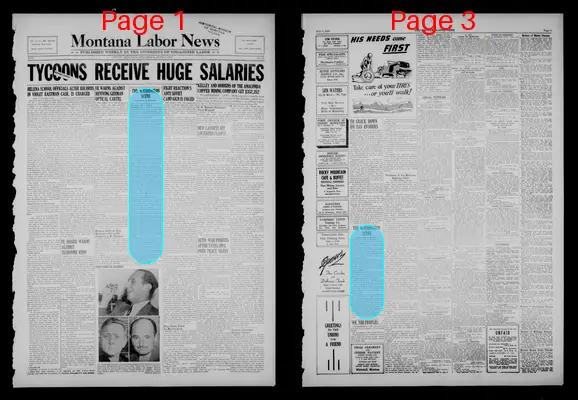
Editorial
July 5, 1945
Montana Labor News
Butte, Silver Bow County, Montana
What is this article about?
Travis K. Hedrick argues against Thomas L. Stokes' support for the Ball-Burton-Hatch labor bill, defending the Wagner Act as essential for labor rights and criticizing the bill as a 'straitjacket' that weakens unions through compulsory arbitration and open shop provisions. Labor is urged to unite in opposition.
Merged-components note: Continuation of 'THE WASHINGTON SCENE' editorial from page 1 to page 3.
Clippings
1 of 2
OCR Quality
95%
Excellent
Full Text
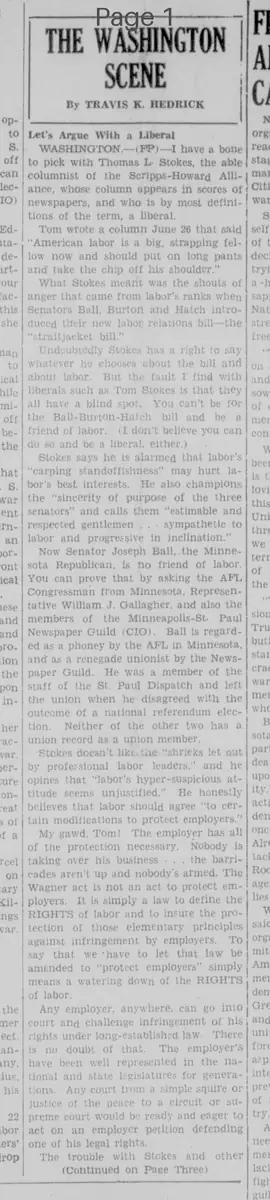
THE WASHINGTON SCENE
By TRAVIS K. HEDRICK
Let's Argue With a Liberal
WASHINGTON—(FP)—I have a bone to pick with Thomas L. Stokes, the able columnist of the Scripps-Howard Alliance, whose column appears in scores of newspapers, and who is by most definitions of the term, a liberal.
Tom wrote a column June 26 that said "American labor is a big, strapping fellow now and should put on long pants and take the chip off his shoulder."
What Stokes meant was the shouts of anger that came from labor's ranks when Senators Ball, Burton and Hatch introduced their new labor relations bill—the straitjacket bill.
Undoubtedly Stokes has a right to say whatever he chooses about the bill and about labor. But the fault I find with liberals such as Tom Stokes is that they all have a blind spot. You can't be for the Ball-Burton-Hatch bill and be a friend of labor. (I don't believe you can do so and be a liberal either.)
Stokes says he is alarmed that labor's "carping standoffishness" may hurt labor's best interests. He also champions the "sincerity of purpose of the three senators" and calls them "estimable and respected gentlemen sympathetic to labor and progressive in inclination."
Now Senator Joseph Ball, the Minnesota Republican, is no friend of labor. You can prove that by asking the AFL Congressman from Minnesota, Representative William J. Gallagher, and also the members of the Minneapolis-St. Paul Newspaper Guild (CIO). Ball is regarded as a phony by the AFL in Minnesota, and as a renegade unionist by the Newspaper Guild. He was a member of the staff of the St. Paul Dispatch and left the union when he disagreed with the outcome of a national referendum election.
Neither of the other two has a union record as a union member.
Stokes doesn't like the "shrieks let out by professional labor leaders," and he opines that labor's hyper-suspicious attitude seems unjustified. He honestly believes that labor should agree to certain modifications to protect employers."
My gawd Tom! The employer has all of the protection necessary. Nobody is taking over his business—the barricades aren't up and nobody's armed. The Wagner act is not an act to protect employers. It is simply a law to define the RIGHTS of labor and to insure the protection of those elementary principles against infringement by employers. To say that we "have to let that law be amended to 'protect employers'" simply means a watering down of the RIGHTS of labor.
Any employer anywhere, can go into court and challenge infringement of his rights under long-established law. There is no doubt of that. The employer's have been well represented in the national and state legislatures for generations. Any court from a simple squire or justice of the peace to a circuit or supreme court would be ready and eager to act on an employer petition defending one of his legal rights.
The trouble with Stokes and other (Continued on Page Three)
THE WASHINGTON
SCENE
(Continued From Page One)
liberals who think along these lines is
that they refuse to see that after years
of giving employers a free rein with
the workers, a law was necessary to
check their unfair practices. It does not
follow, however, that the law defending
labor's rights must be amended to give
employers the right to WEAKEN those
rights in order to be FAIR. That just
doesn't make sense
Labor is justly suspicious of any at-
tempt to change the Wagner act. Espe-
cially so when David Lawrence comes
out and says flatly that the Ball-Bur-
ton-Hatch bill "would change it almost
beyond recognition"
Compulsory arbitration and the virtual
abolishment of the closed shop as pro-
vided in the straitjacket bill will never
be accepted by labor in America
Labor in America is wearing its long
pants. It has no chip on its shoulder
but it has both hands free and has
learned to use them either to grasp an
outstretched mitt across friendly con-
ference table or to double them into
fighting fists
At this time it seems that American
labor, with the AFL, CIO and United
Mine Workers united on the issue, must
form a fighting team to turn back this
new anti-labor bill It can't be done by
praising Joe Ball and his associates as
estimable and respected gentlemen
sympathetic to labor and progressive in
inclination."
Certainly they are not
sympathetic to labor or progressives.
And Tom Stokes is no Heywood Broun,
either
By TRAVIS K. HEDRICK
Let's Argue With a Liberal
WASHINGTON—(FP)—I have a bone to pick with Thomas L. Stokes, the able columnist of the Scripps-Howard Alliance, whose column appears in scores of newspapers, and who is by most definitions of the term, a liberal.
Tom wrote a column June 26 that said "American labor is a big, strapping fellow now and should put on long pants and take the chip off his shoulder."
What Stokes meant was the shouts of anger that came from labor's ranks when Senators Ball, Burton and Hatch introduced their new labor relations bill—the straitjacket bill.
Undoubtedly Stokes has a right to say whatever he chooses about the bill and about labor. But the fault I find with liberals such as Tom Stokes is that they all have a blind spot. You can't be for the Ball-Burton-Hatch bill and be a friend of labor. (I don't believe you can do so and be a liberal either.)
Stokes says he is alarmed that labor's "carping standoffishness" may hurt labor's best interests. He also champions the "sincerity of purpose of the three senators" and calls them "estimable and respected gentlemen sympathetic to labor and progressive in inclination."
Now Senator Joseph Ball, the Minnesota Republican, is no friend of labor. You can prove that by asking the AFL Congressman from Minnesota, Representative William J. Gallagher, and also the members of the Minneapolis-St. Paul Newspaper Guild (CIO). Ball is regarded as a phony by the AFL in Minnesota, and as a renegade unionist by the Newspaper Guild. He was a member of the staff of the St. Paul Dispatch and left the union when he disagreed with the outcome of a national referendum election.
Neither of the other two has a union record as a union member.
Stokes doesn't like the "shrieks let out by professional labor leaders," and he opines that labor's hyper-suspicious attitude seems unjustified. He honestly believes that labor should agree to certain modifications to protect employers."
My gawd Tom! The employer has all of the protection necessary. Nobody is taking over his business—the barricades aren't up and nobody's armed. The Wagner act is not an act to protect employers. It is simply a law to define the RIGHTS of labor and to insure the protection of those elementary principles against infringement by employers. To say that we "have to let that law be amended to 'protect employers'" simply means a watering down of the RIGHTS of labor.
Any employer anywhere, can go into court and challenge infringement of his rights under long-established law. There is no doubt of that. The employer's have been well represented in the national and state legislatures for generations. Any court from a simple squire or justice of the peace to a circuit or supreme court would be ready and eager to act on an employer petition defending one of his legal rights.
The trouble with Stokes and other (Continued on Page Three)
THE WASHINGTON
SCENE
(Continued From Page One)
liberals who think along these lines is
that they refuse to see that after years
of giving employers a free rein with
the workers, a law was necessary to
check their unfair practices. It does not
follow, however, that the law defending
labor's rights must be amended to give
employers the right to WEAKEN those
rights in order to be FAIR. That just
doesn't make sense
Labor is justly suspicious of any at-
tempt to change the Wagner act. Espe-
cially so when David Lawrence comes
out and says flatly that the Ball-Bur-
ton-Hatch bill "would change it almost
beyond recognition"
Compulsory arbitration and the virtual
abolishment of the closed shop as pro-
vided in the straitjacket bill will never
be accepted by labor in America
Labor in America is wearing its long
pants. It has no chip on its shoulder
but it has both hands free and has
learned to use them either to grasp an
outstretched mitt across friendly con-
ference table or to double them into
fighting fists
At this time it seems that American
labor, with the AFL, CIO and United
Mine Workers united on the issue, must
form a fighting team to turn back this
new anti-labor bill It can't be done by
praising Joe Ball and his associates as
estimable and respected gentlemen
sympathetic to labor and progressive in
inclination."
Certainly they are not
sympathetic to labor or progressives.
And Tom Stokes is no Heywood Broun,
either
What sub-type of article is it?
Labor
Legal Reform
What keywords are associated?
Labor Relations Bill
Wagner Act
Ball Burton Hatch
Closed Shop
Compulsory Arbitration
Afl Cio
Anti Labor Legislation
What entities or persons were involved?
Thomas L. Stokes
Senator Joseph Ball
Senator Burton
Senator Hatch
Afl
Cio
United Mine Workers
David Lawrence
William J. Gallagher
Minneapolis St. Paul Newspaper Guild
Editorial Details
Primary Topic
Critique Of Ball Burton Hatch Labor Bill And Defense Of Wagner Act
Stance / Tone
Strongly Pro Labor, Argumentative Against Liberal Support For Anti Labor Bill
Key Figures
Thomas L. Stokes
Senator Joseph Ball
Senator Burton
Senator Hatch
Afl
Cio
United Mine Workers
David Lawrence
William J. Gallagher
Minneapolis St. Paul Newspaper Guild
Key Arguments
Liberals Like Stokes Have A Blind Spot In Supporting The Ball Burton Hatch Bill While Claiming To Be Friends Of Labor
Senator Ball Is No Friend Of Labor, Viewed As Phony By Afl And Renegade By Newspaper Guild
The Wagner Act Protects Labor Rights, Not Employers, And Does Not Need Amendment To 'Protect' Employers
Employers Already Have Ample Legal Protections Through Courts And Legislatures
The Bill Introduces Compulsory Arbitration And Abolishes Closed Shop, Which Labor Will Not Accept
Labor Is United (Afl, Cio, Umw) Against The Bill And Must Fight It
Praising The Senators As Sympathetic To Labor Is Misguided