Thank you for visiting SNEWPapers!
Sign up free
Story
November 10, 1949
The Potters Herald
East Liverpool, Columbiana County, Ohio
What is this article about?
Senate Housing Subcommittee, after European tour, endorses cooperative housing model from Scandinavia for US middle-income crisis; Chairman Sparkman to revive bill, heartened by Senator Bricker's support shift. (178 chars)
Clipping
OCR Quality
98%
Excellent
Full Text
Tour Convinces Senators
Co-op Housing Is Best
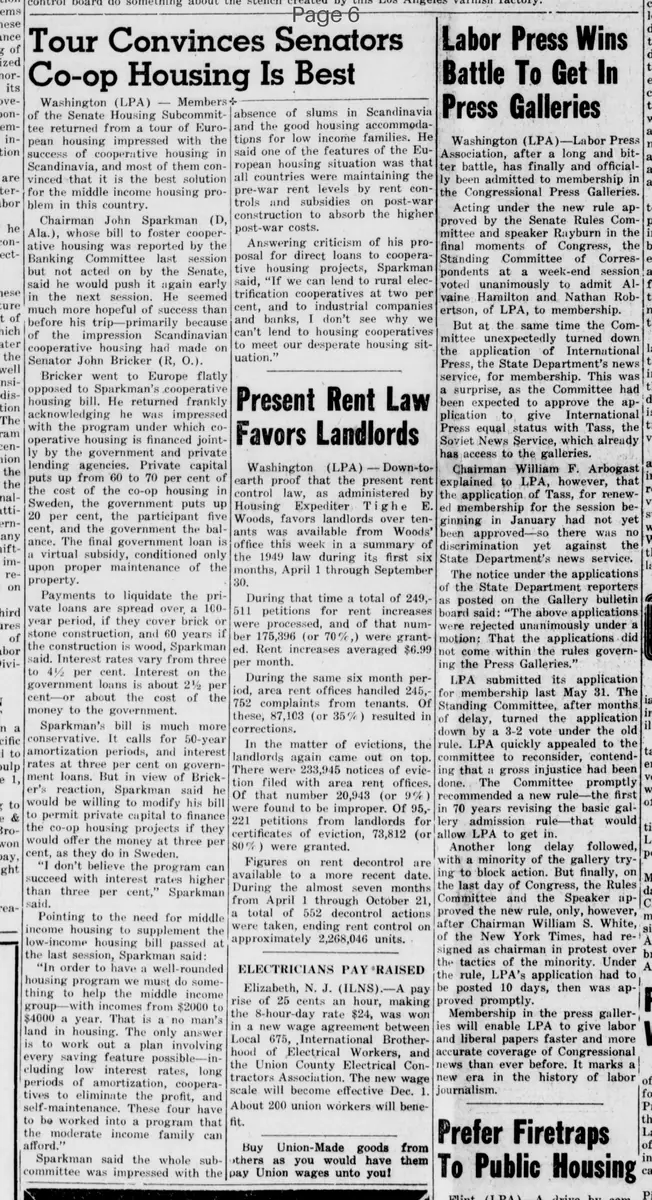
Washington (LPA)—Members of the Senate Housing Subcommittee returned from a tour of European housing impressed with the success of cooperative housing in Scandinavia, and most of them convinced that it is the best solution for the middle income housing problem in this country.
Chairman John Sparkman (D, Ala.), whose bill to foster cooperative housing was reported by the Banking Committee last session but not acted on by the Senate said he would push it again early in the next session. He seemed much more hopeful of success than before his trip—primarily because of the impression Scandinavian cooperative housing had made on Senator John Bricker (R, O.).
Bricker went to Europe flatly opposed to Sparkman's cooperative housing bill. He returned frankly acknowledging he was impressed with the program under which cooperative housing is financed jointly by the government and private lending agencies. Private capital puts up from 60 to 70 per cent of the cost of the co-op housing in Sweden, the government puts up 20 per cent, the participant five per cent, and the government the balance. The final government loan is a virtual subsidy, conditioned only upon proper maintenance of the property.
Payments to liquidate the private loans are spread over a 100-year period, if they cover brick or stone construction, and 60 years if the construction is wood, Sparkman said. Interest rates vary from three to 4½ per cent. Interest on the government loans is about 2½ per cent—or about the cost of the money to the government.
Sparkman's bill is much more conservative. It calls for 50-year amortization periods, and interest rates at three per cent on government loans. But in view of Bricker's reaction, Sparkman said he would be willing to modify his bill to permit private capital to finance the co-op housing projects if they would offer the money at three per cent, as they do in Sweden.
"I don't believe the program can succeed with interest rates higher than three per cent," Sparkman said.
Pointing to the need for middle income housing to supplement the low-income housing bill passed at the last session, Sparkman said: "In order to have a well-rounded housing program we must do something to help the middle income group—with incomes from $2000 to $4000 a year. That is a no man's land in housing. The only answer is to work out a plan involving every saving feature possible—including low interest rates, long periods of amortization, cooperatives to eliminate the profit, and self-maintenance. These four have to be worked into a program that the moderate income family can afford."
Sparkman said the whole subcommittee was impressed with the absence of slums in Scandinavia and the good housing accommodations for low income families. He said one of the features of the European housing situation was that all countries were maintaining the pre-war rent levels by rent controls and subsidies on post-war construction to absorb the higher post-war costs.
Answering criticism of his proposal for direct loans to cooperative housing projects, Sparkman said, "If we can lend to rural electrification cooperatives at two per cent, and to industrial companies and banks, I don't see why we can't lend to housing cooperatives to meet our desperate housing situation."
Co-op Housing Is Best
Washington (LPA)—Members of the Senate Housing Subcommittee returned from a tour of European housing impressed with the success of cooperative housing in Scandinavia, and most of them convinced that it is the best solution for the middle income housing problem in this country.
Chairman John Sparkman (D, Ala.), whose bill to foster cooperative housing was reported by the Banking Committee last session but not acted on by the Senate said he would push it again early in the next session. He seemed much more hopeful of success than before his trip—primarily because of the impression Scandinavian cooperative housing had made on Senator John Bricker (R, O.).
Bricker went to Europe flatly opposed to Sparkman's cooperative housing bill. He returned frankly acknowledging he was impressed with the program under which cooperative housing is financed jointly by the government and private lending agencies. Private capital puts up from 60 to 70 per cent of the cost of the co-op housing in Sweden, the government puts up 20 per cent, the participant five per cent, and the government the balance. The final government loan is a virtual subsidy, conditioned only upon proper maintenance of the property.
Payments to liquidate the private loans are spread over a 100-year period, if they cover brick or stone construction, and 60 years if the construction is wood, Sparkman said. Interest rates vary from three to 4½ per cent. Interest on the government loans is about 2½ per cent—or about the cost of the money to the government.
Sparkman's bill is much more conservative. It calls for 50-year amortization periods, and interest rates at three per cent on government loans. But in view of Bricker's reaction, Sparkman said he would be willing to modify his bill to permit private capital to finance the co-op housing projects if they would offer the money at three per cent, as they do in Sweden.
"I don't believe the program can succeed with interest rates higher than three per cent," Sparkman said.
Pointing to the need for middle income housing to supplement the low-income housing bill passed at the last session, Sparkman said: "In order to have a well-rounded housing program we must do something to help the middle income group—with incomes from $2000 to $4000 a year. That is a no man's land in housing. The only answer is to work out a plan involving every saving feature possible—including low interest rates, long periods of amortization, cooperatives to eliminate the profit, and self-maintenance. These four have to be worked into a program that the moderate income family can afford."
Sparkman said the whole subcommittee was impressed with the absence of slums in Scandinavia and the good housing accommodations for low income families. He said one of the features of the European housing situation was that all countries were maintaining the pre-war rent levels by rent controls and subsidies on post-war construction to absorb the higher post-war costs.
Answering criticism of his proposal for direct loans to cooperative housing projects, Sparkman said, "If we can lend to rural electrification cooperatives at two per cent, and to industrial companies and banks, I don't see why we can't lend to housing cooperatives to meet our desperate housing situation."
What sub-type of article is it?
Historical Event
What themes does it cover?
Social Manners
Triumph
What keywords are associated?
Cooperative Housing
Senate Subcommittee
Scandinavian Housing
Middle Income
Sparkman Bill
Bricker Conversion
What entities or persons were involved?
John Sparkman
John Bricker
Where did it happen?
Washington, Scandinavia, Sweden
Story Details
Key Persons
John Sparkman
John Bricker
Location
Washington, Scandinavia, Sweden
Story Details
Senate Housing Subcommittee tours European cooperative housing, impressed by Scandinavian model; Chairman Sparkman plans to push bill for middle-income housing, influenced by Bricker's conversion from opposition.