Thank you for visiting SNEWPapers!
Sign up free
Editorial
May 6, 1789
Gazette Of The United States
New York, New York County, New York
What is this article about?
Post-Revolutionary War editorial excerpt defending Southern slaveholders' patriotism and right to retain slaves as property after British ravages. Discusses historical precedents for slavery among ancient nations, compares slave conditions favorably to African natives and European poor, criticizes abuses by overseers, and highlights emancipation challenges including support for freed slaves.
Clipping
OCR Quality
98%
Excellent
Full Text
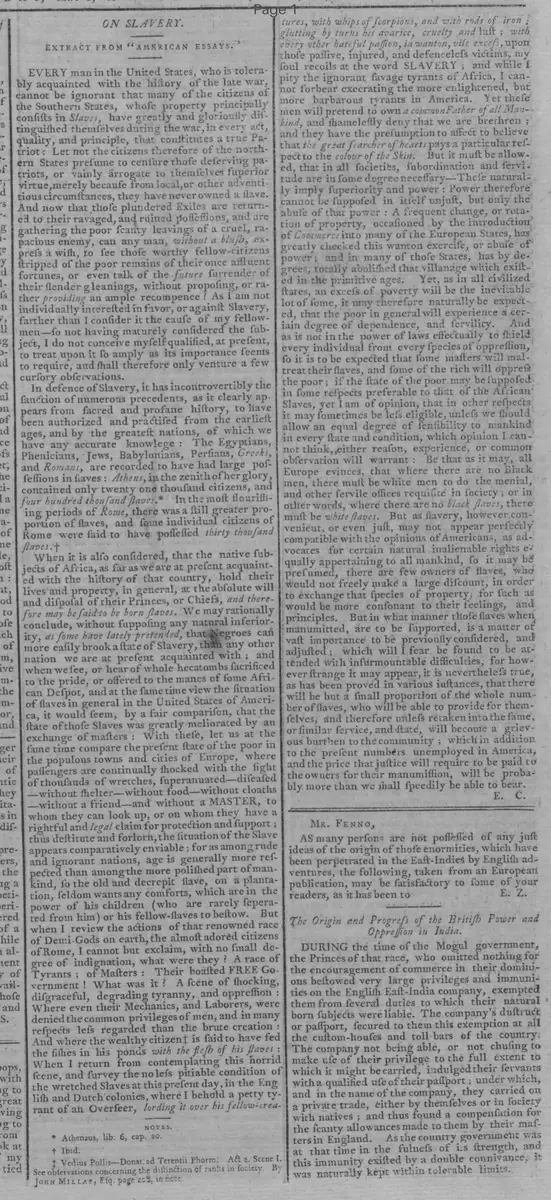
ON SLAVERY.
EXTRACT FROM "AMERICAN ESSAYS."
EVERY man in the United States, who is tolerably acquainted with the history of the late war, cannot be ignorant that many of the citizens of the Southern States, whose property principally consists in Slaves, have greatly and gloriously distinguished themselves during the war, in every act, quality, and principle, that constitutes a true Patriot: Let not the citizens therefore of the northern States presume to censure those deserving patriots, or vainly arrogate to themselves superior virtue, merely because from local, or other adventitious circumstances, they have never owned a slave. And now that those plundered Exiles are returned to their ravaged, and ruined possessions, and are gathering the poor scanty leavings of a cruel, rapacious enemy, can any man, without a blush, express a wish, to see those worthy fellow-citizens stripped of the poor remains of their once affluent fortunes, or even talk of the future surrender of their slender gleanings, without proposing, or rather providing an ample recompence? As I am not individually interested in favor, or against Slavery, farther than I consider it the cause of my fellow-men—so not having maturely considered the subject, I do not conceive myself qualified, at present, to treat upon it so amply as its importance seems to require, and shall therefore only venture a few cursory observations.
In defence of Slavery, it has incontrovertibly the sanction of numerous precedents, as it clearly appears from sacred and profane history, to have been authorized and practised from the earliest ages, and by the greatest nations, of which we have any accurate knowledge: The Egyptians, Phoenicians, Jews, Babylonians, Persians, Greeks, and Romans, are recorded to have had large possessions in slaves: Athens, in the zenith of her glory, contained only twenty one thousand citizens, and four hundred thousand slaves.* In the most flourishing periods of Rome, there was a still greater proportion of slaves, and one individual citizens of Rome were said to have possessed thirty thousand slaves.†
When it is also considered, that the native subjects of Africa, as far as we are at present acquainted with the history of that country, hold their lives and property, in general, at the absolute will and disposal of their Princes, or Chiefs, and therefore may be said to be born slaves. We may rationally conclude, without supposing any natural inferiority, as some have lately pretended, that Negroes can more easily brook a state of Slavery, than any other nation we are at present acquainted with; and when we see, or hear of whole hecatombs sacrificed to the pride, or offered to the manes of some African Despot, and at the same time view the situation of slaves in general in the United States of America, it would seem, by a fair comparison, that the state of those Slaves was greatly meliorated by an exchange of masters: With these, let us at the same time compare the present state of the poor in the populous towns and cities of Europe, where passengers are continually shocked with the sight of thousands of wretches, superannuated diseased—without shelter—without food—without cloaths—without a friend—and without a MASTER, to whom they can look up, or on whom they have a rightful and legal claim for protection and support; thus destitute and forlorn, the situation of the Slave appears comparatively enviable; for as among rude and ignorant nations, age is generally more respected than among the more polished part of mankind, so the old and decrepit slave, on a plantation, seldom wants any comforts, which are in the power of his children (who are rarely separated from him) or his fellow-slaves to bestow. But when I review the actions of that renowned race of Demi-Gods on earth, the almost adored citizens of Rome, I cannot but exclaim, with no small degree of indignation, what were they! A race of Tyrants; of Masters: Their boasted FREE Government! What was it? A scene of shocking, disgraceful, degrading tyranny, and oppression: Where even their Mechanics, and Laborers, were denied the common privileges of men, and in many respects less regarded than the brute creation: And where the wealthy citizen is said to have fed the fishes in his ponds with the flesh of his slaves: When I return from contemplating this horrid scene, and survey the no less pitiable condition of the wretched Slaves at this present day, in the English and Dutch colonies, where I behold a petty tyrant of an Overseer, lording it over his fellow-creatures, with whips of scorpions, and with rods of iron; glutting by turns his avarice, cruelty and lust; with every other hateful passion, in wanton, vile excess, upon those passive, injured, and defenceless victims, my soul recoils at the word SLAVERY; and while I pity the ignorant savage tyrants of Africa, I cannot forbear execrating the more enlightened, but more barbarous tyrants in America. Yet these men will pretend to own a common Father of all Mankind, and shamelessly deny that we are brethren; and they have the presumption to affect to believe that the great searcher of hearts pays a particular respect to the colour of the Skin. But it must be allowed, that in all societies, subordination and servitude are in some degree necessary—These naturally imply superiority and power: Power therefore cannot be supposed in itself unjust, but only the abuse of that power: A frequent change, or rotation of property, occasioned by the introduction of Commerce into many of the European States, has greatly checked this wanton exercise, or abuse of power; and in many of those States, has by degrees, totally abolished that villanage which existed in the primitive ages. Yet, as in all civilized states, an excess of poverty will be the inevitable lot of some, it may therefore naturally be expected, that the poor in general will experience a certain degree of dependence, and servility. And as it is not in the power of laws effectually to shield every individual from every species of oppression, so it is to be expected that some masters will maltreat their slaves, and some of the rich will oppress the poor; if the state of the poor may be supposed in some respects preferable to that of the African Slaves, yet I am of opinion, that in other respects it may sometimes be less eligible, unless we should allow an equal degree of sensibility to mankind in every state and condition, which opinion I cannot think, either reason, experience, or common observation will warrant: Be that as it may, all Europe evinces, that where there are no Black men, there must be white men to do the menial, and other servile offices requisite in society; or in other words, where there are no black slaves, there must be white slaves. But as slavery, however convenient, or even just, may not appear perfectly compatible with the opinions of Americans, as advocates for certain natural inalienable rights equally appertaining to all mankind, so it may be presumed, there are few owners of slaves, who would not freely make a large discount, in order to exchange that species of property; for such as would be more consonant to their feelings, and principles. But in what manner those slaves when manumitted, are to be supported, is a matter of vast importance to be previously considered, and adjusted; which will I fear be found to be attended with insurmountable difficulties, for however strange it may appear, it is nevertheless true, as has been proved in various instances, that there will be but a small proportion of the whole number of slaves, who will be able to provide for themselves, and therefore unless retaken into the same, or similar service, and state, will become a grievous burthen to the community; which in addition to the present numbers unemployed in America, and the price that justice will require to be paid to the owners for their manumission, will be probably more than we shall speedily be able to bear.
E. C.
NOTES.
Athenaus, lib. 6, cap. 20.
+ Ibid.
Vedius Pollio—Donat. ad Terentii Phorm: Act 2. Scene I.
See observations concerning the distinction of ranks in society. By JOHN MILLAR, Esq. page 209, in note
EXTRACT FROM "AMERICAN ESSAYS."
EVERY man in the United States, who is tolerably acquainted with the history of the late war, cannot be ignorant that many of the citizens of the Southern States, whose property principally consists in Slaves, have greatly and gloriously distinguished themselves during the war, in every act, quality, and principle, that constitutes a true Patriot: Let not the citizens therefore of the northern States presume to censure those deserving patriots, or vainly arrogate to themselves superior virtue, merely because from local, or other adventitious circumstances, they have never owned a slave. And now that those plundered Exiles are returned to their ravaged, and ruined possessions, and are gathering the poor scanty leavings of a cruel, rapacious enemy, can any man, without a blush, express a wish, to see those worthy fellow-citizens stripped of the poor remains of their once affluent fortunes, or even talk of the future surrender of their slender gleanings, without proposing, or rather providing an ample recompence? As I am not individually interested in favor, or against Slavery, farther than I consider it the cause of my fellow-men—so not having maturely considered the subject, I do not conceive myself qualified, at present, to treat upon it so amply as its importance seems to require, and shall therefore only venture a few cursory observations.
In defence of Slavery, it has incontrovertibly the sanction of numerous precedents, as it clearly appears from sacred and profane history, to have been authorized and practised from the earliest ages, and by the greatest nations, of which we have any accurate knowledge: The Egyptians, Phoenicians, Jews, Babylonians, Persians, Greeks, and Romans, are recorded to have had large possessions in slaves: Athens, in the zenith of her glory, contained only twenty one thousand citizens, and four hundred thousand slaves.* In the most flourishing periods of Rome, there was a still greater proportion of slaves, and one individual citizens of Rome were said to have possessed thirty thousand slaves.†
When it is also considered, that the native subjects of Africa, as far as we are at present acquainted with the history of that country, hold their lives and property, in general, at the absolute will and disposal of their Princes, or Chiefs, and therefore may be said to be born slaves. We may rationally conclude, without supposing any natural inferiority, as some have lately pretended, that Negroes can more easily brook a state of Slavery, than any other nation we are at present acquainted with; and when we see, or hear of whole hecatombs sacrificed to the pride, or offered to the manes of some African Despot, and at the same time view the situation of slaves in general in the United States of America, it would seem, by a fair comparison, that the state of those Slaves was greatly meliorated by an exchange of masters: With these, let us at the same time compare the present state of the poor in the populous towns and cities of Europe, where passengers are continually shocked with the sight of thousands of wretches, superannuated diseased—without shelter—without food—without cloaths—without a friend—and without a MASTER, to whom they can look up, or on whom they have a rightful and legal claim for protection and support; thus destitute and forlorn, the situation of the Slave appears comparatively enviable; for as among rude and ignorant nations, age is generally more respected than among the more polished part of mankind, so the old and decrepit slave, on a plantation, seldom wants any comforts, which are in the power of his children (who are rarely separated from him) or his fellow-slaves to bestow. But when I review the actions of that renowned race of Demi-Gods on earth, the almost adored citizens of Rome, I cannot but exclaim, with no small degree of indignation, what were they! A race of Tyrants; of Masters: Their boasted FREE Government! What was it? A scene of shocking, disgraceful, degrading tyranny, and oppression: Where even their Mechanics, and Laborers, were denied the common privileges of men, and in many respects less regarded than the brute creation: And where the wealthy citizen is said to have fed the fishes in his ponds with the flesh of his slaves: When I return from contemplating this horrid scene, and survey the no less pitiable condition of the wretched Slaves at this present day, in the English and Dutch colonies, where I behold a petty tyrant of an Overseer, lording it over his fellow-creatures, with whips of scorpions, and with rods of iron; glutting by turns his avarice, cruelty and lust; with every other hateful passion, in wanton, vile excess, upon those passive, injured, and defenceless victims, my soul recoils at the word SLAVERY; and while I pity the ignorant savage tyrants of Africa, I cannot forbear execrating the more enlightened, but more barbarous tyrants in America. Yet these men will pretend to own a common Father of all Mankind, and shamelessly deny that we are brethren; and they have the presumption to affect to believe that the great searcher of hearts pays a particular respect to the colour of the Skin. But it must be allowed, that in all societies, subordination and servitude are in some degree necessary—These naturally imply superiority and power: Power therefore cannot be supposed in itself unjust, but only the abuse of that power: A frequent change, or rotation of property, occasioned by the introduction of Commerce into many of the European States, has greatly checked this wanton exercise, or abuse of power; and in many of those States, has by degrees, totally abolished that villanage which existed in the primitive ages. Yet, as in all civilized states, an excess of poverty will be the inevitable lot of some, it may therefore naturally be expected, that the poor in general will experience a certain degree of dependence, and servility. And as it is not in the power of laws effectually to shield every individual from every species of oppression, so it is to be expected that some masters will maltreat their slaves, and some of the rich will oppress the poor; if the state of the poor may be supposed in some respects preferable to that of the African Slaves, yet I am of opinion, that in other respects it may sometimes be less eligible, unless we should allow an equal degree of sensibility to mankind in every state and condition, which opinion I cannot think, either reason, experience, or common observation will warrant: Be that as it may, all Europe evinces, that where there are no Black men, there must be white men to do the menial, and other servile offices requisite in society; or in other words, where there are no black slaves, there must be white slaves. But as slavery, however convenient, or even just, may not appear perfectly compatible with the opinions of Americans, as advocates for certain natural inalienable rights equally appertaining to all mankind, so it may be presumed, there are few owners of slaves, who would not freely make a large discount, in order to exchange that species of property; for such as would be more consonant to their feelings, and principles. But in what manner those slaves when manumitted, are to be supported, is a matter of vast importance to be previously considered, and adjusted; which will I fear be found to be attended with insurmountable difficulties, for however strange it may appear, it is nevertheless true, as has been proved in various instances, that there will be but a small proportion of the whole number of slaves, who will be able to provide for themselves, and therefore unless retaken into the same, or similar service, and state, will become a grievous burthen to the community; which in addition to the present numbers unemployed in America, and the price that justice will require to be paid to the owners for their manumission, will be probably more than we shall speedily be able to bear.
E. C.
NOTES.
Athenaus, lib. 6, cap. 20.
+ Ibid.
Vedius Pollio—Donat. ad Terentii Phorm: Act 2. Scene I.
See observations concerning the distinction of ranks in society. By JOHN MILLAR, Esq. page 209, in note
What sub-type of article is it?
Slavery Abolition
Moral Or Religious
Social Reform
What keywords are associated?
Slavery Defense
Southern Patriots
Historical Precedents
Slave Conditions
Emancipation Challenges
Abuses Of Power
African Despotism
European Poor
What entities or persons were involved?
Southern States Citizens
Northern States Citizens
African Princes
Roman Citizens
Overseers In English And Dutch Colonies
Editorial Details
Primary Topic
Defense Of Southern Slaveholders' Property Rights And Nuanced Critique Of Slavery
Stance / Tone
Balanced Defense With Criticism Of Abuses And Acknowledgment Of Emancipation Difficulties
Key Figures
Southern States Citizens
Northern States Citizens
African Princes
Roman Citizens
Overseers In English And Dutch Colonies
Key Arguments
Southern Slaveholders Proved Patriotism In The War
Slavery Has Historical Precedents In Ancient Nations
African Natives Are Born Into Effective Slavery Under Despots
U.S. Slaves' Conditions Better Than European Poor Or African Sacrifices
Abuses By Overseers And Historical Tyrants Are Execrable
Subordination Necessary In Society; Power's Abuse Is The Issue
Emancipation Requires Compensation And Support Plans To Avoid Burden