Thank you for visiting SNEWPapers!
Sign up free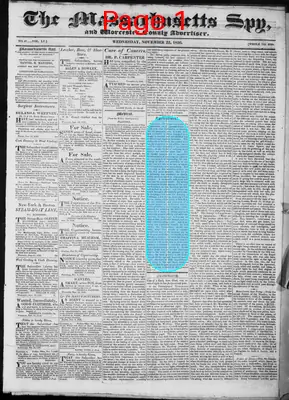
Editorial
November 22, 1826
The Massachusetts Spy, And Worcester County Advertiser
Worcester, Worcester County, Massachusetts
What is this article about?
Editorial urges farmers to specialize in one or related branches of husbandry, akin to craftsmen, to boost profits by focusing on farm-suited activities rather than diversifying broadly.
Clipping
OCR Quality
98%
Excellent
Full Text
Agricultural.
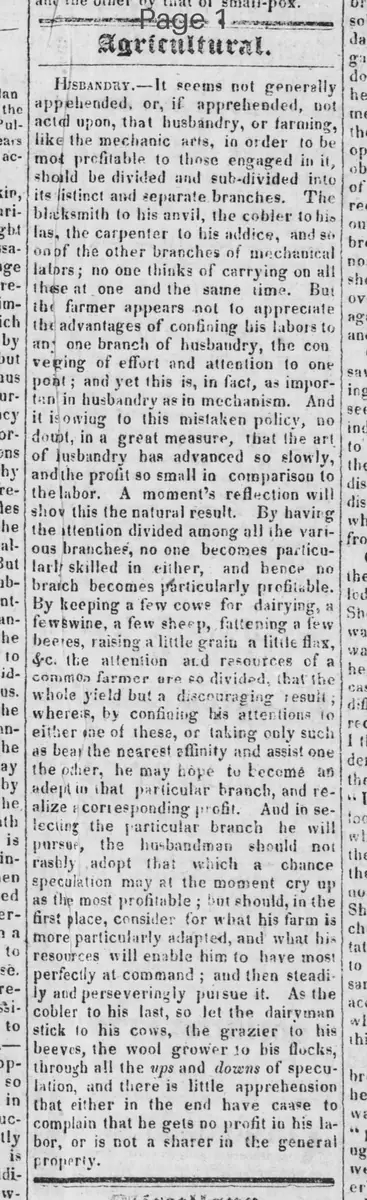
HUSBANDRY.--It seems not generally apprehended, or, if apprehended, not acted upon, that husbandry, or farming, like the mechanic arts, in order to be most profitable to those engaged in it, should be divided and sub-divided into its distinct and separate branches. The blacksmith to his anvil, the cobler to his last, the carpenter to his adze, and so on of the other branches of mechanical labors; no one thinks of carrying on all these at one and the same time. But the farmer appears not to appreciate the advantages of confining his labors to any one branch of husbandry, the concentrating of effort and attention to one point; and yet this is, in fact, as important in husbandry as in mechanism. And it is owing to this mistaken policy, no doubt, in a great measure, that the art of husbandry has advanced so slowly, and the profit so small in comparison to the labor. A moment's reflection will show this the natural result. By having the attention divided among all the various branches, no one becomes particularly skilled in either, and hence no branch becomes particularly profitable. By keeping a few cows for dairying, a few swine, a few sheep, fattening a few beeves, raising a little grain a little flax, &c. the attention and resources of a common farmer are so divided, that the whole yield but a discouraging result; whereas, by confining his attentions to either one of these, or taking only such as bear the nearest affinity and assist one the other, he may hope to become an adept in that particular branch, and realize a corresponding profit. And in selecting the particular branch he will pursue, the husbandman should not rashly adopt that which a chance speculation may at the moment cry up as the most profitable ; but should, in the first place, consider for what his farm is more particularly adapted, and what his resources will enable him to have most perfectly at command; and then steadily and perseveringly pursue it. As the cobler to his last, so let the dairyman stick to his cows, the grazier to his beeves, the wool grower to his flocks, through all the ups and downs of speculation, and there is little apprehension that either in the end have cause to complain that he gets no profit in his labor, or is not a sharer in the general prosperity.
HUSBANDRY.--It seems not generally apprehended, or, if apprehended, not acted upon, that husbandry, or farming, like the mechanic arts, in order to be most profitable to those engaged in it, should be divided and sub-divided into its distinct and separate branches. The blacksmith to his anvil, the cobler to his last, the carpenter to his adze, and so on of the other branches of mechanical labors; no one thinks of carrying on all these at one and the same time. But the farmer appears not to appreciate the advantages of confining his labors to any one branch of husbandry, the concentrating of effort and attention to one point; and yet this is, in fact, as important in husbandry as in mechanism. And it is owing to this mistaken policy, no doubt, in a great measure, that the art of husbandry has advanced so slowly, and the profit so small in comparison to the labor. A moment's reflection will show this the natural result. By having the attention divided among all the various branches, no one becomes particularly skilled in either, and hence no branch becomes particularly profitable. By keeping a few cows for dairying, a few swine, a few sheep, fattening a few beeves, raising a little grain a little flax, &c. the attention and resources of a common farmer are so divided, that the whole yield but a discouraging result; whereas, by confining his attentions to either one of these, or taking only such as bear the nearest affinity and assist one the other, he may hope to become an adept in that particular branch, and realize a corresponding profit. And in selecting the particular branch he will pursue, the husbandman should not rashly adopt that which a chance speculation may at the moment cry up as the most profitable ; but should, in the first place, consider for what his farm is more particularly adapted, and what his resources will enable him to have most perfectly at command; and then steadily and perseveringly pursue it. As the cobler to his last, so let the dairyman stick to his cows, the grazier to his beeves, the wool grower to his flocks, through all the ups and downs of speculation, and there is little apprehension that either in the end have cause to complain that he gets no profit in his labor, or is not a sharer in the general prosperity.
What sub-type of article is it?
Agriculture
What keywords are associated?
Husbandry
Farming Specialization
Agricultural Profit
Dairying
Grazing
Wool Growing
Editorial Details
Primary Topic
Specialization In Farming Branches For Profitability
Stance / Tone
Advisory And Persuasive
Key Arguments
Husbandry Should Be Divided Into Distinct Branches Like Mechanic Arts For Maximum Profit
Farmers Fail To Specialize, Dividing Attention Across Multiple Activities Like Dairying, Swine, Sheep, Beeves, Grain, Flax
Specialization Allows Skill Development And Higher Yields In Chosen Branches
Select Branch Based On Farm Adaptation And Resources, Pursue Steadily Despite Speculations