Thank you for visiting SNEWPapers!
Sign up free
The Daily Worker
Chicago, Cook County, Illinois
What is this article about?
Illinois factory employment rose 2.4% from August to September 1925, adding about 18,000 jobs, but remained below prior years' levels, including 1921 depression, indicating no recovery from post-1923 slump per state labor statistician Cahn.
Clipping
OCR Quality
Full Text
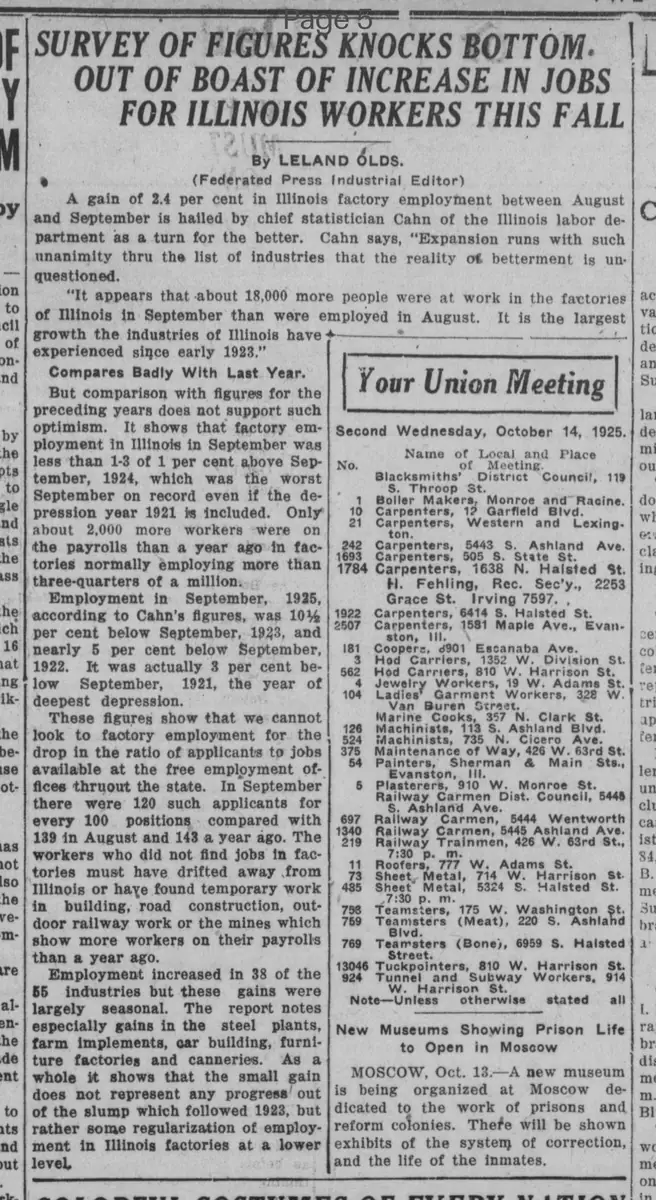
By LELAND OLDS.
(Federated Press Industrial Editor)
A gain of 2.4 per cent in Illinois factory employment between August and September is hailed by chief statistician Cahn of the Illinois labor department as a turn for the better. Cahn says, "Expansion runs with such unanimity thru the list of industries that the reality of betterment is unquestioned."
"It appears that about 18,000 more people were at work in the factories of Illinois in September than were employed in August.
It is the largest growth the industries of Illinois have experienced since early 1923."
Compares Badly With Last Year.
But comparison with figures for the preceding years does not support such optimism. It shows that factory employment in Illinois in September was less than 1-3 of 1 per cent above September, 1924, which was the worst September on record even if the depression year 1921 is included. Only about 2,000 more workers were on the payrolls than a year ago in factories normally employing more than three-quarters of a million.
Employment in September 1925, according to Cahn's figures, was 10 1/2 per cent below September 1923, and nearly 5 per cent below September 1922.
It was actually 3 per cent below September 1921, the year of deepest depression.
These figures show that we cannot look to factory employment for the drop in the ratio of applicants to jobs available at the free employment offices thruout the state. In September there were 120 such applicants for every 100 positions compared with 139 in August and 143 a year ago. The workers who did not find jobs in factories must have drifted away from Illinois or have found temporary work in building, road construction, outdoor railway work or the mines which show more workers on their payrolls than a year ago.
Employment increased in 38 of the 55 industries but these gains were largely seasonal. The report notes especially gains in the steel plants, farm implements, car building, furniture factories and canneries. As a whole it shows that the small gain does not represent any progress out of the slump which followed 1923, but rather some regularization of employment in Illinois factories at a lower level.
What sub-type of article is it?
What keywords are associated?
What entities or persons were involved?
Where did it happen?
Domestic News Details
Primary Location
Illinois
Event Date
September 1925
Key Persons
Outcome
factory employment in september 1925 was less than 1/3 of 1 per cent above september 1924, 10 1/2 per cent below september 1923, nearly 5 per cent below september 1922, and 3 per cent below september 1921. about 18,000 more people employed than in august 1925, but only 2,000 more than a year ago. employment increased in 38 of 55 industries, largely seasonal, with gains in steel plants, farm implements, car building, furniture factories, and canneries. no progress out of the post-1923 slump.
Event Details
A gain of 2.4 per cent in Illinois factory employment between August and September 1925 is reported, but comparisons with previous years show it was below most prior Septembers, including the depression year 1921. The increase does not indicate recovery but regularization at a lower level. Drop in job applicants at free employment offices not due to factory gains; workers likely shifted to other sectors like building, road construction, railway, or mines.