Thank you for visiting SNEWPapers!
Sign up free
Story
February 14, 1921
Norwich Bulletin
Norwich, New London County, Connecticut
What is this article about?
Article warns America to address immigration challenges for national identity and future, promoting Frances A. Kellor's book 'Immigration and the Future.' Leaders urge impartial study and policy on immigration and assimilation, highlighting economic and international implications.
Clipping
OCR Quality
98%
Excellent
Full Text
Will America Longer Ignore Problem Involving Her Future National Life?
Public Is Warned to Awake to Perils and Opportunities in Immigration—Leaders Urge Necessity of Impartial Study of Facts.
By HENRY WILLARD BREVIS
Is America in danger of losing its national identity and of becoming a sort of miniature League of Nations? Will America continue longer to ignore a problem—the immigration problem—which involves her very life and her future as a nation?
With nearly one-third of her population made up of foreign born and of people of foreign parentage and with millions of others now migrating to her shores, is America content with haphazard and temporary expedients, or will American statesmanship, American business, American labor, American agriculture and the American people as a whole unite in the formulation and adoption of a fundamental, forward-looking policy on the vital twin subjects of immigration and assimilation?
These and many other startling questions relating to the results of past and the effects of future immigration, are sharply raised by Frances A. Kellor of New York, one of the country's best known immigration authorities, in a remarkable new book entitled "Immigration and the Future."
National Policy Needed.
Indeed, so important to the country's welfare is an orderly and intelligent solution of these problems regarded by leading thinkers, that many of them are actively seeking to arouse wide public interest in the questions raised by the author.
A number of them have joined in an effort to urge that America shall formulate a sound, constructive, national policy based upon an exhaustive study of every phase of the problem. Among them are: Paul M. Warburg, of New York, former Vice Governor of the Federal Reserve Board; Dr. Jacob Gould Schurman, former President of Cornell University; Prof. E. R. A. Seligman, Professor of Economics, Columbia University; Paul D. Cravath, New York attorney; John H. Fahey, of Boston, former President of the Chamber of Commerce of the United States; Julius Rosenwald, of Chicago, President of the Sears, Roebuck Company; William C. Smith, New York State Commissioner of Immigrant Education; William Butterworth, President of Deere & Company, Moline, Ill.; Miss Mary I. O'Donnell, Secretary, Bureau of Americanization of the Detroit Board of Commerce; Harris Whittemore, President, Eastern Malleable Iron Company, Naugatuck, Conn.; E. J. Mehren, New York, Editor of Engineering News Record; G. H. Carnahan, President, Intercontinental Rubber Company, New York; Ernest T. Trigg, Vice-President, John Lucas & Company, Inc., Philadelphia; Adelbert Moot, Buffalo, N. Y., Regent, University of the State of New York; William C. Wilcox, former President of the Board of Education of New York City; John Williams, former Deputy Commissioner of Labor of the State of New York, and others.
Grave international problems, the future of American foreign trade, the friendly or unfriendly relation of the United States to many of the nations of the world, as well as a host of internal problems are shown by Miss Kellor to be involved in the determination of our national immigration policy.
Europe Holding Its Nationals
While America is failing to give adequate consideration to the questions involved in the movement of aliens to her shores, European countries are not ignoring their own interests as affected by movement abroad of their nationals. According to Miss Kellor's book, these nations are even now planning to tie their emigrants permanently to the home land by granting them a voice in home affairs whether they become naturalized here or not.
What is America going to do about that? inquires the writer.
Other pertinent questions raised by the book are: Will American employers of labor continue to regard our immigrant population only as so much cheap man-power, or will they take the trouble to discover its other and more valuable economic elements, such as love of industry, special mechanical skill, habits of thrift, and ambition for greater productive power and family advancement?
Will American business try to build up a great trade with foreign countries while considering beneath its notice a market of 15,000,000 foreign-born people in her midst and growing at the rate of a million a year?
Will American bankers seek a world-wide financial supremacy, while they ignore the savings and investing powers of the immigrant millions now here and yet to come?
Will American farmers continue to cry for capable farm labor, while making no organized effort to attract experienced agriculturists from among the immigrant and immigrating peoples?
If future immigration is to be assimilated into the fabric of American life, instead of continuing to remain practically alien, what policies are to be pursued?
To find answers to these questions, Miss Kellor points out, means that a vast amount of data must be collected from American and foreign sources and analyzed by a competent body free from taint of propaganda or of control by special interest.
"What America needs," she says again, "is not more technical regulations, not the extension of hardships, not the erection of barriers based on temporary expedients, but a racial inventory and formulation of policies, with such general powers as will enable the government to meet any situation as it arises. And it needs more than all a policy of assimilation which will cover the reception, distribution and adjustment of immigrants after arrival so we can really ascertain if we have assimilated the immigrants who have entered, with a view to determining how many we may wisely admit."
Inasmuch as Miss Kellor has been identified with almost every public movement for solution of immigration problems, and is a widely known authority upon the subject, her book is expected to quicken national interest in the strangers within and knocking at our gates.
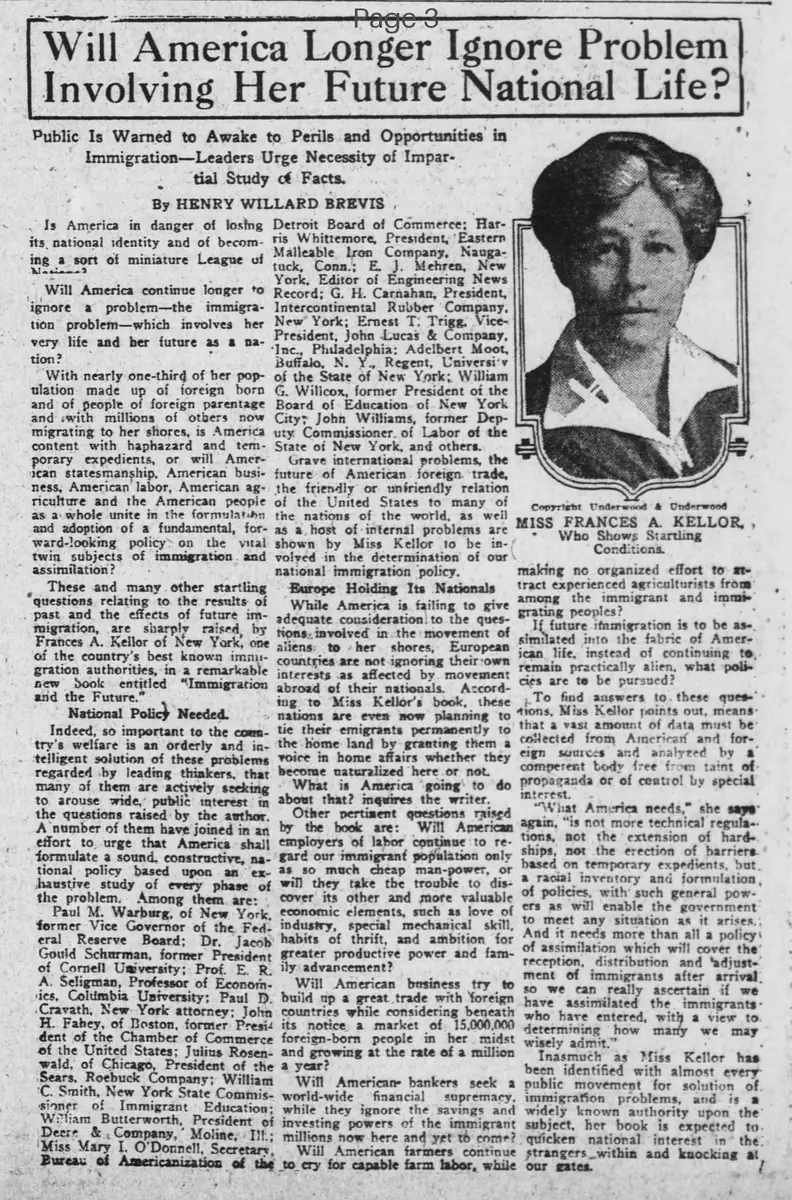
Copyright Underwood & Underwood
MISS FRANCES A. KELLOR,
Who Shows Startling
Conditions.
Public Is Warned to Awake to Perils and Opportunities in Immigration—Leaders Urge Necessity of Impartial Study of Facts.
By HENRY WILLARD BREVIS
Is America in danger of losing its national identity and of becoming a sort of miniature League of Nations? Will America continue longer to ignore a problem—the immigration problem—which involves her very life and her future as a nation?
With nearly one-third of her population made up of foreign born and of people of foreign parentage and with millions of others now migrating to her shores, is America content with haphazard and temporary expedients, or will American statesmanship, American business, American labor, American agriculture and the American people as a whole unite in the formulation and adoption of a fundamental, forward-looking policy on the vital twin subjects of immigration and assimilation?
These and many other startling questions relating to the results of past and the effects of future immigration, are sharply raised by Frances A. Kellor of New York, one of the country's best known immigration authorities, in a remarkable new book entitled "Immigration and the Future."
National Policy Needed.
Indeed, so important to the country's welfare is an orderly and intelligent solution of these problems regarded by leading thinkers, that many of them are actively seeking to arouse wide public interest in the questions raised by the author.
A number of them have joined in an effort to urge that America shall formulate a sound, constructive, national policy based upon an exhaustive study of every phase of the problem. Among them are: Paul M. Warburg, of New York, former Vice Governor of the Federal Reserve Board; Dr. Jacob Gould Schurman, former President of Cornell University; Prof. E. R. A. Seligman, Professor of Economics, Columbia University; Paul D. Cravath, New York attorney; John H. Fahey, of Boston, former President of the Chamber of Commerce of the United States; Julius Rosenwald, of Chicago, President of the Sears, Roebuck Company; William C. Smith, New York State Commissioner of Immigrant Education; William Butterworth, President of Deere & Company, Moline, Ill.; Miss Mary I. O'Donnell, Secretary, Bureau of Americanization of the Detroit Board of Commerce; Harris Whittemore, President, Eastern Malleable Iron Company, Naugatuck, Conn.; E. J. Mehren, New York, Editor of Engineering News Record; G. H. Carnahan, President, Intercontinental Rubber Company, New York; Ernest T. Trigg, Vice-President, John Lucas & Company, Inc., Philadelphia; Adelbert Moot, Buffalo, N. Y., Regent, University of the State of New York; William C. Wilcox, former President of the Board of Education of New York City; John Williams, former Deputy Commissioner of Labor of the State of New York, and others.
Grave international problems, the future of American foreign trade, the friendly or unfriendly relation of the United States to many of the nations of the world, as well as a host of internal problems are shown by Miss Kellor to be involved in the determination of our national immigration policy.
Europe Holding Its Nationals
While America is failing to give adequate consideration to the questions involved in the movement of aliens to her shores, European countries are not ignoring their own interests as affected by movement abroad of their nationals. According to Miss Kellor's book, these nations are even now planning to tie their emigrants permanently to the home land by granting them a voice in home affairs whether they become naturalized here or not.
What is America going to do about that? inquires the writer.
Other pertinent questions raised by the book are: Will American employers of labor continue to regard our immigrant population only as so much cheap man-power, or will they take the trouble to discover its other and more valuable economic elements, such as love of industry, special mechanical skill, habits of thrift, and ambition for greater productive power and family advancement?
Will American business try to build up a great trade with foreign countries while considering beneath its notice a market of 15,000,000 foreign-born people in her midst and growing at the rate of a million a year?
Will American bankers seek a world-wide financial supremacy, while they ignore the savings and investing powers of the immigrant millions now here and yet to come?
Will American farmers continue to cry for capable farm labor, while making no organized effort to attract experienced agriculturists from among the immigrant and immigrating peoples?
If future immigration is to be assimilated into the fabric of American life, instead of continuing to remain practically alien, what policies are to be pursued?
To find answers to these questions, Miss Kellor points out, means that a vast amount of data must be collected from American and foreign sources and analyzed by a competent body free from taint of propaganda or of control by special interest.
"What America needs," she says again, "is not more technical regulations, not the extension of hardships, not the erection of barriers based on temporary expedients, but a racial inventory and formulation of policies, with such general powers as will enable the government to meet any situation as it arises. And it needs more than all a policy of assimilation which will cover the reception, distribution and adjustment of immigrants after arrival so we can really ascertain if we have assimilated the immigrants who have entered, with a view to determining how many we may wisely admit."
Inasmuch as Miss Kellor has been identified with almost every public movement for solution of immigration problems, and is a widely known authority upon the subject, her book is expected to quicken national interest in the strangers within and knocking at our gates.
Copyright Underwood & Underwood
MISS FRANCES A. KELLOR,
Who Shows Startling
Conditions.
What sub-type of article is it?
Social Commentary
Policy Advocacy
What themes does it cover?
Social Manners
Immigration Policy
National Identity
What keywords are associated?
Immigration
Assimilation
National Policy
Foreign Born
American Identity
Economic Impact
European Emigration
What entities or persons were involved?
Frances A. Kellor
Henry Willard Brevis
Paul M. Warburg
Jacob Gould Schurman
E. R. A. Seligman
Paul D. Cravath
John H. Fahey
Julius Rosenwald
William C. Smith
William Butterworth
Mary I. O'donnell
Harris Whittemore
E. J. Mehren
G. H. Carnahan
Ernest T. Trigg
Adelbert Moot
William C. Wilcox
John Williams
Where did it happen?
United States
Story Details
Key Persons
Frances A. Kellor
Henry Willard Brevis
Paul M. Warburg
Jacob Gould Schurman
E. R. A. Seligman
Paul D. Cravath
John H. Fahey
Julius Rosenwald
William C. Smith
William Butterworth
Mary I. O'donnell
Harris Whittemore
E. J. Mehren
G. H. Carnahan
Ernest T. Trigg
Adelbert Moot
William C. Wilcox
John Williams
Location
United States
Story Details
Article discusses immigration challenges to America's national identity, promotes Kellor's book raising questions on policy, assimilation, economic impacts, and urges leaders to formulate a national strategy based on impartial study.