Thank you for visiting SNEWPapers!
Sign up free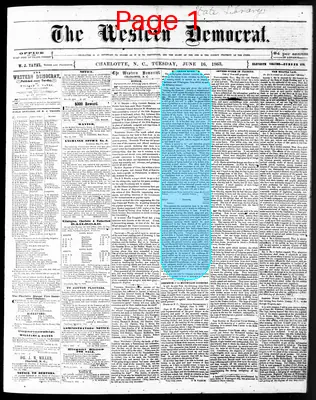
Story
June 16, 1863
The Western Democrat
Charlotte, Mecklenburg County, North Carolina
What is this article about?
The Wilmington Journal article criticizes blockade running at Charleston and Wilmington for introducing vast amounts of Confederate currency through imported goods auctions while exporting low-value cotton, exacerbating inflation and depleting specie reserves, urging regulatory laws.
Clipping
OCR Quality
95%
Excellent
Full Text
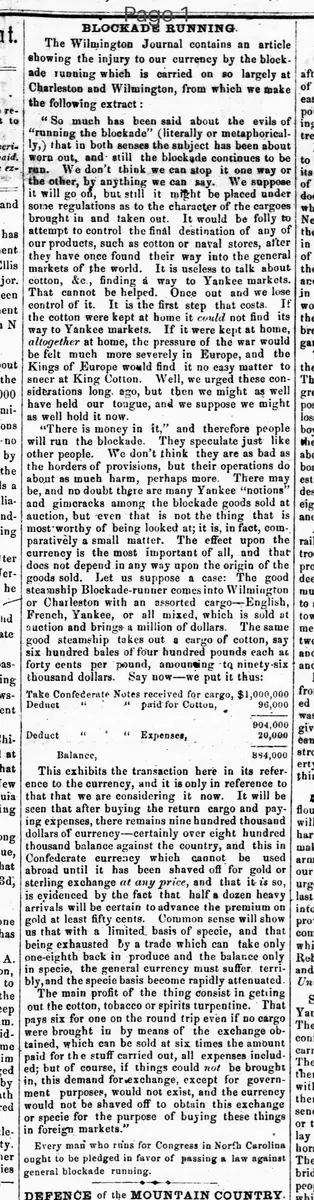
BLOCKADE RUNNING.
The Wilmington Journal contains an article showing the injury to our currency by the blockade running which is carried on so largely at Charleston and Wilmington, from which we make the following extract:
"So much has been said about the evils of "running the blockade" (literally or metaphorically, that in both senses the subject has been about worn out, and still the blockade continues to be run. We don't think we can stop it one way or the other, by anything we can say. We suppose it will go on, but still it might be placed under some regulations as to the character of the cargoes brought in and taken out. It would be folly to attempt to control the final destination of any of our products, such as cotton or naval stores, after they have once found their way into the general markets of the world. It is useless to talk about cotton, &c., finding a way to Yankee markets. That cannot be helped. Once out and we lose control of it. It is the first step that costs. If the cotton were kept at home it could not find its way to Yankee markets. If it were kept at home, altogether at home, the pressure of the war would be felt much more severely in Europe, and the Kings of Europe would find it no easy matter to sneer at King Cotton. Well, we urged these considerations long ago, but then we might as well have held our tongue, and we suppose we might as well hold it now.
"There is money in it," and therefore people will run the blockade. They speculate just like other people. We don't think they are as bad as the hoarders of provisions, but their operations do about as much harm, perhaps more. There may be, and no doubt there are many Yankee "notions" and gimcracks among the blockade goods sold at auction, but even that is not the thing that is most worthy of being looked at; it is, in fact, comparatively a small matter. The effect upon the currency is the most important of all, and that does not depend in any way upon the origin of the goods sold. Let us suppose a case: The good steamer Blockade-runner comes into Wilmington or Charleston with an assorted cargo—English French, Yankee, or all mixed, which is sold at auction and brings a million of dollars. The same good steamship takes out a cargo of cotton, say six hundred bales of four hundred pounds each at forty cents per pound, amounting to ninety-six thousand dollars. Say now—we put it thus:
Take Confederate Notes received for cargo, $1,000,000
Deduct paid for Cotton, 96,000
904,000
Deduct Expenses, 20,000
Balance, 884,000
This exhibits the transaction here in its reference to the currency, and it is only in reference to that that we are considering it now. It will be seen that after buying the return cargo and paying expenses, there remains nine hundred thousand dollars of currency—certainly over eight hundred thousand balance against the country. and this in Confederate currency which cannot be used abroad until it has been shaved off for gold or sterling exchange at any price, and that it is so, is evidenced by the fact that half a dozen heavy arrivals will be certain to advance the premium on gold at least fifty cents. Common sense will show us that with a limited basis of specie, and that being exhausted by a trade which can take only one-eighth back in produce and the balance only in specie, the general currency must suffer. terribly, and the specie basis become rapidly attenuated. The main profit of the thing consist in getting out the cotton, tobacco or spirits turpentine. That pays six for one on the round trip even if no cargo were brought in by means of the exchange ob- tained, which can be sold at six times the amount paid for the stuff carried out, all expenses includ- ed; but of course, if things could not be brought in, this demand for exchange, except for govern- ment purposes, would not exist, and the currency would not be shaved off to obtain this exchange or specie for the purpose of buying these things in foreign markets.
Every man who runs for Congress in North Carolina ought to be pledged in favor of passing a law against general blockade running."
The Wilmington Journal contains an article showing the injury to our currency by the blockade running which is carried on so largely at Charleston and Wilmington, from which we make the following extract:
"So much has been said about the evils of "running the blockade" (literally or metaphorically, that in both senses the subject has been about worn out, and still the blockade continues to be run. We don't think we can stop it one way or the other, by anything we can say. We suppose it will go on, but still it might be placed under some regulations as to the character of the cargoes brought in and taken out. It would be folly to attempt to control the final destination of any of our products, such as cotton or naval stores, after they have once found their way into the general markets of the world. It is useless to talk about cotton, &c., finding a way to Yankee markets. That cannot be helped. Once out and we lose control of it. It is the first step that costs. If the cotton were kept at home it could not find its way to Yankee markets. If it were kept at home, altogether at home, the pressure of the war would be felt much more severely in Europe, and the Kings of Europe would find it no easy matter to sneer at King Cotton. Well, we urged these considerations long ago, but then we might as well have held our tongue, and we suppose we might as well hold it now.
"There is money in it," and therefore people will run the blockade. They speculate just like other people. We don't think they are as bad as the hoarders of provisions, but their operations do about as much harm, perhaps more. There may be, and no doubt there are many Yankee "notions" and gimcracks among the blockade goods sold at auction, but even that is not the thing that is most worthy of being looked at; it is, in fact, comparatively a small matter. The effect upon the currency is the most important of all, and that does not depend in any way upon the origin of the goods sold. Let us suppose a case: The good steamer Blockade-runner comes into Wilmington or Charleston with an assorted cargo—English French, Yankee, or all mixed, which is sold at auction and brings a million of dollars. The same good steamship takes out a cargo of cotton, say six hundred bales of four hundred pounds each at forty cents per pound, amounting to ninety-six thousand dollars. Say now—we put it thus:
Take Confederate Notes received for cargo, $1,000,000
Deduct paid for Cotton, 96,000
904,000
Deduct Expenses, 20,000
Balance, 884,000
This exhibits the transaction here in its reference to the currency, and it is only in reference to that that we are considering it now. It will be seen that after buying the return cargo and paying expenses, there remains nine hundred thousand dollars of currency—certainly over eight hundred thousand balance against the country. and this in Confederate currency which cannot be used abroad until it has been shaved off for gold or sterling exchange at any price, and that it is so, is evidenced by the fact that half a dozen heavy arrivals will be certain to advance the premium on gold at least fifty cents. Common sense will show us that with a limited basis of specie, and that being exhausted by a trade which can take only one-eighth back in produce and the balance only in specie, the general currency must suffer. terribly, and the specie basis become rapidly attenuated. The main profit of the thing consist in getting out the cotton, tobacco or spirits turpentine. That pays six for one on the round trip even if no cargo were brought in by means of the exchange ob- tained, which can be sold at six times the amount paid for the stuff carried out, all expenses includ- ed; but of course, if things could not be brought in, this demand for exchange, except for govern- ment purposes, would not exist, and the currency would not be shaved off to obtain this exchange or specie for the purpose of buying these things in foreign markets.
Every man who runs for Congress in North Carolina ought to be pledged in favor of passing a law against general blockade running."
What sub-type of article is it?
Historical Event
Curiosity
What themes does it cover?
Misfortune
Crime Punishment
What keywords are associated?
Blockade Running
Confederate Currency
Economic Impact
Wilmington
Charleston
Cotton Export
Speculation
Where did it happen?
Charleston And Wilmington, North Carolina
Story Details
Location
Charleston And Wilmington, North Carolina
Story Details
Article extracts from Wilmington Journal decrying blockade running's economic harm: imports sold for millions in Confederate notes, exports yield minimal return, inflating currency and depleting specie; calls for regulatory laws against it.