Thank you for visiting SNEWPapers!
Sign up free
Springfield Weekly Republican
Springfield, Hampden County, Massachusetts
What is this article about?
The letter reports on political controversies in Washington, including treasury officials' defense against committee censure, uncertainties over the civil rights bill, debates on currency expansion, and investigations into District of Columbia government misconduct, while critiquing President Grant's support for questionable figures.
Clipping
OCR Quality
Full Text
This is Event 1 of 2. The full text below covers all events in this component.
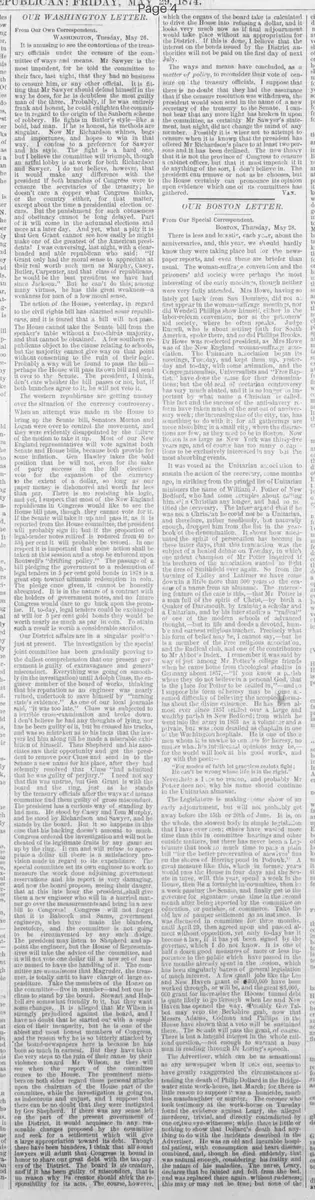
From Our Own Correspondent.
WASHINGTON, Tuesday, May 26.
It is amusing to see the contortions of the treasury officials under the censure of the committee of ways and means. Mr. Sawyer is the most impudent, for he told the committee to their face, last night, that they had no business to censure him, or any other official. It is fitting that Mr. Sawyer should defend himself in the way he does, for he is doubtless the most guilty man of the three. Probably, if he was entirely frank and honest, he could enlighten the committee in regard to the origin of the Sanborn scheme of robbery. He fights in Butler's style—like a bold, bad man. If he is honest, his methods are singular. Now Mr. Richardson whines, begs and importunes, and hopes to win in that way. I confess to a preference for Sawyer and his style. The fight is a hard one, but I believe the committee will triumph, though an artful lobby is at work for both Richardson and Sawyer. 'I do not believe, however, that it would make any difference with the president if both branches of Congress were to censure the secretaries of the treasury; he doesn't care a copper what Congress thinks, or the country either, for that matter, except about the time a presidential election occurs. But the punishment for such obtuseness and obstinacy cannot be long delayed. Part of it will come in the autumnal elections and more at a later day. And yet, what a pity it is that Gen. Grant cannot see how easily he might make one of the greatest of the American presidents! I was conversing, last night, with a clear-headed and able republican who said; 'If Grant only had the moral sense to appreciate at their real worth such men as Murphy, Casey, Butler, Carpenter, and that class of republicans, he would be the best president we have had since Jackson.' But he can't do this; among many virtues, he has this great weakness—a weakness for men of a low moral sense.
The action of the House, yesterday, in regard to the civil rights bill has alarmed some republicans, and it is feared that a bill will not pass. The House cannot take the Senate bill from the speaker's table without a two-thirds majority, and that cannot be obtained. A few southern republicans object to the clause relating to schools, but the majority cannot give way on that point without consenting to the ruin of their logic. Probably a way will be found to pass the bill—perhaps the House will pass its own bill and send it over to the Senate. The president, I think, don't care whether the bill passes or not, but, if both branches agree to it, he will not veto it.
The western republicans are getting uneasy over the situation of the currency controversy. When an attempt was made in the House to bring up the Senate bill, Senators Morton and Logan were over to control the movement, and they were evidently disappointed by the failure of the motion to take it up. Most of our New England representatives will vote against both Senate and House bills, because both provide for some inflation. Gen. Hawley takes the bold position that he will not, even for the sake of party success in the fall elections, vote for the expansion of the currency to the extent of a dollar, so long as our paper money is dishonored and worth far less than par. There is no resisting his logic, and yet, I suspect that most of the New England republicans in Congress would like to see the House bill pass, though they cannot vote for it. If the Senate will take it up and pass it, as it is reported from the House committee, the president will probably sign it; but if the proportion of legal-tender notes retired is reduced from 40 to 33 per cent it will probably be vetoed. In one respect it is important that some action shall be taken at this session and a stop be enforced upon Boutwell's 'drifting policy.' The passage of a bill pledging the government to a redemption of legal tenders in 5 per cent gold bonds in 1878 is a great step toward ultimate redemption in coin. The pledge once given, it cannot be honestly abrogated. It is in the nature of a contract with the holders of government notes, and no future Congress would dare to go back upon the promise. If, to-day, legal tenders could be exchanged at will for 5 per cent gold bonds they would be worth nearly as much as par in coin. To attain such a result is worth a considerable sacrifice.
Our District affairs are in a singular position just at present. The investigation by the special joint committee has been gradually proving to the dullest comprehension that our present government is guilty of extravagance and general misconduct. Everything was going on smoothly (in the investigation) until Adolph Cluss, the engineer member of the board of works, thinking that his reputation as an engineer was nearly ruined, undertook to save himself by 'turning state's evidence.' As one of our local journals said, 'it was too late.' Cluss was subjected to a terrible cross-examination and broke down. I don't believe he had any thoughts of lying, nor has he been guilty of it, but he crossed his tracks, and was so mistaken as to his facts that the lawyers led him along till he made a miserable exhibition of himself. Then Shepherd and his associates saw their opportunity and got the president to remove poor Cluss and send in to the Senate a new name for his place, after they had solemnly resolved that Cluss had admitted that he was guilty of perjury.' Indeed not say that this was untrue, but Gen. Grant is with the board and the ring, just as he stands by the treasury officials after the ways and means committee find them guilty of gross misconduct.
The president has a curious way of standing by bad men. He stood by Casey and Tom Murphy, and he stood by Richardson and Sawyer, and he stands by the board. But it so happens in this case that his backing doesn't amount to much. Congress ordered the investigation and will not be cheated of its legitimate fruits by any game set up by the ring. It can and will refuse to appropriate a dollar till there is a satisfactory provision made in regard to its expenditure. The special committee set its own engineer to work to measure the work done adjoining government reservations and his report is very damaging, and now the board propose, seeing their danger, that at this late hour the president shall give them a new engineer who will in a hurried manner go over the measurements and bring in a new bill to Congress! Congress will not forget that it is Babcock and Sams, government engineers, who have made the blunders, heretofore, and the committee is not going to be circumvented by any such dodge.
The president may listen to Shepherd and appoint the engineer, but the House of Representatives will take the advice of the committee, and it will not vote one dollar till a new set of men are named to have the handling of it. The committee are unanimous that Magruder, the treasurer, is totally unfit to have charge of large expenditure. Take the members of the House on the committee—five in number—and but one inclines to stand by the board. Stewart and Hubbard are somewhat friendly to it, but they want some changes. It is alleged that Mr. Wilson is strongly prejudiced against the board, and I have no doubt that he started out with a suspicion of their incapacity, but he is one of the ablest and most honest members of Congress, and the reason why he is so bitterly attacked by the board-newspapers here is because he has been so much in earnest. But they have taken the very steps to the ruin of their cause by their violence toward Mr. Wilson, as they will see when the report of the committee comes to the House. The prominent members on both sides regard these personal attacks upon the chairman of the House part of the committee, while the investigation is going on, as indecorous and unjust, and I suppose that there can be no doubt that they were instigated by Gov. Shepherd. If there was any sense left on the part of the present government of the District, it would 'acquiesce in any reasonable changes proposed' by the committee and seek for a settlement which will give a large appropriation toward its debt. Though there have been blunders, I think that all sound lawyers will admit that Congress is bound in honor to share our great debt with the tax-payers of the District. The board is its creature, and if it has been guilty of misconduct, that is no reason why its creator should shirk the responsibility for its acts. The course, however, which the organs of the board take is calculated to drive the House into refusing a dollar, and it looks very much now as if final adjournment would take place without an appropriation for the District. 'If this is done, I believe that the interest on the bonds issued by the District authorities will not be paid on the first day of next July.'
The ways and means have concluded, as a matter of policy, to reconsider their vote of censure on the treasury officials. I suppose that there is no doubt that they had the assurance that if the censure resolution was withdrawn, the president would soon send in the name of a new secretary of the treasury to the Senate. I cannot hear that any more light has broken in upon the committee, as certainly Mr. Sawyer's statement, last night, did not change the mind of any member. Possibly it is wiser not to attempt to censure when it is known that the president has offered Mr. Richardson's place to at least two persons and it has been declined. The new theory that it is not the province of Congress to censure a cabinet officer, but that it must impeach if it do anything of the sort, I don't believe in. The president can remove or not as he chooses, but the House certainly can pronounce its opinion upon evidence which one of its committees has gathered.
VAN.
What sub-type of article is it?
What themes does it cover?
What keywords are associated?
What entities or persons were involved?
Letter to Editor Details
Author
Van.
Main Argument
the letter reports on political controversies in washington, including treasury officials' defense against committee censure, uncertainties over the civil rights bill, debates on currency expansion, and investigations into district of columbia government misconduct, while critiquing president grant's support for questionable figures.
Notable Details