Thank you for visiting SNEWPapers!
Sign up free
The Caledonian
Saint Johnsbury, Caledonia County, Vermont
What is this article about?
The 1844 Philadelphia Nativist Riots began with an attack on a Native American meeting in Kensington, escalating into widespread violence between nativists and Irish Catholics. Riots involved shootings, resulting in 14 deaths and 39 injuries, and arson that burned three Catholic churches, a seminary, two priests' houses, and about 60 private homes.
Merged-components note: These components form a continuous report on the Philadelphia riots, including detailed accounts from various sources and a summary overview; all focused on the same event as a single logical domestic news unit.
Clippings
1 of 2
OCR Quality
Full Text
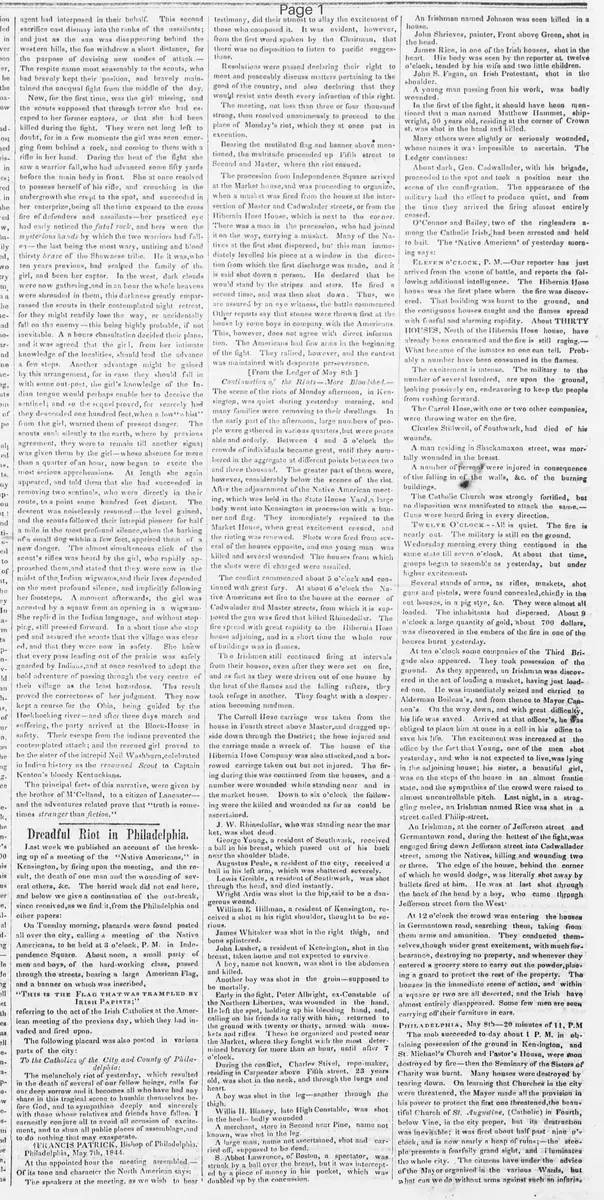
Last week we published an account of the breaking up of a meeting of the "Native Americans," in Kensington, by firing upon the meeting, and the result, the death of one man and the wounding of several others, &c. The horrid work did not end here, and below we give a continuation of the out-break, since received, as we find it, from the Philadelphia and other papers:
On Tuesday morning, placards were found posted all over the city, calling a meeting of the Native Americans, to be held at 3 o'clock, P. M. in Independence Square. About noon, a small party of men and boys, of the hard-working class, passed through the streets, bearing a large American Flag, and a banner on which was inscribed,
"THIS IS THE FLAG THAT WAS TRAMPLED BY IRISH PAPISTS;"
referring to the act of the Irish Catholics at the American meeting of the previous day, which they had invaded and fired upon.
The following placard was also posted in various parts of the city:
To the Catholics of the City and County of Philadelphia:
The melancholy riot of yesterday, which resulted in the death of several of our fellow beings, calls for our deep sorrow and it becomes all who have had any share in this tragical scene to humble themselves before God, and to sympathise deeply and sincerely with those whose relatives and friends have fallen. I earnestly conjure all to avoid all occasion of excitement, and to shun all public places of assemblage, and to do nothing that may exasperate.
FRANCIS PATRICK, Bishop of Philadelphia.
Philadelphia, May 7th, 1844.
At the appointed hour the meeting assembled. Of its tone and character the North American says:
The speakers at the meeting, as we wish to bear testimony, did their utmost to allay the excitement of those who composed it. It was evident, however, from the first word spoken by the Chairman, that there was no disposition to listen to pacific suggestions.
Resolutions were passed declaring their right to meet and peaceably discuss matters pertaining to the good of the country, and also declaring that they would resist unto death every infraction of this right. The meeting, not less than three or four thousand strong, then resolved unanimously to proceed to the place of Monday's riot, which they at once put in execution.
Bearing the mutilated flag and banner above mentioned, the multitude proceeded up Fifth street to Second and Master, where the riot ensued.
The procession from Independence Square arrived at the Market house, and was proceeding to organize, when a musket was fired from the house at the intersection of Master and Cadwalader streets, or from the Hibernia Hose House, which is next to the corner. There was a man in the procession, who had joined it on the way, carrying a musket. Many of the Natives at the first shot dispersed, but this man immediately levelled his piece at a window in the direction from which the first discharge was made, and it is said shot down a person. He declared that he would stand by the stripes and stars. He fired a second time, and was then shot down. Thus, we are assured by an eye witness, the battle commenced.
Other reports say that stones were thrown first at the house by some boys in company with the Americans. This, however, does not agree with direct information. The Americans had few arms in the beginning of the fight. They rallied, however, and the contest was maintained with desperate perseverance.
[From the Ledger of May 8th]
Continuation of the Riots—More Bloodshed.
The scene of the riots of Monday afternoon, in Kensington, was quiet during yesterday morning, and many families were removing to their dwellings. In the early part of the afternoon, large numbers of people were gathered in various quarters, but were peaceable and orderly. Between 4 and 5 o'clock the crowds of individuals became great, until they numbered in the aggregate at different points between two and three thousand. The greater part of them were, however, considerably below the scene of the riot. After the adjournment of the Native American meeting, which was held in the State House Yard, a large body went into Kensington in procession with a banner and flag. They immediately repaired to the Market House, when great excitement ensued, and the rioting was renewed. Shots were fired from several of the houses opposite, and one young man was killed and several wounded. The houses from which the shots were discharged were assailed.
The conflict commenced about 5 o'clock and continued with great fury. At about 6 o'clock the Native Americans set fire to the house at the corner of Cadwalader and Master streets, from which it is supposed the gun was fired that killed Rhinedollar. The fire spread with great rapidity to the Hibernia Hose house adjoining, and in a short time the whole row of buildings was in flames.
The Irishmen still continued firing at intervals from their houses, even after they were set on fire, and as fast as they were driven out of one house by the heat of the flames and the falling rafters, they took refuge in another. They fought with a desperation becoming madmen.
The Carroll Hose carriage was taken from the house in Fourth street above Master, and dragged upside down through the District; the hose injured and the carriage made a wreck of. The house of the Hibernia Hose Company was also attacked, and a borrowed carriage taken out but not injured. The firing during this was continued from the houses, and a number were wounded while standing near and in the market house. Down to six o'clock the following were the killed and wounded as far as could be ascertained.
J. W. Rhinedollar, who was standing near the market, was shot dead.
George Young, a resident of Southwark, received a ball in his breast, which passed out of his back near the shoulder blade.
Augustus Peale, a resident of the city, received a ball in his left arm, which was shattered severely.
Lewis Greible, a resident of Southwark, was shot through the head, and died instantly.
Wright Ardis was shot in the hip, said to be a dangerous wound.
William E. Gillman, a resident of Kensington, received a shot in his right shoulder, thought to be serious.
James Whitaker was shot in the right thigh, and bone splintered.
John Lusher, a resident of Kensington, shot in the breast, taken home and not expected to survive.
A boy, name not known, was shot in the abdomen and killed.
Another boy was shot in the groin—supposed to be mortally.
Early in the fight, Peter Albright, ex-Constable of the Northern Liberties, was wounded in the hand. He left the spot, holding up his bleeding hand, and, calling on his friends to rally with him, returned to the ground with twenty or thirty, armed with muskets and rifles. These he organized and posted near the Market, where they fought with the most determined bravery for more than an hour, until after 7 o'clock.
During the conflict, Charles Stivel, rope-maker, residing in Carpenter above Fifth street, 23 years old, was shot in the neck, and through the lungs and heart.
A boy was shot in the leg—another through the thigh.
Willis H. Blaney, late High Constable, was shot in the heel—badly wounded.
A merchant, store in Second near Pine, name not known, was shot in the leg.
A large man, name not ascertained, shot and carried off, supposed to be dead.
S. Abbot Lawrence, of Boston, a spectator, was struck by a ball over the breast, but it was intercepted by a piece of money in his pocket, which was doubled up by the concussion.
An Irishman named Johnson was seen killed in a house.
John Shrieves, painter, Front above Green, shot in the head.
James Rice, in one of the Irish houses, shot in the heart. His body was seen by the reporter at twelve o'clock, tended by his wife and two little children.
John S. Fagan, an Irish Protestant, shot in the shoulder.
A young man passing from his work, was badly wounded.
In the first of the fight, it should have been mentioned that a man named Matthew Hammel, shipwright, 50 years old, residing at the corner of Crown st. was shot in the head and killed.
Many others were slightly or seriously wounded, whose names it was impossible to ascertain. The Ledger continues:
About dark, Gen. Cadwallader, with his brigade, proceeded to the spot and took a position near the scene of the conflagration. The appearance of the military had the effect to produce quiet, and from the time they arrived the firing almost entirely ceased.
O'Connor and Bailey, two of the ringleaders among the Catholic Irish, had been arrested and held to bail. The 'Native American' of yesterday morning says:
Eleven o'clock, P. M.—Our reporter has just arrived from the scene of battle, and reports the following additional intelligence. The Hibernia Hose house was the first place where the fire was discovered. That building was burnt to the ground, and the contiguous houses caught and the flames spread with fearful and alarming rapidity. About THIRTY HOUSES, North of the Hibernia Hose house, have already been consumed and the fire is still raging. What became of the inmates no one can tell. Probably a number have been consumed in the flames.
The excitement is intense. The military to the number of several hundred, are upon the ground, looking passively on, endeavoring to keep the people from rushing forward.
The Carroll Hose, with one or two other companies, were throwing water on the fire.
Charles Stillwell, of Southwark, had died of his wounds.
A man residing in Shackamaxon street, was mortally wounded in the breast.
A number of persons were injured in consequence of the falling in of the walls, &c. of the burning buildings.
The Catholic Church was strongly fortified, but no disposition was manifested to attack the same.— Guns were heard firing in every direction.
Twelve O'clock—All is quiet. The fire is nearly out. The military is still on the ground.
Wednesday morning every thing continued in the same state till seven o'clock. At about that time, groups began to assemble as yesterday, but under higher excitement.
Several stands of arms, as rifles, muskets, shot guns and pistols, were found concealed, chiefly in the out houses, in a pig sty, &c. They were almost all loaded. The inhabitants had dispersed. About 9 o'clock a large quantity of gold, about $700 dollars, was discovered in the embers of the fire in one of the houses burnt yesterday.
At ten o'clock some companies of the Third Brigade also appeared. They took possession of the ground. As they appeared, an Irishman was discovered in the act of loading a musket, having just loaded one. He was immediately seized and carried to Alderman Boileau's, and from thence to Mayor Cannon's. On the way down, and with great difficulty, his life was saved. Arrived at that officer's, he was obliged to place him at once in a cell in his office to save his life. The excitement was increased at the office by the fact that Young, one of the men shot yesterday, and who is not expected to live, was lying in the adjoining house; his sister, a beautiful girl, was on the steps of the house in an almost frantic state, and the sympathies of the crowd were raised to almost uncontrollable pitch. Last night, in a straggling melee, an Irishman named Rice was shot in a street called Philip-street.
An Irishman, at the corner of Jefferson street and Germantown road, during the hottest of the fight, was engaged firing down Jefferson street into Cadwalader street, among the Natives, killing and wounding two or three. The edge of the house, behind the corner of which he would dodge, was literally shot away by bullets fired at him. He was at last shot through the back of the head by a boy, who came through Jefferson street from the West.
At 12 o'clock the crowd was entering the houses in Germantown road, searching them, taking from them arms and ammunition. They conducted themselves, though under great excitement, with much forbearance, destroying no property, and whenever they entered a grocery store to carry out the powder, placing a guard to protect the rest of the property. The houses in the immediate scene of action, and within a square or two are all deserted, and the Irish have almost entirely disappeared. Some few men are seen carrying off their furniture in carts.
PHILADELPHIA, May 8th—20 minutes of 11, P.M.
The mob succeeded to-day about 1 P. M. in obtaining possession of the ground in Kensington, and St. Michael's Church and Pastor's House, were soon destroyed by fire—then the Seminary of the Sisters of Charity was burnt. Many houses were destroyed by tearing down. On learning that Churches in the city were threatened, the Mayor made all the provision in his power to protect the first one threatened, the beautiful Church of St. Augustine, (Catholic) in Fourth, below Vine, in the city proper, but its destruction was inevitable; it was fired about half past nine o'clock, and is now nearly a heap of ruins—the steeple presents a fearfully grand sight, and illuminates the whole city. The citizens have under the advice of the Mayor organised in the various Wards, but what can we do without arms against such an incursion.
excited mob? So far as I have been enabled to judge, men of all sects, join in the strongest manner in condemning this unholy waste of property, and retaliation for opinion's sake.
HALF PAST 11 P. M.
The military have just arrived from Kensington, and have taken possession of the Churches of St. Mary's and St. Joseph's.
FIRING THE CHURCH. The scene is thus described in the Spirit of the Times:
About 5 o'clock P. M. Mayor Scott arrived in front of the church with a large body of police. He harangued the Natives from the top of a cab for nearly an hour. He made one of the most touching, most eloquent, and most appropriate speeches that can be imagined, and was enthusiastically cheered. But all was of no avail. The excited mob demanded of him the keys of the church—asked who had them—the Mayor exhibited them—said they had been committed to his care—and refused to surrender them.
The mob then insisted that he should dismiss every Irishman from the City Police. He said he had made no appointments except of naturalized citizens, &c., according to law. If there was any fault it was in the law. The First City Troop under Capt. Butler then came up, and after parading around, retired towards Kensington. Quiet ensued for a moment—then the mob rushed at the police, drove them back—pelted the church windows with stones—then lifted two boys over the iron railings who climbed into the building by a window that had been broken, and while one set fire to the curtains with a match, another cut the gas-pipe, thus putting the church into a blaze in a few moments.
The police then rallied, and made several arrests. The two boys were captured, but immediately rescued by the Natives. So were the rest. The police were severely beaten in the attempt to retain the prisoners.
By ten o'clock the building was in flames, which continued to burn until all the wood-work was destroyed. The firemen were present, but did not play upon the neighboring property. Thousands of spectators were looking on and a body of Police, some of them mounted, were parading the streets in the immediate vicinity.
The four buildings on the opposite side of the street were on fire, and were considerably injured—the heat being so intense in the immediate vicinity, that the firemen could not obtain good positions to play upon them.
FOUR O'CLOCK P. M.
The female seminary at the corner of Second and Phenix streets has been fired, and remains a heap of ruins. The excitement increases, and great consternation prevails, and families at more distant points are quitting their houses.
We learn that previous to the firing of the Church, Mr. Donahue, the priest, gave up the keys to Captain Fairlamb, who examined the premises, but found no arms, except in the dwelling, where there was an old rusty musket. This was about 10 o'clock.
The Captain then locked up the church, and after patrolling the district with his command, the attention of the military was directed to an attempt to fire a house corner of Washington and Jefferson streets, and during their absence from the church it was fired.
The military then returned to the premises, but too late to prevent the building from being destroyed. While it was burning the lots back were crowded with unfortunate people, who were driven from their adjoining frame houses by the flames. Some had lost all they possessed in the world, and were driven from their homes and deprived of all shelter.
During the burning of the Church the mob continued to shout, and when the cross at the peak of the roof fell, they gave three cheers and a drum and fife played the Boyne water. Nothing now remains of the gothic structure but its blackened walls.
5 o'clock.—The seminary has been completely destroyed. The temperance grocery store of Mr. Joseph Corr, corner of Phenix and Second streets, opposite the seminary, and from which it was said the volley was fired on Monday evening, which killed Mr. Wright, was completely riddled, and everything in the house destroyed.
The Philadelphia Inquirer says: "Such is the destruction of private property, that in all the streets of West Kensington small American flags, or in the absence of the stars and stripes, bits of the tri-color, are hung from the upper windows of the houses, to denote that the inmates are under its protection."
Up to a late hour in the night the fires were raging in Kensington, and the utmost alarm and excitement prevailed. A few guns had been fired, but probably they were merely charged with powder. The excitement and panic were fearful.
3 o'clock. The Natives have every thing their own way. The military are drawn up before the burning church, but they are perfectly powerless.
As they approached the church, the mob gave them three cheers, and we heard a dozen soldiers say, 'How can we fire on our own citizens, who cheer us as we approach?' The Natives have entered the Priest's house. They are throwing from the windows the books of his library, forgotten in his hurried retreat.
Here comes a carpet waving in the wind as it falls, and now demijohns, a crucifix, some sacred images, are flying through the air, tossed by the infuriated multitude, and carried away by the spectators.
A Catholic Bible produced some contention, but it was at length gotten by one individual who ran off with it. The Priest's house is now on fire.
The flames have extended to a large frame refectory adjoining the Church on the other side. The occupants of two frames next to it are removing their things. These frames are now in a blaze, and also a large frame weaving shop in the rear full of looms.
Two Natives are seen on the lot corner of Master and Second street, with fire-arms. The military surround, capture them, and let them go. In the melee one man is stabbed in the hand with a bayonet, and another hurt. It wants a quarter of our o'clock, and the report of two other guns is heard across the market lot. The soldiers rush, but the offenders could not be found. The Church, the Priest's house, and the adjoining houses are now enveloped in flames and present a sad spectacle.
4 o'clock. A most singular scene is now presented. The people are busy writing with chalk...
in big letters 'No Popery Here,' on their doors.
Others write 'Native Americans' on theirs.
2 o'clock A. M. About 11 o'clock, the 1st division were withdrawn from Kensington, and the 1st brigade marched to St. John's Church.
On arriving at St. John's Church the first brigade, under General Cadwallader, charged on a very large crowd assembled there, and drove every one from the ground.
He addressed the people in a very spirited manner, and declared that if they did not disperse in five minutes, he would order the troops to fire upon them.
The threat had the desired effect.
The infantry of this brigade were afterward sent to the other churches, the artillery remaining at St. John's, guarding the state arsenal, opposite the church and the Roman Catholic Orphan Asylum in Chestnut street.
There are field pieces planted on both these streets, Clover street and Market street.
Thursday Morning, 1 o'clock. The Catholic Churches throughout the City are now protected by Companies of Volunteers.
The whole of the first Division has arrived from Kensington, leaving that District to the care of two companies of Germantown Volunteers.
The Philadelphia Riots.
We give to-day rather extended accounts of the shameful Riots in the County of Philadelphia—and these accounts gathered from the various papers and among rumors there may be misstatements and errs before many days the whole truth will appear.
The military from out of the City and County are in numerously on Thursday and Friday, and the efficient measures of the City Authority, though at a late hour, effectually stopped the rioters.
The question which is asked, why efficient and early measures were not adopted to quell the outrage, finds something of an answer in the fact stated, that the Mayor when knocked down by a brickbat was forsaken except by one person and that one was a thief.
The result—14 killed, and 39 wounded—some fatally:—three Catholic Churches burned, one Catholic Female Seminary and two Priest's houses, and some 60 private houses.
The County, by law, is holder to pay for all property destroyed in this manner.
What sub-type of article is it?
What keywords are associated?
What entities or persons were involved?
Where did it happen?
Domestic News Details
Primary Location
Philadelphia, Kensington
Event Date
May 7 8, 1844
Key Persons
Outcome
14 killed, 39 wounded (some fatally); three catholic churches burned (st. michael's, st. augustine's, others protected); one catholic female seminary and two priests' houses destroyed; about 60 private houses burned or torn down; arrests of o'connor and bailey; military intervention quelled the riots by thursday-friday.
Event Details
Escalation from an initial attack on a Native American meeting in Kensington led to a large procession marching there, sparking renewed fighting with Irish Catholics involving gunfire from houses, resulting in casualties. Nativists set fire to buildings including the Hibernia Hose house and about 30 houses. Violence spread to burning St. Michael's Church, its pastor's house, a seminary, and later St. Augustine's Church in the city. Military and police attempted to intervene but were initially overwhelmed; eventual troop deployment restored order.