Thank you for visiting SNEWPapers!
Sign up free
Wisconsin Herald
Lancaster, Grant County, Wisconsin
What is this article about?
In a U.S. Senate speech on July 24, 1848, Thomas Corwin opposes the Compromise Bill, arguing against extending slavery into new territories like California and New Mexico. He critiques deferring the issue to the Supreme Court, invokes historical precedents from Jefferson and the Northwest Ordinance, and condemns peonage as slavery, urging moral opposition to its spread.
Clipping
OCR Quality
Full Text
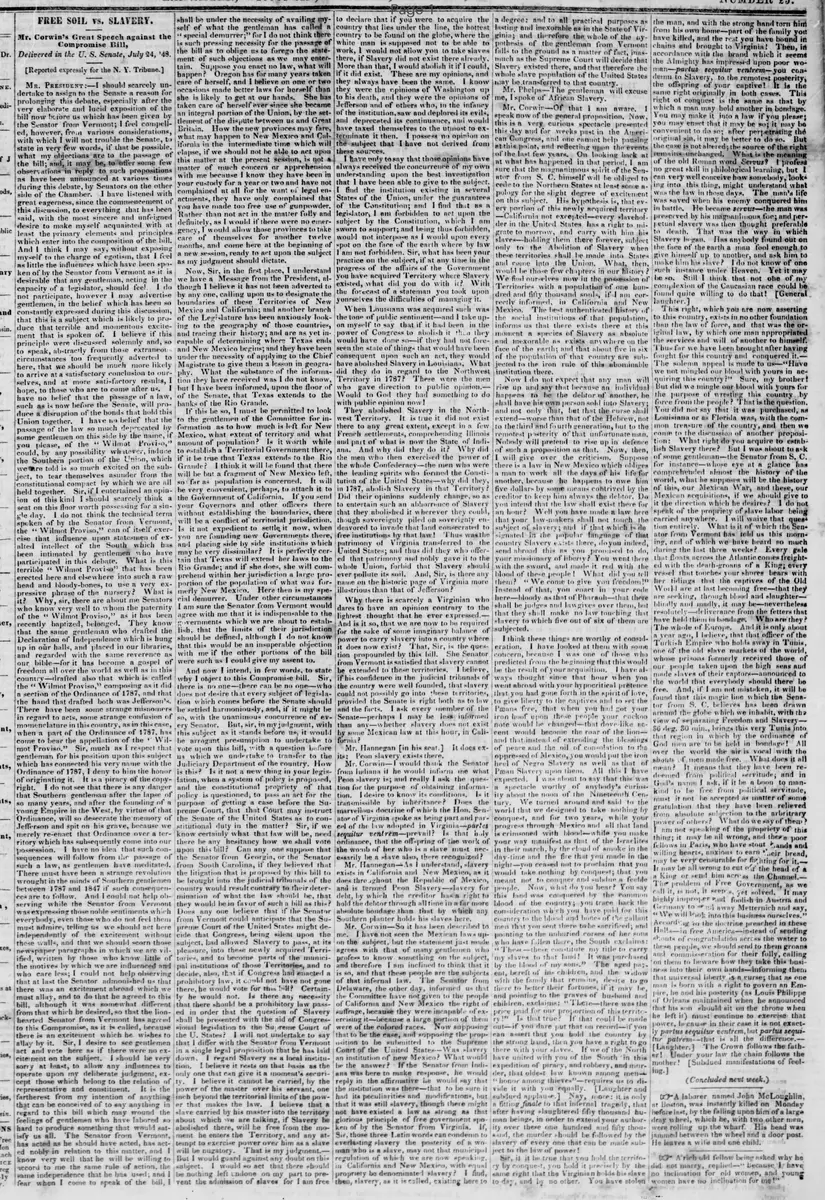
Mr. Corwin's Great Speech against the
Compromise Bill,
Delivered in the U. S. Senate, July 24, '48.
[Reported expressly for the N. Y. Tribune.]
Mr. President: I should scarcely under-
take to assign to the Senate a reason for
prolonging this debate, especially after the
very elaborate and lucid exposition of the
bill now before us which has been given by
the Senator from Vermont; I feel compelled,
however, from various considerations,
with which I will not trouble the Senate, to
state in very few words, if that be possible,
what my objections are to the passage of
the bill; and, it may be, to offer some few
observations in reply to such propositions
as have been announced at various times
during this debate, by Senators on the other
side of the Chamber. I have listened with
great eagerness, since the commencement of
this discussion, to everything that has been
said, with the most sincere and unfeigned
desire to make myself acquainted with at
least the primary elements and principles
which enter into the composition of the bill.
And I think I may say, without exposing
myself to the charge of egotism, that I feel
as little the influences which have been spo-
ken of by the Senator from Vermont as it is
desirable that any gentleman, acting in the
capacity of a legislator, should feel. I do
not participate, however I may advertise
gentlemen, in the belief which has been so
constantly expressed during this discussion,
that this is a subject which is likely to pro-
duce that terrible and momentous excite-
ment that is spoken of. I believe if this
principle were discussed solemnly and, so
to speak, abstractly from those extraneous
circumstances too frequently adverted to
here, that we should be much more likely
to arrive at a satisfactory conclusion to our-
selves, and at more satisfactory results, I
hope, to those who are to come after us. I
have no belief that the passage of a law,
such as is now before the Senate, will pro-
duce a disruption of the bonds that hold this
Union together. I have no belief that the
passage of the law so much deprecated by
some gentlemen on this side by the name, if
you please, of the "Wilmot Proviso,"
could, by any possibility whatever, induce
the Southern portion of the Union, which
we are told is so much excited on the sub-
ject, to tear themselves asunder from the
constitutional compact by which we are all
held together. Sir, if I entertained an opin-
ion of this kind I should scarcely think a
seat on this floor worth possessing for a sin-
gle day. I do not think the technical term
spoken of by the Senator from Vermont,
the "Wilmot Proviso," can of itself exer-
cise that influence upon statesmen of ex-
alted intellect of the South which has
been intimated by gentlemen who have
participated in this debate. What is this
terrible "Wilmot Proviso" that has been
erected here and elsewhere into such a raw
head and bloody-bones, to use a very ex-
pressive phrase of the nursery? What is
it? Why, sir, there are about me Senators
who know very well to whom the paternity
of the "Wilmot Proviso," as it has been
recently baptized, belonged. They know
that the same gentleman who drafted the
Declaration of Independence which is hung
up in our halls, and placed in our libraries,
and regarded with the same reverence as
our bible--for it has become a gospel of
freedom all over the world as well as in this
country--drafted also that which is called
the "Wilmot Proviso," composing as it did
a section of the Ordinance of 1787, and that
the hand that drafted both was Jefferson's.
There have been some strange misnomers
in regard to acts, some strange confusion of
nomenclature in this country, as in this case,
when a part of the Ordinance of 1787, has
come to bear the appellation of the "Wil-
mot Proviso." Sir, much as I respect that
gentleman for his position upon this subject
which has connected his very name with the
Ordinance of 1787, I deny to him the honor
of originating it. It is a piracy of the copy-
right. I do not see that there is any danger
that Southern gentlemen after the lapse of
so many years, and after the founding of a
young Empire in the West, by virtue of that
Ordinance, will so desecrate the memory of
Jefferson and spit on his grave, because we
merely re-enact that Ordinance over a ter-
ritory which has subsequently come into our
possession. I have no idea that such con-
sequences will follow from the passage of
such a law, as gentlemen have meditated.
There must have been a strange revolution
wrought in the minds of Southern gentlemen
between 1787 and 1847 if such consequen-
ces are to follow. And I could not help ob-
serving while the Senator from Vermont
was expressing those noble sentiments which
everybody, even those who do not feel them
must admire, telling us we should act here
independently of the excitement without
these walls, and that we should scorn those
newspaper paragraphs in which we are vil-
ified, written by those who know little of
the motives by which we are influenced and
who care less; I could not help observing
that at last the Senator admonished us that
there was an excitement abroad which we
must allay, and to do that he agreed to this
bill, although it was somewhat different
from that which he desired, so that the lion-
hearted Senator from Vermont has agreed
to this Compromise, as it is called, because
there is an excitement which he wishes to
allay by it. Sir, I desire to see gentlemen
act and vote here as if there were no ex-
citement on the subject. I should be very
sorry at least, to allow any influences to
operate upon my deliberate judgment, ex-
cept those which belong to the relation of
representative and constituent. It is the
furthest from my intention of anything
that can be conceived of to say anything in
regard to this bill which may wound the
feelings of gentlemen who have labored so
hard to produce something that would sat-
isfy us all. The Senator from Vermont,
has acted as he should have acted, has act-
ed nobly in relation to this matter, and I
know very well that he will be willing to
accord to me the same rule of action, the
same independence that he has used; and I
fear when I come to speak of the bill. I
shall be under the necessity of availing my-
self of what the gentleman has called a
"special demurrer;" for I do not think there
is such pressing necessity for the passage of
the bill as to oblige us to forego the state-
ment of such objections as we may enter-
tain. Suppose you enact no law, what will
happen? Oregon has for many years taken
care of herself, and I believe on one or two
occasions made better laws for herself than
she is likely to get at our hands. She has
taken care of herself ever since she became
an integral portion of the Union, by the set-
tlement of the dispute between us and Great
Britain. How the new provinces may fare,
what may happen to New Mexico and Cal-
ifornia in the intermediate time which will
elapse, if we should not be able to act upon
this matter at the present session, is not a
matter of much concern or apprehension
with me because I know they have been in
your custody for a year or two and have not
complained at all for the want of legal en-
actments, they have only complained that
you have made too free use of gunpowder.
Rather than not act in the matter fully and
definitely, as I would if there were no emer-
gency, I would allow those provinces to take
care of themselves for another twelve
months, and come here at the beginning of
a new session, ready to act upon the subject
as my judgment should dictate.
Now, Sir, in the first place, I understand
we have a Message from the President, al-
though I believe it has not been adverted to
by any one, calling upon us to designate the
boundaries of these Territories of New
Mexico and California; and another branch
of the Legislature has been anxiously look-
ing to the geography of those countries,
and tracing their history; and are as yet in-
capable of determining where Texas ends
and New Mexico begins; and they have been
under the necessity of applying to the Chief
Magistrate to give them a lesson in geogra-
phy. What the substance of the informa-
tion they have received was I do not know,
but I have been informed, upon the floor of
of the Senate, that Texas extends to the
banks of the Rio Grande.
If this be so, I must be permitted to look
to the gentlemen of the Committee for in-
formation as to how much is left for New
Mexico. What extent of territory and what
amount of population? Is it worth while
to establish a Territorial Government there,
if it be true that Texas extends to the Rio
Grande? I think it will be found that there
will be but a fragment of New Mexico left,
so far as population is concerned. It will
be very convenient, perhaps, to attach it to
the Government of California. If you send
your Governors and other officers there
without establishing the boundaries, there
will be a conflict of territorial jurisdiction.
Is it not expedient to settle it now, when
you are founding new Governments there,
and placing side by side institutions which
may be very dissimilar? It is perfectly cer-
tain that Texas will extend her laws to the
Rio Grande; and if she does, she will com-
prehend within her jurisdiction a large pro-
portion of the population of what was for-
merly New Mexico. Here then is my spe-
cial demurrer. Under other circumstances
I am sure the Senator from Vermont would
agree with me that it is indispensable to the
governments which we are about to estab-
lish, that the limits of their jurisdiction
should be defined, although I do not know
that this would be an insuperable objection
with me if the other portions of the bill
were such as I could give my assent to.
And now I intend, in few words, to state
why I object to this Compromise bill. Sir,
there is no one--there can be no one--who
does not desire that every subject of legisla-
tion which comes before the Senate should
be settled harmoniously, and, if it might be
so, with the unanimous concurrence of ev-
ery Senator. But, sir, in my judgment, with
this subject as it stands before us, it would
be arrogant presumption to undertake to
vote upon this bill, with a question before
us which we undertake to transfer to the
Judiciary Department of the country. How
is this? Is it not a new thing in your legis-
dation, when a system of policy is proposed,
and the constitutional propriety of that
policy is questioned, to pass an act for the
purpose of getting a case before the Su-
preme Court, that that Court may instruct
the Senate of the United States as to con-
stitutional duty in the matter? Sir, if we
know certainly what that law will be, need
there be any hesitancy how we shall vote
upon this bill? Can any one suppose that
the Senator from Georgia, or the Senator
from South Carolina, if they believed that
the litigation that is proposed by this bill to
be brought into the judicial tribunals of the
country would result contrary to their deter.
mination of what the law should be, that
they would be in favor of such a bill as this?
Does any one believe that if the Senator
from Vermont could anticipate that the Su-
preme Court of the United States might de-
cide that Congress, being silent upon the
subject, had allowed Slavery to pass, at its
pleasure, into these newly acquired Terri-
tories, and to become parts of the munici-
pal institutions of those Territories, and to
decide, also, that if Congress had enacted a
prohibitory law, it could not have gone
there, he would vote for this bill? Certain-
ly he would not. Is there any necessity
that there should be a prohibitory law pass-
ed in order that the question of Slavery
shall be presented with the aid of Congres-
sional legislation to the Supreme Court of
the U. States? I will not undertake to say
that I differ with the Senator from Vermont
in a single legal proposition that he has laid
down. I regard Slavery as a local institu-
tion. I believe it rests on that basis as the
only one that can give it a moment's security. I believe it cannot be carried, by the
power of the master over his servant, one
inch beyond the territorial limits of the power that makes the law. I believe that a
slave carried by his master into the territory
about which we are talking, if Slavery be
abolished there, will be free from the mo-
ment he enters the Territory, and any at-
tempt to exercise power over him as a slave
will be nugatory. That is my judgment.-
But I would guard against any doubt on this
subject. I would so act that there should
be nothing left undone on my part to pre-
vent the admission of slaves for I am free
to declare that if you were to acquire the
country that lies under the line, the hottest
country to be found on the globe, where the
white man is supposed not to be able to
work, I would not allow you to take slaves
there, if Slavery did not exist there already.
More than that, I would abolish it if I could,
if it did exist. These are my opinions, and
they always have been the same. I know
they were the opinions of Washington up
to his death, and they were the opinions of
Jefferson and of others who, in the infancy
of the institution, saw and deplored its evils,
and deprecated its continuance, and would
have taxed themselves to the utmost to ex-
terminate it then. I possess no opinion on
the subject that I have not derived from
these sources.
I have only to say that those opinions have
always received the concurrence of my own
understanding upon the best investigation
that I have been able to give to the subject.
I find the institution existing in several
States of the Union, under the guarantees
of the Constitution: and I find that as a
legislator, I am forbidden to act upon the
subject by the Constitution, which I am
sworn to support; and being thus forbidden,
would not interpose as I would upon every
spot on the face of the earth where by law
I am not forbidden. Sir, what has been your
practice on the subject, if at any time in the
progress of the affairs of the Government
you have acquired Territory where Slavery
existed, what did you do with it? With
the forecast of a statesman you took upon
yourselves the difficulties of managing it.
When Louisiana was acquired such was
the tone of public sentiment--and I take up-
on myself to say that if it had been in the
power of Congress to abolish it then they
would have done so--if they had not fore-
seen the state of things that would have been
consequent upon such an act, they would
have abolished Slavery in Louisiana. What
did they do in regard to the Northwest
Territory in 1787? These were the men
who gave direction to public opinion.-
Would to God they had something to do
with public opinion now!
They abolished Slavery in the North-
west Territory. It is true it did not exist
there to any great extent, except in a few
French settlements, comprehending Illinois
and part of what is now the State of Indi-
ana. And why did they do it? Why did
the men who then exercised the power of
the whole Confederacy--the men who were
the leading spirits who formed the Consti-
tution of the United States--why did they,
in 1787, abolish Slavery in that Territory?
Did their opinions suddenly change, so as
to entertain such an abhorrence of Slavery
that they abolished it wherever they could,
though sovereignty piled on sovereignty en-
deavored to invade that land consecrated to
free institutions by that law! Thus was the
patrimony of Virginia transferred to the
United States; and thus did they who offer-
ed that patrimony and nobly gave it to the
whole Union, forbid that Slavery should
ever pollute its soil. And, Sir, is there any
name on the historic page of Virginia more
illustrious than that of Jefferson?
Why there is scarcely a Virginian who
da res to have an opinion contrary to the
lightest thought that he ever expressed.-
And is it so, that we are now to be required
for the sake of some imaginary balance of
power to carry slavery into a country where
it does not now exist? That, Sir, is the ques-
tion propounded by this bill. The Senator
from Vermont is satisfied that slavery cannot
be extended to these territories. I believe,
if his confidence in the judicial tribunals of
the country were well founded, that slavery
could not possibly go into these territories,
provided the Senate is right both as to law
and the facts. I ask every member of the
Senate--perhaps I may be less informed
than any--whether slavery does not exist
by some Mexican law at this hour, in Cali-
fornia?
Mr. Hannegan [in his seat.] It does ex-
ists: Peon slavery exists there.
Mr. Corwin--I would thank the Senator
from Indiana if he would inform me what
Peon slavery is; and really I ask the ques-
tion for the purpose of obtaining informa-
tion. I desire to know its conditions. Is it
transmissible by inheritance? Does the
marvelous doctrine of which the Hon. Sen-
ator of Virginia spoke as being part and par-
cel of the law adopted in Virginia--partus
sequitur ventrem--prevail? Is that holy
ordinance, that the offspring of the work of
the womb of her who is a slave must nec-
essarily be a slave also, there recognized?
Mr. Hannegan--As I understand, slavery
exists in California and New Mexico, as it
does throughout the Republic of Mexico,
and is termed Peon Slavery--slavery for
debt, by which the creditor has a right to
hold the debtor through all time in a far more
absolute bondage than that by which any
Southern planter holds his slaves here.
Mr. Corwin--So it has been described to
me. I have not seen the Mexican laws up-
on the subject, but the statement just made
agrees with that of many gentlemen who
profess to know something on the subject,
and therefore I am inclined to think that it
is so, and that these people are the subjects
of that infernal law. The Senator from
Delaware, the other day, informed us that
the Committee have not given to the people
of California and New Mexico the right of
suffrage, because they were incapable of ex-
ercising it--because a large portion of them
were of the colored races. Now supposing
that to be the case, and supposing the prop-
position to be submitted to the Supreme
Court of the United States--Was slavery
an institution of New Mexico? What would
be the answer? If the Senator from Indi-
ana was here to make response, he would
reply in the affirmative he would say that
the institution was there--that to be sure it
had its peculiarities and modifications, but
that it was still slavery, though there might
not have existed a law as strong as that
glorious principle of free government spo-
ken of by the Senator from Virginia. If,
Sir, those three Latin words can condemn to
everlasting slavery the posterity of a wo-
man who is a slave, may not that municipal
regulation of which we are now speaking,
in California and New Mexico, with equal
propriety be denominated slavery? I find,
then, slavery, as it is called, existing there to
a degree: and to all practical purposes as
lasting and inexorable as in the State of Vir-
ginia; and therefore the whole of the hy-
pothesis of the gentleman from Vermont
falls to the ground as a matter of fact, inas-
much as the Supreme Court will decide that
Slavery existed there, and that therefore the
whole slave population of the United States
may be transferred to that country.
Mr. Phelps--The gentleman will excuse
me, I spoke of African Slavery.
Mr. Corwin--Of that I am aware. I
speak now of the general proposition. Now,
this is a very curious spectacle presented
this day and for weeks past in the Ameri-
can Congress, and one cannot help pausing
at this point, and reflecting upon the events
of the last few years. On looking back at
what has happened in that period, I am
sure that the magnanimous spirit of the Sen-
ator from S. C. himself will be obliged to
cede to the Northern States at least some a-
pology for the slight degree of excitement
on this subject. His hypothesis is, that ev-
ery portion of this newly acquired territory
--California not excepted--every slavehol-
der in the United States has a right to mi-
grate tomorrow, and carry with him his
slaves--holding them there forever, subject
only to the Abolition of Slavery when
these territories shall be made into States
and come into the Union. What, then,
would be those few chapters in our history?
We find ourselves now in the possession of
Territories with a population of one hun-
dred and fifty thousand souls, if I am cor-
rectly informed, in California and New
Mexico. The best authenticated history of
the social institutions of that population,
informs us that there exists there at this
moment a species of Slavery as absolute
and inexorable as exists anywhere on the
face of the earth; and that about five in six
of the population of that country are sub-
jected to the iron rule of this abominable
institution there.
Now I do not expect that any man will
rise up and say that because an individual
happens to be the debtor of another, he
shall have his own person sold into Slavery;
and not only that, but that the curse shall
extend--worse than that of the Hebrew, not
to the third and fourth generation, but to the
remotest posterity of that unfortunate man,
Nobody will pretend to rise up in defence
of such a proposition as that. Now, then,
I will give over the criticism. Suppose
there is a law in New Mexico which obliges
a man to work all the days of his life for
another, because he happens to owe him
five dollars by some means contrived by the
creditor to keep him always the debtor. Do
you intend that the law shall exist there for
an hour? Well you have made a law here
that your law-makers shall not touch the
subject of slavery; and if that which is de-
signated in the popular language of that
country Slavery exists there, do you indeed,
send abroad this as you promised to do,
your missionary of liberty? You went there
with the sword, and made it red with the
blood of these people! What did you tell
them? "We come to give you freedom!"
instead of that, you enact in your code
here--bloody as that of Pharaoh--that there
shall be judges and law givers over them, but
that they shall make no law touching that
slavery to which five out of six of them are
subjected.
I think these things are worthy of consid-
eration. I have looked at them with some
concern, because I was one of those who
predicted from the beginning that this would
be the result of your acquisition. I have al-
ways thought since that hour when you
went abroad with your hypocritical pretence
that you had gone forth in the spirit of love,
to give liberty to the captives and to set the
Paeans free, that when you had got your
iron hoof upon those people your cuckoo
note would be changed--that dove-like ac-
cent would become the roar of the lion--
and that instead of extending the blessings
of peace and the oil of consolation to the
oppressed of Mexico, you would put the iron
heel of Negro Slavery as well as that of
Paan Slavery upon them. All this I have
expected. I was about to say that this was
a spectacle worthy of anybody's curiosity about the noon of the Nineteenth Cen-
tury. We turned around and said to the
world that we designed to take nothing by
conquest, and for two years, while your
progress through Mexico and all that land
is crimsoned with blood--while you make
your way manifest as that of the Israelites
in their march, by the cloud of smoke in the
day-time and the fire that you made in the
ight--you ceased not to proclaim that you
would take nothing by conquest; that you
meant not to conquer and subdue a feeble
people. Now, what do you hear? You say
this land was conquered by the Common
blood of the country; you trace back the
consideration which you have paid for this
country to the blood and bones of the gallant
men that you sent there to be sacrificed; and
pointing to the unburied corpses of her sons
who have fallen there, the South exclaims:
"These--these constitute my title to carry
my slaves to that land! It was purchased
by the blood of my sons." The aged pa-
rent, bereft of his children, and the widow
with the family that remains, desire to go
there to better their fortunes, if it may be,
and pointing to the graves of husband and
children, exclaims: "There--there was the
price paid for our proportion of this territo-
ry!" Is that true? If that could be made
out--if you dare put that on record--if you
can assert that you hold the country by
the strong hand, then you have a right to go
there with your slaves. If we of the North
have united with you of the South in this
expedition of piracy, and robbery, and mur-
der, that oldest law known among men--
"honor among thieves"--requires us to di-
vide it with you equally. [Laughter and
subdued applause.] Nay, more: it is only
a fitting finale to that infernal tragedy, that
after having slaughtered fifty thousand hu-
man beings, in order to extend your author-
ity over there one hundred and fifty thou-
sand, the murder should be followed by the
slavery of every one that can be made sub-
ject to the law of power!
Sir, if it be true that you hold the territo-
ry by conquest, you hold it precisely by the
same right that the Virginian holds his slave
to day, and by no other. You have stolen
the man, and with the strong hand torn him
from his own home--part of the family you
have killed, and the rest you have bound in
chains and brought to Virginia! Then, in
accordance with the brand which it seems
the Almighty has impressed upon poor wo-
man--partus sequitur ventrem--you con-
demn to Slavery, to the remotest posterity
the offspring of your captive! It is the
same right originally in both cases. This
right of conquest is the same as that by
which a man may hold another in bondage.
You may make it into a law if you please;
you may enact that it may be so; it may be
convenient to do so; after perpetrating the
original sin, it may be better to do so. But
the case is not altered; the source of the right
remains unchanged. What is the meaning
of the old Roman word Servus? I profess
no great skill in philological learning, but I
can very well conceive how somebody, looking into this thing, might understand what
was the law in those days. The man's life
was saved when his enemy conquered him
in battle. He became servus--the man was
preserved by his magnanimous foe; and per-
petual slavery was then thought preferable
to death. That was the way in which
Slavery began. Has anybody found out on
the face of the earth a man fool enough to
give himself up to another, and ask him to
make him his slave? I do not know of one
such instance under Heaven. Yet it may
be so. Still I think that not one of my
complexion of the Caucasian race could be
found quite willing to do that! [General
laughter.]
This right, which you are now asserting
to this country, exists in no other foundation
than the law of force, and that was the or-
ignal law, by which one man appropriated
the services and will of another to himself.
Thus far we have been brought after having
fought for this country and conquered it.-
The solemn appeal is made to us--"Have
we not mingled our blood with yours in ac-
quiring this country?" Sure, my brother
But did we mingle our blood with yours for
the purpose of wresting this country by
force from the people? That is the question.
You did not say that it was purchased, as
Louisiana or as Florida was, with the com-
mon treasure of the country, and then we
come to the discussion of another proposi-
tion: What right do you acquire to estab-
lish Slavery there? But I was about to ask
of some gentleman--the Senator from S. C.
for instance--whose eye at a glance has
comprehended almost the history of the
world, what he supposes will be the history
of this, our Mexican War, and these, our
Mexican acquisitions, if we should give to
it the direction which he desires? I do not
speak of the propriety of slave labor being
carried anywhere. I will waive that ques-
tion entirely. What is it of which the Sen-
ator from Vermont has told us this morn-
ing, and of which we have heard so much
during the last three weeks? Every gale
that floats across the Atlantic comes freight-
ed with the death-groans of a King! every
vessel that touches your shores bears with
her tidings that the captives of the Old
World are at last becoming free--that they
are seeking, through blood and slaughter--
blindly and madly, it may be--nevertheless
resolutely--deliverance from the fetters that
have held them in bondage. Who are they?
The whole of Europe. And it is only about
a year ago, I believe, that that officer of the
Turkish Empire who holds sway in Tunis,
one of the old slave markets of the world,
whose prisons formerly received those of
our people taken upon the high seas and
made slaves of their captors--announced to
the world that everybody should there be
free. And, if I am not mistaken, it will be
found that this magic line which the Sena-
tor from S. C. believes has been drawn
around the globe which we inhabit, with the
view of separating Freedom and Slavery--
36 deg. 30 min., brings this very Tunis into
that region in which by the ordinance of
God men are to be held in bondage! All
over the world the air is vocal with the
shouts of men made free. What does it all
mean? It means that they have been re-
deemed from political servitude; and in
God's name I ask, if it be a boon to man-
kind to be free from political servitude,
must it not be accepted as matter of some
gratulation that they have been relieved
from absolute subjection to the arbitrary
power of others? What do we say of them?
I am not speaking of the propriety of this
thing; it may be all wrong, and there poor
fellows in Paris, who have stout hands and
willing hearts, anxious to earn their bread,
may be very censurable for fighting for it.-
It may be all wrong to cut off the head of a
King or send him across the Channel.-
The problem of Free Government, as we
call it, is not, it seems, yet solved. It may
be highly improper and foolish in Austria and
Germany to send away Metternich and say,
"We will look into this business ourselves."
According to the doctrine preached in these
Halls--in free America--instead of sending
shouts of congratulation across the water to
these people, we should send to them groans
and commiseration for their folly, calling
on them to beware how they take this busi-
ness into their own hands--informing them
that universal liberty is a curse; that as one
man is born with a right to govern an Em-
pire, he and his posterity (as Louis Philippe
of Orleans maintained when he announced
that his son should sit on the throne when
he left it) must continue to exercise that
power, because in their case it is not exact-
ly partus sequitur ventrem, but partus sequi-
tur patrem--that is all the difference.-
[Laughter.] The Crown follows the fath-
er! Under your law the chain follows the
mother! [Subdued manifestations of feel-
ing.]
(Concluded next week.)
What sub-type of article is it?
What themes does it cover?
What keywords are associated?
What entities or persons were involved?
Where did it happen?
Story Details
Key Persons
Location
U. S. Senate
Event Date
July 24, 1848
Story Details
Thomas Corwin delivers a speech opposing the Compromise Bill, arguing it would allow slavery into new territories by deferring to the Supreme Court; he defends the Wilmot Proviso as rooted in Jefferson's Ordinance of 1787, critiques peon slavery in Mexico as equivalent to chattel slavery, condemns the Mexican War as conquest justifying slavery extension, and calls for moral opposition to slavery's spread based on historical precedents.