Thank you for visiting SNEWPapers!
Sign up free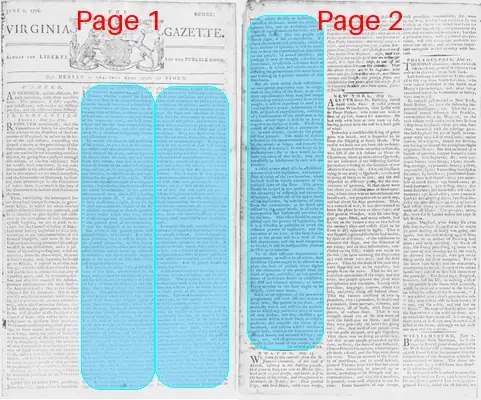
Editorial
June 7, 1776
The Virginia Gazette
Williamsburg, Virginia
What is this article about?
Philosophical essay on human nature and the need for government to curb passions and promote virtue through equality and justice. Advocates representative democracy with bicameral legislature, single executive, and independent judiciary to secure liberty and public good.
Merged-components note: Continuation of the editorial 'Loose thoughts on GOVERNMENT' across pages 1 and 2, as the text flows directly from one to the next.
Clippings
1 of 2
OCR Quality
98%
Excellent
Full Text
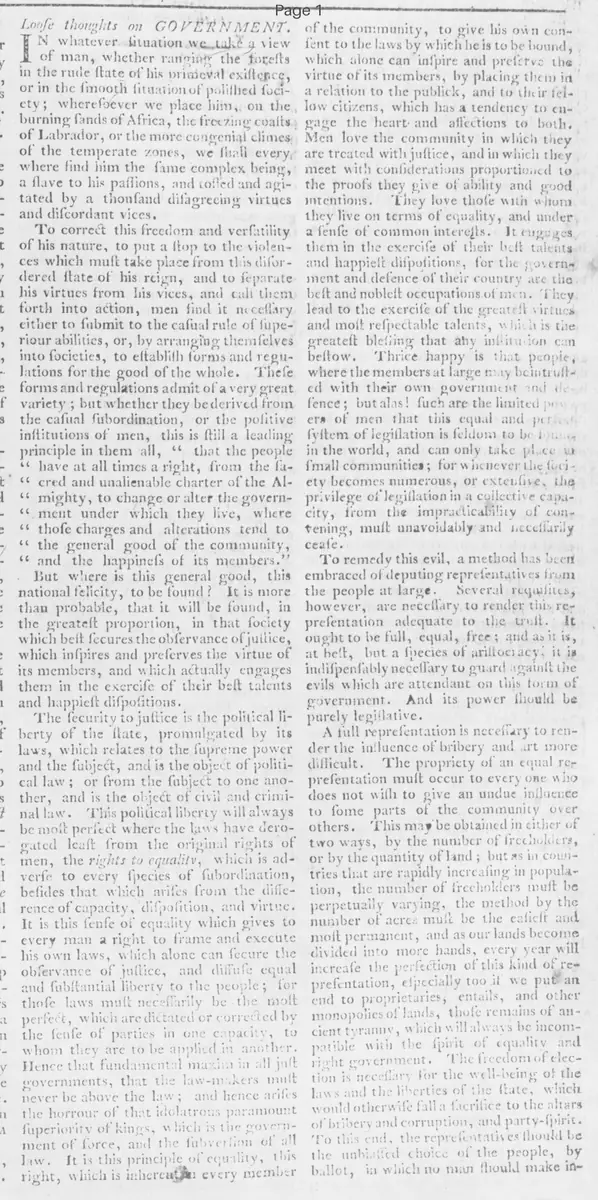
Loose thoughts on GOVERNMENT.
In whatever situation we take a view of man, whether ranging the forests in the rude state of his primaeval existence, or in the smooth situation of polished society; wheresoever we place him, on the burning sands of Africa, the freezing coasts of Labrador, or the more congenial climes of the temperate zones, we shall everywhere find him the same complex being, a slave to his passions, and tossed and agitated by a thousand disagreeing virtues and discordant vices.
To correct this freedom and versatility of his nature, to put a stop to the violences which must take place from this disordered state of his reign, and to separate his virtues from his vices, and call them forth into action, men find it necessary either to submit to the casual rule of superior abilities, or, by arranging themselves into societies, to establish forms and regulations for the good of the whole. These forms and regulations admit of a very great variety; but whether they be derived from the casual subordination, or the positive institutions of men, this is still a leading principle in them all, "that the people have at all times a right, from the sacred and unalienable charter of the Almighty, to change or alter the government under which they live, where those changes and alterations tend to the general good of the community, and the happiness of its members."
But where is this general good, this national felicity, to be found? It is more than probable, that it will be found, in the greatest proportion, in that society which best secures the observance of justice, which inspires and preserves the virtue of its members, and which actually engages them in the exercise of their best talents and happiest dispositions.
The security to justice is the political liberty of the state, promulgated by its laws, which relates to the supreme power and the subject, and is the object of political law; or from the subject to one another, and is the object of civil and criminal law. This political liberty will always be most perfect where the laws have derogated least from the original rights of men, the rights to equality, which is adverse to every species of subordination, besides that which arises from the difference of capacity, disposition, and virtue.
It is this sense of equality which gives to every man a right to frame and execute his own laws, which alone can secure the observance of justice, and diffuse equal and substantial liberty to the people; for those laws must necessarily be the most perfect, which are dictated or corrected by the sense of parties in one capacity, to whom they are to be applied in another.
Hence that fundamental maxim in all just governments, that the law-makers must never be above the law; and hence arises the horror of that idolatrous paramount superiority of kings, which is the government of force, and the subversion of all law. It is this principle of equality, this right, which is inherent in every member of the community, to give his own consent to the laws by which he is to be bound, which alone can inspire and preserve the virtue of its members, by placing them in a relation to the publick, and to their fellow citizens, which has a tendency to engage the heart and affections to both.
Men love the community in which they are treated with justice, and in which they meet with considerations proportioned to the proofs they give of ability and good intentions. They love those with whom they live on terms of equality, and under a sense of common interests. It engages them in the exercise of their best talents and happiest dispositions, for the government and defence of their country are the best and noblest occupations of men. They lead to the exercise of the greatest virtues and most respectable talents, which is the greatest blessing that any institution can bestow.
Thrice happy is that people where the members at large may be intrusted with their own government and defence; but alas! such are the limited powers of men that this equal and perfect system of legislation is seldom to be found in the world, and can only take place in small communities; for whenever the society becomes numerous, or extensive, the privilege of legislation in a collective capacity, from the impracticability of convening, must unavoidably and necessarily cease.
To remedy this evil, a method has been embraced of deputing representatives from the people at large. Several requisites, however, are necessary to render this representation adequate to the trust. It ought to be full, equal, free; and as it is, at best, but a species of aristocracy: it is indispensably necessary to guard against the evils which are attendant on this form of government. And its power should be purely legislative.
A full representation is necessary to render the influence of bribery and intrigue more difficult. The propriety of an equal representation must occur to every one who does not wish to give an undue influence to some parts of the community over others. This may be obtained in either of two ways, by the number of freeholders, or by the quantity of land; but as in countries that are rapidly increasing in population, the number of freeholders must be perpetually varying, the method by the number of acres must be the easiest and most permanent, and as our lands become divided into more hands, every year will increase the perfection of this kind of representation, especially too if we put an end to proprietaries, entails, and other monopolies of lands, those remains of ancient tyranny, which will always be incompatible with the spirit of equality and right government.
The freedom of election is necessary for the well-being of the laws and the liberties of the state, which would otherwise fall a sacrifice to the altars of bribery and corruption, and party-spirit.
To this end, the representatives should be the unbiased choice of the people, by ballot, in which no man should make interest directly or indirectly, either by himself or by any other person, in his behalf.
treat, either directly or indirectly, for himself or his friend, under the penalty of a heavy fine, and an exclusion from the house of representatives for ever; for it is generally found, that the people will choose right, if left to themselves. To check the aristocratick principle, which always inclines to tyranny, it will be necessary to keep the representatives dependent on the people, by annual elections; and perhaps it may be thought a further improvement, to establish a limited kind of rotation, as a sure and certain means of diffusing the government into more hands, and training up a greater number of able statesmen.
But as, even under these restrictions, an overgrown popularity may be dangerous to the safety of the state, or an arbitrary representative body may find means of imposing partial temporary laws on the people, it will be expedient to erect a second legislative power, independent of the first, or house of representatives, consisting of a small number of the ablest men in the nation, whose right it shall be to have a negative on the lower house. These may consist of 12, elected by a committee of 21, in each county, chosen by the people for that purpose: This mode of election will obviate the inconveniencies of a choice by the people at large, and remove the absurdity of leaving it to the house of representatives; for as they would be the mere creatures of that body, they must necessarily be subservient to their will and pleasure.
A third power must also be established, unconnected with legislation, and independent of either of the two branches, whose business shall be wholly executive of the political laws of the state. This power should be lodged in one person only, for the advantage of dispatch and execution of business, chosen out of the upper house of the legislature, by a majority of votes from the committees, to be aided and assisted by the upper house, in all cases of emergencies not sufficiently provided for by the laws. This office should be unconnected with the powers of legislation, for it is a solecism in politicks to invest the different powers of legislation, and the execution of the laws, in the same hands; and as this power will be a trust of the first importance, and the most dangerous to liberty, it will be indispensably prudent to fill it up in rotation.
To all these different departments of government, as well as to all others, such moderate salaries ought to be affixed as to place the sense of publick virtue higher in the estimation of the people than the thirst of gain; and lastly, an independent court of judicature should be established, for civil and criminal matters, to whom every member in the state ought to be subject, even unto death.
Such an arrangement of the powers of government will erect different orders of men, who, like parties in the state, will mutually watch and restrain the partialities to which any particular party or interest may incline, and thus establish a government which is most likely to inspire, preserve, and exercise the virtue of its members, and enforce a strict obedience to the laws, which is the foundation of all political liberty and national felicity; and thus, too, will all government be ultimately in the hands of the people, whose right it is.
DEMOCRATICUS.
In whatever situation we take a view of man, whether ranging the forests in the rude state of his primaeval existence, or in the smooth situation of polished society; wheresoever we place him, on the burning sands of Africa, the freezing coasts of Labrador, or the more congenial climes of the temperate zones, we shall everywhere find him the same complex being, a slave to his passions, and tossed and agitated by a thousand disagreeing virtues and discordant vices.
To correct this freedom and versatility of his nature, to put a stop to the violences which must take place from this disordered state of his reign, and to separate his virtues from his vices, and call them forth into action, men find it necessary either to submit to the casual rule of superior abilities, or, by arranging themselves into societies, to establish forms and regulations for the good of the whole. These forms and regulations admit of a very great variety; but whether they be derived from the casual subordination, or the positive institutions of men, this is still a leading principle in them all, "that the people have at all times a right, from the sacred and unalienable charter of the Almighty, to change or alter the government under which they live, where those changes and alterations tend to the general good of the community, and the happiness of its members."
But where is this general good, this national felicity, to be found? It is more than probable, that it will be found, in the greatest proportion, in that society which best secures the observance of justice, which inspires and preserves the virtue of its members, and which actually engages them in the exercise of their best talents and happiest dispositions.
The security to justice is the political liberty of the state, promulgated by its laws, which relates to the supreme power and the subject, and is the object of political law; or from the subject to one another, and is the object of civil and criminal law. This political liberty will always be most perfect where the laws have derogated least from the original rights of men, the rights to equality, which is adverse to every species of subordination, besides that which arises from the difference of capacity, disposition, and virtue.
It is this sense of equality which gives to every man a right to frame and execute his own laws, which alone can secure the observance of justice, and diffuse equal and substantial liberty to the people; for those laws must necessarily be the most perfect, which are dictated or corrected by the sense of parties in one capacity, to whom they are to be applied in another.
Hence that fundamental maxim in all just governments, that the law-makers must never be above the law; and hence arises the horror of that idolatrous paramount superiority of kings, which is the government of force, and the subversion of all law. It is this principle of equality, this right, which is inherent in every member of the community, to give his own consent to the laws by which he is to be bound, which alone can inspire and preserve the virtue of its members, by placing them in a relation to the publick, and to their fellow citizens, which has a tendency to engage the heart and affections to both.
Men love the community in which they are treated with justice, and in which they meet with considerations proportioned to the proofs they give of ability and good intentions. They love those with whom they live on terms of equality, and under a sense of common interests. It engages them in the exercise of their best talents and happiest dispositions, for the government and defence of their country are the best and noblest occupations of men. They lead to the exercise of the greatest virtues and most respectable talents, which is the greatest blessing that any institution can bestow.
Thrice happy is that people where the members at large may be intrusted with their own government and defence; but alas! such are the limited powers of men that this equal and perfect system of legislation is seldom to be found in the world, and can only take place in small communities; for whenever the society becomes numerous, or extensive, the privilege of legislation in a collective capacity, from the impracticability of convening, must unavoidably and necessarily cease.
To remedy this evil, a method has been embraced of deputing representatives from the people at large. Several requisites, however, are necessary to render this representation adequate to the trust. It ought to be full, equal, free; and as it is, at best, but a species of aristocracy: it is indispensably necessary to guard against the evils which are attendant on this form of government. And its power should be purely legislative.
A full representation is necessary to render the influence of bribery and intrigue more difficult. The propriety of an equal representation must occur to every one who does not wish to give an undue influence to some parts of the community over others. This may be obtained in either of two ways, by the number of freeholders, or by the quantity of land; but as in countries that are rapidly increasing in population, the number of freeholders must be perpetually varying, the method by the number of acres must be the easiest and most permanent, and as our lands become divided into more hands, every year will increase the perfection of this kind of representation, especially too if we put an end to proprietaries, entails, and other monopolies of lands, those remains of ancient tyranny, which will always be incompatible with the spirit of equality and right government.
The freedom of election is necessary for the well-being of the laws and the liberties of the state, which would otherwise fall a sacrifice to the altars of bribery and corruption, and party-spirit.
To this end, the representatives should be the unbiased choice of the people, by ballot, in which no man should make interest directly or indirectly, either by himself or by any other person, in his behalf.
treat, either directly or indirectly, for himself or his friend, under the penalty of a heavy fine, and an exclusion from the house of representatives for ever; for it is generally found, that the people will choose right, if left to themselves. To check the aristocratick principle, which always inclines to tyranny, it will be necessary to keep the representatives dependent on the people, by annual elections; and perhaps it may be thought a further improvement, to establish a limited kind of rotation, as a sure and certain means of diffusing the government into more hands, and training up a greater number of able statesmen.
But as, even under these restrictions, an overgrown popularity may be dangerous to the safety of the state, or an arbitrary representative body may find means of imposing partial temporary laws on the people, it will be expedient to erect a second legislative power, independent of the first, or house of representatives, consisting of a small number of the ablest men in the nation, whose right it shall be to have a negative on the lower house. These may consist of 12, elected by a committee of 21, in each county, chosen by the people for that purpose: This mode of election will obviate the inconveniencies of a choice by the people at large, and remove the absurdity of leaving it to the house of representatives; for as they would be the mere creatures of that body, they must necessarily be subservient to their will and pleasure.
A third power must also be established, unconnected with legislation, and independent of either of the two branches, whose business shall be wholly executive of the political laws of the state. This power should be lodged in one person only, for the advantage of dispatch and execution of business, chosen out of the upper house of the legislature, by a majority of votes from the committees, to be aided and assisted by the upper house, in all cases of emergencies not sufficiently provided for by the laws. This office should be unconnected with the powers of legislation, for it is a solecism in politicks to invest the different powers of legislation, and the execution of the laws, in the same hands; and as this power will be a trust of the first importance, and the most dangerous to liberty, it will be indispensably prudent to fill it up in rotation.
To all these different departments of government, as well as to all others, such moderate salaries ought to be affixed as to place the sense of publick virtue higher in the estimation of the people than the thirst of gain; and lastly, an independent court of judicature should be established, for civil and criminal matters, to whom every member in the state ought to be subject, even unto death.
Such an arrangement of the powers of government will erect different orders of men, who, like parties in the state, will mutually watch and restrain the partialities to which any particular party or interest may incline, and thus establish a government which is most likely to inspire, preserve, and exercise the virtue of its members, and enforce a strict obedience to the laws, which is the foundation of all political liberty and national felicity; and thus, too, will all government be ultimately in the hands of the people, whose right it is.
DEMOCRATICUS.
What sub-type of article is it?
Constitutional
Legal Reform
What keywords are associated?
Government Structure
Political Liberty
Equality Rights
Representation
Separation Of Powers
Democratic Principles
Checks And Balances
Editorial Details
Primary Topic
Principles Of Just Government Based On Equality And Representation
Stance / Tone
Advocacy For Democratic Institutions With Checks And Balances
Key Arguments
People Have A Right To Alter Government For The General Good.
Political Liberty Is Perfected By Laws Preserving Equality.
Law Makers Must Be Subject To The Law; Oppose Monarchical Superiority.
Representation Must Be Full, Equal, And Free To Prevent Corruption.
Use Land Based Representation For Stability.
Annual Elections And Rotation To Check Aristocracy.
Bicameral Legislature With Upper House Veto On Lower.
Single Executive Independent Of Legislature, Filled By Rotation.
Moderate Salaries To Prioritize Public Virtue.
Independent Judiciary For All, Including Officials.