Thank you for visiting SNEWPapers!
Sign up free
Editorial
October 15, 1828
Virginia Statesman
Wheeling, Ohio County, West Virginia
What is this article about?
Editorial compilation criticizing General Andrew Jackson's written opinions favoring a large standing army over militia and cursing the government's reduction of military forces, presented as evidence of his anti-republican views during the 1828 election.
Clipping
OCR Quality
95%
Excellent
Full Text
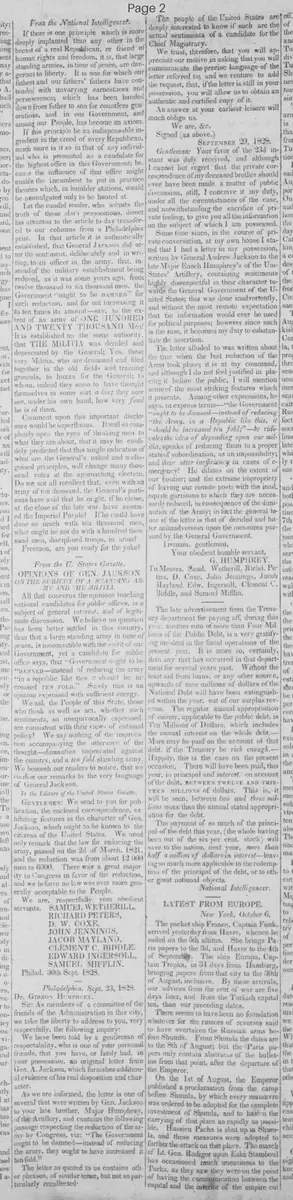
From the National Intelligencer.
If there is one principle which is more deeply implanted than any other in the breast of a real Republican, or friend of human rights and freedom, it is, that large standing armies, in time of peace, are dangerous to liberty. It is one for which our fathers and our fathers' fathers have contended with unvarying earnestness and perseverance; which has been handed down from father to son for countless generations, and in our Government, and among our People, has become an axiom.
If this principle be an indispensable ingredient in the creed of every Republican, much more is it so in that of any individual who is presented as a candidate for the highest office in this Government: because the influence of that office might enable the incumbent to put in practice theories which, in humbler stations, would be promulgated only to be hooted at.
Let the candid reader, who admits the truth of these old propositions, direct his attention to the article to-day transferred to our columns from a Philadelphia print. In that article it is authentically established, that General Jackson did utter the sentiment, deliberately and in writing, to an officer in the army, that, instead of the military establishment being reduced, as it was some years ago, from twelve thousand to six thousand men, the Government "ought to be DAMNED" for such reduction, and for not increasing it to ten times its amount—say, to the extent of an army of ONE HUNDRED AND TWENTY THOUSAND Men!
It is established on the same authority, that THE MILITIA was derided and depreciated by the General; Yes, these very Militia, who are drummed and filed together in the old fields and training grounds, to huzza for the General: to whom, indeed they seem to have thought themselves in some sort akin; they now see, under his own hand, how very fond he is of them.
Comment upon this important disclosure would be superfluous. It will so completely open the eyes of thinking men to what they are about, that it may be confidently predicted that this single indication of what are the General's naked and undisguised principles, will change many thousand votes at the approaching election.
Do we not all recollect that, even with an army of ten thousand, the General's partisans have said that he might, if he chose, at the close of the late war, have assumed the Imperial Purple? If he could have done so much with ten thousand men, what might he not do with a hundred thousand men, disciplined troops, in arms?
Freemen, are you ready for the yoke?
From the U. States Gazette.
OPINIONS OF GEN. JACKSON ON THE SUBJECT OF A STANDING ARMY AND THE MILITIA
All that concerns the opinions touching national candidates for public offices, is a subject of general interest, and of legitimate discussion. We believe no question has been better settled in this country, than that a large standing army in time of peace, is incompatible with the spirit of our Government, yet a candidate for public office says, that "Government ought to be "DAMNED—instead of reducing the army "in a republic like this, it should be increased ten "fold." Surely this is an opinion expressed with sufficient energy.
We ask the People of this State, those who think as well as act, whether such sentiments, so unequivocally expressed, are consistent with their views of national policy? We say nothing of the imprecation accompanying the utterance of the thought—damnation imprecated against the country, and a ten fold standing army
We beseech our readers to notice, that we confine our remarks to the very language of General Jackson.
To the Editors of the United States Gazette.
Gentlemen: We send to you for publication, the enclosed correspondence, exhibiting features in the character of Gen. Jackson, which ought to be known to the citizens of the United States. We need only remark that the law for reducing the army, passed on the 2d of March, 1821, and the reduction was from about 12,000 men to 6,000. There was a great majority in Congress in favor of the reduction, and we believe no law was ever more generally acceptable to the People,
We are, respectfully, your obedient servants,
SAMUEL WETHERILL,
RICHARD PETERS,
D. W. COXE.
JOHN JENNINGS.
JACOB MAYLAND,
CLEMENT C. BIDDLE.
EDWARD INGERSOLL,
SAMUEL MIFFLIN.
Philad. 30th Sept. 1828.
Philadelphia, Sept. 23, 1828.
Dr. GIDEON HUMPHREY.
Sir: As members of a committee of the friends of the Administration in this city, we take the liberty to address to you, very respectfully, the following inquiry:
We have been told by a gentleman of respectability, who is one of your personal friends, that you have, or lately had, in your possession, an original letter from Gen. A. Jackson, which furnishes additional evidence of his real disposition and character.
As we are informed, the letter is one of several that were written by Gen. Jackson to your late brother, Major Humphrey, of the Artillery, and contains the following passage respecting the reduction of the army by Congress, viz: "The Government ought to be damned—instead of reducing the army, they ought to have increased it ten fold."
The letter as quoted to us contains other phrases, of similar tenor, but not so particularly recollected
The people of the United States are deeply interested to know if such are the actual sentiments of a candidate for the Chief Magistracy.
We trust, therefore, that you will appreciate our motive in asking that you will communicate the precise language of the letter referred to: and we venture to add the request, that, if the letter is still in your possession, you will allow us to obtain an authentic and certified copy of it.
An answer at your earliest leisure will much oblige us.
We are, &c.
Signed (as above.)
SEPTEMBER 29, 1828.
Gentlemen: Your favor of the 23d instant was duly received, and although I cannot but regret that the private correspondence of my deceased brother should ever have been made a matter of public discussion, still, I conceive it my duty, under all the circumstances of the case, and notwithstanding the sacrifice of private feeling, to give you all the information on the subject of which I am possessed.
Some time since, in the course of private conversation, at my own house I stated that I had a letter in my possession, written by General Andrew Jackson to the late Major Enoch Humphrey, of the United States' Artillery, containing sentiments highly disrespectful in their character towards the General Government of the United States; this was done inadvertently, and without the most remote expectation that the information would ever be used for political purposes; however since such is the case, it becomes my duty to substantiate the assertion.
The letter alluded to was written about the time when the last reduction of the Army took place: it is at my command, and although I do not feel justified in placing it before the public, I will mention some of the most striking features which it presents. Among other expressions, he says, in express terms——"the Government ought to be damned—instead of reducing the Army, in a Republic like this, it should be increased ten fold;"—he ridicules the idea of depending upon our militia, speaks of reducing them to a proper state of subordination, as an impossibility: and their utter inefficiency in cases of emergency! He dilates on the extent of our frontier; and the extreme impropriety of leaving our remote posts with the inadequate garrisons to which they are necessarily reduced, in consequence of the diminution of the Army; in fact the general tenor of the letter is that of decided and bitter animadversion upon the measures pursued by the General Government.
I remain, gentlemen,
Your obedient humble servant,
G. HUMPHREY
To Messrs. Saml. Wetherill, Richd. Peters, D. Coxe, John Jennings, Jacob Mayland Edw. Ingersoll, Clement C. Biddle, and Samuel Mifflin.
If there is one principle which is more deeply implanted than any other in the breast of a real Republican, or friend of human rights and freedom, it is, that large standing armies, in time of peace, are dangerous to liberty. It is one for which our fathers and our fathers' fathers have contended with unvarying earnestness and perseverance; which has been handed down from father to son for countless generations, and in our Government, and among our People, has become an axiom.
If this principle be an indispensable ingredient in the creed of every Republican, much more is it so in that of any individual who is presented as a candidate for the highest office in this Government: because the influence of that office might enable the incumbent to put in practice theories which, in humbler stations, would be promulgated only to be hooted at.
Let the candid reader, who admits the truth of these old propositions, direct his attention to the article to-day transferred to our columns from a Philadelphia print. In that article it is authentically established, that General Jackson did utter the sentiment, deliberately and in writing, to an officer in the army, that, instead of the military establishment being reduced, as it was some years ago, from twelve thousand to six thousand men, the Government "ought to be DAMNED" for such reduction, and for not increasing it to ten times its amount—say, to the extent of an army of ONE HUNDRED AND TWENTY THOUSAND Men!
It is established on the same authority, that THE MILITIA was derided and depreciated by the General; Yes, these very Militia, who are drummed and filed together in the old fields and training grounds, to huzza for the General: to whom, indeed they seem to have thought themselves in some sort akin; they now see, under his own hand, how very fond he is of them.
Comment upon this important disclosure would be superfluous. It will so completely open the eyes of thinking men to what they are about, that it may be confidently predicted that this single indication of what are the General's naked and undisguised principles, will change many thousand votes at the approaching election.
Do we not all recollect that, even with an army of ten thousand, the General's partisans have said that he might, if he chose, at the close of the late war, have assumed the Imperial Purple? If he could have done so much with ten thousand men, what might he not do with a hundred thousand men, disciplined troops, in arms?
Freemen, are you ready for the yoke?
From the U. States Gazette.
OPINIONS OF GEN. JACKSON ON THE SUBJECT OF A STANDING ARMY AND THE MILITIA
All that concerns the opinions touching national candidates for public offices, is a subject of general interest, and of legitimate discussion. We believe no question has been better settled in this country, than that a large standing army in time of peace, is incompatible with the spirit of our Government, yet a candidate for public office says, that "Government ought to be "DAMNED—instead of reducing the army "in a republic like this, it should be increased ten "fold." Surely this is an opinion expressed with sufficient energy.
We ask the People of this State, those who think as well as act, whether such sentiments, so unequivocally expressed, are consistent with their views of national policy? We say nothing of the imprecation accompanying the utterance of the thought—damnation imprecated against the country, and a ten fold standing army
We beseech our readers to notice, that we confine our remarks to the very language of General Jackson.
To the Editors of the United States Gazette.
Gentlemen: We send to you for publication, the enclosed correspondence, exhibiting features in the character of Gen. Jackson, which ought to be known to the citizens of the United States. We need only remark that the law for reducing the army, passed on the 2d of March, 1821, and the reduction was from about 12,000 men to 6,000. There was a great majority in Congress in favor of the reduction, and we believe no law was ever more generally acceptable to the People,
We are, respectfully, your obedient servants,
SAMUEL WETHERILL,
RICHARD PETERS,
D. W. COXE.
JOHN JENNINGS.
JACOB MAYLAND,
CLEMENT C. BIDDLE.
EDWARD INGERSOLL,
SAMUEL MIFFLIN.
Philad. 30th Sept. 1828.
Philadelphia, Sept. 23, 1828.
Dr. GIDEON HUMPHREY.
Sir: As members of a committee of the friends of the Administration in this city, we take the liberty to address to you, very respectfully, the following inquiry:
We have been told by a gentleman of respectability, who is one of your personal friends, that you have, or lately had, in your possession, an original letter from Gen. A. Jackson, which furnishes additional evidence of his real disposition and character.
As we are informed, the letter is one of several that were written by Gen. Jackson to your late brother, Major Humphrey, of the Artillery, and contains the following passage respecting the reduction of the army by Congress, viz: "The Government ought to be damned—instead of reducing the army, they ought to have increased it ten fold."
The letter as quoted to us contains other phrases, of similar tenor, but not so particularly recollected
The people of the United States are deeply interested to know if such are the actual sentiments of a candidate for the Chief Magistracy.
We trust, therefore, that you will appreciate our motive in asking that you will communicate the precise language of the letter referred to: and we venture to add the request, that, if the letter is still in your possession, you will allow us to obtain an authentic and certified copy of it.
An answer at your earliest leisure will much oblige us.
We are, &c.
Signed (as above.)
SEPTEMBER 29, 1828.
Gentlemen: Your favor of the 23d instant was duly received, and although I cannot but regret that the private correspondence of my deceased brother should ever have been made a matter of public discussion, still, I conceive it my duty, under all the circumstances of the case, and notwithstanding the sacrifice of private feeling, to give you all the information on the subject of which I am possessed.
Some time since, in the course of private conversation, at my own house I stated that I had a letter in my possession, written by General Andrew Jackson to the late Major Enoch Humphrey, of the United States' Artillery, containing sentiments highly disrespectful in their character towards the General Government of the United States; this was done inadvertently, and without the most remote expectation that the information would ever be used for political purposes; however since such is the case, it becomes my duty to substantiate the assertion.
The letter alluded to was written about the time when the last reduction of the Army took place: it is at my command, and although I do not feel justified in placing it before the public, I will mention some of the most striking features which it presents. Among other expressions, he says, in express terms——"the Government ought to be damned—instead of reducing the Army, in a Republic like this, it should be increased ten fold;"—he ridicules the idea of depending upon our militia, speaks of reducing them to a proper state of subordination, as an impossibility: and their utter inefficiency in cases of emergency! He dilates on the extent of our frontier; and the extreme impropriety of leaving our remote posts with the inadequate garrisons to which they are necessarily reduced, in consequence of the diminution of the Army; in fact the general tenor of the letter is that of decided and bitter animadversion upon the measures pursued by the General Government.
I remain, gentlemen,
Your obedient humble servant,
G. HUMPHREY
To Messrs. Saml. Wetherill, Richd. Peters, D. Coxe, John Jennings, Jacob Mayland Edw. Ingersoll, Clement C. Biddle, and Samuel Mifflin.
What sub-type of article is it?
Military Affairs
Partisan Politics
What keywords are associated?
Standing Army
Militia
Andrew Jackson
Army Reduction
1828 Election
Republican Principles
Military Policy
What entities or persons were involved?
General Andrew Jackson
Congress
Militia
Gideon Humphrey
Samuel Wetherill
Richard Peters
D. W. Coxe
John Jennings
Jacob Mayland
Clement C. Biddle
Edward Ingersoll
Samuel Mifflin
Major Enoch Humphrey
Editorial Details
Primary Topic
Criticism Of Andrew Jackson's Advocacy For Expanding The Standing Army
Stance / Tone
Strongly Oppositional To Jackson, Warning Of Threat To Republican Liberty
Key Figures
General Andrew Jackson
Congress
Militia
Gideon Humphrey
Samuel Wetherill
Richard Peters
D. W. Coxe
John Jennings
Jacob Mayland
Clement C. Biddle
Edward Ingersoll
Samuel Mifflin
Major Enoch Humphrey
Key Arguments
Large Standing Armies In Peacetime Endanger Liberty
Jackson Cursed The Government For Reducing The Army From 12,000 To 6,000 Men
Jackson Advocated Increasing The Army Tenfold To 120,000
Jackson Derided The Militia As Inefficient And Impossible To Subordinate
Such Views Are Incompatible With Republican Principles
Disclosure Will Sway Votes In The 1828 Election
Jackson Could Use A Large Army To Seize Power