Thank you for visiting SNEWPapers!
Sign up free
The Virginian
Lynchburg, Virginia
What is this article about?
Washington Irving's essay from The Sketch Book reflects on the devastating effects of disappointed love on women, contrasting their emotional depth with men's worldly pursuits. It narrates the tragic fate of Robert Emmet's devoted lover, who wastes away after his execution, culminating in Thomas Moore's poignant poem.
Merged-components note: Continuation of the same literary piece, 'The Broken Heart' from Washington Irving's Sketch Book, in sequential reading order.
Clipping
OCR Quality
Full Text
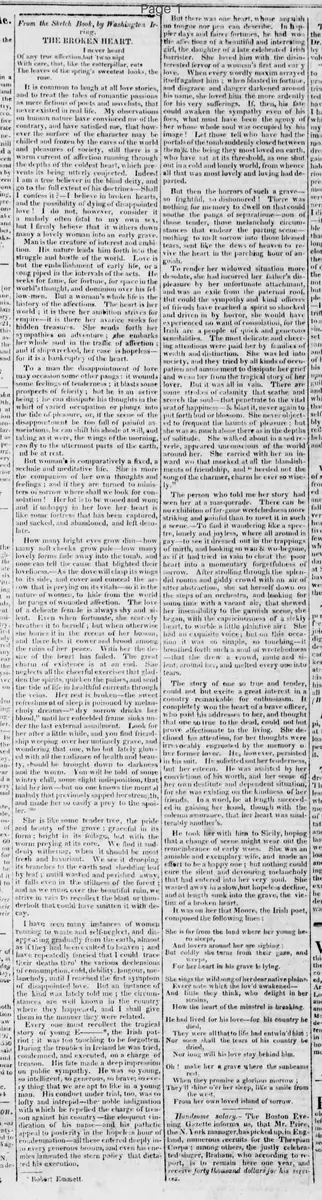
THE BROKEN HEART.
I never heard Of any true affection, but 'twas nipt With care, that, like the caterpillar, eats The leaves of the spring's sweetest looks, the rose.
It is common to laugh at all love stories, and to treat the tales of romantic passions as mere fictions of poets and novelists, that never existed in real life. My observations on human nature have convinced me of the contrary, and have satisfied me, that however the surface of the character may be chilled and frozen by the cares of the world and pleasures of society, still there is a warm current of affection running through the depths of the coldest heart, which prevents its being utterly congealed. Indeed I am a true believer in the blind deity, and go to the full extent of his doctrines—Shall I confess it ?—I believe in broken hearts, and the possibility of dying of disappointed love! I do not, however, consider it a malady often fatal to my own sex, but I firmly believe that it withers down many a lovely woman into an early grave.
Man is the creature of interest and ambition. His nature leads him forth into the struggle and bustle of the world. Love is but the embellishment of early life, or a song piped in the intervals of the acts. He seeks for fame, for fortune, for space in the world's thought, and dominion over his fellow-men. But a woman's whole life is the history of the affections. The heart is her world : it is there her ambition strives for empire—it is there her avarice seeks for hidden treasures. She sends forth her sympathies on adventure; she embarks her whole soul in the traffic of affection ; and if shipwrecked, her case is hopeless—for it is a bankruptcy of the heart.
To a man the disappointment of love may occasion some other pangs: it wounds some feelings of tenderness ; it blasts some prospects of felicity; but he is an active being ; he can dissipate his thoughts in the whirl of varied occupation or plunge into the tide of pleasure, or, if the scene of the disappointment be too full of painful associations, he can shift his abode at will, and taking as it were, the wings of the morning, can fly to the uttermost parts of the earth, and be at rest.
But woman' is comparatively a fixed, a secluded and meditative life. She is more the companion of her own thoughts and feelings ; and if they are turned to ministers of sorrow where shall we look for consolation ! Her lot is to be wooed and won; and if unhappy in her love her heart is like some fortress that has been captured, and sacked, and abandoned, and left desolate.
How many bright eyes grow dim—how many soft cheeks grow pale—how many lovely forms fade away into the tomb, and none can tell the cause that blighted their loveliness.—As the dove will clasp its wings to its side, and cover and conceal the arrow that is preying on its vitals—so it is the nature of woman, to hide from the world the pangs of wounded affection. The love of a delicate female is always shy and silent. Even when fortunate, she scarcely breathes it to herself; but when otherwise she buries it in the recess of her bosom, and there lets it cower and brood among the ruins of her peace. With her the desire of the heart has failed. The great charm of existence is at an end. She neglects all the cheerful exercises that gladden the spirits, quicken the pulses, and send the tide of life in healthful currents through the veins. Her rest is broken—the sweet refreshment of sleep is poisoned by melancholy dreams—"dry sorrow drinks her blood," until her enfeebled frame sinks under the last external assailment. Look for her after a little while, and you find friendship weeping over her untimely grave, and wondering that one, who but lately glowed with all the radiance of health and beauty, should be brought down to darkness and the worm. You will be told of some wintry chill, some slight indisposition, that laid her low—but no one knows the mental malady that previously sapped her strength, and made her so easily a prey to the spoiler.
She is like some tender tree, the pride and beauty of the grove ; graceful in its form; bright in its foliage, but with the worm preying at its core. We find it suddenly withering, when it should be most fresh and luxuriant. We see it drooping its branches to the earth and shedding leaf by leaf ; until wasted and perished away, it falls even in the stillness of the forest : and as we muse over the beautiful ruin, we strive in vain to recollect the blast or thunderbolt that could have smitten it with decay.
I have seen many instances of women running to waste and self-neglect, and disappearing gradually from the earth, almost as if they had been exalted to heaven ; and have repeatedly fancied that I could trace their deaths through the various declensions of consumption, cold, debility, languor, melancholy, until I reached the first symptom of disappointed love. But an instance of the kind was lately told me ; the circumstances are well known in the country where they happened, and I shall give them in the manner they were related.
Every one must recollect the tragical story of young E-*, the Irish patriot ; it was too touching to be forgotten. During the troubles in Ireland he was tried, condemned, and executed, on a charge of treason. His fate made a deep impression on public sympathy. He was so young, so intelligent, so generous, so brave; so every thing that we are apt to like in a young man. His conduct under trial, too, was so lofty and intrepid—the noble indignation with which he repelled the charge of treason against his country—the eloquent vindication of his name—and his pathetic appeal to posterity in the hopeless hour of condemnation—all these entered deeply into every generous bosom, and even his enemies lamented the stern policy that dictated his execution,
Robert Emmet.
But there was one heart, whose anguish no tongue nor pen can describe. In happier days and fairer fortunes. he had won the affections of a beautiful and interesting girl, the daughter of a late celebrated Irish barrister. She loved him with the disinterested fervor of a woman's first and early love. When every worldly maxim arrayed itself against him ; when blasted in fortune, and disgrace and danger darkened around his name, she loved him the more ardently for his very sufferings. If, then, his fate could awaken the sympathy even of his foes, what must have been' the agony of her whose whole soul was occupied by his image ! Let those tell who have had the portals of the tomb suddenly closed between them'& the being they most loved on earth, who have sat at its threshold, as one shut out in a cold and lonely world, from whence all that was most lovely and loving had departed.
But then the horrors of such a grave—so frightful, so dishonored ! There was nothing for memory to dwell on that could soothe the pangs of separation—none of those tender, those melancholy circumstances that endear the parting scene—nothing to melt sorrow into those blessed tears, sent like the dews of heaven to revive the heart in the parching hour of anguish.
To render her widowed situation more desolate, she had incurred her father's displeasure by her unfortunate attachment, and was an exile from the paternal roof. But could the sympathy and kind offices of friends have reached a spirit so shocked and driven in by horror, she would have experienced no want of consolation, for the Irish are a people of quick and generous sensibilities. The most delicate and cheering attentions were paid her by families of wealth and distinction. She was led into society, and they tried by all kinds of occupation and amusement to dissipate her grief and wean her from the tragical story of her lover. But it was all in vain. There are some strokes of calamity that scathe and scorch the soul—that penetrate to the vital seat of happiness—& blast it, never again to put forth bud or blossom. She never objected to frequent the haunts of pleasure : but she was as much alone there as in the depths of solitude. She walked about in a sad reverie, appeared unconscious of the world around her. She carried with her an inward wo that mocked at all the blandishments of friendship, and" heeded not the song of the charmer, charm he ever so wisely."
The person who told me her story had seen her at a masquerade. There can be no exhibition of far-gone wretchedness more striking and painful than to meet it in such a scene.—To find it wandering like a spectre, lonely and joyless, where all around is gay—to see it dressed out in the trappings of mirth, and looking so wan & wo-begone, as if it had tried in vain to cheat the poor heart into a momentary forgetfulness of sorrow. After strolling through the splendid rooms and giddy crowd with an air of utter abstraction, she sat herself down on the steps of an orchestra, and looking for some time with a vacant air. that shewed her insensibility to the garnish scene, she began, with the capriciousness of a sickly heart, to warble a little plaintive air: She had an exquisite voice; but on this occasion it was so simple, so touching—it breathed forth such a soul of wretchedness—that she drew a crowd, mute and silent, around her, and melted every one into tears.
The story of one so true and tender could not but excite. a great interest in a country remarkable for enthusiasm. It completely won the heart of a brave officer who paid his addresses to her, and thought that one so true to the dead, could not but prove affectionate to the living. She declined his attention, for her thoughts were irrevocably engrossed by the memory of her former lover. He, however, persisted in his suit. He solicited not her tenderness, but her esteem. He was assisted by her convictions of his worth, and her sense of her own destitute and dependent situation, for she was existing on the kindness of her friends. In a word, he at length succeeded in gaining her hand, though with the solemn assurance. that her heart was unalterably another's.
He took her with him to Sicily, hoping that a change of scene might wear out the remembrance of early woes. She was an amiable and exemplary wife, and made an effort to be a happy one ; but nothing could cure the silent and devouring melancholy that had entered into her very soul. She wasted away in a slow, but hopeless decline, and at length sunk into the grave, the victim of a broken heart.
It was on her that Moore, the Irish poet, composed the following lines :
She is far from the land where her young hero sleeps, And lovers around her are sighing: But coldly she turns from their gaze, and weeps, For her heart in his grave is lying
She sings the wild song of her dear native plains Every note which she lov'd awakened- And little they think, who delight in her strains, How the heart of the minstrel is breaking.
He had lived for his love—for his country he died, They were all that to life had entwin'd him; Nor soon shall the tears of his country be dried, Nor long will his love stay behind him.
Oh ! make her a grave where the sunbeams rest, When they promise a glorious morrow; They'll shine o'er her sleep, like a smile from the west, From her own loved island of sorrow.
What sub-type of article is it?
What themes does it cover?
What keywords are associated?
What entities or persons were involved?
Literary Details
Title
The Broken Heart.
Author
From The Sketch Book, By Washington Irving.
Subject
On Disappointed Love And Its Fatal Effects On Women, Illustrated By The Story Of Robert Emmet's Lover
Form / Style
Reflective Essay With Embedded Tragic Narrative
Key Lines