Thank you for visiting SNEWPapers!
Sign up free
Story
July 12, 1852
The Republic
Washington, District Of Columbia
What is this article about?
Enthusiastic reception of Daniel Webster in Boston on Friday last, with 30,000 attendees on the Common. Webster responds with a speech recounting his career since 1823, praising Massachusetts' revolutionary history and commitment to national liberty and union.
Clipping
OCR Quality
95%
Excellent
Full Text
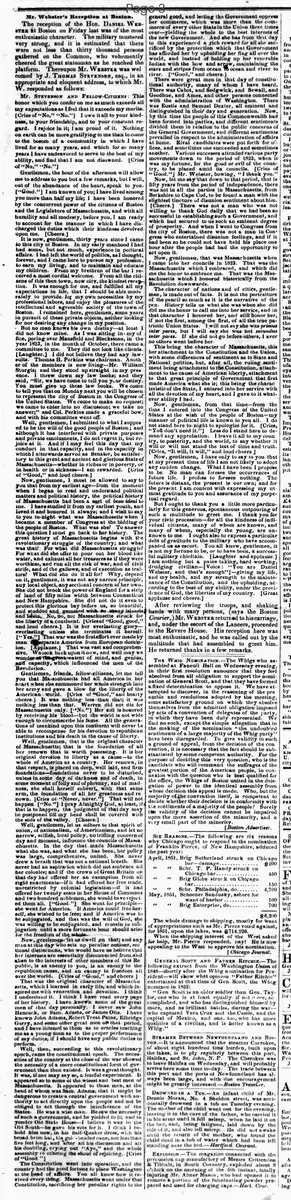
Mr. Webster's Reception at Boston.
The reception of the Hon. Daniel Webster at Boston on Friday last was of the most enthusiastic character. The military mustered very strong, and it is estimated that there were not less than thirty thousand persons gathered on the Common, who vehemently cheered the great statesman as he reached the platform. Thereupon Mr. Webster was welcomed by J. Thomas Stevenson, esq., in an appropriate and eloquent address, to which Mr. W. responded as follows:
Mr. Stevenson And Fellow-Citizens: This honor which you confer on me as much exceeds all my expectations as I feel that it exceeds my merits. [Cries of "No," "No."] I owe it all to your kindness, to your friendship, and to your constant regard. I rejoice in it; I am proud of it. Nothing on earth can be more gratifying to me than to come to the bosom of a community in which I have lived for so many years, and which for so many years I have endeavored to serve to the best of my ability, and find that I am not disowned. [Cries of "No," "No."]
Gentlemen, the hour of the afternoon will allow me to address to you but a few remarks, but I will out of the abundance of the heart, speak to you. ["Good."] I am known of you; I have lived among you more than half my life; I have been honored by the concurrent power of the citizens of Boston and the Legislature of Massachusetts, and with all humility and all modesty, before you, I am ready to account for the manner in which I have discharged the duties which their kindness devolved upon me. [Cheers.]
It is now, gentlemen, thirty years since I came to this city of Boston. In my early manhood I had had some, but not much, experience in political affairs. I had left the world of politics, as I thought, forever, and I came here to pursue my profession, to earn my living, and to maintain and educate my children. From my brethren of the bar I received a most cordial welcome. From all the citizens of this then town, now city, the kindest reception. It was enough for me, and fulfilled all my expectations in life, that I should be able moderately to provide for my own necessities by my professional labors, and enjoy the pleasures of the intellectual and agreeable society of the town of Boston. I remained here, gentlemen, some years in pursuit of these private objects, neither looking for nor desiring any change in my position.
But no man knows his own destiny—at least I did not know mine. As I was sitting in my office, poring over Mansfield and Blackstone, in the year 1823, in the month of October, there came a committee to me. They did not look like clients. [Laughter.] I did not believe they had any lawsuits. Thomas H. Perkins was chairman. Another of the members is now living—Mr. William Sturgis; and they stood up straight in my presence. I threw down my law books; and they said, "Sir, we have come to tell you your destiny. You must give up these law books. We come to tell you that on Monday next you will be chosen to represent the city of Boston in the Congress of the United States. We come to make no request; we come to enter into no discussion; we take no answer;" and Col. Perkins made a graceful bow, and with his committee went off.
Well, gentlemen, I submitted to what I supposed to be the will of the good people of Boston; and although it has interfered with private purposes and private emoluments, I do not regret it, but rejoice at it. And if I may feel this day that my conduct in that capacity, and in the capacity in which I afterwards served as Senator, be satisfactory to this great and ancient and glorious State of Massachusetts—whether in riches or in poverty, or in health or in sickness—I am rewarded. [Cries of "Good," and loud cheers.]
Now, gentlemen, I must be allowed to say to you that from my earliest age—from the moment when I began to read and understand political matters and political history, the political history of Massachusetts had been a sort of beau ideal to me. I have studied it from my earliest youth, and loved it and honored it always; and I wish to say to you to-night what was Massachusetts when I became a member of Congress at the bidding of the people of Boston. What was she? To answer this question I must go back to her history. The great history of Massachusetts begins with the revolutionary struggle of the country; and what was that? For what did Massachusetts struggle? For what did she offer to pour out her blood like water, and exhaust all her treasures as if they were worthless, and run all the risk of war, and of civil strife, and of the gallows, and of execution as traitors?
What did she do it all for? Why, depend on it, gentlemen, it was not any narrow principle, any local object, any sectional concern of her own. She did not brook the power of England for a strip of land of fifty miles width between Connecticut and New Hampshire. She did not do it even to protect this glorious bay before us, so beautiful, and studded and gemmed with so many islands and isles. No, no, no; Massachusetts struck for the liberty of a continent. [Cries of "Good, good," and loud cheers.] It is her everlasting glory—everlasting unless she terminates it herself. ["Yes."] That war was the first effort ever made by man to separate America from European domination. [Applause.] That was vast and comprehensive. We look back upon it now, and well may we wonder at the great extent of mind, and genius, and capacity, which influenced the men of the Revolution.
Gentlemen, friends, fellow-citizens, let me tell you that Massachusetts had all America in her heart when she summoned her whole strength into her army and gave a blow for the liberty of the American world. [Cries of "Good," and hearty cheers.] It was nothing less than that; it was nothing less than that. Warren did not die for Massachusetts only. ["No."] Her soil is honored by receiving his blood—but the world is not wide enough to circumscribe his fame. All the generations of mankind upon this continent will never be able to recompense for his devotion to republican institutions and his death in the cause of liberty.
Well, gentlemen, that is the original character of Massachusetts; that is the foundation of all her renown that is worth possessing. It is her original devotion to liberty as a cause—to the whole of America as a country. Her renown, in that respect, is placed on deep, well laid, and firm foundations—foundations never to be disturbed, unless in some day of darkness and of death, in some moment of folly and of phrenzy, and of madness, she shall herself subvert, with that same arm, the foundation of all her greatness and renown. [Cries of "Never, never."] That will not happen. ["No."] I pray Almighty God, at least, if that is to happen, the judgment of that day may be postponed till my head shall be covered with the sods of the valley. [Cheers.]
Well, gentlemen, let us adhere to that spirit of union, of nationalism, of Americanism, and let no narrow, selfish, local policy, no trifling concern of day and moment, influence the councils of Massachusetts. In the day that made Massachusetts what she was, and what she has been, her policy was large, comprehensive, united. She never drew a breath that was not a national breath. She never had an aspiration which did not embrace all her colonies; and if the crown of Great Britain on that day had offered her an exemption from all rigid enactments—if it had offered her free trade, unrestricted by colonial legislation—if it had offered her twenty seats in her House of Commons and two hundred noblemen, she would have rejected them all. ["Good."] She went for principle—she went for America. If America could free herself, she wished to be free; and if America was to be subjugated, and that was the will of God, she was willing to be subjugated, and remain in subjugation until a more fortunate hour should arise for the freedom of the whole.
Now, gentlemen, let us dwell on that; and any man at this day who sets up peculiar notions, sectional distinctions, who would have us believe that her interests are essentially disconnected from and alien to the interests of other members of this Republic, is an enemy to you, is an enemy to the republican cause, and an enemy to freedom all over the world. [Cries of "Good," and cheers.]
That was the original character of Massachusetts, which I learned in early life, and which inspired me with veneration and devotion. I think I understand it. I think I have read every page of her history. I have known some of the great men of that day personally. I never saw John Hancock, or Sam. Adams, or James Otis. I have known John Adams, Robert Treat Paine, Elbridge Gerry, and some other great men of that period, and I have listened to them as to oracles teaching me as a young man as to the proper performance of my duties, if I should have any public duties to perform.
Well, then, succeeding to this revolutionary epoch, came the constitutional epoch. The necessities of the country at the close of the war showed the necessity of a more constitutional form of government than then existed. It was a great thought. It was, if one may say so, a fearful experiment. It appeared so to some of the wisest and best men of Massachusetts. It appeared to those men, at the head of whom was Sam. Adams, that it might be dangerous to create a central government with authority to act directly upon the people and not be obliged to act through the interference of the States. He was a wise man. He saw the necessity of such a government, and he yielded to it; and in yonder Old State House—I believe it was in the Old South—he gave his vote for it. I think I behold him now, in his half-Quaker dress, with his broad-brim hat, his gold-headed cane, not less than five feet long, and after all his discussion and all his doubting, crying out "Aye," and the whole assembly re-echoing the shout of rejoicing. [Cries of "Good."]
The Constitution went into operation, and the country had the good fortune to place Washington at the head of affairs. You all know how it revived every thing. Massachusetts went under that Constitution, sacrificing her peculiar rights to the general good, and letting the Government oppress her commerce, which was more than the commerce of every other State in the Union three times over, yielding the whole to the best interests of the new Government. And she has from that day to this experienced a rich reward for all she sacrificed by the protection which that Government has afforded her by upholding her flag all over the world, and instead of holding up her venerable Indian with the bow and arrow, maintaining the stars and stripes from ocean to ocean and river to river. ["Good," and cheers.]
There were great men in that day of constitutional authority, many of whom I have heard. There was Cabot, and Sedgwick, and Sewall, and Goodhue, and Ames, and other persons connected with the administration of Washington. There was Eustis and Samuel Dexter, all eminent and distinguished in their day and generation. Now, by this time the people of this Commonwealth had been formed into parties, and different sentiments divided them in relation to the public concerns of the General Government, and different sentiments prevailed in respect to the administration of affairs at home. Rival candidates were put forth for offices, and sometimes one succeeded and sometimes another. Various successes attended various party movements down to the period of 1823, when it was my fortune, for the good or evil of the country, to be placed amid its councils. [Cries of "Good."] Mr. Webster, bowing, "I thank you."
Now, let me say that down to that period, that is fifty years from the period of independence, there was not in all the parties in Massachusetts, from Berkshire to Cape Cod, to be found a man with the slightest tincture of disunion sentiment about him. [Cheers.] There was not a man who was not willing to thank God daily that we had been so successful in establishing such a Government, and which had secured to us such an eminent degree of prosperity. And when I went to Congress from the city of Boston, there was not a man in Congress who entertained disunion feelings, and if it had been so he could not have held his place one hour after the people had had the opportunity to act upon it.
Now, gentlemen, that was Massachusetts when I came into her councils in 1823. That was the Massachusetts which I embraced, and which did me the honor to embrace me. That was the Massachusetts which I honored historically from the Revolution downwards.
The character of nations and of cities, gentlemen, is made out of facts. It is not the portraiture of the pencil so much as it is the narrative of the pen. History tells us what she was when she did me the honor to call me into her service, and in that character I honored her, and still honor her, if not the first, among the first, of all the true patriotic Union States. I will not say she was primus inter pares, but I will say she was not, secunda inter pares. If she did not go before others, I aver no others went before her.
This being the character of Massachusetts, this her attachment to the Constitution and the Union, with some differences of sentiment as to State and National politics, but, after all, the ruling sentiment being attachment to the Constitution, attachment to the cause of American liberty, attachment to that great principle of Government that first made America what she is; this being the characteristic of the State, I entered into her service with all the devotion of my heart, and I gave to it whatever ability I had.
Now, gentlemen, from that time—from the time I entered into the Congress of the United States at the wish of the people of Boston—my manner of political life is known to you all. I do not stand here to-night to apologise for it. [Cries, "You don't need it."] Less do I stand here to demand any approbation. I leave it all to my country, to posterity, and the world, to say whether it will or will not stand the test of time and truth. [Cries, "It will, it will," and loud cheers.]
Now, gentlemen, I have only to say to you that at my present time of life I am not likely to adopt any sudden change. What I have been I propose to be. No man can foresee the occurrences of future life. I profess to foresee nothing. The future is distant, the present is our own; and for the present I am content with expressing my utmost gratitude to you and assurance of my perpetual regard.
But I ought to thank you a little more particularly for this generous, spontaneous outpouring of such a multitude to greet me. I thank you for your civic procession—for all the kindness of individual citizens, many of whom are known, and many of whom, especially the young, are unknown to me. I ought also to express a particular debt of gratitude to the military who have accompanied us as escort. You all know, gentlemen, it is not my fortune to be, or to have been, a successful military chieftain. [Laughter and applause.] I am nothing but a painstaking, hard-working, drudging civilian—[Voice: "You are Daniel Webster, and that's enough!" ]—giving my life, and my health, and my strength to the maintenance of the Constitution, and the upholding, according to the best of my ability, under the providence of God, the liberties of my country. [Great applause and cheers.]
After reviewing the troops, and shaking hands with many persons, (says the Boston Courier,) Mr. Webster returned to his carriage, and, under the escort of the Lancers, proceeded to the Revere House. His reception here was most enthusiastic, and he was called out by the multitude that had assembled to greet him. He returned thanks in a few remarks.
The reception of the Hon. Daniel Webster at Boston on Friday last was of the most enthusiastic character. The military mustered very strong, and it is estimated that there were not less than thirty thousand persons gathered on the Common, who vehemently cheered the great statesman as he reached the platform. Thereupon Mr. Webster was welcomed by J. Thomas Stevenson, esq., in an appropriate and eloquent address, to which Mr. W. responded as follows:
Mr. Stevenson And Fellow-Citizens: This honor which you confer on me as much exceeds all my expectations as I feel that it exceeds my merits. [Cries of "No," "No."] I owe it all to your kindness, to your friendship, and to your constant regard. I rejoice in it; I am proud of it. Nothing on earth can be more gratifying to me than to come to the bosom of a community in which I have lived for so many years, and which for so many years I have endeavored to serve to the best of my ability, and find that I am not disowned. [Cries of "No," "No."]
Gentlemen, the hour of the afternoon will allow me to address to you but a few remarks, but I will out of the abundance of the heart, speak to you. ["Good."] I am known of you; I have lived among you more than half my life; I have been honored by the concurrent power of the citizens of Boston and the Legislature of Massachusetts, and with all humility and all modesty, before you, I am ready to account for the manner in which I have discharged the duties which their kindness devolved upon me. [Cheers.]
It is now, gentlemen, thirty years since I came to this city of Boston. In my early manhood I had had some, but not much, experience in political affairs. I had left the world of politics, as I thought, forever, and I came here to pursue my profession, to earn my living, and to maintain and educate my children. From my brethren of the bar I received a most cordial welcome. From all the citizens of this then town, now city, the kindest reception. It was enough for me, and fulfilled all my expectations in life, that I should be able moderately to provide for my own necessities by my professional labors, and enjoy the pleasures of the intellectual and agreeable society of the town of Boston. I remained here, gentlemen, some years in pursuit of these private objects, neither looking for nor desiring any change in my position.
But no man knows his own destiny—at least I did not know mine. As I was sitting in my office, poring over Mansfield and Blackstone, in the year 1823, in the month of October, there came a committee to me. They did not look like clients. [Laughter.] I did not believe they had any lawsuits. Thomas H. Perkins was chairman. Another of the members is now living—Mr. William Sturgis; and they stood up straight in my presence. I threw down my law books; and they said, "Sir, we have come to tell you your destiny. You must give up these law books. We come to tell you that on Monday next you will be chosen to represent the city of Boston in the Congress of the United States. We come to make no request; we come to enter into no discussion; we take no answer;" and Col. Perkins made a graceful bow, and with his committee went off.
Well, gentlemen, I submitted to what I supposed to be the will of the good people of Boston; and although it has interfered with private purposes and private emoluments, I do not regret it, but rejoice at it. And if I may feel this day that my conduct in that capacity, and in the capacity in which I afterwards served as Senator, be satisfactory to this great and ancient and glorious State of Massachusetts—whether in riches or in poverty, or in health or in sickness—I am rewarded. [Cries of "Good," and loud cheers.]
Now, gentlemen, I must be allowed to say to you that from my earliest age—from the moment when I began to read and understand political matters and political history, the political history of Massachusetts had been a sort of beau ideal to me. I have studied it from my earliest youth, and loved it and honored it always; and I wish to say to you to-night what was Massachusetts when I became a member of Congress at the bidding of the people of Boston. What was she? To answer this question I must go back to her history. The great history of Massachusetts begins with the revolutionary struggle of the country; and what was that? For what did Massachusetts struggle? For what did she offer to pour out her blood like water, and exhaust all her treasures as if they were worthless, and run all the risk of war, and of civil strife, and of the gallows, and of execution as traitors?
What did she do it all for? Why, depend on it, gentlemen, it was not any narrow principle, any local object, any sectional concern of her own. She did not brook the power of England for a strip of land of fifty miles width between Connecticut and New Hampshire. She did not do it even to protect this glorious bay before us, so beautiful, and studded and gemmed with so many islands and isles. No, no, no; Massachusetts struck for the liberty of a continent. [Cries of "Good, good," and loud cheers.] It is her everlasting glory—everlasting unless she terminates it herself. ["Yes."] That war was the first effort ever made by man to separate America from European domination. [Applause.] That was vast and comprehensive. We look back upon it now, and well may we wonder at the great extent of mind, and genius, and capacity, which influenced the men of the Revolution.
Gentlemen, friends, fellow-citizens, let me tell you that Massachusetts had all America in her heart when she summoned her whole strength into her army and gave a blow for the liberty of the American world. [Cries of "Good," and hearty cheers.] It was nothing less than that; it was nothing less than that. Warren did not die for Massachusetts only. ["No."] Her soil is honored by receiving his blood—but the world is not wide enough to circumscribe his fame. All the generations of mankind upon this continent will never be able to recompense for his devotion to republican institutions and his death in the cause of liberty.
Well, gentlemen, that is the original character of Massachusetts; that is the foundation of all her renown that is worth possessing. It is her original devotion to liberty as a cause—to the whole of America as a country. Her renown, in that respect, is placed on deep, well laid, and firm foundations—foundations never to be disturbed, unless in some day of darkness and of death, in some moment of folly and of phrenzy, and of madness, she shall herself subvert, with that same arm, the foundation of all her greatness and renown. [Cries of "Never, never."] That will not happen. ["No."] I pray Almighty God, at least, if that is to happen, the judgment of that day may be postponed till my head shall be covered with the sods of the valley. [Cheers.]
Well, gentlemen, let us adhere to that spirit of union, of nationalism, of Americanism, and let no narrow, selfish, local policy, no trifling concern of day and moment, influence the councils of Massachusetts. In the day that made Massachusetts what she was, and what she has been, her policy was large, comprehensive, united. She never drew a breath that was not a national breath. She never had an aspiration which did not embrace all her colonies; and if the crown of Great Britain on that day had offered her an exemption from all rigid enactments—if it had offered her free trade, unrestricted by colonial legislation—if it had offered her twenty seats in her House of Commons and two hundred noblemen, she would have rejected them all. ["Good."] She went for principle—she went for America. If America could free herself, she wished to be free; and if America was to be subjugated, and that was the will of God, she was willing to be subjugated, and remain in subjugation until a more fortunate hour should arise for the freedom of the whole.
Now, gentlemen, let us dwell on that; and any man at this day who sets up peculiar notions, sectional distinctions, who would have us believe that her interests are essentially disconnected from and alien to the interests of other members of this Republic, is an enemy to you, is an enemy to the republican cause, and an enemy to freedom all over the world. [Cries of "Good," and cheers.]
That was the original character of Massachusetts, which I learned in early life, and which inspired me with veneration and devotion. I think I understand it. I think I have read every page of her history. I have known some of the great men of that day personally. I never saw John Hancock, or Sam. Adams, or James Otis. I have known John Adams, Robert Treat Paine, Elbridge Gerry, and some other great men of that period, and I have listened to them as to oracles teaching me as a young man as to the proper performance of my duties, if I should have any public duties to perform.
Well, then, succeeding to this revolutionary epoch, came the constitutional epoch. The necessities of the country at the close of the war showed the necessity of a more constitutional form of government than then existed. It was a great thought. It was, if one may say so, a fearful experiment. It appeared so to some of the wisest and best men of Massachusetts. It appeared to those men, at the head of whom was Sam. Adams, that it might be dangerous to create a central government with authority to act directly upon the people and not be obliged to act through the interference of the States. He was a wise man. He saw the necessity of such a government, and he yielded to it; and in yonder Old State House—I believe it was in the Old South—he gave his vote for it. I think I behold him now, in his half-Quaker dress, with his broad-brim hat, his gold-headed cane, not less than five feet long, and after all his discussion and all his doubting, crying out "Aye," and the whole assembly re-echoing the shout of rejoicing. [Cries of "Good."]
The Constitution went into operation, and the country had the good fortune to place Washington at the head of affairs. You all know how it revived every thing. Massachusetts went under that Constitution, sacrificing her peculiar rights to the general good, and letting the Government oppress her commerce, which was more than the commerce of every other State in the Union three times over, yielding the whole to the best interests of the new Government. And she has from that day to this experienced a rich reward for all she sacrificed by the protection which that Government has afforded her by upholding her flag all over the world, and instead of holding up her venerable Indian with the bow and arrow, maintaining the stars and stripes from ocean to ocean and river to river. ["Good," and cheers.]
There were great men in that day of constitutional authority, many of whom I have heard. There was Cabot, and Sedgwick, and Sewall, and Goodhue, and Ames, and other persons connected with the administration of Washington. There was Eustis and Samuel Dexter, all eminent and distinguished in their day and generation. Now, by this time the people of this Commonwealth had been formed into parties, and different sentiments divided them in relation to the public concerns of the General Government, and different sentiments prevailed in respect to the administration of affairs at home. Rival candidates were put forth for offices, and sometimes one succeeded and sometimes another. Various successes attended various party movements down to the period of 1823, when it was my fortune, for the good or evil of the country, to be placed amid its councils. [Cries of "Good."] Mr. Webster, bowing, "I thank you."
Now, let me say that down to that period, that is fifty years from the period of independence, there was not in all the parties in Massachusetts, from Berkshire to Cape Cod, to be found a man with the slightest tincture of disunion sentiment about him. [Cheers.] There was not a man who was not willing to thank God daily that we had been so successful in establishing such a Government, and which had secured to us such an eminent degree of prosperity. And when I went to Congress from the city of Boston, there was not a man in Congress who entertained disunion feelings, and if it had been so he could not have held his place one hour after the people had had the opportunity to act upon it.
Now, gentlemen, that was Massachusetts when I came into her councils in 1823. That was the Massachusetts which I embraced, and which did me the honor to embrace me. That was the Massachusetts which I honored historically from the Revolution downwards.
The character of nations and of cities, gentlemen, is made out of facts. It is not the portraiture of the pencil so much as it is the narrative of the pen. History tells us what she was when she did me the honor to call me into her service, and in that character I honored her, and still honor her, if not the first, among the first, of all the true patriotic Union States. I will not say she was primus inter pares, but I will say she was not, secunda inter pares. If she did not go before others, I aver no others went before her.
This being the character of Massachusetts, this her attachment to the Constitution and the Union, with some differences of sentiment as to State and National politics, but, after all, the ruling sentiment being attachment to the Constitution, attachment to the cause of American liberty, attachment to that great principle of Government that first made America what she is; this being the characteristic of the State, I entered into her service with all the devotion of my heart, and I gave to it whatever ability I had.
Now, gentlemen, from that time—from the time I entered into the Congress of the United States at the wish of the people of Boston—my manner of political life is known to you all. I do not stand here to-night to apologise for it. [Cries, "You don't need it."] Less do I stand here to demand any approbation. I leave it all to my country, to posterity, and the world, to say whether it will or will not stand the test of time and truth. [Cries, "It will, it will," and loud cheers.]
Now, gentlemen, I have only to say to you that at my present time of life I am not likely to adopt any sudden change. What I have been I propose to be. No man can foresee the occurrences of future life. I profess to foresee nothing. The future is distant, the present is our own; and for the present I am content with expressing my utmost gratitude to you and assurance of my perpetual regard.
But I ought to thank you a little more particularly for this generous, spontaneous outpouring of such a multitude to greet me. I thank you for your civic procession—for all the kindness of individual citizens, many of whom are known, and many of whom, especially the young, are unknown to me. I ought also to express a particular debt of gratitude to the military who have accompanied us as escort. You all know, gentlemen, it is not my fortune to be, or to have been, a successful military chieftain. [Laughter and applause.] I am nothing but a painstaking, hard-working, drudging civilian—[Voice: "You are Daniel Webster, and that's enough!" ]—giving my life, and my health, and my strength to the maintenance of the Constitution, and the upholding, according to the best of my ability, under the providence of God, the liberties of my country. [Great applause and cheers.]
After reviewing the troops, and shaking hands with many persons, (says the Boston Courier,) Mr. Webster returned to his carriage, and, under the escort of the Lancers, proceeded to the Revere House. His reception here was most enthusiastic, and he was called out by the multitude that had assembled to greet him. He returned thanks in a few remarks.
What sub-type of article is it?
Biography
Historical Event
Personal Triumph
What themes does it cover?
Moral Virtue
Providence Divine
Triumph
What keywords are associated?
Daniel Webster
Boston Reception
Political Speech
Massachusetts History
American Union
What entities or persons were involved?
Daniel Webster
J. Thomas Stevenson
Thomas H. Perkins
William Sturgis
Where did it happen?
Boston
Story Details
Key Persons
Daniel Webster
J. Thomas Stevenson
Thomas H. Perkins
William Sturgis
Location
Boston
Event Date
Friday Last
Story Details
Daniel Webster is enthusiastically received in Boston, delivers a speech reflecting on his life, entry into politics in 1823, devotion to Massachusetts and the Union, and the state's historical commitment to American liberty from the Revolution onward.