Thank you for visiting SNEWPapers!
Sign up free
Atlanta Daily World
Atlanta, Fulton County, Georgia
What is this article about?
Following President Eisenhower's heart attack on September 24, 1955, uncertainty surrounds his 1956 reelection bid, sparking intense competition for Republican and Democratic presidential nominations. Potential candidates include Nixon, Warren, Dewey for Republicans, and Stevenson, Kefauver for Democrats, with appeals to colored voters highlighted.
Clipping
OCR Quality
Full Text
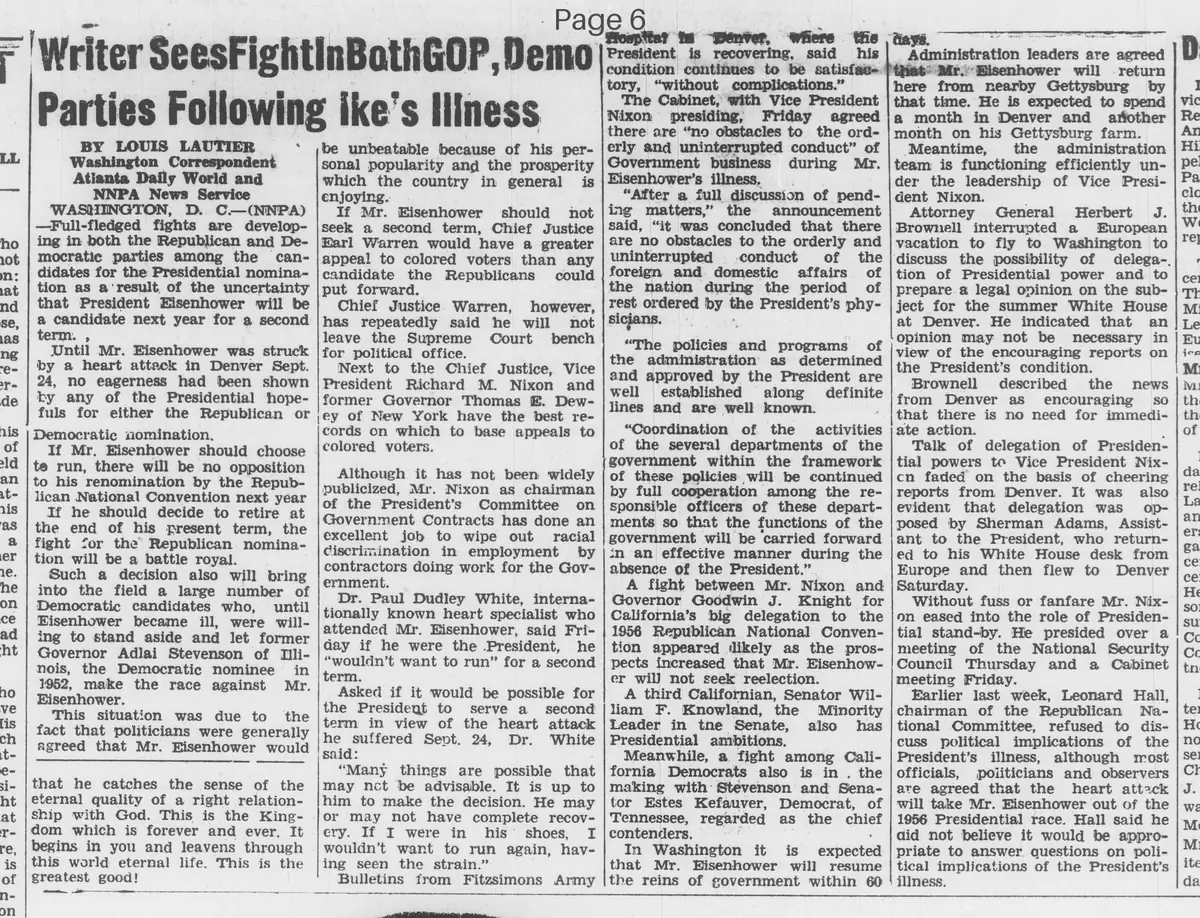
BY LOUIS LAUTER
Washington Correspondent
Atlanta Daily World and NNPA News Service
WASHINGTON, D. C.-(NNPA) -Full-fledged fights are developing in both the Republican and Democratic parties among the candidates for the Presidential nomination as a result of the uncertainty that President Eisenhower will be a candidate next year for a second term.
Until Mr. Eisenhower was struck by a heart attack in Denver Sept. 24, no eagerness had been shown by any of the Presidential hopefuls for either the Republican or Democratic nomination.
If Mr. Eisenhower should choose to run, there will be no opposition to his renomination by the Republican National Convention next year. If he should decide to retire at the end of his present term, the fight for the Republican nomination will be a battle royal.
Such a decision also will bring into the field a large number of Democratic candidates who, until Eisenhower became ill, were willing to stand aside and let former Governor Adlai Stevenson of Illinois, the Democratic nominee in 1952, make the race against Mr. Eisenhower.
This situation was due to the fact that politicians were generally agreed that Mr. Eisenhower would be unbeatable because of his personal popularity and the prosperity which the country in general is enjoying.
If Mr. Eisenhower should not seek a second term, Chief Justice Earl Warren would have a greater appeal to colored voters than any candidate the Republicans could put forward.
Chief Justice Warren, however, has repeatedly said he will not leave the Supreme Court bench for political office.
Next to the Chief Justice, Vice President Richard M. Nixon and former Governor Thomas E. Dewey of New York have the best records on which to base appeals to colored voters.
Although it has not been widely publicized, Mr. Nixon as chairman of the President's Committee on Government Contracts has done an excellent job to wipe out racial discrimination in employment by contractors doing work for the Government.
Dr. Paul Dudley White, internationally known heart specialist who attended Mr. Eisenhower, said Friday if he were the President, he "wouldn't want to run" for a second term.
Asked if it would be possible for the President to serve a second term in view of the heart attack he suffered Sept. 24, Dr. White said:
"Many things are possible that may not be advisable. It is up to him to make the decision. He may or may not have complete recovery. If I were in his shoes, I wouldn't want to run again, having seen the strain."
Bulletins from Fitzsimons Army Hospital in Denver, where the President is recovering, said his condition continues to be satisfactory, "without complications."
The Cabinet, with Vice President Nixon presiding, Friday agreed there are "no obstacles to the orderly and uninterrupted conduct" of Government business during Mr. Eisenhower's illness.
"After a full discussion of pending matters," the announcement said, "it was concluded that there are no obstacles to the orderly and uninterrupted conduct of the foreign and domestic affairs of the nation during the period of rest ordered by the President's physicians."
"The policies and programs of the administration as determined and approved by the President are well established along definite lines and are well known.
"Coordination of the activities of the several departments of the government within the framework of these policies will be continued by full cooperation among the responsible officers of these departments so that the functions of the government will be carried forward in an effective manner during the absence of the President."
A fight between Mr. Nixon and Governor Goodwin J. Knight for California's big delegation to the 1956 Republican National Convention appeared likely as the prospects increased that Mr. Eisenhower will not seek reelection.
A third Californian, Senator William F. Knowland, the Minority Leader in the Senate, also has Presidential ambitions.
Meanwhile, a fight among California Democrats also is in the making with Stevenson and Senator Estes Kefauver, Democrat, of Tennessee, regarded as the chief contenders.
In Washington it is expected that Mr. Eisenhower will resume the reins of government within 60 days.
Administration leaders are agreed that Mr. Eisenhower will return here from nearby Gettysburg by that time. He is expected to spend a month in Denver and another month on his Gettysburg farm.
Meantime, the administration team is functioning efficiently under the leadership of Vice President Nixon.
Attorney General Herbert J. Brownell interrupted a European vacation to fly to Washington to discuss the possibility of delegation of Presidential power and to prepare a legal opinion on the subject for the summer White House at Denver. He indicated that an opinion may not be necessary in view of the encouraging reports on the President's condition.
Brownell described the news from Denver as encouraging so that there is no need for immediate action.
Talk of delegation of Presidential powers to Vice President Nixon faded on the basis of cheering reports from Denver. It was also evident that delegation was opposed by Sherman Adams, Assistant to the President, who returned to his White House desk from Europe and then flew to Denver Saturday.
Without fuss or fanfare Mr. Nixon eased into the role of Presidential stand-by. He presided over a meeting of the National Security Council Thursday and a Cabinet meeting Friday.
Earlier last week, Leonard Hall, chairman of the Republican National Committee, refused to discuss political implications of the President's illness, although most officials, politicians and observers are agreed that the heart attack will take Mr. Eisenhower out of the 1956 Presidential race. Hall said he did not believe it would be appropriate to answer questions on political implications of the President's illness.
What sub-type of article is it?
What keywords are associated?
What entities or persons were involved?
Where did it happen?
Domestic News Details
Primary Location
Washington, D. C.
Event Date
Sept. 24
Key Persons
Outcome
president eisenhower recovering satisfactorily from heart attack; government business continues uninterrupted under vice president nixon; increased competition for 1956 presidential nominations in both parties.
Event Details
Uncertainty over President Eisenhower's reelection due to his September 24 heart attack leads to emerging fights for Republican and Democratic nominations. Republicans consider Nixon, Warren, Dewey; Democrats consider Stevenson, Kefauver. Nixon handles administration duties effectively.