Thank you for visiting SNEWPapers!
Sign up free
New York Dispatch
New York, New York County, New York
What is this article about?
In a police hearing, storekeeper Philip Lowenthal is charged with malicious mischief for breaking a neighbor's window in retaliation. He complains against Patrolman Cohen for warrantless arrest and Sergeant Christel for refusing bail, humorously reading from his diary during testimony.
Clipping
OCR Quality
Full Text
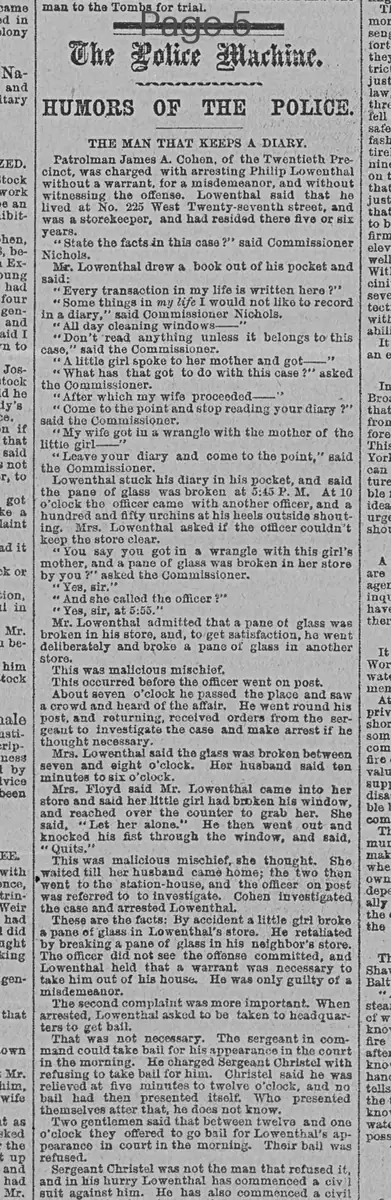
HUMORS OF THE POLICE.
THE MAN THAT KEEPS A DIARY
Patrolman James A. Cohen, of the Twentieth Precinct, was charged with arresting Philip Lowenthal without a warrant, for a misdemeanor, and without witnessing the offense. Lowenthal said that he lived at No. 225 West Twenty-seventh street, and was a storekeeper, and had resided there five or six years.
"State the facts in this case?" said Commissioner Nichols.
Mr. Lowenthal drew a book out of his pocket and said:
"Every transaction in my life is written here?"
"Some things in my life I would not like to record in a diary," said Commissioner Nichols.
"All day cleaning windows
"Don't read anything unless it belongs to this case," said the Commissioner.
"A little girl spoke to her mother and got"
What has that got to do with this case?" asked the Commissioner.
"After which my wife proceeded
"Come to the point and stop reading your diary?" said the Commissioner.
"My wife got in a wrangle with the mother of the little girl
"Leave your diary and come to the point." said the Commissioner.
Lowenthal stuck his diary in his pocket, and said the pane of glass was broken at 5:45 P. M. At 10 o'clock the officer came with another officer, and a hundred and fifty urchins at his heels outside shouting. Mrs. Lowenthal asked if the officer couldn't keep the store clear.
"You say you got in a wrangle with this girl's mother, and a pane of glass was broken in her store by you?" asked the Commissioner.
"Yes, sir."
"And she called the officer?"
"Yes, sir, at 5:55.'"
Mr. Lowenthal admitted that a pane of glass was broken in his store, and, to get satisfaction, he went deliberately and broke a pane of glass in another store.
This was malicious mischief.
This occurred before the officer went on post. About seven o'clock he passed the place and saw a crowd and heard of the affair. He went round his post, and returning, received orders from the sergeant to investigate the case and make arrest if he thought necessary.
Mrs. Lowenthal said the glass was broken between seven and eight o'clock.
Her husband said ten minutes to six o'clock.
Mrs. Floyd said Mr. Lowenthal came into her store and said her little girl had broken his window, and reached over the counter to grab her. She said, "Let her alone." He then went out and knocked his fist through the window, and said "Quits."
This was malicious mischief, she thought. She waited till her husband came home; the two then went to the station-house, and the officer on post was referred to to investigate. Cohen investigated the case and arrested Lowenthal.
These are the facts: By accident a little girl broke a pane of glass in Lowenthal's store. He retaliated by breaking a pane of glass in his neighbor's store. The officer did not see the offense committed, and Lowenthal held that a warrant was necessary to take him out of his house. He was only guilty of a misdemeanor.
The second complaint was more important. When arrested, Lowenthal asked to be taken to headquarters to get bail.
That was not necessary.
The sergeant in command could take bail for his appearance in the court in the morning. He charged Sergeant Christel with refusing to take bail for him. Christel said he was relieved at five minutes to twelve o'clock, and no bail had then presented itself. Who presented themselves after that, he does not know.
Two gentlemen said that between twelve and one o'clock they offered to go bail for Lowenthal's appearance in court in the morning.
Their bail was refused.
Sergeant Christel was not the man that refused it and in his hurry Lowenthal has commenced a civil suit against him. He has also commenced a civil suit against Cohen for arresting him without a warrant, after having acknowledged that he was guilty of a misdemeanor, but which was not committed in the officer's presence. The fact that Lowenthal admitted his guilt is equal to the officer having seen the offense committed.
The charge against the sergeant in command refusing to accept bail is the more important of the two.
We would suggest that a general order be issued that when a man is locked up, and a friend comes to offer bail, the prisoner be brought up, as in a police court, and if bail is refused, he be a witness to the proceedings. That is his right.
What sub-type of article is it?
What themes does it cover?
What keywords are associated?
What entities or persons were involved?
Where did it happen?
Story Details
Key Persons
Location
Twentieth Precinct, No. 225 West Twenty Seventh Street
Story Details
Patrolman Cohen arrested storekeeper Philip Lowenthal without a warrant for malicious mischief after Lowenthal retaliated by breaking a neighbor's window following his own being broken by a child. Lowenthal complained of the arrest and refusal of bail by Sergeant Christel, reading irrelevant diary entries during the hearing.