Thank you for visiting SNEWPapers!
Sign up free
Alexandria Gazette & Daily Advertiser
Alexandria, Virginia
What is this article about?
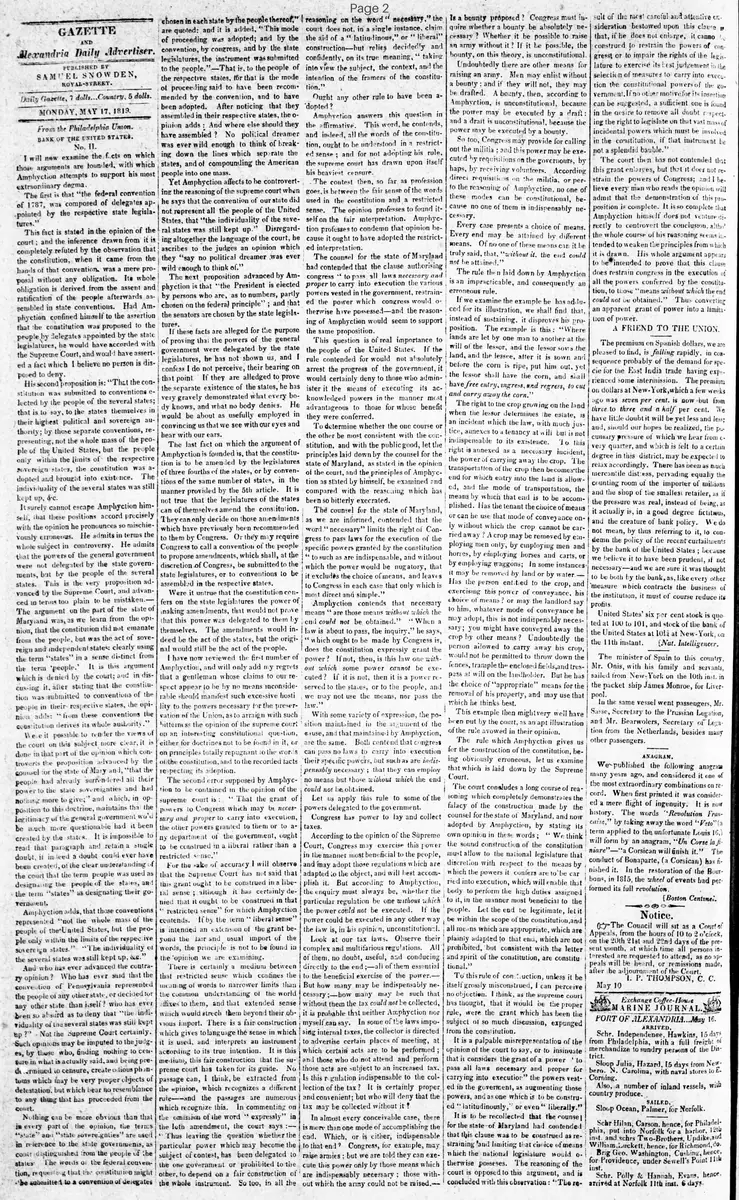
This editorial, part II from Philadelphia Union, defends the Supreme Court's opinion upholding the Bank of the United States against critic Amphyction. It argues the Constitution derives from the people via state conventions, not state governments, and advocates fair construction of the 'necessary and proper' clause to allow Congress discretion in means, rejecting strict limits that would hinder federal powers.
Clipping
OCR Quality
Full Text
BANK OF THE UNITED STATES.
No. II.
I will now examine the facts on which those arguments are founded, with which Amphyction attempts to support his most extraordinary dogma.
The first is that "the federal convention of 1787, was composed of delegates appointed by the respective state legislatures."
This fact is stated in the opinion of the court; and the inference drawn from it is completely refuted by the observation that the constitution, when it came from the hands of that convention, was a mere proposal without any obligation. Its whole obligation is derived from the assent and ratification of the people afterwards assembled in state conventions. Had Amphyction confined himself to the assertion that the constitution was proposed to the people by delegates appointed by the state legislatures, he would have accorded with the Supreme Court, and would have asserted a fact which I believe no person is disposed to deny.
His second proposition is: "That the constitution was submitted to conventions elected by the people of the several states; that is to say, to the states themselves in their highest political and sovereign authority; by those separate conventions, representing, not the whole mass of the people of the United States, but the people only within the limits of the respective sovereign states, the constitution was adopted and brought into existence. The individuality of the several states was still kept up, &c."
It surely cannot escape Amphyction himself, that these positions accord precisely with the opinion he pronounces so mischievously erroneous. He admits in terms the whole subject in controversy. He admits that the powers of the general government were not delegated by the state governments, but by the people of the several states. This is the very proposition advanced by the Supreme Court, and advanced in terms too plain to be mistaken.
The argument on the part of the state of Maryland was, as we learn from the opinion, that the constitution did not emanate from the people, but was the act of sovereign and independent states: clearly using the term "states" in a sense distinct from the term "people." It is this argument which is denied by the court: and in discussing it, after stating that the constitution was submitted to conventions of the people in their respective states, the opinion adds: "from these conventions the constitution derives its whole authority."
Were it possible to render the views of the court on this subject more clear, it is done in that part of the opinion which controverts the proposition advanced by the counsel for the state of Maryland, "that the people had already surrendered all their power to the state sovereignties and had nothing more to give;" and which, in opposition to this doctrine, maintains that the legitimacy of the general government would be much more questionable had it been created by the states. It is impossible to read that paragraph and retain a single doubt, if indeed a doubt could ever have been created, of the clear understanding of the court that the term "people" was used as designating the people of the states, and the term "states" as designating their government.
Amphyction adds, that those conventions represented "not the whole mass of the people of the United States, but the people only within the limits of the respective sovereign states." "The individuality of the several states was still kept up, &c."
And who has ever advanced the contrary opinion? Who has ever said that the convention of Pennsylvania represented the people of any other state, or decided for any other state than itself? Who has ever been so absurd as to deny that "the individuality of the several states was still kept up?" Not the Supreme Court certainly.
Such opinions may be imputed to the judges, by those who, finding nothing to censure in what is actually said, and being predetermined to censure, create octious phantoms which may be very proper objects of detestation, but which bear no resemblance to any thing that has proceeded from the court.
Nothing can be more obvious than that in every part of the opinion, the terms "state" and "state sovereignties" are used in reference to the state governments, as contrasted from the people of the states. The words of the federal convention, requesting that the constitution might be submitted to a convention of delegates chosen in each state by the people thereof."
are quoted: and it is added, "This mode of proceeding was adopted; and by the convention, by congress, and by the state legislatures, the instrument was submitted to the people."—That is, to the people of the respective states, for that is the mode of proceeding said to have been recommended by the convention, and to have been adopted. After noticing that they assembled in their respective states, the opinion adds: And where else should they have assembled? No political dreamer was ever wild enough to think of breaking down the lines which separate the states, and of compounding the American people into one mass.
Yet Amphyction affects to be controverting the reasoning of the supreme court when he says that the convention of our state did not represent all the people of the United States, that "the individuality of the several states was still kept up." Disregarding altogether the language of the court, he ascribes to the judges an opinion which they say no political dreamer was ever wild enough to think of.
The next proposition advanced by Amphyction is that the President is elected by persons who are, as to numbers, partly chosen on the federal principle; and that the senators are chosen by the state legislatures.
If these facts are alleged for the purpose of proving that the powers of the general government were delegated by the state legislatures, he has not shown us, and I confess I do not perceive, their bearing on that point. If they are alleged to prove the separate existence of the states, he has very gravely demonstrated what every body knows, and what no body denies. He would be about as usefully employed in convincing us that we see with our eyes and hear with our ears.
The last fact on which the argument of Amphyction is founded is, that the constitution is to be amended by the legislatures of three fourths of the states, or by conventions of the same number of states, in the manner provided by the 5th article. It is not true that the legislatures of the states can of themselves amend the constitution. They can only decide on those amendments which have previously been recommended to them by Congress. Or they may require Congress to call a convention of the people to propose amendments, which shall, at the discretion of Congress, be submitted to the state legislatures, or to conventions to be assembled in the respective states.
Were it untrue that the constitution confers on the state legislatures the power of making amendments, that would not prove that this power was delegated to them by the people. The amendments would indeed be the act of the states, but the original would still be the act of the people.
I have now reviewed the first number of Amphyction, and will only add my regrets that a gentleman whose claims to our respect appear to be by no means inconsiderable should manifest such excessive hostility to the powers necessary for the preservation of the Union, as to arraign with such bitterness the opinion of the supreme court on an interesting constitutional question, either for doctrines not to be found in it, or on principles totally repugnant to the words of the constitution, and to the recorded facts respecting its adoption.
The second error supposed by Amphyction to be contained in the opinion of the supreme court is: "That the grant of powers to Congress which may be necessary and proper to carry into execution, the other powers granted to them or to any department of the government, ought to be construed in a liberal rather than a restricted sense."
For the sake of accuracy I will observe that the Supreme Court has not said that this grant ought to be construed in a liberal sense; although it has certainly denied that it ought to be construed in that "restricted sense" for which Amphyction contends. If by the term "liberal sense" is intended an extension of the grant beyond the fair and usual import of the words, the principle is not to be found in the opinion we are examining.
There is certainly a medium between that restricted sense which confines the meaning of words to narrower limits than the common understanding of the world affixes to them, and that extended sense which would stretch them beyond their obvious import. There is a fair construction which gives to language the sense in which it is used, and interprets an instrument according to its true intention. It is this medium, this fair construction that the supreme court has taken for its guide. No passage can, I think, be extracted from the opinion, which recognizes a different rule—and the passages are numerous which recognize this. In commenting on the omission of the word "expressly" in the 10th amendment, the court says:—
"Thus leaving the question whether the particular power which may become the subject of contest, has been delegated to the one government or prohibited to the other, to depend on a fair construction of the whole instrument. So too, in all the reasoning on the word "necessary," the court does not, in a single instance, claim the aid of a "latitudinous," or "liberal" construction—but relies decidedly and confidently, on its true meaning. "taking into view the subject, the context, and the intention of the framers of the constitution."
Ought any other rule to have been adopted?
Amphyction answers this question in the affirmative. This word, he contends, and indeed, all the words of the constitution, ought to be understood in a restricted sense; and for not adopting his rule, the supreme court has drawn upon itself his heaviest censure.
The contest then, so far as profession goes, is between the fair sense of the words used in the constitution and a restricted sense. The opinion professes to found itself on the fair interpretation. Amphyction professes to condemn that opinion because it ought to have adopted the restricted interpretation:
The counsel for the state of Maryland had contended that the clause authorising congress "to pass all laws necessary and proper to carry into execution the various powers vested in the government, restrained the power which congress would otherwise have possessed—and the reasoning of Amphyction would seem to support the same proposition.
This question is of real importance to the people of the United States. If the rule contended for would not absolutely arrest the progress of the government, it would certainly deny to those who administer it the means of executing its acknowledged powers in the manner most advantageous to those for whose benefit they were conferred.
To determine whether the one course or the other be most consistent with the constitution, and with the public good, let the principles laid down by the counsel for the state of Maryland, as stated in the opinion of the court, and the principles of Amphyction as stated by himself, be examined and compared with the reasoning which has been so bitterly execrated.
The counsel for the state of Maryland as we are informed, contended that the word "necessary" limits the right of Congress to pass laws for the execution of the specific powers granted by the constitution to such as are indispensible, and without which the power would be nugatory, that it excludes the choice of means, and leaves to Congress in each case that only which is most direct and simple.
Amphyction contends that necessary means "are those means without which the end could not be obtained." "When a law is about to pass, the inquiry," he says, "which ought to be made by Congress is, does the constitution expressly grant the power? If not, then, is this law one without which some power cannot be executed? If it is not, then it is a power reserved to the states, or to the people, and we may not use the means, nor pass the law."
With some variety of expression, the position maintained in the argument of the cause, and that maintained by Amphyction, are the same. Both contend that congress can pass no laws to carry into execution their specific powers, but such as are indispensably necessary; that they can employ no means but those without which the end could not be obtained.
Let us apply this rule to some of the powers delegated to the government.
Congress has power to lay and collect taxes.
According to the opinion of the Supreme Court, Congress may exercise this power in the manner most beneficial to the people, and may adopt those regulations which are adapted to the object, and will best accomplish it. But according to Amphyction, the enquiry must always be, whether the particular regulation be one without which the power could not be executed. If the power could be executed in any other way the law is, in his opinion, unconstitutional.
Look at our tax laws. Observe their complex and multifarious regulations. All of them, no doubt, useful, and conducing directly to the end;—all of them essential to the beneficial exercise of the power.—But how many may be indispensably necessary; how many may be such that without them the tax could not be collected. It is probable that neither Amphyction nor myself can say. In some of the laws imposing internal taxes, the collector is directed to advertise certain places of meeting, at which certain acts are to be performed; and those who do not attend and perform those acts are subject to an increased tax.
Is this regulation indispensable to the collection of the tax? It is certainly proper and convenient; but who will deny that the tax may be collected without it!
In almost every conceivable case, there is more than one mode of accomplishing the end. Which, or is either, indispensable to that end? Congress, for example, may raise armies: but we are told they can execute this power only by those means which are indispensably necessary; those without which the army could not be raised.—
Is a bounty proposed? Congress must inquire whether a bounty be absolutely necessary? Whether it be possible to raise an army without it? If it be possible, the bounty, on this theory, is unconstitutional.
Undoubtedly there are other means for raising an army. Men may enlist without a bounty; and if they will not, they may be drafted. A bounty, then, according to Amphyction, is unconstitutional, because the power may be executed by a draft: and a draft is unconstitutional, because the power may be executed by a bounty.
So too, Congress may provide for calling out the militia: and this power may be executed by requisitions on the governours, by direct requisitions on the militia, or perhaps, by receiving volunteers. According to the reasoning of Amphyction, no one of these modes can be constitutional, because no one of them is indispensably necessary.
Every case presents a choice of means. Every end may be attained by different means. Of no one of these means can it be truly said, that. "without it, the end could not be attained."
The rule then laid down by Amphyction is an impracticable, and consequently an erroneous rule.
If we examine the example he has adduced for its illustration, we shall find that, instead of sustaining, it disproves his proposition. The example is this: Where lands are let by one man to another at the will of the lessor, and the lessor sows the land, and the lessee, after it is sown and before the corn is ripe, put him out, yet the lessor shall have the corn, and shall have free entry, ingress, and regress, to cut and carry away the corn.
The right to the crop growing on the land when the lessor determines the estate, is an incident which the law, with much justice, annexes to a tenancy at will but is not indispensable to its existence. To this right is annexed as a necessary incident, the power of carrying away the crop. The transportation of the crop then becomes the end for which entry into the land is allowed, and the mode of transportation, the means by which that end is to be accomplished. Has the tenant the choice of means or can he use that mode of conveyance only without which the crop cannot be carried away? A crop may be removed by employing men only, by employing men and horses, by employing horses and carts, or by employing waggons; In some instances it may be removed by land or by water.—Has the person entitled to the crop, and exercising this power of conveyance, his choice of means? or may the landlord say to him, whatever mode of conveyance he may adopt, this is not indispensably necessary; you might have conveyed away the crop by other means? Undoubtedly the person allowed to carry away his crop, would not be permitted to throw down the fences, trample the enclosed fields, and trespass at will on the landholder. But he has the choice of "appropriate" means for the removal of his property, and may use that which he thinks best.
This example then might very well have been put by the court, as an apt illustration of the rule avowed in their opinion.
The rule which Amphyction gives us for the construction of the constitution, being obviously erroneous, let us examine that which is laid down by the Supreme Court,
The court concludes a long course of reasoning which completely demonstrates the fallacy of the construction made by the counsel for the state of Maryland, and now adopted by Amphyction, by stating its own opinion in these words: "We think the sound construction of the constitution must allow to the national legislature that discretion with respect to the means by which the powers it confers are to be carried into execution, which will enable that body to perform the high duties assigned to it, in the manner most beneficial to the people. Let the end be legitimate, let it be within the scope of the constitution, and all means which are appropriate, which are plainly adapted to that end, which are not prohibited, but consistent with the letter and spirit of the constitution, are constitutional."
To this rule of construction, unless it be itself grossly misconstrued, I can perceive no objection. I think, as the supreme court has thought, that it would be the proper rule, were the grant which has been the subject of so much discussion, expunged from the constitution.
It is a palpable misrepresentation of the opinion of the court to say, or to insinuate that it considers the grant of a power to pass all laws necessary and proper for carrying into execution the powers vested in the government, as augmenting those powers, and as one which is to be construed "latitudinously," or even "liberally."
It is to be recollected that the counsel for the state of Maryland had contended that this clause was to be construed as restraining and limiting that choice of means which the national legislature would otherwise possess. The reasoning of the court is opposed to this argument, and is concluded with this observation: The result of the most careful and attentive consideration bestowed upon this clause that, if it does not enlarge, it cannot be construed to restrain the powers of congress, or to impair the rights of the legislature to exercise its best judgment in the selection of measures to carry into execution the constitutional powers of the government. If no other motive for its insertion can be suggested, a sufficient one is found in the desire to remove all doubt respecting the right to legislate on that vast mass of incidental powers which must be involved in the constitution, if that instrument be not a splendid bauble.
The court then has not contended that this grant enlarges, but that it does not restrain the powers of Congress; and I believe every man who reads the opinion will admit that the demonstration of this proposition is complete. It is so complete that Amphyction himself does not venture directly to controvert the conclusion, although the whole course of his reasoning seems intended to weaken the principles from which it is drawn. His whole argument appears to be intended to prove that this clause does restrain congress in the execution of all the powers conferred by the constitution, to those "means without which the end could not be obtained." Thus converting an apparent grant of power into a limitation of power.
What sub-type of article is it?
What keywords are associated?
What entities or persons were involved?
Editorial Details
Primary Topic
Defense Of Supreme Court Opinion On Constitutional Origins And Necessary And Proper Clause For Bank Of The United States
Stance / Tone
Strongly Supportive Of Federal Authority And Fair Constitutional Construction Against Strict State Rights Interpretation
Key Figures
Key Arguments