Thank you for visiting SNEWPapers!
Sign up free
Story
August 24, 1950
St. Ignatius Post
Saint Ignatius, Lake County, Montana
What is this article about?
An educational article from 'Good Citizen' booklet explaining the importance of paying taxes as a civic duty, detailing how taxes fund public services, types of taxes, and mechanisms for appeals, emphasizing representation in taxation.
Clipping
OCR Quality
98%
Excellent
Full Text
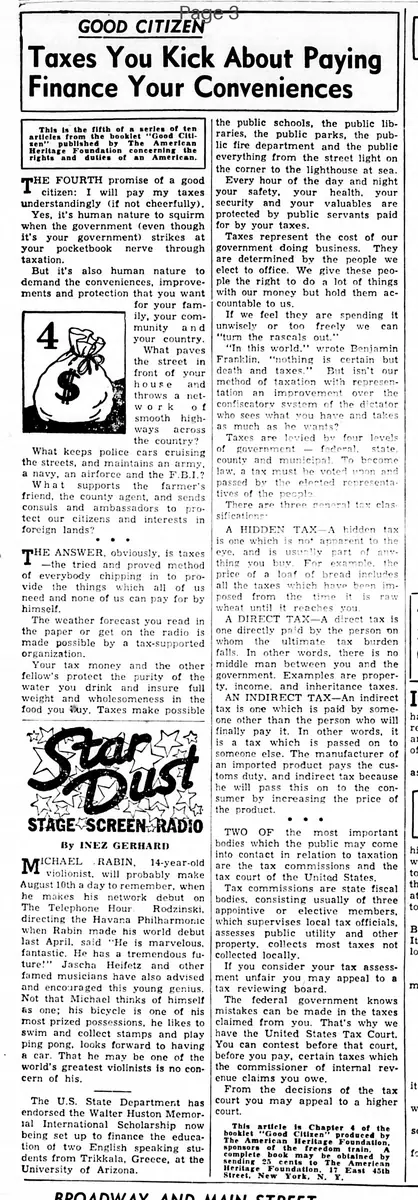
GOOD CITIZEN
Taxes You Kick About Paying Finance Your Conveniences
This is the fifth of a series of ten articles from the booklet "Good Citizen" published by The American Heritage Foundation concerning the rights and duties of an American.
The fourth promise of a good citizen: I will pay my taxes understandingly (if not cheerfully).
Yes, it's human nature to squirm when the government (even though it's your government) strikes at your pocketbook nerve through taxation.
But it's also human nature to demand the conveniences, improvements and protection that you want for your family, your community and your country.
What paves the street in front of your house and throws a network of smooth highways across the country?
What keeps police cars cruising the streets, and maintains an army, a navy, an air force and the F.B.I.?
What supports the farmer's friend, the county agent, and sends consuls and ambassadors to protect our citizens and interests in foreign lands?
The answer, obviously, is taxes - the tried and proved method of everybody chipping in to provide the things which all of us need and none of us can pay for by himself.
The weather forecast you read in the paper or get on the radio is made possible by a tax-supported organization.
Your tax money and the other fellow's protect the purity of the water you drink and insure full weight and wholesomeness in the food you buy. Taxes make possible the public schools, the public libraries, the public parks, the public fire department and the public everything from the street light on the corner to the lighthouse at sea.
Every hour of the day and night your safety, your health, your security and your valuables are protected by public servants paid for by your taxes.
Taxes represent the cost of our government doing business. They are determined by the people we elect to office. We give these people the right to do a lot of things with our money but hold them accountable to us.
If we feel they are spending it unwisely or too freely we can "turn the rascals out."
"In this world," wrote Benjamin Franklin, "nothing is certain but death and taxes." But isn't our method of taxation with representation an improvement over the confiscatory system of the dictator who sees what you have and takes as much as he wants?
Taxes are levied by four levels of government - federal, state, county and municipal. To become law, a tax must be voted upon and passed by the elected representatives of the people.
There are three general tax classifications:
A HIDDEN TAX - A hidden tax is one which is not apparent to the eye, and is usually part of anything you buy. For example, the price of a loaf of bread includes all the taxes which have been imposed from the time it is raw wheat until it reaches you.
A DIRECT TAX - A direct tax is one directly paid by the person on whom the ultimate tax burden falls. In other words, there is no middle man between you and the government. Examples are property, income, and inheritance taxes.
AN INDIRECT TAX - An indirect tax is one which is paid by someone other than the person who will finally pay it. In other words, it is a tax which is passed on to someone else. The manufacturer of an imported product pays the customs duty, an indirect tax because he will pass this on to the consumer by increasing the price of the product.
Two of the most important bodies which the public may come into contact in relation to taxation are the tax commissions and the tax court of the United States.
Tax commissions are state fiscal bodies, consisting usually of three appointive or elective members, which supervises local tax officials, assesses public utility and other property, collects most taxes not collected locally.
If you consider your tax assessment unfair you may appeal to a tax reviewing board.
The federal government knows mistakes can be made in the taxes claimed from you. That's why we have the United States Tax Court.
You can contest before that court, before you pay, certain taxes which the commissioner of internal revenue claims you owe.
From the decisions of the tax court you may appeal to a higher court.
This article is Chapter 4 of the booklet "Good Citizen" produced by The American Heritage Foundation, sponsors of the freedom train. A complete book may be obtained by sending 25 cents to The American Heritage Foundation, 17 East 45th Street, New York, N. Y.
Taxes You Kick About Paying Finance Your Conveniences
This is the fifth of a series of ten articles from the booklet "Good Citizen" published by The American Heritage Foundation concerning the rights and duties of an American.
The fourth promise of a good citizen: I will pay my taxes understandingly (if not cheerfully).
Yes, it's human nature to squirm when the government (even though it's your government) strikes at your pocketbook nerve through taxation.
But it's also human nature to demand the conveniences, improvements and protection that you want for your family, your community and your country.
What paves the street in front of your house and throws a network of smooth highways across the country?
What keeps police cars cruising the streets, and maintains an army, a navy, an air force and the F.B.I.?
What supports the farmer's friend, the county agent, and sends consuls and ambassadors to protect our citizens and interests in foreign lands?
The answer, obviously, is taxes - the tried and proved method of everybody chipping in to provide the things which all of us need and none of us can pay for by himself.
The weather forecast you read in the paper or get on the radio is made possible by a tax-supported organization.
Your tax money and the other fellow's protect the purity of the water you drink and insure full weight and wholesomeness in the food you buy. Taxes make possible the public schools, the public libraries, the public parks, the public fire department and the public everything from the street light on the corner to the lighthouse at sea.
Every hour of the day and night your safety, your health, your security and your valuables are protected by public servants paid for by your taxes.
Taxes represent the cost of our government doing business. They are determined by the people we elect to office. We give these people the right to do a lot of things with our money but hold them accountable to us.
If we feel they are spending it unwisely or too freely we can "turn the rascals out."
"In this world," wrote Benjamin Franklin, "nothing is certain but death and taxes." But isn't our method of taxation with representation an improvement over the confiscatory system of the dictator who sees what you have and takes as much as he wants?
Taxes are levied by four levels of government - federal, state, county and municipal. To become law, a tax must be voted upon and passed by the elected representatives of the people.
There are three general tax classifications:
A HIDDEN TAX - A hidden tax is one which is not apparent to the eye, and is usually part of anything you buy. For example, the price of a loaf of bread includes all the taxes which have been imposed from the time it is raw wheat until it reaches you.
A DIRECT TAX - A direct tax is one directly paid by the person on whom the ultimate tax burden falls. In other words, there is no middle man between you and the government. Examples are property, income, and inheritance taxes.
AN INDIRECT TAX - An indirect tax is one which is paid by someone other than the person who will finally pay it. In other words, it is a tax which is passed on to someone else. The manufacturer of an imported product pays the customs duty, an indirect tax because he will pass this on to the consumer by increasing the price of the product.
Two of the most important bodies which the public may come into contact in relation to taxation are the tax commissions and the tax court of the United States.
Tax commissions are state fiscal bodies, consisting usually of three appointive or elective members, which supervises local tax officials, assesses public utility and other property, collects most taxes not collected locally.
If you consider your tax assessment unfair you may appeal to a tax reviewing board.
The federal government knows mistakes can be made in the taxes claimed from you. That's why we have the United States Tax Court.
You can contest before that court, before you pay, certain taxes which the commissioner of internal revenue claims you owe.
From the decisions of the tax court you may appeal to a higher court.
This article is Chapter 4 of the booklet "Good Citizen" produced by The American Heritage Foundation, sponsors of the freedom train. A complete book may be obtained by sending 25 cents to The American Heritage Foundation, 17 East 45th Street, New York, N. Y.
What sub-type of article is it?
Educational Article
Civic Lesson
What themes does it cover?
Moral Virtue
Justice
What keywords are associated?
Taxes
Civic Duty
Public Services
Tax Classifications
Tax Appeals
What entities or persons were involved?
Benjamin Franklin
Story Details
Key Persons
Benjamin Franklin
Story Details
Explains the civic duty to pay taxes understandingly, how taxes fund public services and protections, contrasts with dictatorial systems, describes tax types (hidden, direct, indirect), and outlines tax commissions and the U.S. Tax Court for appeals.