Thank you for visiting SNEWPapers!
Sign up free
Editorial
January 28, 1859
Oxford Democrat
Paris, South Paris, Oxford County, Maine
What is this article about?
Editorial by W. H. Gardner advocates for greater social institutions among farmers to enable communication, knowledge exchange, and improvement, contrasting their isolation with urban commercial networks, and praises town and county fairs.
Clipping
OCR Quality
98%
Excellent
Full Text
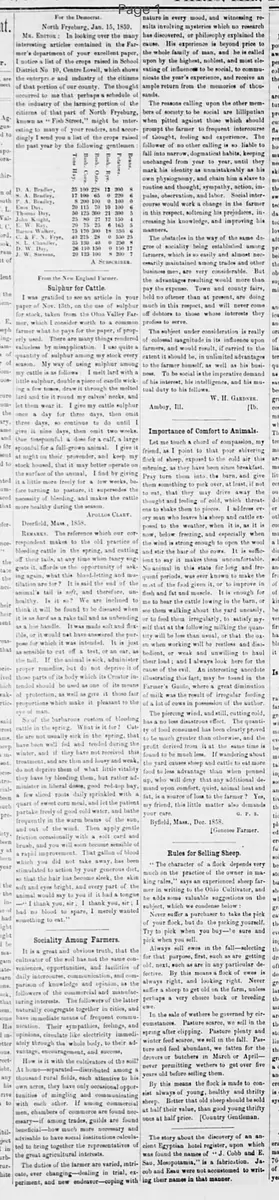
Sociality Among Farmers.
It is a great and obvious truth, that the cultivator of the soil has not the same conveniences, opportunities, and facilities of daily intercourse, communication, and comparison of knowledge and opinion, as the followers of the commercial and manufacturing interests. The followers of the latter naturally congregate together in cities, and have immediate means of frequent communication. Their sympathies, feelings, and opinions, circulate like electricity immediately through the whole body, to their advantage, encouragement, and success.
How is it with the cultivators of the soil? At home—separated—distributed among a thousand rural fields, each attentive to his own acres, they have only occasional opportunities of mingling and communicating with each other. If among commercial men, chambers of commerce are found necessary—if among trades, guilds are found beneficial—how much more necessary and advisable to have social institutions calculated to bring together the representatives of the great agricultural interests.
The duties of the farmer are varied, intricate, ever changing—dealing in trial, experiment, and new endeavor—coping with nature in every mood, and witnessing results involving mysteries which no research has discovered, or philosophy explained the cause. His experience is beyond price to the whole family of man, and he is called upon by the highest, noblest, and most elevating of influences to be social, to communicate the year's experience, and receive an ample return from the memories of thousands.
The reasons calling upon the other members of society to be social are Lilliputian when pitted against those which should prompt the farmer to frequent intercourse of thought, feeling and experience. The follower of no other calling is so liable to fall into narrow, dogmatical habits, keeping unchanged from year to year, until they mark his identity as unmistakably as his own physiognomy, and chain him a slave to routine and thought, sympathy, action, impulse, observation, and labor. Social intercourse would work a change in the farmer in this respect, softening his prejudices, increasing his knowledge, and improving his manners.
The obstacles in the way of the same degree of sociality being established among farmers, which is so easily and almost necessarily maintained among trades and other business men, are very considerable. But the advantages resulting would more than pay the expense. Town and county fairs, held no oftener than at present, are doing much in this respect, and will never come off debtors to those whose interests they profess to serve.
The subject under consideration is really of colossal magnitude in its influence upon farmers, and would result, if carried to the extent it should be, in unlimited advantages to the farmer himself, as well as his business.
To be social is the imperative demand of his interest, his intelligence, and his mutual duty to his fellows.
W. H. GARDNER.
Amboy, Ill.
It is a great and obvious truth, that the cultivator of the soil has not the same conveniences, opportunities, and facilities of daily intercourse, communication, and comparison of knowledge and opinion, as the followers of the commercial and manufacturing interests. The followers of the latter naturally congregate together in cities, and have immediate means of frequent communication. Their sympathies, feelings, and opinions, circulate like electricity immediately through the whole body, to their advantage, encouragement, and success.
How is it with the cultivators of the soil? At home—separated—distributed among a thousand rural fields, each attentive to his own acres, they have only occasional opportunities of mingling and communicating with each other. If among commercial men, chambers of commerce are found necessary—if among trades, guilds are found beneficial—how much more necessary and advisable to have social institutions calculated to bring together the representatives of the great agricultural interests.
The duties of the farmer are varied, intricate, ever changing—dealing in trial, experiment, and new endeavor—coping with nature in every mood, and witnessing results involving mysteries which no research has discovered, or philosophy explained the cause. His experience is beyond price to the whole family of man, and he is called upon by the highest, noblest, and most elevating of influences to be social, to communicate the year's experience, and receive an ample return from the memories of thousands.
The reasons calling upon the other members of society to be social are Lilliputian when pitted against those which should prompt the farmer to frequent intercourse of thought, feeling and experience. The follower of no other calling is so liable to fall into narrow, dogmatical habits, keeping unchanged from year to year, until they mark his identity as unmistakably as his own physiognomy, and chain him a slave to routine and thought, sympathy, action, impulse, observation, and labor. Social intercourse would work a change in the farmer in this respect, softening his prejudices, increasing his knowledge, and improving his manners.
The obstacles in the way of the same degree of sociality being established among farmers, which is so easily and almost necessarily maintained among trades and other business men, are very considerable. But the advantages resulting would more than pay the expense. Town and county fairs, held no oftener than at present, are doing much in this respect, and will never come off debtors to those whose interests they profess to serve.
The subject under consideration is really of colossal magnitude in its influence upon farmers, and would result, if carried to the extent it should be, in unlimited advantages to the farmer himself, as well as his business.
To be social is the imperative demand of his interest, his intelligence, and his mutual duty to his fellows.
W. H. GARDNER.
Amboy, Ill.
What sub-type of article is it?
Agriculture
Social Reform
What keywords are associated?
Farmers Sociality
Agricultural Institutions
Rural Communication
Town Fairs
Knowledge Exchange
What entities or persons were involved?
W. H. Gardner
Farmers
Commercial Men
Editorial Details
Primary Topic
Social Institutions For Farmers
Stance / Tone
Advocacy For Farmer Sociality
Key Figures
W. H. Gardner
Farmers
Commercial Men
Key Arguments
Farmers Lack Daily Communication Unlike Urban Commercial Groups
Social Institutions Like Chambers Of Commerce Are Needed For Agriculture
Farmer Duties Involve Complex Experiments Benefiting From Shared Experience
Sociality Prevents Narrow Habits And Improves Knowledge And Manners
Town And County Fairs Provide Valuable Opportunities Despite Obstacles