Thank you for visiting SNEWPapers!
Sign up free
The New Hampshire Gazette
Portsmouth, Rockingham County, New Hampshire
What is this article about?
In an Irish court on the North-West circuit, a jury acquits a poor tenant accused of assaulting his landlord for defending his daughter from attempted ravishment, defying the judge's demand to reconsider and eloquently asserting their constitutional independence.
Clipping
OCR Quality
Full Text
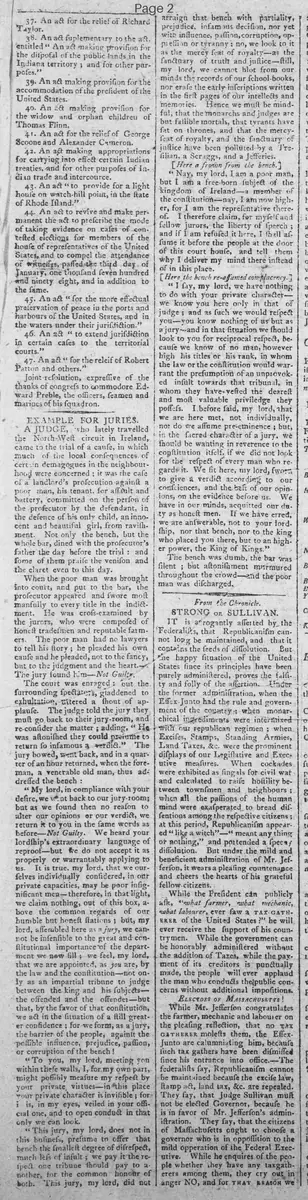
A JUDGE who lately travelled the North-West circuit in Ireland, came to the trial of a cause, in which much of the local consequences of certain demagogues in the neighbourhood were concerned; it was the case of a landlord's prosecution against a poor man, his tenant, for assault and battery, committed on the person of the prosecutor by the defendant, in the defence of his only child, an innocent and beautiful girl, from ravishment. Not only the bench, but the whole bar, dined with the prosecutor's father the day before the trial: and some of them praise the venison and the claret even to this day.
When the poor man was brought into court, and put to the bar, the prosecutor appeared and swore most manfully to every title in the indictment. He was cross-examined by the jurors, who were composed of honest tradesmen and reputable farmers. The poor man had no lawyers to tell his story; he pleaded his own cause and he pleaded, not to the fancy, but to the judgment and the heart.
The jury found him--Not Guilty.
The court was enraged: but the surrounding spectators, gladdened to exultation, uttered a shout of applause. The judge told the jury they must go back to their jury-room, and re-consider the matter; adding, "He was astonished they could presume to return so infamous a verdict." The jury bowed, went back, and in a quarter of an hour returned, when the foreman, a venerable old man, thus addressed the bench:
"My lord, in compliance with your desire, we went back to our jury-room; but as we found then no reason to alter our opinions or our verdict, we return it to you in the same words as before--Not Guilty. We heard your lordship's extraordinary language of reproof--but we do not accept it as properly or warrantably applying to us. It is true, my lord, that we ourselves individually considered, in our private capacities, may be poor insignificant men--therefore, in that light, we claim nothing, out of this box, above the common regards of our humble but honest stations; but, my lord, assembled here as a jury, we cannot be insensible to the great and constitutional importance of the department we now fill; we feel, my lord, that we are appointed, as you are, by the law and the constitution--not only as an impartial tribune to judge between the king and his subjects--the offended and the offender--but that, by the favor of that constitution, we act in the situation of still greater confidence; for we form, as a jury, the barrier of the people, against the possible influence, prejudice, passion, or corruption of the bench!
"To you, my lord, meeting you within these walls, I, for my own part, might possibly measure my respect by your private virtues--in this place your private character is invisible; for it is, in my eyes, veiled in your official one, and to official conduct in that only we can look.
"This jury, my lord, does not in this business, presume to offer that bench the smallest degree of disrespect, much less of insult; we pay it the respect one tribune should pay to another, for the common honour of both. This jury, my lord, did not arraign that bench with partiality, prejudice, infamous decision, nor yet with influence, passion, corruption, oppression or tyranny; no, we look to it as the mercy seat of royalty--as the sanctuary of truth and justice--till, my lord, we cannot blot from our minds the records of our school-books, nor erase the early inscriptions written in the first pages of our intellects and memories. Hence we must be mindful, that the monarchs and judges are but fallible mortals, that tyrants have sat on thrones, and that the mercy-seat of royalty, and the sanctuary of justice have been polluted by a Tresilian, a Scroggs, and a Jeffries."
Here a frown from the bench.
"Nay, my lord, I am a poor man, but I am a free-born subject of the kingdom of Ireland--a member of the constitution--nay, I am now higher, for I am the representative thereof. I therefore claim, for myself and fellow jurors, the liberty of speech; and if I am refused it here, I shall assume it before the people at the door of this court house, and tell them why I deliver my mind there instead of in this place."
Here the bench re-assumed complacency.
"I say, my lord, we have nothing to do with your private character--we know you here only in that of judge; and as such we would respect you--you know nothing of us but as a jury--and in that situation we should look to you for reciprocal respect, because we know of no man, however high his titles or his rank, in whom the law or the constitution would warrant the presumption of an unprovoked insult towards that tribunal, in whom they have vested the dearest and most valuable privilege they possess. I before said, my lord, that we are here met, not individually, nor do we assume pre-eminence; but, in the sacred character of a jury, we should be wanting in reverence to the constitution itself, if we did not look for the respect of every man who regards it. We sit here, my lord, sworn to give a verdict according to our consciences, and the best of our opinions, on the evidence before us. We have in our minds, acquitted our duty as honest men. If we have erred, we are answerable, not to your lordship, nor that bench, nor to the king who placed you there, but to a higher power, the King of Kings."
The bench was dumb, the bar was silent: but astonishment murmured throughout the crowd--and the poor man was discharged.
What sub-type of article is it?
What themes does it cover?
What keywords are associated?
What entities or persons were involved?
Where did it happen?
Story Details
Key Persons
Location
North West Circuit In Ireland
Story Details
A poor tenant is prosecuted by his landlord for assault in defending his daughter from attempted ravishment. The jury, composed of tradesmen and farmers, acquits him after his personal plea. Despite the judge's outrage and order to reconsider, the foreman delivers a powerful speech defending the jury's constitutional role and independence, leading to the tenant's discharge.