Thank you for visiting SNEWPapers!
Sign up free
Philanthropist
Mount Pleasant, Jefferson County, Ohio
What is this article about?
In this third installment, Philanthropist argues that slavery abolition requires state action backed by public will, hindered by fears of black insurrections. Proposes colonizing free blacks to ease white anxieties, enabling gradual emancipation and moral reform among divided white classes in slave states.
Merged-components note: Continuation of the letter 'No. 3' on colonization and emancipation, text flows directly.
Clippings
1 of 2
OCR Quality
Full Text
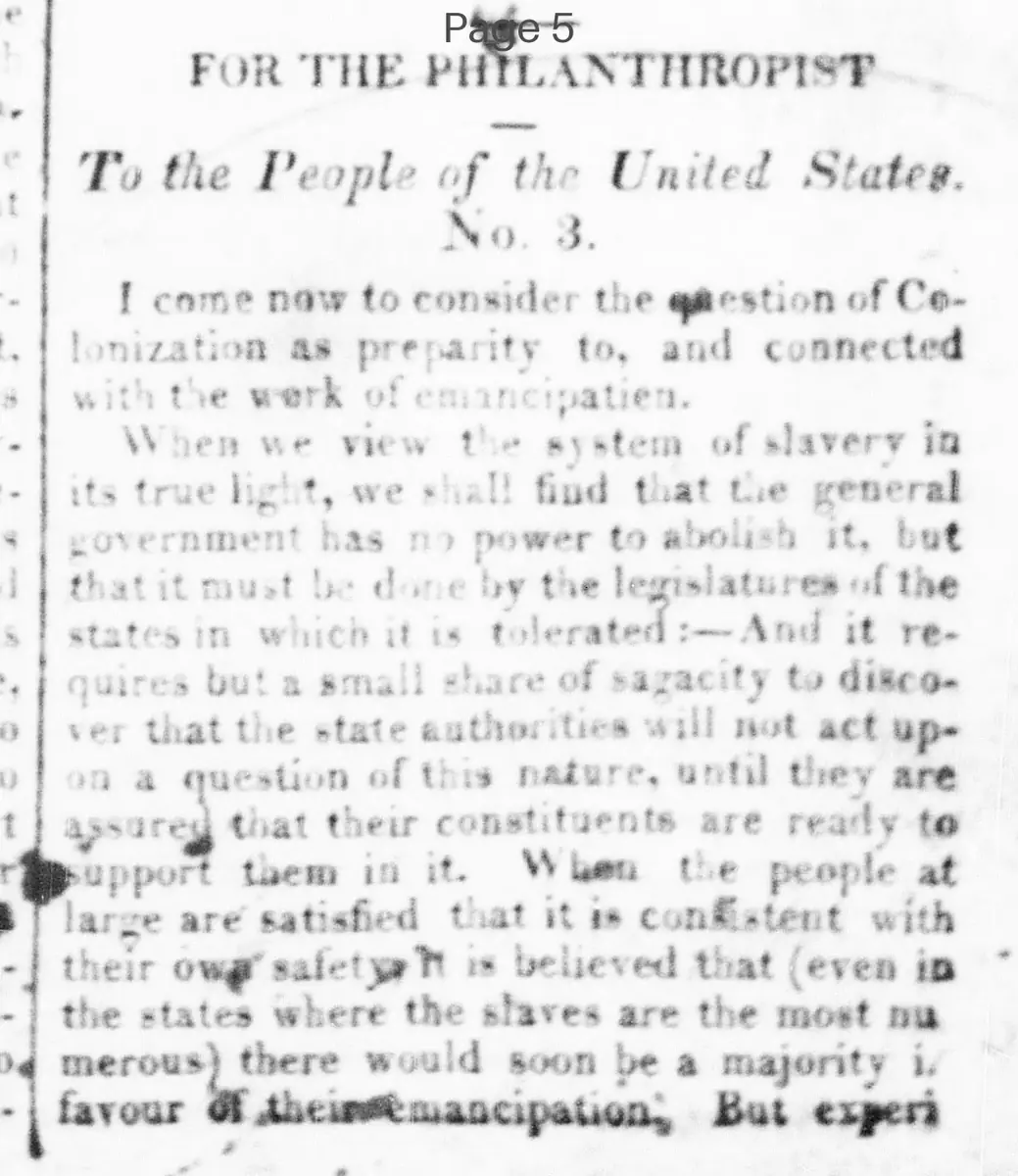
To the People of the United States.
No. 3.
I come now to consider the question of Colonization as preparatory to, and connected with the work of emancipation. When we view the system of slavery in its true light, we shall find that the general government has no power to abolish it, but that it must be done by the legislatures of the states in which it is tolerated:--And it requires but a small share of sagacity to discover that the state authorities will not act upon a question of this nature, until they are assured that their constituents are ready to support them in it. When the people at large are satisfied that it is consistent with their own safety, it is believed that (even in the states where the slaves are the most numerous) there would soon be a majority in favour of the emancipation; But experience teaches us, that in the present situation of things, they will not sanction a measure of this kind: they even refuse to do anything that may tend to the melioration of their condition in the slightest degree, from the persuasion that it would give rise to insurrections and rebellions among them. The free blacks are already so numerous, that they are a terror to the whites—hence, the exertions of the latter to perpetuate the ruling chain of servitude, and their aversion to the enlightening of their minds, or diminishing the burdens of those who remain in a state of bondage. It cannot be denied that this is a true statement of the case: and it follows that something must be done to convince the whites that they will be secure in their persons and property ere they will consent to the emancipation of their slaves. If this cannot be done, the cruelties of that abominable system will probably be continued for ages, unless indeed it shall please the Supreme Ruler of the Universe to work a miracle in favour of the sufferers.
Now if a colony should be established in some convenient place, under proper regulations, and sufficient encouragement held out to the free blacks to remove to it, the fears of the whites would gradually diminish, and their objections to the manumission of the slaves would decrease in a ratio with the number colonized: this would open a door for the friends of humanity, and enable them to carry on the work of benevolence, and finally to abolish that inhuman practice, which has proved to be a Pandora's box, teeming with evils of every name and kind.
The white population of the slave states may be divided into three classes; First, those who do not hold slaves—Second, those who hold slaves, but at the same time are convinced of its impropriety—and Third, the slave-holders who are in favour of the system. The first and second of these classes only, can be calculated upon to aid the friend of emancipation: the latter, with a few exceptions, can never be brought to see or to acknowledge the hypocrisy and inconsistency of their conduct. The former, however it is confidently believed will compose a majority, and nothing more is wanting to induce them to act, than a knowledge that they will be safe in so doing. Those who do not hold slaves, are continually treated with contempt, by the petty lordlings who have been accustomed to view the system as proper, and habituated to the use of the rod. Should an opportunity once offer, they would with alacrity wrest from their hands the sceptre of usurped authority, in order to humble, and bring them upon a level with themselves. The second class would of course act in conjunction: but, until the objects of their dread are removed from their sight, they will all co-operate with the advocates of oppression, and the entreaties and the labours of the philanthropist will be in vain.
PHILANTHROPOS
I would be understood as speaking of the people in general. It is true that among the slave-holders, there are many who from avaricious motives trample under foot all laws both human and divine in the rigorous treatment of their slaves, when there does not exist even a shadow of the "tyrant's plea" to extenuate their baseness and villainy.
What sub-type of article is it?
What themes does it cover?
What keywords are associated?
What entities or persons were involved?
Letter to Editor Details
Author
Philanthropos
Recipient
To The People Of The United States.
Main Argument
the federal government lacks power to abolish slavery, which must be done by state legislatures with public support; however, fears of insurrections prevent action. establishing a colony for free blacks would alleviate these fears, enabling gradual emancipation and reducing the cruelties of slavery.
Notable Details