Thank you for visiting SNEWPapers!
Sign up free
Gazette Of The United States & Evening Advertiser
Philadelphia, Philadelphia County, Pennsylvania
What is this article about?
On July 3, 1793, deputy Peter Marec presented to the French National Convention a project for a navigation act, proposed by the committees of Marine, Commerce, and Public Safety, to prohibit indirect foreign shipping in French trade and reserve coastal transport to national vessels, drawing on England's 1651 model to boost French commerce and marine.
Clipping
OCR Quality
Full Text
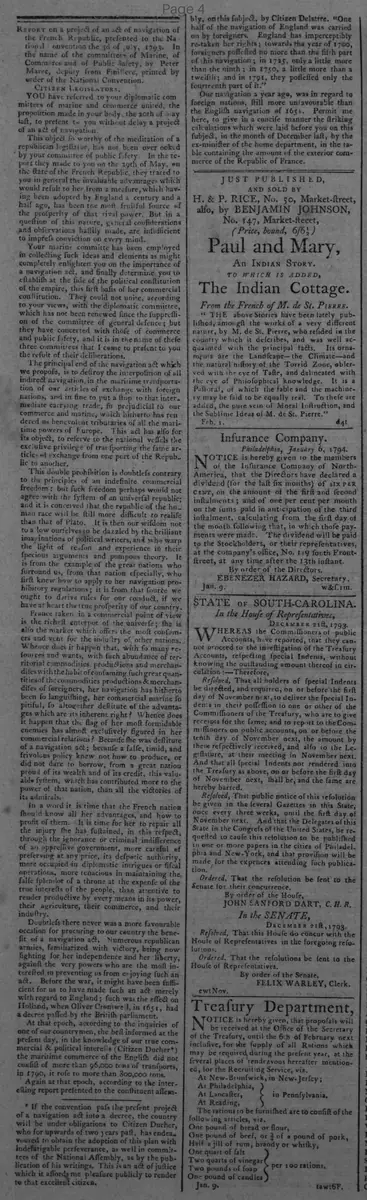
CITIZEN LEGISLATORS,
YOU have referred to your diplomatic committees of marine and commerce united, the proposition made in your body, the 20th of May last, to present to you without delay a project of an act of navigation. This object so worthy of the meditation of a republican legislator, has not been overlooked by your committee of public safety. In the report they made to you on the 29th of May, on the state of the French Republic, they traced to you in general the invaluable advantages which would result to her from a measure, which having been adopted by England a century and a half ago, has been the most fruitful source of the prosperity of that rival power. But in a question of this nature, general considerations and observations hastily made, are insufficient to impress conviction on every mind.
Your marine committee has been employed in collecting such ideas and elements as might completely enlighten you on the importance of a navigation act, and finally determine you to establish at the side of the political constitution of the empire, this first basis of her commercial constitution. They could not unite, according to your views, with the diplomatic committee, which has not been renewed since the suppression of the committee of general defence; but they have concerted with those of commerce and public safety, and it is in the name of these three committees that I come to present to you the result of their deliberations.
The principal end of the navigation act which we propose, is to destroy the interposition of all indirect navigation, in the maritime transportation of our articles of exchange with foreign nations, and in fine to put a stop to that intermediate carrying trade, so prejudicial to our commerce and marine, which hitherto has rendered us benevolent tributaries of all the maritime powers of Europe. This act has also for its object, to reserve to the national vessels the exclusive privilege of transporting the same articles of exchange from one port of the Republic to another.
This double prohibition is doubtless contrary to the principles of an indefinite commercial freedom: but such freedom perhaps would not agree with the system of a universal republic; and it is conceived that the republic of the human race will be still more difficult to realize than that of Plato. It is then our wisdom not to allow ourselves to be dazzled by the brilliant imaginations of political writers, and who warp the light of reason and experience in their specious arguments and pompous theory. It is from the example of the great nations who surround us, from that nation especially, who first knew how to apply to her navigation prohibitory regulations; it is from that source we ought to derive rules for our conduct, if we have at heart the true prosperity of our country.
France taken in a commercial point of view is the richest entrepot of the universe; she is also the market which offers the most consumers and vent for the industry of other nations. Whence does it happen that, with so many resources and wants, with such abundance of territorial commodities, productions and merchandises with the habit of consuming such great quantities of the commodities productions & merchandises of foreigners, her navigation has hitherto been so languishing, her commercial marine so pitiful, so altogether destitute of the advantages which are its inherent right? Whence does it happen that the flag of her most formidable enemies has almost exclusively figured in her commercial relations? Because she was destitute of a navigation act; because a false, timid, and frivolous policy knew not how to produce, or did not dare to borrow, from a great nation proud of its wealth and of its credit, this valuable system, which has contributed more to the power of that nation, than all the victories of its admirals.
In a word it is time that the French nation should know all her advantages, and how to profit of them. It is time for her to repair all the injury she has sustained, in this respect, through the ignorance or criminal indifference of an oppressive government, more careful of preserving at any price, its despotic authority, more occupied in diplomatic intrigues or fiscal operations, more tenacious in maintaining the false splendor of a throne at the expense of the true interests of the people, than attentive to render productive by every means in its power, their agriculture, their commerce, and their industry.
Doubtless there never was a more favourable occasion for procuring to our country the benefit of a navigation act. Numerous republican armies, familiarized with victory, being now fighting for her independence and her liberty, against the very powers who are the most interested in preventing us from enjoying such an act. Before the war, it might have been sufficient for us to have made such an act merely with regard to England; such was the effect on Holland, when Oliver Cromwell, in 1651, had a decree passed by the British parliament.
At that epoch, according to the inquiries of one of our countrymen, the best informed at the present day, in the knowledge of our true commercial & political interests (Citizen Duche*), the maritime commerce of the English did not consist of more than 96,000 tons of transports, in 1790, it rose to more than 800,000 tons.
Again at that epoch, according to the interesting report presented to the constituent assembly, on this subject, by Citizen Dejattre. "One half of the navigation of England was carried on by foreigners. England has imperceptibly re-taken her rights; towards the year of 1700, foreigners possessed no more than the fifth part of this navigation; in 1725, only a little more than the ninth; in 1750, a little more than a twelfth; and in 1791, they possessed only the fourteenth part of it."
Our navigation a year ago, was in regard to foreign nations, still more unfavourable than the English navigation of 1651. Permit me here, to give in a concise manner the striking calculations which were laid before you on this subject, in the month of December last, by the ex-minister of the home department, in the table containing the amount of the exterior commerce of the Republic of France.
What sub-type of article is it?
What keywords are associated?
What entities or persons were involved?
Where did it happen?
Foreign News Details
Primary Location
French Republic
Event Date
3d Of July, 1793
Key Persons
Outcome
proposal for navigation act to prohibit indirect foreign shipping and reserve coastal trade to french vessels, modeled on england's 1651 act to enhance french commerce and marine power.
Event Details
Deputy Peter Marec, on behalf of the committees of Marine, Commerce, and Public Safety, presented a project for a navigation act to the National Convention. The act aims to eliminate indirect navigation by foreign vessels in French trade with other nations and reserve transport between French ports to national ships, countering the dominance of foreign maritime powers and boosting French commercial marine, drawing lessons from England's historical success.