Thank you for visiting SNEWPapers!
Sign up free
Literary
February 26, 1791
The New Hampshire Gazette And General Advertiser
Portsmouth, Rockingham County, New Hampshire
What is this article about?
An essay advising New England farmers to reduce mowing land to half, improve management with manuring, rolling, and fencing to increase hay yields, save labor, and prevent soil damage from overgrazing and poor practices.
Clipping
OCR Quality
98%
Excellent
Full Text
From the New England Farmer.
Of MOWING GROUND.
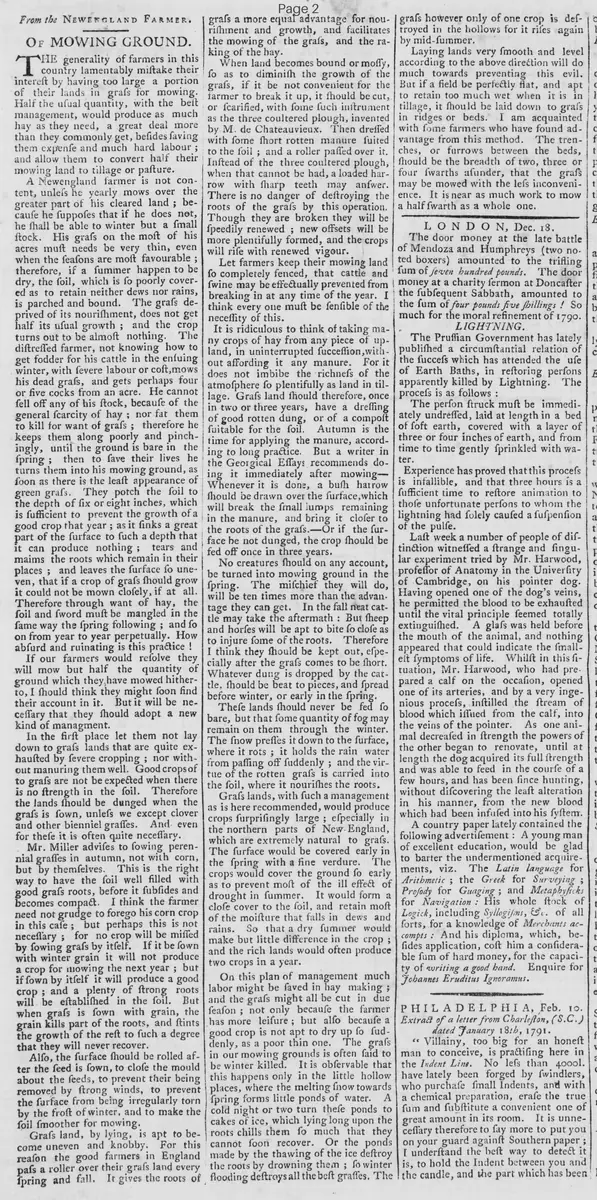
The generality of farmers in this country lamentably mistake their interest by having too large a portion of their lands in grass for mowing. Half the usual quantity, with the best management, would produce as much hay as they need, a great deal more than they commonly get, besides saving them expense and much hard labour; and allow them to convert half their mowing land to tillage or pasture.
A New England farmer is not content, unless he yearly mows over the greater part of his cleared land; because he supposes that if he does not, he shall be able to winter but a small stock. His grass on the most of his acres must needs be very thin, even when the seasons are most favourable; therefore, if a summer happen to be dry, the soil, which is so poorly covered as to retain neither dews nor rains, is parched and bound. The grass deprived of its nourishment, does not get half its usual growth; and the crop turns out to be almost nothing. The distressed farmer, not knowing how to get fodder for his cattle in the ensuing winter, with severe labour or cost, mows his dead grass, and gets perhaps four or five cocks from an acre. He cannot fell off any of his stock, because of the general scarcity of hay; nor fat them to kill for want of grass; therefore he keeps them along poorly and pinchingly, until the ground is bare in the spring; then to save their lives he turns them into his mowing ground, as soon as there is the least appearance of green grass. They poach the soil to the depth of six or eight inches, which is sufficient to prevent the growth of a good crop that year; as it sinks a great part of the surface to such a depth that it can produce nothing; tears and maims the roots which remain in their places; and leaves the surface so uneven, that if a crop of grass should grow it could not be mown closely, if at all. Therefore through want of hay, the soil and sward must be mangled in the same way the spring following; and so on from year to year perpetually. How absurd and ruinous is this practice!
If our farmers would resolve they will mow but half the quantity of ground which they have mowed hitherto, I should think they might soon find their account in it. But it will be necessary that they should adopt a new kind of management.
In the first place let them not lay down to grass lands that are quite exhausted by severe cropping; nor without manuring them well. Good crops of grass are not to be expected when there is no strength in the soil. Therefore the lands should be dunged when the grass is sown, unless we except clover and other biennial grasses. And even for these it is often quite necessary.
Mr. Miller advises to sowing perennial grasses in autumn, not with corn, but by themselves. This is the right way to have the soil well filled with good grass roots, before it subsides and becomes compact. I think the farmer need not grudge to forego his corn crop in this case; but perhaps this is not necessary; for no crop will be missed by sowing grass by itself. If it be sown with winter grain it will not produce a crop for mowing the next year; but if sown by itself it will produce a good crop; and a plenty of strong roots will be established in the soil. But when grass is sown with grain, the grain kills part of the roots, and stints the growth of the rest to such a degree that they will never recover.
Also, the surface should be rolled after the seed is sown, to close the mould about the seeds, to prevent their being removed by strong winds, to prevent the surface from being irregularly torn by the frost of winter, and to make the soil smoother for mowing.
Grass land, by lying, is apt to become uneven and knobby. For this reason the good farmers in England pass a roller over their grass land every spring and fall. It gives the roots of grass a more equal advantage for nourishment and growth, and facilitates the mowing of the grass, and the raking of the hay.
When land becomes bound or mossy, so as to diminish the growth of the grass, if it be not convenient for the farmer to break it up, it should be cut, or scarified, with some such instrument as the three coultered plough, invented by M. de Chateauvieux. Then dressed with some short rotten manure suited to the soil: and a roller passed over it. Instead of the three coultered plough, when that cannot be had, a loaded harrow with sharp teeth may answer. There is no danger of destroying the roots of the grass by this operation. Though they are broken they will be speedily renewed; new offsets will be more plentifully formed, and the crops will rise with renewed vigour.
Let farmers keep their mowing land so completely fenced, that cattle and swine may be effectually prevented from breaking in at any time of the year. I think every one must be sensible of the necessity of this.
It is ridiculous to think of taking many crops of hay from any piece of upland, in uninterrupted succession, without affording it any manure. For it does not imbibe the richness of the atmosphere so plentifully as land in tillage. Grass land should therefore, once in two or three years, have a dressing of good rotten dung, or of a compost suitable for the soil. Autumn is the time for applying the manure, according to long practice. But a writer in the Georgical Essays recommends doing it immediately after mowing-- Whenever it is done, a bush harrow should be drawn over the surface, which will break the small lumps remaining in the manure, and bring it closer to the roots of the grass.--Or if the surface be not dunged, the crop should be fed off once in three years.
No creatures should on any account, be turned into mowing ground in the spring. The mischief they will do, will be ten times more than the advantage they can get. In the fall neat cattle may take the aftermath: But sheep and horses will be apt to bite so close as to injure some of the roots. Therefore I think they should be kept out, especially after the grass comes to be short.
Whatever dung is dropped by the cattle, should be beat to pieces, and spread before winter, or early in the spring. These lands should never be fed so bare, but that some quantity of fog may remain on them through the winter. The snow presses it down to the surface, where it rots; it holds the rain water from passing off suddenly; and the virtue of the rotten grass is carried into the soil, where it nourishes the roots.
Grass lands, with such a management as is here recommended, would produce crops surprisingly large; especially in the northern parts of New England, which are extremely natural to grass. The surface would be covered early in the spring with a fine verdure. The crops would cover the ground so early as to prevent most of the ill effect of drought in summer. It would form a close cover to the soil, and retain most of the moisture that falls in dews and rains. So that a dry summer would make but little difference in the crop; and the rich lands would often produce two crops in a year.
On this plan of management much labor might be saved in hay making; and the grass might all be cut in due season; not only because the farmer has more leisure; but also because a good crop is not apt to dry up so suddenly, as a poor thin one. The grass in our mowing grounds is often said to be winter killed. It is observable that this happens only in the little hollow places, where the melting snow towards spring forms little ponds of water. A cold night or two turn these ponds to cakes of ice, which lying long upon the roots chills them so much that they cannot soon recover. Or the ponds made by the thawing of the ice destroy the roots by drowning them; so winter flooding destroys all the best grasses. The grass however only of one crop is destroyed in the hollows for it rises again by mid-summer.
Laying lands very smooth and level according to the above direction will do much towards preventing this evil. But if a field be perfectly flat, and apt to retain too much wet when it is in tillage, it should be laid down to grass in ridges or beds. I am acquainted with some farmers, who have found advantage from this method. The trenches, or furrows between the beds, should be the breadth of two, three or four swarths asunder, that the grass may be mowed with the less inconvenience. It is near as much work to mow a half swarth as a whole one.
Of MOWING GROUND.
The generality of farmers in this country lamentably mistake their interest by having too large a portion of their lands in grass for mowing. Half the usual quantity, with the best management, would produce as much hay as they need, a great deal more than they commonly get, besides saving them expense and much hard labour; and allow them to convert half their mowing land to tillage or pasture.
A New England farmer is not content, unless he yearly mows over the greater part of his cleared land; because he supposes that if he does not, he shall be able to winter but a small stock. His grass on the most of his acres must needs be very thin, even when the seasons are most favourable; therefore, if a summer happen to be dry, the soil, which is so poorly covered as to retain neither dews nor rains, is parched and bound. The grass deprived of its nourishment, does not get half its usual growth; and the crop turns out to be almost nothing. The distressed farmer, not knowing how to get fodder for his cattle in the ensuing winter, with severe labour or cost, mows his dead grass, and gets perhaps four or five cocks from an acre. He cannot fell off any of his stock, because of the general scarcity of hay; nor fat them to kill for want of grass; therefore he keeps them along poorly and pinchingly, until the ground is bare in the spring; then to save their lives he turns them into his mowing ground, as soon as there is the least appearance of green grass. They poach the soil to the depth of six or eight inches, which is sufficient to prevent the growth of a good crop that year; as it sinks a great part of the surface to such a depth that it can produce nothing; tears and maims the roots which remain in their places; and leaves the surface so uneven, that if a crop of grass should grow it could not be mown closely, if at all. Therefore through want of hay, the soil and sward must be mangled in the same way the spring following; and so on from year to year perpetually. How absurd and ruinous is this practice!
If our farmers would resolve they will mow but half the quantity of ground which they have mowed hitherto, I should think they might soon find their account in it. But it will be necessary that they should adopt a new kind of management.
In the first place let them not lay down to grass lands that are quite exhausted by severe cropping; nor without manuring them well. Good crops of grass are not to be expected when there is no strength in the soil. Therefore the lands should be dunged when the grass is sown, unless we except clover and other biennial grasses. And even for these it is often quite necessary.
Mr. Miller advises to sowing perennial grasses in autumn, not with corn, but by themselves. This is the right way to have the soil well filled with good grass roots, before it subsides and becomes compact. I think the farmer need not grudge to forego his corn crop in this case; but perhaps this is not necessary; for no crop will be missed by sowing grass by itself. If it be sown with winter grain it will not produce a crop for mowing the next year; but if sown by itself it will produce a good crop; and a plenty of strong roots will be established in the soil. But when grass is sown with grain, the grain kills part of the roots, and stints the growth of the rest to such a degree that they will never recover.
Also, the surface should be rolled after the seed is sown, to close the mould about the seeds, to prevent their being removed by strong winds, to prevent the surface from being irregularly torn by the frost of winter, and to make the soil smoother for mowing.
Grass land, by lying, is apt to become uneven and knobby. For this reason the good farmers in England pass a roller over their grass land every spring and fall. It gives the roots of grass a more equal advantage for nourishment and growth, and facilitates the mowing of the grass, and the raking of the hay.
When land becomes bound or mossy, so as to diminish the growth of the grass, if it be not convenient for the farmer to break it up, it should be cut, or scarified, with some such instrument as the three coultered plough, invented by M. de Chateauvieux. Then dressed with some short rotten manure suited to the soil: and a roller passed over it. Instead of the three coultered plough, when that cannot be had, a loaded harrow with sharp teeth may answer. There is no danger of destroying the roots of the grass by this operation. Though they are broken they will be speedily renewed; new offsets will be more plentifully formed, and the crops will rise with renewed vigour.
Let farmers keep their mowing land so completely fenced, that cattle and swine may be effectually prevented from breaking in at any time of the year. I think every one must be sensible of the necessity of this.
It is ridiculous to think of taking many crops of hay from any piece of upland, in uninterrupted succession, without affording it any manure. For it does not imbibe the richness of the atmosphere so plentifully as land in tillage. Grass land should therefore, once in two or three years, have a dressing of good rotten dung, or of a compost suitable for the soil. Autumn is the time for applying the manure, according to long practice. But a writer in the Georgical Essays recommends doing it immediately after mowing-- Whenever it is done, a bush harrow should be drawn over the surface, which will break the small lumps remaining in the manure, and bring it closer to the roots of the grass.--Or if the surface be not dunged, the crop should be fed off once in three years.
No creatures should on any account, be turned into mowing ground in the spring. The mischief they will do, will be ten times more than the advantage they can get. In the fall neat cattle may take the aftermath: But sheep and horses will be apt to bite so close as to injure some of the roots. Therefore I think they should be kept out, especially after the grass comes to be short.
Whatever dung is dropped by the cattle, should be beat to pieces, and spread before winter, or early in the spring. These lands should never be fed so bare, but that some quantity of fog may remain on them through the winter. The snow presses it down to the surface, where it rots; it holds the rain water from passing off suddenly; and the virtue of the rotten grass is carried into the soil, where it nourishes the roots.
Grass lands, with such a management as is here recommended, would produce crops surprisingly large; especially in the northern parts of New England, which are extremely natural to grass. The surface would be covered early in the spring with a fine verdure. The crops would cover the ground so early as to prevent most of the ill effect of drought in summer. It would form a close cover to the soil, and retain most of the moisture that falls in dews and rains. So that a dry summer would make but little difference in the crop; and the rich lands would often produce two crops in a year.
On this plan of management much labor might be saved in hay making; and the grass might all be cut in due season; not only because the farmer has more leisure; but also because a good crop is not apt to dry up so suddenly, as a poor thin one. The grass in our mowing grounds is often said to be winter killed. It is observable that this happens only in the little hollow places, where the melting snow towards spring forms little ponds of water. A cold night or two turn these ponds to cakes of ice, which lying long upon the roots chills them so much that they cannot soon recover. Or the ponds made by the thawing of the ice destroy the roots by drowning them; so winter flooding destroys all the best grasses. The grass however only of one crop is destroyed in the hollows for it rises again by mid-summer.
Laying lands very smooth and level according to the above direction will do much towards preventing this evil. But if a field be perfectly flat, and apt to retain too much wet when it is in tillage, it should be laid down to grass in ridges or beds. I am acquainted with some farmers, who have found advantage from this method. The trenches, or furrows between the beds, should be the breadth of two, three or four swarths asunder, that the grass may be mowed with the less inconvenience. It is near as much work to mow a half swarth as a whole one.
What sub-type of article is it?
Essay
What themes does it cover?
Agriculture Rural
What keywords are associated?
Mowing Ground
Hay Production
Grass Management
New England Farming
Soil Care
Manuring
Rolling Grass Land
What entities or persons were involved?
From The New England Farmer.
Literary Details
Title
Of Mowing Ground.
Author
From The New England Farmer.
Key Lines
How Absurd And Ruinous Is This Practice!
If Our Farmers Would Resolve They Will Mow But Half The Quantity Of Ground Which They Have Mowed Hitherto, I Should Think They Might Soon Find Their Account In It.
Grass Lands, With Such A Management As Is Here Recommended, Would Produce Crops Surprisingly Large; Especially In The Northern Parts Of New England, Which Are Extremely Natural To Grass.