Thank you for visiting SNEWPapers!
Sign up free
The National Intelligencer And Washington Advertiser
Washington, District Of Columbia
What is this article about?
Diplomatic papers from May-August 1802 detail Anglo-French negotiations on implementing the Treaty of Amiens' 10th article for the Order of Malta's reorganization, including appointments of envoys, Russian involvement, and papal election of grand master. Also covers tensions over French exiles in Britain, press libels, and demands for their removal.
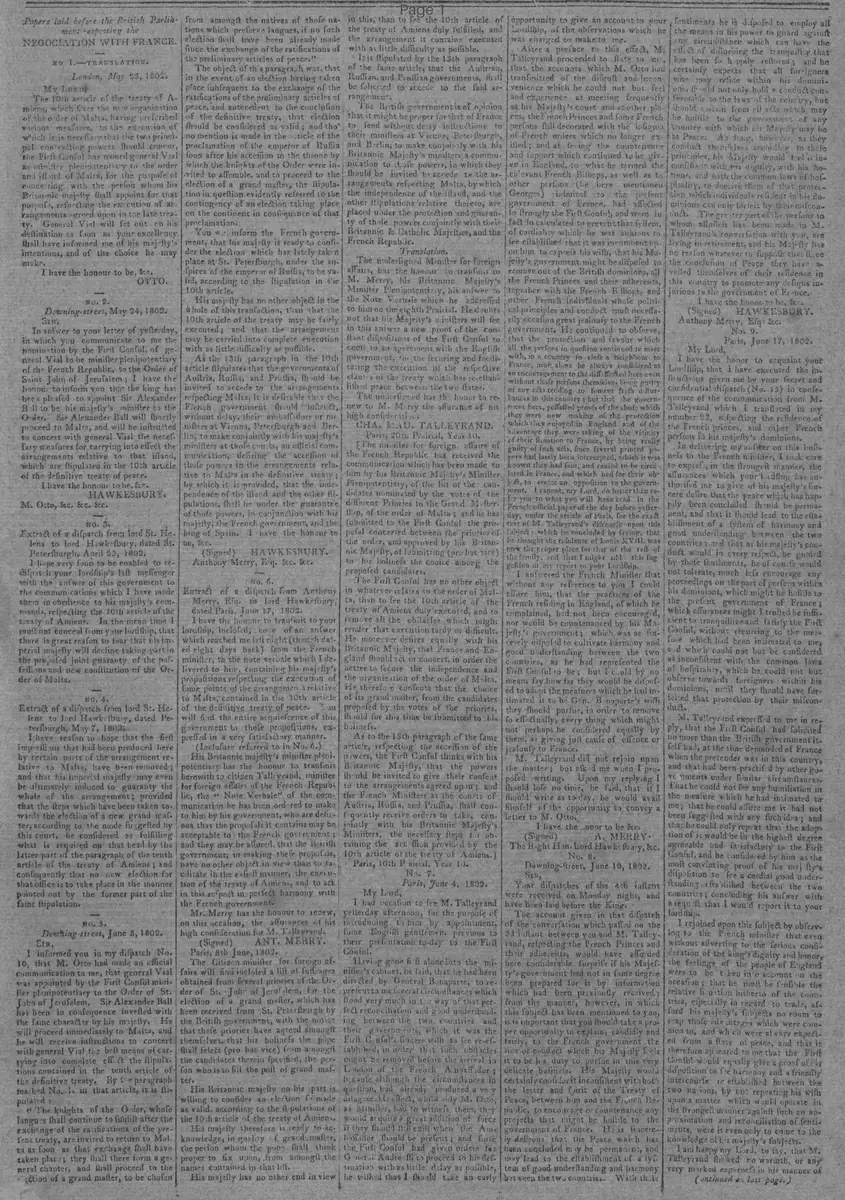
Merged-components note: These components form a single continuous foreign news article on British-French diplomatic negotiations regarding the Treaty of Amiens, Malta, and related dispatches, spanning pages 1, 2, and 4, as indicated by explicit 'continued' markers in the text.
Clippings
1 of 3
OCR Quality
Full Text
NEGOTIATION WITH FRANCE.
NO. I.—TRANSLATION.
London, May 23, 1802.
My LORD,
The 10th article of the treaty of Amiens, which fixes the new organisation
of the order of Malta, having prescribed various measures, to the execution of
which it is necessary that the two principal contracting powers should concur,
the First Consul has named General Vial as minister plenipotentiary to the order
and island of Malta, for the purpose of concerting with the person whom his
Britannic majesty shall appoint for that purpose, respecting the execution of arrangements agreed upon in the late treaty. General Vial will set out on his
destination as soon as your excellency shall have informed me of his majesty's
intentions, and of the choice he may make.
I have the honour to be, &c.
OTTO.
NO. 2.
Downing-street, May 24, 1802.
SIR,
In answer to your letter of yesterday, in which you communicate to me the
nomination by the First Consul, of General Vial to be minister plenipotentiary
of the French Republic, to the Order of Saint John of Jerusalem; I have the
honour to inform you that the king has been pleased to appoint Sir Alexander
Ball to be his majesty's minister to the Order. Sir Alexander Ball will shortly
proceed to Malta, and will be instructed to concert with General Vial the necessary
measures for carrying into effect the arrangements relative to that island,
which are stipulated in the 10th article of the definitive treaty of peace.
I have the honour to be, &c.
HAWKESBURY.
M. Otto, &c. &c. &c.
NO. 3.
Extract of a dispatch from Lord St. Helens to Lord Hawkesbury, dated St.
Petersburgh, April 23, 1802.
I hope very soon to be enabled to re-dispatch your lordship's last messenger
with the answer of this government to the communications which I have made
them in obedience to his majesty's commands, respecting the 10th article of the
treaty of Amiens. In the mean time I must not conceal from your lordship, that
there is great reason to fear that his imperial majesty will decline taking part in
the proposed joint guarantee of the possessions and new constitution of the Order of Malta.
NO. 4.
Extract of a dispatch from Lord St. Helens to Lord Hawkesbury, dated Petersburgh, May 7, 1802.
I have reason to hope that the first impressions that had been produced here
by certain parts of the arrangement relative to Malta, have been removed;
and that his imperial majesty may even be ultimately induced to guarantee the
whole of the arrangement; provided that the steps which have been taken towards the election of a new grand master, according to the mode suggested by
this court, be considered as fulfilling what is required on that head by the
latter part of the paragraph of the tenth article of the treaty of Amiens; and
consequently that no new election for that office is to take place in the manner
pointed out by the former part of the same stipulation.
NO. 5.
Downing-street, June 5, 1802.
SIR,
I informed you in my dispatch No. 10, that M. Otto had made an official
communication to me, that General Vial was appointed by the First Consul minister
plenipotentiary to the Order of St. John of Jerusalem. Sir Alexander Ball
has been in consequence invested with the same character by his majesty. He
will proceed immediately to Malta, and he will receive instructions to concert
with General Vial the best means of carrying into complete effect the stipulations contained in the tenth article of the definitive treaty. By the paragraph
marked No. 1. in that article, it is stipulated:
"The knights of the Order, whose languages shall continue to exist after the
exchange of the ratifications of the present treaty, are invited to return to Malta as soon as that exchange shall have taken place; they shall there form a general chapter, and shall proceed to the election of a grand master, to be chosen
from amongst the natives of those nations which preserve languages, if no such
election shall have been already made since the exchange of the ratifications of
the preliminary articles of peace."
The object of this paragraph was, that in the event of an election having taken
place subsequent to the exchange of the ratifications of the preliminary articles of
peace, and antecedent to the conclusion of the definitive treaty, that election
should be considered as valid; and though no mention is made in the article of the
proclamation of the emperor of Russia soon after his accession to the throne by
which the knights of the Order were invited to assemble, and to proceed to the
election of a grand master, the stipulation in question evidently referred to the
contingency of an election taking place on the continent in consequence of that
proclamation.
You will inform the French government, that his majesty is ready to consider the election which has lately taken place at St. Peterburgh, under the auspices of the emperor of Russia, to be valid, according to the stipulation in the
10th article.
His majesty has no other object in the whole of this transaction, than that the
10th article of the treaty may be fairly executed; and that the arrangement
may be carried into complete execution with as little difficulty as possible.
As the 13th paragraph in the 10th article stipulates that the governments of
Austria, Russia, and Prussia, should be invited to accede to the arrangements
respecting Malta, it is desirable that the French government should instruct,
without delay, their ambassadors or ministers at Vienna, Peterburgh and Berlin, to make conjointly with his majesty's ministers at those courts, an official communication, desiring the accession of those powers to the arrangements relative to Malta in the definitive treaty; by which it is provided, that the independence of the island and the other stipulations, shall be under the guarantee
of those powers, in conjunction with his majesty, the French government, and the
king of Spain.
I have the honour to be, &c.
(Signed) HAWKESBURY.
Anthony Merry, Esq. &c. &c.
No. 6.
Extract of a dispatch from Anthony Merry, Esq. to Lord Hawkesbury,
dated Paris, June 17, 1802.
I have the honour to transmit to your lordship, enclosed, copy of an answer
which reached me last night (though dated eight days back) from the French
minister, to the note verbale which I delivered to him, containing his majesty's
propositions respecting the execution of some points of the arrangements relative
to Malta, contained in the 10th article of the definitive treaty of peace. You
will find the entire acquiescence of this government to those propositions, expressed in a very satisfactory manner.
(Inclosure referred to in No. 6.)
His Britannic majesty's minister plenipotentiary has the honour to transmit
herewith to citizen Talleyrand, minister for foreign affairs of the French Republic, the "Note Verbale" of the communication he has been ordered to make
to him by his government, who are desirous that the proposals it contains may be
acceptable to the French government; and they may be assured, that the British
government, in making these proposals, have no other object in view than to facilitate in the easiest manner, the execution of the treaty of Amiens, and to act
in this respect in perfect harmony with the French government.
Mr. Merry has the honour to renew, on this occasion, the assurances of his
high consideration for M. Talleyrand.
(Signed)
ANT. MERRY.
Paris, 8th June, 1802.
The Citizen minister for foreign affairs will find enclosed a list of suffrages
obtained from several priories of the Order of St. John of Jerusalem, for the
election of a grand master, which has been received from St. Peterburgh by
the British government, with the notice that these priories have agreed amongst
themselves, that his holiness the pope shall elect (pro hac vice) from amongst
the candidates therein specified, the person who is to fill the post of grand master.
His Britannic majesty on his part is willing to consider an election so made
as valid, according to the stipulations of the 10th article of the treaty of Amiens.
His majesty therefore is ready to acknowledge, in quality of grand master,
the person whom the pope shall think proper to fix upon, from amongst the
names contained in that list.
His majesty has no other end in view in this, than to see the 10th article of
the treaty of Amiens duly fulfilled, and the arrangement it contains executed
with as little difficulty as possible.
It is stipulated by the 13th paragraph of the same article that the Austrian,
Russian, and Prussian governments, shall be solicited to accede to the said arrangement.
The British government is of opinion that it might be proper for that of France
to send without delay instructions to their ministers at Vienna, Peterburgh,
and Berlin, to make conjointly with his Britannic Majesty's ministers a communication to those powers, in which they should be invited to accede to the arrangements respecting Malta, by which the independence of the island, and the
other stipulations relative thereto, are placed under the protection and guarantee
of those powers conjointly with their Britannic & Catholic Majesties, and the
French Republic.
Translation.
The undersigned Minister for foreign affairs, has the honour to transmit to
M. Merry, his Britannic Majesty's Minister Plenipotentiary, his answer to
the Note Verbale which he addressed to him on the eighth Prairial. He doubts
not that his Majesty's ministers will see in this answer a new proof of the constant dispositions of the First Consul to come to an agreement with the English
government, for the securing and facilitating the execution of the respective
clauses of the treaty which has re-established peace between the two states.
The undersigned has the honor to re-new to M. Merry the assurance of his
high consideration.
CHA. MAU. TALLEYRAND.
Paris, 20th Prairial, Year 10.
The minister for foreign affairs of the French Republic has received the
communication which has been made to him by his Britannic Majesty's Minister
Plenipotentiary, of the list of the candidates nominated by the votes of the
different Priories to the Grand Mastership, of the order of Malta; and he has
submitted to the First Consul the proposal concerted between the priories of
the order, and approved by his Britannic Majesty, of submitting (pro hac vice)
to his holiness the choice among the proposed candidates.
The First Consul has no other object in whatever relates to the order of Malta,
than to see the 10th article of the treaty of Amiens duly executed, and to
remove all the obstacles which might render that execution tardy or difficult.
He moreover desires equally with his Britannic Majesty, that France and England should act in concert, in order the better to secure the independence and
the organization of the order of Malta.
He therefore consents that the choice of its grand master, from the candidates
proposed by the votes of the priories, should for this time be submitted to his
holiness.
As to the 13th paragraph of the same article, respecting the accession of the
powers, the First Consul thinks with his Britannic Majesty, that the powers
should be invited to give their consent to the arrangements agreed upon; and
the French Ministers at the Courts of Austria, Russia, and Prussia, shall consequently receive orders to take, conjointly with his Britannic Majesty's
Ministers, the necessary steps for obtaining the accession provided by the
10th article of the treaty of Amiens.
Paris, 10th Prairial, Year 10.
No. 7.
Paris, June 4, 1802.
My Lord,
I had occasion to see M. Talleyrand yesterday afternoon, for the purpose of
introducing to him by appointment, some English gentlemen, previous to
their presentation to-day to the First Consul.
Having gone in alone into the minister's cabinet, he said, that he had been
directed by General Bonaparte, to repeat to me several circumstances which
stood very much in the way of that perfect reconciliation and good understanding between the two countries and their governments, which it was the
First Consul's sincere wish to see re-established, in order that such obstacles
might be removed before the arrival in London of the French Ambassador;
because although the circumstances in question, had already produced a very
disagreeable effect, whilst only M. Otto, as Minister, had to witness them, they
would acquire a great addition of force if they should still exist when the Ambassador should be present; and since the First Consul had given orders for
General Andreossi to proceed to his destination with as little delay as possible,
he wished that I should take an early opportunity to give an account to your
Lordship, of the observations which he was charged to make to me.
After a preface to this effect, M. Talleyrand proceeded to state to me that the accounts which M. Otto had transmitted of the disgust and inconvenience which he could not but feel and experience at meeting frequently at his Majesty's court and at other places, the French Princes and some French
persons still decorated with the insignia of French orders which no longer existed; and at seeing the countenance and support which continued to be given in England, to what he termed the ci-devant French Bishops, as well as to
other persons (he here mentioned Georges) inimical to the present government of France, had acted so strongly on the First Consul, and were in fact so calculated to prevent that system of cordiality which he was anxious to see established that it was incumbent upon him to express his wish, that his Majesty's government might be disposed to remove out of the British dominions, all
the French Princes and their adherents, together with the French Bishops, and
other French individuals whose political principles and conduct must necessarily occasion great jealousy to the French government. He continued to observe,
that the protection and favour which all the persons in question continued to meet with, in a country so close a neighbour to France, must alone be always considered as an encouragement to the disaffected here even without those persons themselves, being guilty of any act tending to foment fresh disturbances in this country; but that the government here, possessed proofs of the abuse which they were now making of the protection which they enjoyed in England and of the advantage they were taking of the vicinity of their situation to France, by being really guilty of such acts, since several printed papers had lately been intercepted, which it was known they had sent, and caused to be circulated in France, and which had for their object, to create an opposition to the government, I cannot, my Lord, do better than refer you to what you will have read in the French official paper of the day before yesterday, under the article of Paris, for the exact text of M. Talleyrand's discourse upon this subject: which he concluded by saying, that he thought the residence of Louis XVIII. was now the proper place for that of the rest of the family. and that I might add this suggestion in my report to your Lordship.
I answered the French Minister that without any reference to you I could
assure him, that the practices of the French residing in England, of which he
complained, had not been encouraged, nor would be countenanced by his Majesty's government; which was as sincerely disposed to cultivate harmony and
good understanding between the two Countries, as he had represented the
First Consul to be; but I could by no means say how far they would be disposed to adopt the measures which he had intimated it to be Gen. Bonaparte's wish
they should pursue, in order to remove effectually, every thing which might
not perhaps be considered equally by them, as giving just cause of offence or
jealousy to France.
M. Talleyrand did not rejoin upon the matter; but asked me when I proposed writing. Upon my replying I should lose no time, he said, that if I should
write as to day, he would avail himself of the opportunity to convey a letter to M. Otto.
I have the honour to be &c.
(Signed)
A. MERRY.
The Right Hon. Lord Hawkesbury, &c.
No. 8.
Downing-street. June 10, 1802.
SIR,
Your dispatches of the 4th instant were received on Monday night, and
have been laid before the King.
The account given in that dispatch of the conversation which passed on the
3d instant between you and M. Talleyrand, respecting the French Princes and
their adherents, would have afforded here considerable surprise, if his Majesty’s
government had not in some degree been prepared for it by information which had been previously received; from the manner, however, in which this subject has been mentioned to you, it is important that you should take a proper opportunity to explain, candidly and fairly, to the French government the
line of conduct which his Majesty feels it to be his duty to pursue in this very
delicate business. His Majesty would certainly consider it inconsistent both
with the letter and spirit of the Treaty of Peace, between him and the French Republic, to encourage or countenance any projects that might be hostile to the
government of France. He is sincerely desirous that the Peace which has
been concluded may be permanent, and may lead to the establishment of a system of good understanding and harmony between the two countries. With these
sentiments he is disposed to employ all the means in his power to guard against
any circumstance which can have the effect of disturbing the tranquillity that
has been so happily restored; and he certainly expects that all foreigners who may reside within his dominions, should not only hold a conduct conformable to the laws of the country, but should abstain from all acts which may be hostile to the government of any country with which his Majesty may be at Peace. As long, however, as they conduct themselves according to these principles, his Majesty would feel it inconsistent with his dignity, with his honour, and with the common laws of hospitality, to deprive them of that protection which individuals resident in his dominions can only forfeit by their misconduct. The greater part of the persons to whom allusion has been made in M.
Talleyrand's conversation with you, are living in retirement, and his Majesty has
no reason whatever to suppose that since the conclusion of Peace they have availed themselves of their residence in this country to promote any designs injurious to the government of France.
I have the honor to be, &c.
(Signed) HAWKESBURY.
Anthony Merry, Esq. &c.
No. 9.
Paris, June 17, 1802.
My Lord,
I have the honor to acquaint your Lordship, that I have executed the instructions given me by your secret and confidential dispatch (No. 15) in consequence of the communication from M. Talleyrand which I transmitted in my
number 23, respecting the residence of the French princes, and other French
persons in his majesty's dominions.
In delivering my answer on this business to the French minister, I took care
to express, in the strongest manner, the assurances which your lordship has authorized me to give of his majesty's sincere desire that the peace which has happily been concluded should be permanent, and that it should lead to the establishment of a system of harmony and good understanding between the two
countries: and that as his majesty's conduct would in every respect, be guided
by those sentiments, he of course would not tolerate, much less encourage any
proceedings on the part of persons within his dominions, which might be hostile to
the present government of France; which assurances might I trusted be sufficient to tranquillize and satisfy the First Consul, without recurring to the measure which had been intimated to me, and which could not but be considered
as inconsistent with the common laws of hospitality, which he could not but
observe towards foreigners within his dominions, until they should have forfeited that protection by their misconduct.
M. Talleyrand expressed to me in reply, that the First Consul had solicited
no more than the British government itself had, at the time demanded of France
when the pretender was in this country, and that had been practised by other governments under similar circumstances. That he could not see any humiliation in
the measure which he had intimated to me; that he could assure me it had not
been suggested with any such idea; and that he could only repeat that the adoption of it would be in the highest degree agreeable and satisfactory to the First
Consul, and be considered by him as the most convincing proof of his majesty's
disposition to see a cordial good understanding established between the two
countries; concluding his answer with a request that I would report it to your
lordship.
I rejoined upon this subject by observing to the French minister that even
without adverting to the serious consideration of the king's dignity and honor,
the feelings of the people of England were to be taken into account on the
occasion: that he must be sensible the relative situation hitherto of the countries, especially in regard to trade, afforded his majesty's subjects no room to
reap those advantages which were common to, and which were always expected from a state of peace, and that it therefore appeared to me that the First
Consul would equally give a proof of his disposition to see harmony and a friendly intercourse re-established between the two nations, by not repeating his wish upon a matter which would operate in the strongest manner against such an approximation and reconciliation of sentiments, were it even only to come to the knowledge of his majesty's subjects.
I am happy my Lord, to say, that M. Talleyrand showed no warmth, or any
very marked eagerness in his manner of replying to my communication; and that our conversation on this head terminated with this: The remarks I made to him when he changed it to another subject.
I have the honor to be, &c.
(Signed) ANTHONY MERRY.
Right hon. lord Hawkesbury, &c. &c.
No. 10—Translation.
Portman Square, July 25, 1802.
My Lord,
I transmitted some time ago to Mr. Hammond, a number of Peltier's containing the most gross calumnies against the French government, and against the whole nation; and I observed that I should probably receive an order to demand the punishment of such an abuse of the press. That order is actually arrived, and I cannot conceal from your Lordship that the reiterated insults sustained by a multitude of foreigners assembled in London to conspire against the French government, produce the most unfavorable effects on the good understanding between the two nations. Even though the first article of the treaty of Amiens had not provided for the maintenance of that respect, which two independent nations owe to each other: the general maxims of the law of nations would formally condemn so revolting an abuse of the liberty of the press. It cannot be believed that the law can give more sanctuary to a libeller than to any other individual, who, without a declaration of war, should wantonly himself to violate the duties of good neighbourhood. The offence in question is so much the more serious, as its object is evidently to disturb the harmony which subsists between the two governments.
It is not to Peltier alone, but to the Editor of the Courier Francois de Londres, to Colbet and other writers who resemble them, that I have to direct the attention of his majesty's government. The perfidious and malevolent publications of these men are in open contradiction to the principles of Peace and if it can ever enter into the mind of the French government to permit retaliation, writers would doubtless be found in France, willing to avenge their countrymen by filling their pages with odious reflections on the most respectable persons, and on the dearest institutions of Great Britain.
The want of positive laws against these sorts of offences, cannot palliate the violation of the law of nations, according to which peace should put a stop to all species of hostilities; and doubtless those which wound the honor and the reputation of a government, and which tend to cause a revolt of the people, whose interests are confided to that government, are the most apt to lessen the advantages of peace, and to keep up national resentments.
I have the honor to be, &c.
(Signed)
OTTO.
To his excellency lord Hawkesbury,
minister and Secretary of State for the Foreign Department.
No. 11.
Downing Street, July 28, 1802.
Sir,
I have the honor to acknowledge the receipt of your letter on the subject of the last number of Peltier. It is impossible that his majesty's government could peruse the article in question without the greatest displeasure and without an anxious desire that the person who published it should suffer the punishment he so justly deserves. The calumnies, however, to which his majesty's government, and many of the best subjects in this country, are frequently exposed in the public prints, must necessarily convince all foreign governments of the difficulties which exist in a Constitution like that of Great Britain, in preventing the abuse which is often unavoidably attendant on the greatest political benefits; and though publications of this kind are as they certainly ought to be, by the law of England, subject to punishment, it is often difficult to prove the guilt of an individual satisfactorily as to obtain the judgment of a court of justice; and the inconvenience which arises from prosecution unless there is a reasonable prospect of success, is frequently sufficient to deter both the government and individuals from undertaking it. In the present case, I have thought it my duty to refer the article in question to his majesty's attorney general, for his opinion whether it is or is not a libel according to the construction of the law of England, and whether it is such a libel as he would under all circumstances recommend for prosecution.
As soon as I receive his report, I shall have the honor of communicating it to you.
I have the honor to be, &c.
M. Otto, &c. &c.
(Signed)
HAWKESBURY.
No. 12—(Translation) NOTE.
The undersigned Minister Plenipotentiary of the French Republic, having submitted to his government the Letter which his Excellency Lord Hawkesbury, Minister and Principal Secretary of State to his British Majesty, did him the honor of writing under date of the 27th July, is directed to offer the following observations:
If the British government tolerates censures upon the acts of its administration and the personal abuse of the most respectable men, it does not suffer even the slightest attempt against the public tranquillity, the fundamental laws of the empire, and the supreme authority which arises from them. Every nation is, moreover, at liberty to sacrifice any advantage whatever in its interior, in order to obtain another to which it attaches a higher value; but the government which does not repress the licentiousness of the Press when it may be injurious to the honor or the interests of foreign powers, would afford an opportunity for libellers to endanger the public tranquillity, or at least the good understanding that forms the basis of it, and whenever such serious injuries are continued in a regular and systematic manner, doubts must arise as to its own dispositions.
The particular laws and constitution of Great Britain are subordinate to the general principles of the law of nations, which supersede the laws of each individual state. If it be a right in England to allow the most extensive liberty to the press, it is a public right of polished nations, and the bounden duty of government to prevent, repress, and punish, every attack which might by those means be made against the rights, the interests, and the honor, of foreign powers.
This general maxim of the law of nations has never been mistaken without paving the way for the greatest divisions, and has ever furnished in England a plausible pretext to those who have written volumes to prove the necessity of the last war against France. Are these men now desirous of presenting to the Consular government a weapon which they have wielded with so much address? And can they flatter themselves that the authority which has signed the peace has not power to maintain it?
By the first article of the treaty of Amiens, the two powers agree to afford no protection, either directly or indirectly, to those who should cause prejudice to any of them.
But the greatest of all injuries doubtless is, that which tends to debase a foreign government, or to excite within its territory civil and religious commotions and the worst decided of all protection, is that which places under the safeguard of the laws, men who seek not only to disturb the political tranquillity of Europe, but even to dissolve the first bonds of society.
The undersigned minister must moreover observe, that this is not a question respecting some paragraphs, which, through the inadvertence of an Editor, might have been accidentally inserted in a public print: but it is a question of a deep and continued system of defamation, directed not only against the chief of the French Republic, but against all the constituted authorities of the Republic, against the whole nation, represented by these libellers in the most odious and degrading terms. It has ever been remarked that many of these prints contain an appeal to the French people, against the government and fundamental laws of their country.
If these observations apply to the English writers, who for these three months past, have deluged the public with the most perfidious and unbecoming publications, they are still more applicable to a class of foreign calumniators, who appear to avail themselves of the asylum offered to them in England only for the purpose of the better gratifying their hatred against France, and undermining the foundations of peace.
It is not merely by insulting and seditious writings, evidently published with a view to circulate in France, but by other incendiary papers distributed thro' the maritime departments, in order to excite the evil-disposed or weak inhabitants to resist the execution of the Concordat, that these implacable enemies of France continue to exercise hostilities, and to provoke the just indignation of the French government and people. Not a doubt exists of these writings having been composed and circulated by Georges and by former bishops of France. These men can no longer be considered but as rebels against both political and religious authority; and after their reiterated attempts to disturb the good understanding between the two governments, their residence in England militates openly against the spirit and letter of the treaty of peace.
The meetings likewise which have taken place in the island of Jersey, and the odious plots which are there framed, in spite of the representations which the undersigned minister has already taken care to make on this subject, also demand immediate measures to be taken by a government the neighbour and friend of France.
Other persons (attached, by recollections never to be effaced, and by regrets too long uttered, to an order of things which no longer exists in France) find themselves daily implicated by the plots of those who pretend to serve them. A sense of their own reputation will, without doubt, lead them to avoid a focus of intrigues, with which they ought not to have the least connection.
Peace happily re-established, the mutual desire of the two governments to render it solid and lasting, and the general interests of humanity, require that all these causes of dissatisfaction should be done away, and that his Majesty's ministry should, by frank and energetic measures, manifest their disapprobation of all the attempts made to produce new divisions.
The undersigned has in consequence received special orders to solicit,
1st. That his Majesty's government will adopt the most effectual measures to put a stop to the unbecoming and seditious publications with which the newspapers and other writings in England are filled.
2d. That the individuals mentioned in the undersigned minister's letter of the 23d July last, shall be sent out of the island of Jersey.
3d. That the former bishops of Arras and St. Pol de Leon, and all those, who like them, under the pretext of religion seek to raise disturbances in the interior of France, shall likewise be sent away.
4th. That Georges and his adherents shall be transported to Canada, according to the intention which the undersigned has been directed to transmit to his government at the request of Lord Hawkesbury.
5th. That in order to deprive the evil disposed of every pretext for disturbing the good understanding between the two governments, it shall be recommended to the Princes of the House of Bourbon at present in Great Britain, to repair to Warsaw, the residence of the head of their family.
6th. That each of the French emigrants as shall think proper to wear the orders and decorations belonging to the ancient government of France, shall be required to quit the territory of the British empire.
These demands are founded upon the treaty of Amiens, and upon the verbal assurances that the undersigned minister has had the satisfaction to receive in the course of the negotiations, with regard to a mutual agreement for maintaining tranquillity and good order in the two countries. If any one in particular of these demands does not proceed immediately from the treaty concluded, it would be easy to justify it by striking examples, and to prove how very attentive the British government has been in times of internal fermentation, to remove from the territory of a neighbouring power those who might endanger the public tranquillity.
NO. 13.)
Downing street, Aug. 28, 1802.
SIR,
I send you the copy of a letter which I received some days ago from M. Otto, together with a copy of an official note enclosed in it. I have informed M. Otto that you would receive instructions to enter into explanations with the French government on the several points to which it refers. It is impossible not to feel considerable surprise at the circumstances under which it has been thought proper to present such a note, at the style in which it is drawn up, and at the complaints contained in it. Whatever may be the general dispositions of the French government towards this country, supposing them to be as hostile as they have been at any former period, or even more so, it would appear so contrary to their interest to provoke a war with us at the present moment, that I am inclined to ascribe their conduct, in the whole of this business, more to temper, than to any other motive; but whether their conduct is to be referred to temper or to policy, the effect of it may in any be the same; it is therefore become of the utmost importance that a frank explanation should be made of the line of conduct which his majesty has determined to adopt on occasions of the nature of those to which this note refers, and of the motives on which it is founded; and it is to be hoped that such an explanation will have the effect of putting an end to a course of proceeding which can lead only to perpetual irritation between the two governments, and which might ultimately tend to the most serious consequences. This consideration naturally arises on this transaction is that of the peculiar circumstances under which the note of M. Otto has been presented. It cannot be denied that some very improper paragraphs have lately appeared in some of the English newspapers against the government of France; it cannot be denied likewise that publications of a still more improper and indecent nature have made their appearance in this country, with the names of foreigners affixed to them. Under these circumstances the French government would have been warranted in expecting every redress that the laws of this country could afford them; but as, instead of seeking it in the ordinary course they have thought it to resort to themselves, or at least to authorize it in others, they could have no right to complain if their vague appeal to his majesty had failed to produce the effect that otherwise would have attended it. Whatever may have been the nature of the prior injury, they have in fact taken the law into their own hands: and what is this recrimination and retort? The paragraphs in the English newspapers, the publications to which I have above referred, have not appeared under any authority of the British government, and are disavowed and disapproved of by them; but the paragraph in the Moniteur has appeared in a paper avowedly official, for which the government are therefore considered as responsible, as his majesty's government is responsible for the contents of the London Gazette. And this retort is not confined to the unauthorized English newspapers, or to the other publications of which complaint is now made, but is converted into, and made a pretence for a direct attack upon the government of his majesty. His majesty feels it beneath his dignity to make any formal complaint on this occasion; but it has
been impossible for me to proceed to the other parts of the subject, without pointing your attention to the conduct of the French government in this respect, that you may observe upon it in the manner it deserves.
The propositions in M. Otto's official note, are six in number: but may in fact be divided under two heads; the first that which relates to the libels of all descriptions, which are alleged to be published against the French government; the last, comprehending the five complaints which relate to the emigrants resident in this country. On the first, I am sure you must be aware that his majesty cannot, and never will, in consequence of any representations or any menace from a foreign power, make any concession; which can be in the smallest degree dangerous to the liberty of the press, as secured by the constitution of this country. This liberty is justly dear to every British subject. The constitution admits of no previous restraints upon publications of any description; but there exist, judicatures, wholly independent of the executive government, capable of taking cognizance of such publications as the laws deem to be criminal and which are bound to inflict the punishment the delinquents may deserve; these judicatures may take cognizance not only of libels against the government and the magistracy of this kingdom but, as has been repeatedly experienced, of publications defamatory of those in whose hands the administration of foreign governments is placed. That our government neither has nor wants any other protection than what the laws of the country afford; and tho' they are willing and ready to give to every foreign government all the protection against offences of this nature, which the principle of their laws and constitution will admit, they never can consent to new model their laws or to change their constitution, to gratify the wishes of any foreign power. If the present French government are dissatisfied with our laws on the subject of libels or entertain the opinion that the administration of justice in our courts is too tardy and lenient they have it in their power to redress themselves by punishing the vendors and distributors of such publications within their own territories, in any manner that they may think proper, and thereby preventing the circulation of them. If they think their present laws are not sufficient for this purpose they may enact new ones; or, if they think it expedient, they may exercise the right which they have of prohibiting the importation of any foreign newspapers, or periodical publications, into the territories of the French Republic— His majesty will not complain of such a measure, as it is not his intention to interfere in the manner in which the people or territories of France should be governed; but he expects, on the other hand, that the French government will not interfere in the manner in which the government of his dominions is conducted, or call for a change in those laws with which his people are perfectly satisfied. With respect to the distinction which appears to be drawn in M. Otto's note, between the publication of British subjects and those of foreigners, and the power which his majesty is supposed to have in consequence of the alien act, of sending foreigners out of his dominions, it is important to observe that the provisions of that act were made for the purpose of preventing the residence of foreigners, whose numbers and principles had a tendency to disturb the internal peace of his own dominions, and whom the safety of those dominions might require in many instances to be removed, even if their actual conduct had not exposed them to punishment by law. It does not follow that it would be a warrantable application of such a law to exert its powers in the cases of individuals such as those of whom complaint is now made, and particularly as they are liable to be prosecuted under the law of the land, in like manner as others have been in similar cases. at the instance, and upon the complaint of foreign governments. The second general head, which includes the five last complaints, relates to the removal of some of the French emigrants resident in this country. His Majesty entertained hopes that the explanation furnished on this head in my dispatch No. 14, would have proved satisfactory, and would have precluded the necessity of any further discussion on this subject. The French government have upon several occasions resorted on this part of the subject to precedent, and have particularly rested on the demand formerly made by this country, that the person then called the pretender, should be sent from the French dominions. It is important that the differences between these two cases should be stated. When James the second abdicated the throne, and left this country, he retired with his adherents to France: and though in the war which immediately succeeded that event, the French government adopted his cause as their own, no stipulation was made at the treaty of Ryswick, that he should be sent from that country, nor was any subsequent demand ever made to the French government to this effect; but he was suffered to remain at Saint Germain, in the neighbourhood of Paris,
surrounded by his family and friends, till the time of his death. It was not till after his demise, when Lewis the fourteenth, in direct violation of the treaty of Ryswick, had acknowledged his son as King of Great Britain, that a different course of proceeding was adopted by the British government and in the treaty of peace signed at Utrecht, which put an end to the war which had been carried on, on account of the Spanish succession, an article was inserted to prevent the Pretender from residing in any part of the French dominions. The demand which was subsequently made for the removal of the Pretender from a town which was situated in the centre of those dominions, was founded on this article of the treaty, which was in fact one of the conditions of the peace; but both the article in the treaty and the demand were confined to the Pretender personally, and were not extended to any of his family, or to any of his adherents. After his removal, many of his adherents continued to reside in France; many persons resident in this country, who were attached to the cause of the Pretender, and had promoted the rebellion in his favour and who were consequently attainted for high treason, sought refuge in France, and were permitted to remain there till their death, without any application ever having been made by the British government for their removal. The Duke of Berwick, the natural son of James the second, who from his principles and talents was the most dangerous man to the interests of this country and the protestant succession, continued to be a general in the French armies, and though descended from the King, an Englishman and an emigrant. it was not required that he should be sent out of France. In the present case, there is no article in the treaty of peace, by which his majesty is bound to send from this country any Frenchman whatever, except on account of the crimes specified in the twentieth article of the definitive treaty, and in consequence of the proofs therein required having been adduced. In the present case, it cannot be pretended that his Majesty has ever given the slightest countenance to the cause of the royalists in France against the present government, since the period when he acknowledged that government; and if there were not these important differences in the two cases, they would be dissimilar in the only remaining point; for in the case of the house of Stuart, as has been already stated, notwithstanding the violence of the times, and the danger to which the protestant succession was really exposed, this strong act of authority was confined to the person of the Pretender: and the individual who may be recognized in that character by the French government, and whose case can alone bear any similarity to the former even in this respect, is not, and never has been within his Majesty's dominions: Other precedents might be adduced on this subject; but it is not necessary to state them, as the foregoing are sufficient.
With respect to the complaints in detail under the second head. Upon the first, you may inform the French government, that the emigrants in Jersey, many of whom remained there solely on account of the cheapness of subsistence, had actually removed, or were removing previous to the representation concerning them in M. Otto's note, and that before your explanation with M. Talleyrand can take place, there will probably not be an emigrant in the island.
To the second complaint, which relates to the bishops of Arras and St. Paul de Leon, and others, his Majesty can only reply, that if the facts alleged against them can be substantiated; if it can be proved that they have distributed papers on the coast of France with a view of disturbing the government, and of inducing the people to resist the new church establishment, his Majesty would think himself justified in taking all measures within his power for obliging them to leave the country; but no proof must be adduced of these facts; and such proof must not be that of their having in a single instance, viz. in reply to the Pope's Mandate published a vindication of their own conduct, in refusing to conform to the law establishment a proceeding in which they would be justifiable on every principle of toleration and justice; but should show that they have since availed themselves of their situation in this Country to excite the people of France against the authority of that government, whether civil or ecclesiastical.
Of the third complaint, which respects the removal of Georges, and those persons supposed to be described as his adherents. M. Otto must have mistaken me in what he supposes me to have said on that subject. His majesty is however very desirous to obviate any cause of complaint or uneasiness with regard to these persons, and measures are in contemplation, and will be taken, for the purpose of removing them out of his majesty's European dominions.
On the fourth complaint respecting the princes of the house of Bourbon, I can only refer you to my former answer. His majesty has no desire that, they should continue to reside in this country,
if they are disposed, or can be induced to quit it, but he thinks it to be inconsistent with his honor and his sense of justice to withdraw from them the rights of hospitality, as long as they conduct themselves peaceably and quietly; and unless some charge can be substantiated of their attempting to disturb the peace which subsists between the two governments.
With respect to the fifth complaint, which relates to the French emigrants wearing in this country the orders of their ancient government, there are few if any persons of that description in the country who wear such orders. It might be more proper if they all abstained from it; but the French government could not persist in expecting, that even if it were not consistent with law, his majesty could not be induced to commit so harsh an act of authority as to send them out of the country on such an account.
I have thus stated to you his majesty's sentiments on the several points contained in M. Otto's note. You will take an early opportunity of communicating these sentiments to the French government, and of accompanying them with the arguments and explanations above stated. And if it should be desired, and you should be of opinion, that it was likely to produce any good effect, there is no objection to your putting the substance of what you shall have stated in writing, and of delivering it to the minister of Foreign Affairs, as a memorandum of your conversation.
Upon the general tone and style of M. Otto's note, it is important to observe, that it is far from conciliating; and that the practice of presenting notes of this description, on any motive or suggestion of personal irritation, cannot fail to have the effect of indisposing the two governments towards each other, instead of consolidating and strengthening the peace which happily subsists between them. That after a war, in which the passions of men have been roused beyond all former examples, it is natural to suppose that the distrust, jealousy, and other hostile feelings of individuals should not immediately subside, and under these circumstances it appears to be both the interest and the duty of the two governments by a mild and temperate conduct, gradually to allay these feelings, and not on the contrary to provoke and augment them by untimely irritation on their part, and by ascribing proceedings like those above noticed, to causes to which they have no reference.
His majesty has thus fully and frankly explained his sentiment, and the ground of his conduct. He is sincerely disposed to adopt every measure for the preservation of peace, which is consistent with the honor and independence of the country, and with the security of its laws and constitution. But the French government must have formed a most erroneous judgment of the disposition of the British nation, and of the character of its government, if they have been taught to expect that any representation of a foreign power will ever induce them to consent to a violation of those rights on which the liberties of the people of this country are founded.
I have the honor to be, &c.
(Signed) HAWKESBURY.
Anthony Merry, Esq.
(Continued from first page.)
Whatever may be the protection which the English laws afford to native writers and to other subjects of his majesty, the French government knows that foreigners do not here enjoy the same protection; and that the law, known by the title of the Alien Act, gives the ministry of his Britannic majesty an authority which it has often exercised against foreigners whose residence was prejudicial to the interests of Great Britain. The first clause of this act states expressly, that any order in council which requires a foreigner to quit the kingdom shall be executed under pain of imprisonment and transportation. There exists, therefore, in the ministry a legal and sufficient power to restrain foreigners, without having recourse to the courts of law, and the French government, which offers on this point a reciprocity, thinks it gives a new proof of its pacific intentions, by demanding that those persons may be sent away, whose machinations uniformly tend to sow discord between the two people. It owes to itself and to the nation at large (which has made it the depository of its power and of its honour) not to appear insensible to insults and to plots during profound peace, which the irritation of open war could not justify, and it is too well acquainted with the conciliatory dispositions of the British ministry, not to rely upon its efforts to disperse a faction equally the enemy of France and England.
The undersigned minister seizes this opportunity to present to his excellency Lord Hawkesbury, the homage of his respectful consideration.
(Signed) OTTO.
London, 17th August, 1802.
(To be continued.)
What sub-type of article is it?
What keywords are associated?
What entities or persons were involved?
Where did it happen?
Foreign News Details
Primary Location
Malta
Event Date
May To August 1802
Key Persons
Outcome
agreement on papal election of malta grand master from priory candidates; invitations to austria, russia, prussia for guarantees; ongoing tensions over french exiles in britain and press libels, with british refusal to expel without proof of misconduct.
Event Details
Series of diplomatic dispatches between British and French officials on executing the 10th article of the Treaty of Amiens for reorganizing the Order of Malta, including envoy appointments, Russian emperor's role in grand master election submitted to Pope, and joint invitations to other powers for guarantees. Additional exchanges address French complaints about exiles, bishops, and libels in British press, with Britain defending hospitality and press freedom while promising action against proven hostilities.