Thank you for visiting SNEWPapers!
Sign up free
Gazette Of The United States, & Philadelphia Daily Advertiser
Philadelphia, Philadelphia County, Pennsylvania
What is this article about?
Proceedings in the U.S. House of Representatives from July 6-10, 1797, debating and advancing the impeachment of Senator William Blount for alleged treasonous plot, including authentication of his letter, constitutional discussions, and appointment of a committee to prepare charges during recess.
Merged-components note: These components continue a single narrative story reporting on congressional proceedings regarding the impeachment of William Blount; direct textual continuation across pages and sequential reading order.
Clippings
1 of 2
OCR Quality
Full Text
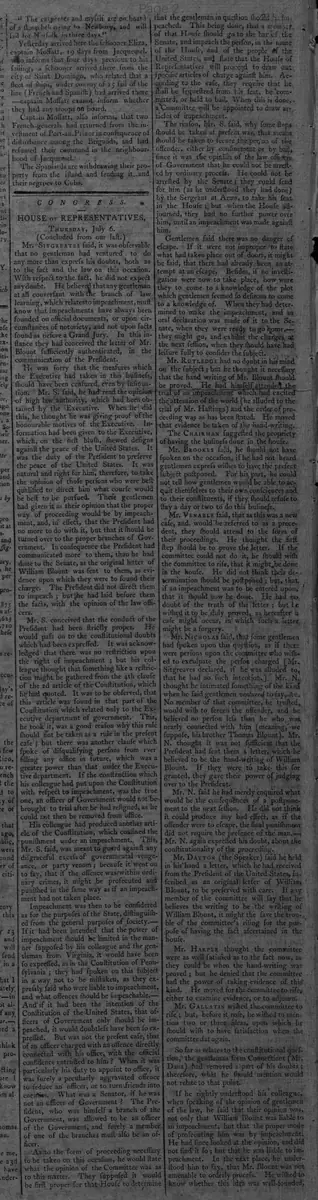
HOUSE OF REPRESENTATIVES,
THURSDAY, July 6.
Mr. Sitgreaves said, it was observable that no gentleman had ventured to do any more than express his doubts, both as to the fact and the law on this occasion. With respect to the fact, he did not expect any doubt. He believed that any gentleman at all conversant with the branch of law learning, which relates to impeachment, must know that impeachments have always been founded on official documents, or upon circumstances of notoriety, and not upon facts found as before a Grand Jury. In this instance they had conceived the letter of Mr. Blount sufficiently authenticated, in the communication of the President.
He was sorry that the measures which the Executive had taken in this business, should have been censured, even by insinuation. Mr. S. said, he had read the opinion of high law authority, which had been obtained by the Executive. When he did this, he thought he was giving proof of the honourable motives of the Executive. Information had been given to the Executive, which, on the first blush, shewed designs against the peace of the United States. It was the duty of the President to preserve the peace of the United States. It was natural and right for him, therefore, to take the opinion of those persons who were best qualified to direct him what course would be best to be pursued. These gentlemen had given it as their opinion that the proper way of proceeding would be by impeachment, and, in effect, that the President had no more to do with it, but that it should be turned over to the proper branches of Government. In consequence the President had communicated more to them, than he had done to the Senate, as the original letter of William Blount was sent to them, as evidence upon which they were to found their charge. The President did not direct them to impeach; but he had laid before them the facts, with the opinion of the law officers.
Mr. S. conceived that the conduct of the President had been strictly proper. He would pass on to the constitutional doubts which had been expressed. It was acknowledged that there was no restriction upon the right of impeachment; but his colleague thought that something like a restriction might be gathered from the 4th clause of the 2d article of the Constitution, which he had quoted. It was to be observed, that this article was found in that part of the Constitution which related only to the Executive department of government. This, he took it, was a good reason why this rule should not be taken as a rule in the present case; but there was another clause which spoke of disqualifying persons from ever filling any office in future, which was a greater power than that under the Executive department. If the construction which his colleague had put upon the Constitution with respect to impeachment, was the true one, an officer of Government would not be brought to trial after he had resigned, as he could not then be removed from office.
His colleague had produced another article of the Constitution, which confined the punishment under an impeachment. This, Mr. S. said, was meant to guard against any disgraceful excess of governmental vengeance, or party venom; because it went on to say, that if the offence was within ordinary crimes, it might be prosecuted and punished in the same way as if an impeachment had not taken place.
Impeachment was then to be considered as for the purposes of the State, distinguished from the general purposes of society.—If it had been intended that the power of impeachment should be limited in the manner supposed by his colleague and the gentleman from Virginia, it would have been so expressed, as in the Constitution of Pennsylvania; they had spoken on this subject in a way not to be mistaken, as they expressly said who were liable to impeachment, and what offences should be impeachable.—And if it had been the intention of the Constitution of the United States, that officers of Government only should be impeached, it would doubtless have been so expressed. But was not the present case, that of an officer charged with an offence directly connected with his office, with the official confidence entrusted to him? When it was particularly his duty to appoint to office, it was surely a peculiarly aggravated offence to seduce an officer, or to turn friends into enemies. What was a Senator, if he was not an officer of Government? The President, who was himself a branch of the Government, was allowed to be an officer of the Government, and surely a member of one of the branches must also be an officer.
As to the form of proceeding necessary to be taken on this occasion, he would state what this opinion of the Committee was as to this matter. They supposed it would be first proper for that House to determine that the gentleman in question should be impeached. This being done, that a member of that House should go to the bar of the Senate, and impeach the person, in the name of the House, and of the people of the United States, and state that the House of Representatives will proceed to draw out precise articles of charge against him. According to the case, they require that he shall be sequestered from his seat, be committed, or held to bail. When this is done, a Committee will be appointed to draw articles of impeachment.
The reason, Mr. S. said, why some steps should be taken at present was, that means should be taken to secure the person of the offender, either by confinement or by bail since it was the opinion of the law officers of Government that he could not be arrested by ordinary process. He could not be arrested by the Senate's they could send for him (as he understood they had done) by the Sergeant at Arms, to take his seat in the House ; but when the House adjourned, they had no further power over him, until an impeachment was made against him.
Gentlemen said there was no danger of escape. If it were not improper to state what had taken place out of doors, it might be said, that there had already been, an attempt at an escape. Besides, if no investigation were now to take place, how were they to come to a knowledge of the plot which gentlemen seemed so desirous to come to a knowledge of. When they had determined to make the impeachment, and an oral declaration was made of it to the Senate, when they were ready to go home, they might go, and exhibit the charges, at the next session, when they should have had leisure fully to consider the subject.
Mr. Rutledge had no doubt in his mind on the subject; but he thought it necessary that the hand writing of Mr. Blount should be proved. He had himself attended the trial of an impeachment which had excited the attention of the world (he alluded to the trial of Mr. Hastings) and the order of proceeding was as has been stated. He moved that evidence be taken of the hand-writing.
The Chairman suggested the propriety of having the business done in the house.
Mr. Brookes said, he should not have spoken on the occasion, if he had not heard gentlemen express wishes to have the present subject postponed. For his part, he could not tell how gentlemen would be able to acquit themselves to their own consciences and to their constituents, if they should refuse to stay a day or two to do this business.
Mr. Venable said, that as this was a new case, and would be referred to as a precedent, they should attend to the form of their proceedings. He thought the first step should be to prove the letter. If the committee could not do it, he should wish the committee to rise, that it might be done in the house. He did not think their determination should be postponed; but, that if an impeachment was to be entered upon, that it should now be done. He had no doubt of the truth of the letter; but he wished it to be proved, as hereafter a case might occur, in which such a letter might be a forgery.
Mr. Nicholas said, that some gentlemen had spoken upon this question, as if there were persons upon the committee who wished to exculpate the person charged [Mr. Sitgreaves declared, if he was alluded to, that he had no such intention]. Mr. N. thought he intimated something of the kind when he said gentlemen ventured to say, &c. No member of that committee, he trusted, would wish to screen the offender, and he believed no person less than he who was nearly connected with him (meaning, we suppose, his brother Thomas Blount). Mr. N. thought it was not sufficient that the President had sent them a letter, which he believed to be the hand-writing of William Blount. If they were to take this for granted, they gave their power of judging over to the President.
Mr. N. said he had merely enquired what would be the consequences of a postponement to the next session. He did not think it could produce any bad effect, as if the offender were to escape, the final punishment did not require the presence of the man,—
Mr. N. again expressed his doubt, about the constitutionality of the proceeding.
Mr. Dayton (the Speaker) said he held in his hand a letter, which he had received from the President of the United States, inscribed as an original letter of William Blount, to be preserved with care: If any member of the committee will say that he believes the writing to be the writing of William Blount, it might then save the trouble of the committee's rising for the purpose of having the fact ascertained in the house.
Mr. Harper thought the committee were as well satisfied as to the fact now, as they could be when the hand-writing was proved; but he denied that the committee had the power of taking evidence of this kind. He moved for the committee to rise, either to examine evidence, or to adjourn.
Mr. Gallatin wished the committee to rise; but, before it rose, he wished to mention two or three ideas, upon which he should wish to have satisfaction when the committee met again.
So far as relates to the constitutional question, the gentleman from Connecticut (Mr. Dana) had removed a part of his doubts; therefore, what he should mention would not relate to that point.
If he rightly understood his colleague when speaking of the opinion of gentlemen of the law, he said that their opinion was not only that William Blount was liable to an impeachment, but that this proper mode of prosecuting him was by impeachment. He had since looked at the opinion, and did not find it so; but that he was liable to impeachment. In the next place, he understood him to say, that Mr. Blount was not amenable to ordinary process. He wished to know whether this idea was well-founded,
and whether the only mode in which he could be prosecuted was by impeachment.
He wished to know this that he might regulate his proceedings accordingly. He wished the business to be gone into as fully as possible; and he trusted that this mode of impeachment was not thrown upon them in order to prevent the bringing of the subject before a court of justice, and by that means suppress the inquiry which he wished to prosecute. He thought an investigation of the plot was of far greater consequence than the impeachment and disqualification of an individual. If the prosecution and the inquiry were to go on together, it would be well; but he wished to know whether, if they entered upon the impeachment, it was the design to drop every other mode of proceeding.
Mr. McDowell hoped the committee would not rise for the purpose of proving the hand-writing of Mr. Blount. He was acquainted with his writing, and believed it to be his. As he had this belief, he wished to come to a determination as soon as possible. He thought the design a very criminal one, as it went not only to destroy the peace and happiness of this country, but also of others. He trusted, therefore, that they should take such steps as should prevent foreign ministers in future from engaging persons to carry into effect views of this kind.
Mr. Harper wished the committee to rise. If the gentleman from Pennsylvania had known any thing of the law, he must have known, that the courts of justice were wholly inadequate to the inquiries he had mentioned. He did not believe this offence was punishable in any other way than by impeachment. Mr. H. said it was at present unnecessary to say any thing about any other persons being implicated in this business; he believed gentlemen might as well spare their insinuations until they were better acquainted with the subject. He believed when they had read the papers, gentlemen would be convinced the charges brought against the British minister were unfounded.
Mr. Brooks wished to know whether they could proceed to impeach a man if he were not present.
Mr. Dana said, when this subject was under debate with closed doors, the secretary of state was present, and when it was doubted whether the publication of these papers might impede the prosecution of an inquiry into the business, they were informed by him that such steps were taken that the publication of the papers could not have a bad effect.
The committee rose, and obtained leave to sit again.
It was proposed that the Speaker should proceed to take evidence as to the hand-writing of the letter of William Blount.
The Speaker suggested the propriety of calling in a magistrate, as he had no power to administer an oath, except in the case of qualifying the members of that house.
Mr. Lyon moved that the Speaker be authorized to administer an oath on this occasion.
The question was put and negatived 53 to 29.
Judge Keene, in the mean time coming into the house, a motion was made and carried, that he be requested to administer the oath to Messrs. Macon, McDowell, Grove, and Baldwin, which was accordingly done, and they gave their testimony as to the reality of the hand-writing as stated yesterday.
FRIDAY, JULY 7.
Mr. D. Foster moved a resolution for an adjournment on Monday.
Mr. Havens moved to amend the resolution by inserting Saturday.
This amendment, after some conversation, was negatived 50 to 23, and the original motion was carried without a division.
The order of the day was moved on the bill for the relief of major Thomas Lewis.
The house went into a committee on the subject, and reported the bill without amendment. It was ordered to be engrossed for a third reading, which it afterwards received and passed.
Mr. Sitgreaves moved to go into a committee of the whole on the report of the committee on the confidential communication of the President of the United States on Monday last.
The Speaker said, before the house went into a committee of the whole on this subject, he would read a letter which he had just received. He read a letter from Thomas Blount, requesting to be excused from voting on the question which so nearly concerned his brother.
He was excused.
The house then went into a committee of the whole on the resolution yesterday reported, proposing an impeachment of William Blount, when it was agreed to without debate or division. The house took up the resolution, and also agreed to it in the same way.
Mr. Sitgreaves moved, "that a member go to the Senate, and at the bar of that house impeach William Blount, in the name of this house, and of all the people of the United States, and to inform them that they will, in due time, exhibit articles of impeachment against him, and make good the same."
Mr. Gallatin said, he was not well acquainted with the business; but he did not think it would be right to go on and impeach at once, before they saw what articles of impeachment were to be preferred. He thought it would be best first to appoint a committee to prepare the articles of impeachment, and present them to the Senate, at the same time that they sent them their determination to impeach.
Mr. Sitgreaves said, that the mode which he proposed, was the same which was practiced in the case of Mr. Hastings. Mr. Burke went up to the house of Lords and impeached him in words similar to those now proposed to be used. Some time afterwards the articles of impeachment having been drawn, Mr. Burke again went up to the house of Lords and exhibited them. Mr. S. spoke also of a work lately published, in continuation of Judge Blackstone's Commentaries, which had a chapter on parliamentary impeachment, and pointed out this as the proper mode of procedure. He had also looked into the proceedings on the trial of the earl of Macclesfield, and found the same course was taken. It was true, that in the case of a public officer of the state of Pennsylvania, which perhaps his colleague might have in his eye, the articles of impeachment were exhibited at the same time that the impeachment was made.
Mr. S. thought, however, that there was a good reason for not doing more at this time. If a Committee were to be appointed to prepare the specific charges against Mr. Blount, it would create considerable delay, and it would be proper that immediate measures should be taken, in order to secure the person of Mr. Blount. Besides, at present, the only evidence of this mysterious business, was the letter of Mr. Blount. Measures were taken to procure further evidence; but it could not be got till some time hence. When this was got, it might considerably develope the plot. At present, every thing was conjecture. In every point of view, therefore, he thought it would be best to observe the usual mode of proceeding in similar cases.
Mr. Gallatin said, if his memory was right, all the specific charges brought against Warren Hastings, were first agreed to by the House of Commons, before impeachment was made.
There was one thing, however, fell from his colleague, which would seem to make the mode proposed desirable. Mr. G. said he had considered the question which had been agreed to as a mere question of form, and that they should have gone on to exhibit articles of impeachment; but it appeared from what had fallen from his colleague, that the articles of impeachment were not intended to be exhibited till next session. If this were the case, he thought it was perfectly right in wishing to present the impeachment in general terms. Till now he thought it had been the intention to have gone further.
Mr. Harper believed it would not be proper for the House to stop in the present stage of their proceeding. He thought the proper mode of doing the business was that recommended by Mr. Sitgreaves. Having come to a resolution to impeach, the Senate should be immediately informed thereof, as they could then take measures accordingly. It was not necessary at the same time to exhibit the particular charges. They might afterwards determine whether they would exhibit the specific articles of charge during this session, or at the next. He thought the charge might now be made; and if any additional facts appeared before the next session, which might make additional charges necessary, they might then be made.
Mr. Sitgreaves believed his colleague might be right with respect to what took place on the trial of Mr. Hastings. He had not the particulars of the parliamentary proceedings on that business before him. He had those in the case of the Earl of Macclesfield, which were as he had stated. All that he contended for was, that having taken the resolution to impeach, it became necessary, of course, that the resolution should be communicated to the Senate. In no instance had the articles of impeachment attended the oral communication. After it had been made, the House could determine whether the specific articles should be drawn now, or at the next session.
Mr. Gordon said, there might be different modes adopted in cases where the persons accused were not members of the Legislature. In the case of lord Strafford, he recollected, that in half an hour after the vote passed resolving to impeach him, he was taken into execution.
The question was put and carried without a division.
Mr. Sitgreaves proposed also the following: "That the said member do demand that the said William Blount be sequestered from his seat in the Senate, and that they take order for his appearance to answer to the charges which shall be exhibited against him."
Mr. Venable thought they had gone far enough, and that they should leave it to the Senate to take such measures as they should think proper with respect to displacing their member from his seat. If the resolution were, however, adopted, he wished the word suspended might be used rather than sequestered.
Mr. Sitgreaves thought the word synonymous. He had used sequestered, because he found the word used in the books.
Mr. Harper thought the motion right in substance; for though the Senate had the power of displacing their member from his seat; yet the taking order for his appearance to answer the charges brought against him, should be done from the application of the prosecutor, as in ordinary cases.
Mr. Sewall thought that each House was the best judge of the conduct of its own members, and to require the sequestration of Mr. Blount from his seat was not necessary. He believed the Senate were at that moment taking measures for expelling him from his seat, any interference of theirs on that subject was therefore wholly unnecessary.
Mr. Nicholas was of opinion that in following too closely the practice of Great Britain with respect to impeachment, they should be lead astray, as the punishment consequent upon the conviction of an offender was very different in the two countries. In Britain, an offence might reach the life of a person, whereas in this country, the extent of the punishment, was removal from office, and disqualification for the future. For his own part, therefore, he did not see any occasion for confinement of the person, except it were necessary to examine him by interrogatory.
Mr. Harper said it was certainly necessary to secure the person of the offender, otherwise he could not be brought to trial; since it was a maxim never to be departed from that a person could not be tried in his absence.
Mr. Sitgreaves was of the same opinion.
Mr. Venable agreed with Mr. Nicholas, that the difference of punishment consequent upon trials by impeachment was not sufficiently attended to. He did not think that the doctrine was founded, that a man could not be tried in his absence. It would be an unfortunate conclusion, that effectual process could not be had against a man because he was absent.
Mr. Kittera said the gentleman last up was certainly mistaken in saying that a man might be tried in his absence. He thought it would be best to pursue the usual mode on similar occasions.
Mr. Gordon insisted upon the right which that house had to require the Senate to sequester Mr. Blount from his seat, and that they should hold him to answer the charges to be exhibited against him. If this were not the case an offender might, go on to execute his purposes to the great injury of the country, before he was expelled from his seat or held to bail.
Mr. Sewall had no idea that it was necessary to sequester Mr. Blount from his seat in order to hold him to appear to the charges to be exhibited against him; though he conceived it necessary to hold him to bail, as no trial could take place except he was present.
This proposition was put and carried 41 to 30.
Mr. Sitgreaves was appointed to wait upon the Senate, to carry into effect the above proposition.
The Speaker read a note which he had received from a member of the Senate informing him that seats were prepared for the reception of the members of that house, in case they chose to attend the business then before the Senate which was the question for expelling Mr. Blount from his seat, opposed by the counsel of Mr. Blount, viz. Messrs. Dallas and Ingersoll.
Mr. Dent moved that when the house adjourn, it adjourn till two o'clock. Agreed, and the house adjourned about 12 o'clock, and attended the Senate.
At two o'clock the house re-summed its sitting; and after Mr. Sitgreaves had made a report of his commission to the Senate, the house resolved itself into a committee of the whole on Algerine business, and the galleries were closed for the remainder of the sitting.
SATURDAY, July 8.
A message was received from the Senate, informing the house that they had agreed to their amendment to the appropriation bill; and that they had in consequence of their impeachment of William Blount, a Senator of the United States, proceeded to hold him to bail to appear to the charges to be exhibited against him, himself in 20,000 dollars, and two sureties each in 10,000 dollars.
By messages from the President of the United States to the two houses it appears that he has approved and signed the act for laying a stamp duty on parchment, vellum and paper: also the act allowing full mileage to the members of the two houses; the act concerning consuls and vice-consuls; and the act to continue in force an act authorizing the transfer of the stock standing to the credit of certain states.
On motion of Mr. Macon, the committee of the whole to whom was referred the bill authorizing the President of the United States during the recess of Congress, to provide armed galleys, was discharged.
Mr. Harper said it would be recollected that he had laid two resolutions on the table relative to the securing of live oak timber, &c. From the press of business, which had been continually before the house, he had not had an opportunity of calling them up; and the session being now too far advanced, he gave notice that he should bring forward the subject early in the next session.
Mr. Holmes said that he thought it necessary, in order to enforce a general compliance with the laws of the United States, that they should be printed in the German language, as well as in the English, since there were very many of the inhabitants of this country who could read no other. He therefore proposed a resolution to the following effect:
Resolved by the Senate and House of Representatives of the United States, that a number of copies of the laws of this session, not exceeding 8,000 copies, shall be printed in the German language, and distributed by the Secretary of State among the Executives of the several states, for the information of the German inhabitants of each state respectively.
Mr. Lyon thought it would be proper to pass a resolution of this kind. He did not know what number might be necessary. He also thought that some measures should be taken for a general publication of their laws in the English language; at present, it was merely by chance if the people in his district came to a knowledge of them. He thought all laws of general import should be inserted in every newspaper throughout the Union.
Mr. Coxe said, if they were to promulge their laws in the German language it would be necessary that they should all become critically acquainted with it, for, if they were to authorize any translation, great mischiefs would arise from its not being correct.
Mr. Gallatin said, that the weight of the objections urged by the gentlemen last up had always been thought sufficient in the Legislature of Pennsylvania, in which state there was a greater proportion of Germans than in any other. There was also another objection to the measure. If it were to be passed, it must be accompanied with an appropriation law which the advanced state of the session would not admit.
The resolution was put and negatived.
Mr. Sitgreaves proposed the following resolution to the house:
"Resolved, that a committee be appointed to prepare and report articles of impeachment against William Blount, a Senator of the United States impeached by this house of High Crimes and Misdemeanors, and that the same Committee have power to sit during the recess of Congress, and to send for persons, papers and records."
Mr. Gallatin wished a division of the resolution at the word misdemeanors.
The first part was then put and carried.
Mr. Gallatin desired the determination on the second part to be postponed till Monday. It was a new subject, and he wished a little time to consider of it. The committee he supposed could in the mean time be appointed.
Mr. Brooks enquired whether the latter part of the resolution for sending for "persons, papers and records," should not be connected with the first part of the resolution.
Mr. Venable said the gentleman last up might be accommodated by adding the words in question; and if, before they adjourned, it was found necessary that the committee should have power to sit during the recess, that power could be given to them.
Mr. Sitgreaves did not think it would be proper to pass one part of the resolution without the other. The house had resolved to adjourn on Monday, and there was little doubt that the other branch of the legislature would agree to it. If the committee should be appointed to report articles of Impeachment at this session, it would be found that it would require more time than he believed Congress would be inclined to give to it: for if prepared, they must also be exhibited; and if exhibited the Senate, would think it necessary to proceed to act upon them. In this view of the subject, great advantage might arise from the committee's having leisure to pursue enquiry into the plan, so as to develope the mischief during the recess of Congress.
Mr. Venable said the object of gentlemen seemed to be mistaken. They wished merely to have a little time to consider of the subject. He had doubts whether it was in the power of the house to authorize a committee to sit during the recess.
Mr. Sitgreaves did not wish to hurry the business.
Mr. Rutledge had no objection to deferring the vote till Monday; but he thought it absolutely necessary to empower the committee to sit during the recess. This was according to British precedent. It was the plan also upon which two different impeachments had been conducted in the State of South Carolina. He thought the reason in this case very strong; the object was not only to bring the charge home to the person impeached, but to bring forward all the persons concerned in this plot. Indeed the articles of impeachment must be founded, in a great measure, on information which was to be discovered by this investigation. He trusted, therefore that this power would be given.
Mr. Gallatin said he was in no want of precedent on this occasion. He was a member of a committee of impeachment in the state of Pennsylvania, where similar measures were adopted; but he was of opinion that this business had been already too much hurried, and that some of the steps taken would have been better taken, if they had had more time. He wished, therefore, to consider upon this proposition till Monday. Gentlemen who brought forward the measure were doubtless ready to vote for it; but he trusted they would allow others a little time.
Mr. McDowell wished a committee to be immediately appointed, and the charges made, because there might be at present persons in the city, who could not be examined during the recess of Congress.
The words "to send for persons, papers and records," were to be added to the former part of the resolution, and the latter part was postponed till Monday.
Messrs. Sitgreaves, Baldwin, Dawson, Dana and Harper were appointed a committee for preparing the articles of impeachment.
Mr. Harper said, that though he did not intend to bring forward the subject of purchasing timber, and providing naval yards this session, he wished the house to enter into a resolution which he thought would be proper in the mean time. He offered one to the following effect:
"Resolved that the President of the United States be requested to prosecute and cause to be laid before this house, early in the next session, information respecting such land furnished with live oak timber, as may be purchased for the use of the United States, and also of such timber as may be purchased without the land, and also respecting proper sites for naval yards, and to state the probable expense of such land and timber, and of proper sites for naval yards."
This resolution was supported by the mover and Mr. Swanwick, and opposed by Messrs. Macon, J. Williams, and McDowell; and without taking a question, the house being very thin, a motion was made and carried about one o'clock to adjourn.
Monday, July 10, 1797.
A message was received from the Senate informing the house what had been done with respect to governor Blount; that they, had agreed to their resolution for an adjournment of the two Houses this day; and that they had postponed the consideration of the bill for the relief of Major Lewis till next session.
On motion of Mr. Dent, a committee was appointed to wait upon the President of the United States, in conjunction with a like committee from the Senate, to inform him the two houses were about to adjourn. The committee waited upon the President accordingly, and reported his acquiescence, and his good wishes for the safe arrival of the members at their several homes.
On motion of Mr. Sitgreaves, the resolution entered into some time ago, calling upon the President for an account of the quantity of arms in the possession of the United States, and at what places they were lodged, was suspended.
Mr. Sitgreaves said he wished to make a report upon a subject which would require the galleries to be cleared; they continued shut till the House adjourned to the second Monday in November.
What sub-type of article is it?
What themes does it cover?
What keywords are associated?
What entities or persons were involved?
Where did it happen?
Story Details
Key Persons
Location
House Of Representatives
Event Date
July 6 10, 1797
Story Details
House debates authenticity of Blount's incriminating letter, constitutional aspects of impeaching a senator, procedures following British precedents, votes to impeach Blount for high crimes and misdemeanors related to a plot against U.S. peace, appoints committee to prepare articles during recess, secures bail via Senate.