Thank you for visiting SNEWPapers!
Sign up free
Literary
April 10, 1882
The Tombstone Epitaph
Tombstone, Pima County, Cochise County, Arizona
What is this article about?
Narrative of Francisco Pizarro's conquest of Peru in 1531-1538, capturing Inca emperor Atahualpa, receiving gold ransom, founding Lima, defeating rivals, and his assassination by Diego de Almagro's son amid family.
Clipping
OCR Quality
82%
Good
Full Text
CONQUEST OF PERU.
A Cell Full of Solid Gold as a Ransom for a Captive-The Aged Chieftain Assassinated in his Home and Before his Family's Eyes.
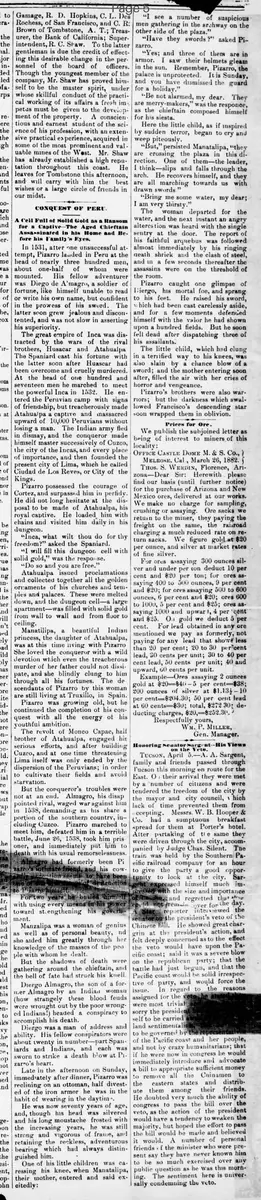
In 1531, after one unsuccessful attempt, Pizarro landed in Peru at the head of nearly three hundred men, about one-half of whom were mounted. His fellow adventurer was Diego de Almagro, a soldier of fortune, like himself unable to read or write his own name, but confident in the prowess of his sword. The latter soon grew jealous and discontented, and was not slow in asserting his superiority. The great empire of Inca was distracted by the wars of the rival brothers, Huascar and Atahualpa. The Spaniard cast his fortune with the latter soon after Huascar had been overcome and cruelly murdered. At the head of one hundred and seventeen men he marched to meet the powerful Inca in 1532. He entered the Peruvian camp with signs of friendship, but treacherously made Atahualpa a captive and massacred upward of 10,000 Peruvians without losing a man. The Indian army fled in dismay, and the conqueror made himself master successively of Cuzco, the city of the Incas, and every place of importance, and then founded the present city of Lima, which he called Ciudad de Los Reyes, or City of the Kings. Pizarro possessed the courage of Cortez, and surpassed him in perfidy. He did not long hesitate at the disposal to be made of Atahualpa, his royal captive. He loaded him with chains and visited him daily in his dungeon. "Inca, what wilt thou do for thy freedom?" asked the Spaniard. "I will fill this dungeon cell with solid gold," was the response. "Do so and you are free." Atahualpa issued proclamations and collected together all the golden ornaments of his churches and temples and palaces. These were melted down, and the dungeon cell-a large apartment-was filled with solid gold from wall to wall and from floor to ceiling. Manatilipa, a beautiful Indian princess, the daughter of Atahualpa was at this time living with Pizarro. She loved the conqueror with a wild devotion which even the treacherous murder of her father could not dissipate, and she blindly clung to him through all his fortunes. The descendants of Pizarro by this woman are still living at Truxillo, in Spain. Pizarro was growing old, but he continued the completion of his conquest with all the energy of his youthful ambition. The revolt of Manco Capac, half brother of Atahualpa, engaged his serious efforts, and after building Cuzco, and at one time threatening Lima itself was only ended by the dispersion of the Peruvians; in order to cultivate their fields and avoid starvation. But the conqueror's troubles were not at an end. Almagro, his disappointed rival, waged war against him in 1538, demanding as his share a portion of the southern country, including Cuzco. Pizarro marched to meet him, defeated him in a terrible battle, June 26, 1538, took him prisoner, and immediately put him to death with his usual remorselessness. Almagro had formerly been Pizarro's intimate friend, and his conqueror to have been Pizarro's intimate friend, and his conqueror to have been remorseless to Pizarro himself. For two years he busied himself with using every means in his power toward strengthening his government. Manatilipa was a woman of genius as well as of personal beauty, and she aided him greatly through her knowledge of the masses of the people with whom he dealt. But the shadows of death were gathering around the chieftain, and the bell of fate had struck his knell. Diego Almagro, the son of a former Almagro by an Indian woman (how strangely these blood feuds were wrought out by the poor wronged Indians!) headed a conspiracy to accomplish his death. Diego was a man of address and ability. His fellow conspirators were about twenty in number—part Spaniards and Indians, and each was sworn to strike a death blow at Pizarro's heart. Late in the afternoon on Sunday, immediately after dinner, Pizarro was reclining on an ottoman, half divested of the iron armor he was in the habit of wearing in the daytime. He was now seventy years of age, and, though his head was silvered and his long moustache frosted with the increasing years, he was still strong and vigorous of frame, and retaining the reckless, adventurous bearing which had always distinguished him. One of his little children was caressing his knee, when Manatilipa, their mother, entered and said excitedly: "I see a number of suspicious men gathering in the archway on the other side of the plaza." "Have they swords?" asked Pizarro. "Yes; and three of them are in armor. I saw their helmets gleam in the sun. Remember, Pizarro, the palace is unprotected. It is Sunday, and you have dismissed the guard for a holiday." "Be not alarmed, my dear. They are merry-makers," was the response, as the chieftain composed himself for his siesta. Here the little child, as if inspired by sudden terror, began to cry and weep piteously. "But," persisted Manatilipa, "they are crossing the plaza in this direction. One of them-the leader I think-slips and falls through the arch. He recovers himself, and they are all marching towards us with drawn swords." "Bring me some water, my dear; I am very thirsty." The woman departed for the water, and the next instant an angry altercation was heard with the single sentry at the door. The report of his faithful arquebus was followed almost immediately by his ringing death shriek and the clash of steel, and in a few seconds thereafter the assassins were on the threshold of the room. Pizarro caught one glimpse of Diego, his mortal foe, and sprang to his feet. He raised his sword, which had been cast carelessly aside, and for a few moments defended himself with the valor he had shown upon a hundred fields. But he soon fell dead after dispatching three of his assailants. The little child, which had clung in a terrified way to his knees, was also slain by a chance blow of a sword; and the mother entering soon after, filled the air with her cries of horror and vengeance. Pizarro's brothers were also warriors; but the darkness which swallowed Francisco's descending star soon wrapped them in oblivion.
A Cell Full of Solid Gold as a Ransom for a Captive-The Aged Chieftain Assassinated in his Home and Before his Family's Eyes.
In 1531, after one unsuccessful attempt, Pizarro landed in Peru at the head of nearly three hundred men, about one-half of whom were mounted. His fellow adventurer was Diego de Almagro, a soldier of fortune, like himself unable to read or write his own name, but confident in the prowess of his sword. The latter soon grew jealous and discontented, and was not slow in asserting his superiority. The great empire of Inca was distracted by the wars of the rival brothers, Huascar and Atahualpa. The Spaniard cast his fortune with the latter soon after Huascar had been overcome and cruelly murdered. At the head of one hundred and seventeen men he marched to meet the powerful Inca in 1532. He entered the Peruvian camp with signs of friendship, but treacherously made Atahualpa a captive and massacred upward of 10,000 Peruvians without losing a man. The Indian army fled in dismay, and the conqueror made himself master successively of Cuzco, the city of the Incas, and every place of importance, and then founded the present city of Lima, which he called Ciudad de Los Reyes, or City of the Kings. Pizarro possessed the courage of Cortez, and surpassed him in perfidy. He did not long hesitate at the disposal to be made of Atahualpa, his royal captive. He loaded him with chains and visited him daily in his dungeon. "Inca, what wilt thou do for thy freedom?" asked the Spaniard. "I will fill this dungeon cell with solid gold," was the response. "Do so and you are free." Atahualpa issued proclamations and collected together all the golden ornaments of his churches and temples and palaces. These were melted down, and the dungeon cell-a large apartment-was filled with solid gold from wall to wall and from floor to ceiling. Manatilipa, a beautiful Indian princess, the daughter of Atahualpa was at this time living with Pizarro. She loved the conqueror with a wild devotion which even the treacherous murder of her father could not dissipate, and she blindly clung to him through all his fortunes. The descendants of Pizarro by this woman are still living at Truxillo, in Spain. Pizarro was growing old, but he continued the completion of his conquest with all the energy of his youthful ambition. The revolt of Manco Capac, half brother of Atahualpa, engaged his serious efforts, and after building Cuzco, and at one time threatening Lima itself was only ended by the dispersion of the Peruvians; in order to cultivate their fields and avoid starvation. But the conqueror's troubles were not at an end. Almagro, his disappointed rival, waged war against him in 1538, demanding as his share a portion of the southern country, including Cuzco. Pizarro marched to meet him, defeated him in a terrible battle, June 26, 1538, took him prisoner, and immediately put him to death with his usual remorselessness. Almagro had formerly been Pizarro's intimate friend, and his conqueror to have been Pizarro's intimate friend, and his conqueror to have been remorseless to Pizarro himself. For two years he busied himself with using every means in his power toward strengthening his government. Manatilipa was a woman of genius as well as of personal beauty, and she aided him greatly through her knowledge of the masses of the people with whom he dealt. But the shadows of death were gathering around the chieftain, and the bell of fate had struck his knell. Diego Almagro, the son of a former Almagro by an Indian woman (how strangely these blood feuds were wrought out by the poor wronged Indians!) headed a conspiracy to accomplish his death. Diego was a man of address and ability. His fellow conspirators were about twenty in number—part Spaniards and Indians, and each was sworn to strike a death blow at Pizarro's heart. Late in the afternoon on Sunday, immediately after dinner, Pizarro was reclining on an ottoman, half divested of the iron armor he was in the habit of wearing in the daytime. He was now seventy years of age, and, though his head was silvered and his long moustache frosted with the increasing years, he was still strong and vigorous of frame, and retaining the reckless, adventurous bearing which had always distinguished him. One of his little children was caressing his knee, when Manatilipa, their mother, entered and said excitedly: "I see a number of suspicious men gathering in the archway on the other side of the plaza." "Have they swords?" asked Pizarro. "Yes; and three of them are in armor. I saw their helmets gleam in the sun. Remember, Pizarro, the palace is unprotected. It is Sunday, and you have dismissed the guard for a holiday." "Be not alarmed, my dear. They are merry-makers," was the response, as the chieftain composed himself for his siesta. Here the little child, as if inspired by sudden terror, began to cry and weep piteously. "But," persisted Manatilipa, "they are crossing the plaza in this direction. One of them-the leader I think-slips and falls through the arch. He recovers himself, and they are all marching towards us with drawn swords." "Bring me some water, my dear; I am very thirsty." The woman departed for the water, and the next instant an angry altercation was heard with the single sentry at the door. The report of his faithful arquebus was followed almost immediately by his ringing death shriek and the clash of steel, and in a few seconds thereafter the assassins were on the threshold of the room. Pizarro caught one glimpse of Diego, his mortal foe, and sprang to his feet. He raised his sword, which had been cast carelessly aside, and for a few moments defended himself with the valor he had shown upon a hundred fields. But he soon fell dead after dispatching three of his assailants. The little child, which had clung in a terrified way to his knees, was also slain by a chance blow of a sword; and the mother entering soon after, filled the air with her cries of horror and vengeance. Pizarro's brothers were also warriors; but the darkness which swallowed Francisco's descending star soon wrapped them in oblivion.
What sub-type of article is it?
Prose Fiction
What themes does it cover?
War Peace
Political
What keywords are associated?
Conquest Of Peru
Pizarro
Atahualpa
Gold Ransom
Assassination
Inca Empire
Diego Almagro
Literary Details
Title
Conquest Of Peru.
Subject
The Conquest Of The Inca Empire By Francisco Pizarro
Key Lines
"Inca, What Wilt Thou Do For Thy Freedom?" Asked The Spaniard. "I Will Fill This Dungeon Cell With Solid Gold," Was The Response. "Do So And You Are Free."
Pizarro Caught One Glimpse Of Diego, His Mortal Foe, And Sprang To His Feet. He Raised His Sword, Which Had Been Cast Carelessly Aside, And For A Few Moments Defended Himself With The Valor He Had Shown Upon A Hundred Fields. But He Soon Fell Dead After Dispatching Three Of His Assailants.