Thank you for visiting SNEWPapers!
Sign up free
Literary
July 17, 1828
The Litchfield County Post
Litchfield, Litchfield County, Connecticut
What is this article about?
Biographical memoir of Julia Brace, a deaf, blind, and dumb girl at the Hartford Asylum for the Deaf and Dumb, detailing her early life, remarkable intelligence, moral virtues, daily habits, and serving as a lesson in gratitude for sensory abilities to young readers.
Clipping
OCR Quality
95%
Excellent
Full Text
From the Juvenile Miscellany.
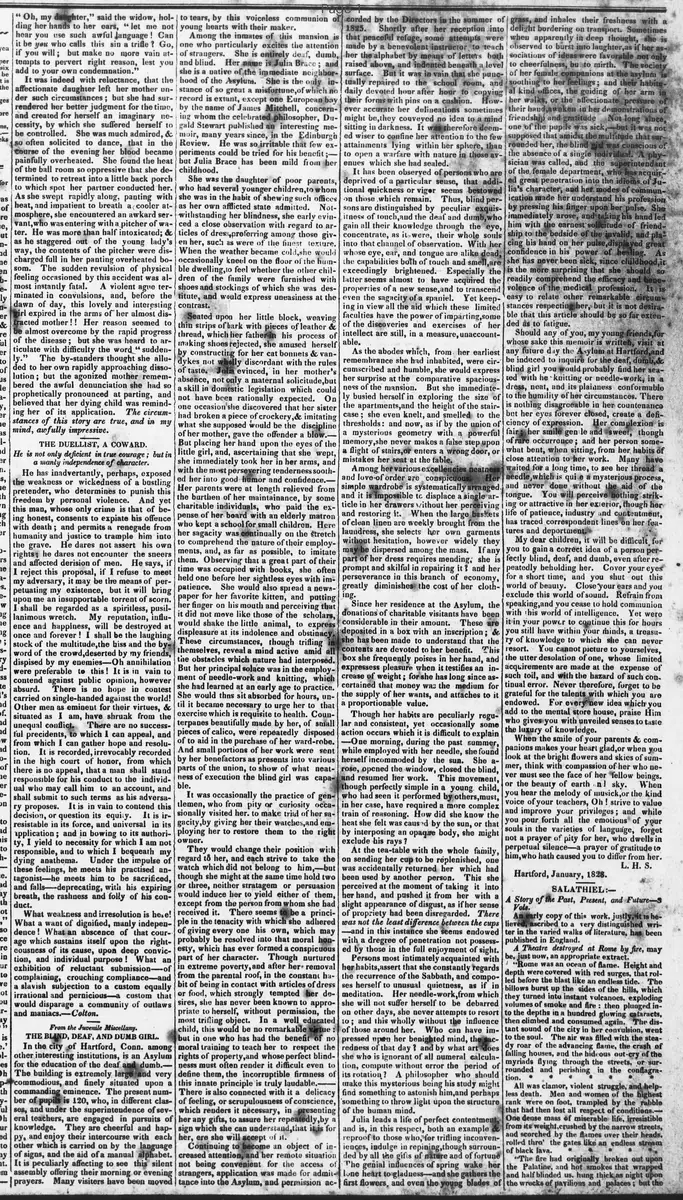
THE BLIND, DEAF, AND DUMB GIRL
In the city of Hartford, Conn. among other interesting institutions, is an Asylum for the education of the deaf and dumb. The building is extremely large and very commodious, and finely situated upon a commanding eminence. The present number of pupils is 120, who, in different classes, and under the superintendence of several teachers, are engaged in pursuits of knowledge. They are cheerful and happy, and enjoy their intercourse with each other which is carried on by the language of signs, and the aid of a manual alphabet. It is peculiarly affecting to see this silent assembly offering their morning or evening to tears, by this voiceless communion of young hearts with their maker.
Among the inmates of this mansion is one who particularly excites the attention of strangers. She is entirely deaf, dumb, and blind. Her name is Julia Brace; and she is a native of the immediate neighborhood of the Asylum. She is the only instance of so great a misfortune, of which no record is extant, except one European boy by the name of James Mitchell, concerning whom the celebrated philosopher, Dugald Stewart published an interesting memoir, many years since, in the Edinburgh Review. He was so irritable that few experiments could be tried for his benefit; but Julia Brace has been mild from her childhood.
She was the daughter of poor parents, who had several younger children, to whom she was in the habit of shewing such offices as her own afflicted state admitted. Notwithstanding her blindness, she early evinced a close observation with regard to articles of dress preferring among those given her, such as were of the finest texture. When the weather became cold, she would occasionally kneel on the floor of the humble dwelling, to feel whether the other children of the family were furnished with shoes and stockings of which she was destitute, and would express uneasiness at the contrast. Seated upon her little block, weaving thin strips of bark with pieces of leather & thread, which her father in his process of making shoes rejected, she amused herself by constructing for her cat bonnets & vandyks not wholly discordant with the rules of taste. Julia evinced, in her mother's absence, not only a maternal solicitude, but a skill in domestic legislation which could not have been rationally expected. On one occasion she discovered that her sister had broken a piece of crockery, & imitating what she supposed would be the discipline of her mother, gave the offender a blow. But placing her hand upon the eyes of the little girl, and ascertaining that she wept, she immediately took her in her arms, and with the most persevering tenderness soothed her into good humor and confidence. Her parents were at length relieved from the burthen of her maintenance, by some charitable individuals, who paid the expense of her board with an elderly matron who kept a school for small children. Here her sagacity was continually on the stretch to comprehend the nature of their employments, and, as far as possible, to imitate them. Observing that a great part of their time was occupied with books, she often held one before her sightless eyes with impatience. She would also spread a newspaper for her favorite kitten, and putting her finger on his mouth and perceiving that it did not move like those of the scholars, would shake the little animal, to express displeasure at its indolence and obstinacy. These circumstances, though trifling in themselves, reveal a mind active amid all the obstacles which nature had interposed. But her principal solace was in the employment of needle-work and knitting, which she had learned at an early age to practice. She would thus sit absorbed for hours, until it became necessary to urge her to that exercise which is requisite to health. Counterpanes beautifully made by her, of small pieces of calico, were repeatedly disposed of to aid in the purchase of her wardrobe. And small portions of her work were sent by her benefactors as presents into various parts of the union, to show of what neatness of execution the blind girl was capable.
It was occasionally the practice of gentlemen, who from pity or curiosity occasionally visited her, to make trial of her sagacity, by giving her their watches, and employing her to restore them to the right owner. They would change their position with regard to her, and each strive to take the watch which did not belong to him, but though she might at the same time hold two or three, neither stratagem or persuasion would induce her to yield either of them, except from the person from whom she had received it. There seems to be a principle in the tenacity with which she adhered of giving every one his own, which may probably be resolved into that moral honesty, which has ever formed a conspicuous part of her character. Though nurtured in extreme poverty, and after her removal from the parental roof, in the constant habit of being in contact with articles of dress or food, which strongly tempted her desires, she has never been known to appropriate to herself, without permission, the most trifling object. In a well educated child, this would be no remarkable virtue: but in one who has had the benefit of no moral training to teach her to respect the rights of property, and whose perfect blindness must often render it difficult even to define them, the incorruptible firmness of this innate principle is truly laudable. There is also connected with it a delicacy of feeling, or scrupulousness of conscience, which renders it necessary, in presenting her any gifts, to assure her repeatedly, by a sign which she can understand, that it is for her, ere she will accept of it. Continuing to become an object of increased attention, and her remote situation not being convenient for the access of strangers, application was made for admittance into the Asylum, and permission accorded by the Directors in the summer of 1825. Shortly after her reception into that peaceful refuge, some attempts were made by a benevolent instructor to teach her the alphabet by means of letters both raised above, and indented beneath a level surface. But it was in vain that she punctually repaired to the school room, and daily devoted hour after hour to copying their forms with pins on a cushion. However accurate her delineations sometimes might be, they conveyed no idea to a mind sitting in darkness. It was therefore deemed wiser to confine her attention to the few attainments lying within her sphere, than to open a warfare with nature in those avenues which she had sealed.
It has been observed of persons who are deprived of a particular sense, that additional quickness or vigor seems bestowed on those which remain. Thus, blind persons are distinguished by peculiar exquisiteness of touch, and the deaf and dumb who gain all their knowledge through the eye, concentrate, as it were, their whole souls into that channel of observation. With her whose eye, ear, and tongue are alike dead, the capabilities both of touch and smell are exceedingly brightened. Especially the latter seems almost to have acquired the properties of a new sense, and to transcend even the sagacity of a spaniel. Yet keeping in view all the aid which these limited faculties have the power of imparting, some of the discoveries and exercises of her intellect are still, in a measure, unaccountable. As the abodes which, from her earliest remembrance she had inhabited, were circumscribed and humble, she would express her surprise at the comparative spaciousness of the mansion. But she immediately busied herself in exploring the size of the apartments, and the height of the staircase; she even knelt, and smelled to the thresholds: and now, as if by the union of a mysterious geometry with a powerful memory, she never makes a false step upon a flight of stairs, or enters a wrong door, or mistakes her seat at the table. Among her various excellencies neatness and love of order are conspicuous. Her simple wardrobe is systematically arranged, and it is impossible to displace a single article in her drawers without her perceiving and restoring it. When the large baskets of clean linen are weekly brought from the laundress, she selects her own garments without hesitation, however widely they may be dispersed among the mass. If any part of her dress requires mending; she is prompt and skilful in repairing it; and her perseverance in this branch of economy, greatly diminishes the cost of her clothing. Since her residence at the Asylum, the donations of charitable visitants have been considerable in their amount. These are deposited in a box with an inscription; & she has been made to understand that the contents are devoted to her benefit. This box she frequently poises in her hand, and expresses pleasure when it testifies an increase of weight; for she has long since ascertained that money was the medium for the supply of her wants, and attaches to it a proportionable value. Though her habits are peculiarly regular and consistent, yet occasionally some action occurs which it is difficult to explain. One morning, during the past summer, while employed with her needle, she found herself incommoded by the sun. She arose, opened the window, closed the blind, and resumed her work. This movement, though perfectly simple in a young child, who had seen it performed by others, must, in her case, have required a more complex train of reasoning. How did she know the heat she felt was caused by the sun, or that by interposing an opaque body, she might exclude his rays? At the tea-table with the whole family, on sending her cup to be replenished, one was accidentally returned her which had been used by another person. This she perceived at the moment of taking it into her hand, and pushed it from her with a slight appearance of disgust, as if her sense of propriety had been disregarded. There was not the least difference between the cups; and in this instance she seems endowed with a degree of penetration not possessed by those in the full enjoyment of sight. Persons most intimately acquainted with her habits, assert that she constantly regards the recurrence of the Sabbath, and composes herself to unusual quietness, as if in meditation. Her needle-work, from which she will not suffer herself to be debarred on other days, she never attempts to resort to; and this wholly without the influence of those around her. Who can have impressed upon her benighted mind, the sacredness of that day? and by what art does she who is ignorant of all numeral calculation, compute without error the period of its rotation? A philosopher who should wake this mysterious being his study might find something to astonish him, and perhaps something to throw light upon the structure of the human mind. Julia leads a life of perfect contentment, and is, in this respect, both an example and reproof to those who, for trifling inconveniences, indulge in repining, though surrounded by all the gifts of nature and of fortune. The genial influences of spring wake her lone heart to gladness; and she gathers the first flowers, and even the young blades of grass, and inhales their freshness with a delight bordering on transport. Sometimes when apparently in deep thought, she is observed to burst into laughter, as if her associations of ideas were favorable not only to cheerfulness, but to mirth. The society of her female companions at the asylum is soothing to her feelings; and their habitual kind offices, the guiding of her arm in her walks, or the affectionate pressure of their hand, awaken in her demonstrations of friendship and gratitude. Not long since one of the pupils was sick, but it was not supposed that amidst the multitude that surrounded her, the blind girl was conscious of the absence of a single individual. A physician was called, and the superintendant of the female department, who has acquired great penetration into the idioms of Julia's character, and her modes of communication made her understand his profession by pressing his finger upon her pulse. She immediately arose, and taking his hand led him with the earnest solicitude of friendship to the bedside of the invalid, and placing his hand on her pulse displayed great confidence in his power of healing. As she has never been sick, since childhood, it is the more surprising that she should so readily comprehend the efficacy and benevolence of the medical profession. It is easy to relate other remarkable circumstances respecting her, but it is not desirable that this article should be so far extended as to fatigue. Should any of you, my young friends for whose sake this memoir is written, visit at any future day the Asylum at Hartford and be induced to inquire for the deaf, dumb & blind girl you would probably find her seated with her knitting or needle-work, in a dress, neat, and its plainness conformable to the humility of her circumstances. There is nothing disagreeable in her countenance but her eyes forever closed, create a deficiency of expression. Her complexion is fair: her smile gentle and sweet, though of rare occurrence; and her person somewhat bent, when sitting, from her habits of close attention to her work. Many have waited for a long time, to see her thread a needle which is quite a mysterious process, and never done without the aid of the tongue. You will perceive nothing striking or attractive in her exterior, though her life of patience, industry and contentment, has traced correspondent lines on her features and deportment.
My dear children, it will be difficult for you to gain a correct idea of a person perfectly blind, deaf, and dumb, even after repeatedly beholding her. Cover your eyes for a short time, and you shut out this world of beauty. Close your ears and you exclude this world of sound. Refrain from speaking, and you cease to hold communion with this world of intelligence. Yet were it in your power to continue this for hours you still have within your minds, a treasury of knowledge to which she can never resort. You cannot picture to yourselves, the utter desolation of one, whose limited acquirements are made at the expense of such toil, and with the hazard of such continual error. Never therefore, forget to be grateful for the talents with which you are endowed. For every new idea which you add to the mental store house, praise Him who gives you with unveiled senses to taste the luxury of knowledge. When the smile of your parents & companions makes your heart glad, or when you look at the bright flowers and skies of summer, think with compassion of her who never must see the face of her fellow beings, or the beauty of earth and sky. When you hear the melody of music, or the kind voice of your teachers, Oh! strive to value and improve your privileges; and while you pour forth all the emotions of your souls in the varieties of language, forget not a prayer of pity for her, who dwells in perpetual silence; a prayer of gratitude to him, who hath caused you to differ from her.
L. H. S.
Hartford, January, 1828.
THE BLIND, DEAF, AND DUMB GIRL
In the city of Hartford, Conn. among other interesting institutions, is an Asylum for the education of the deaf and dumb. The building is extremely large and very commodious, and finely situated upon a commanding eminence. The present number of pupils is 120, who, in different classes, and under the superintendence of several teachers, are engaged in pursuits of knowledge. They are cheerful and happy, and enjoy their intercourse with each other which is carried on by the language of signs, and the aid of a manual alphabet. It is peculiarly affecting to see this silent assembly offering their morning or evening to tears, by this voiceless communion of young hearts with their maker.
Among the inmates of this mansion is one who particularly excites the attention of strangers. She is entirely deaf, dumb, and blind. Her name is Julia Brace; and she is a native of the immediate neighborhood of the Asylum. She is the only instance of so great a misfortune, of which no record is extant, except one European boy by the name of James Mitchell, concerning whom the celebrated philosopher, Dugald Stewart published an interesting memoir, many years since, in the Edinburgh Review. He was so irritable that few experiments could be tried for his benefit; but Julia Brace has been mild from her childhood.
She was the daughter of poor parents, who had several younger children, to whom she was in the habit of shewing such offices as her own afflicted state admitted. Notwithstanding her blindness, she early evinced a close observation with regard to articles of dress preferring among those given her, such as were of the finest texture. When the weather became cold, she would occasionally kneel on the floor of the humble dwelling, to feel whether the other children of the family were furnished with shoes and stockings of which she was destitute, and would express uneasiness at the contrast. Seated upon her little block, weaving thin strips of bark with pieces of leather & thread, which her father in his process of making shoes rejected, she amused herself by constructing for her cat bonnets & vandyks not wholly discordant with the rules of taste. Julia evinced, in her mother's absence, not only a maternal solicitude, but a skill in domestic legislation which could not have been rationally expected. On one occasion she discovered that her sister had broken a piece of crockery, & imitating what she supposed would be the discipline of her mother, gave the offender a blow. But placing her hand upon the eyes of the little girl, and ascertaining that she wept, she immediately took her in her arms, and with the most persevering tenderness soothed her into good humor and confidence. Her parents were at length relieved from the burthen of her maintenance, by some charitable individuals, who paid the expense of her board with an elderly matron who kept a school for small children. Here her sagacity was continually on the stretch to comprehend the nature of their employments, and, as far as possible, to imitate them. Observing that a great part of their time was occupied with books, she often held one before her sightless eyes with impatience. She would also spread a newspaper for her favorite kitten, and putting her finger on his mouth and perceiving that it did not move like those of the scholars, would shake the little animal, to express displeasure at its indolence and obstinacy. These circumstances, though trifling in themselves, reveal a mind active amid all the obstacles which nature had interposed. But her principal solace was in the employment of needle-work and knitting, which she had learned at an early age to practice. She would thus sit absorbed for hours, until it became necessary to urge her to that exercise which is requisite to health. Counterpanes beautifully made by her, of small pieces of calico, were repeatedly disposed of to aid in the purchase of her wardrobe. And small portions of her work were sent by her benefactors as presents into various parts of the union, to show of what neatness of execution the blind girl was capable.
It was occasionally the practice of gentlemen, who from pity or curiosity occasionally visited her, to make trial of her sagacity, by giving her their watches, and employing her to restore them to the right owner. They would change their position with regard to her, and each strive to take the watch which did not belong to him, but though she might at the same time hold two or three, neither stratagem or persuasion would induce her to yield either of them, except from the person from whom she had received it. There seems to be a principle in the tenacity with which she adhered of giving every one his own, which may probably be resolved into that moral honesty, which has ever formed a conspicuous part of her character. Though nurtured in extreme poverty, and after her removal from the parental roof, in the constant habit of being in contact with articles of dress or food, which strongly tempted her desires, she has never been known to appropriate to herself, without permission, the most trifling object. In a well educated child, this would be no remarkable virtue: but in one who has had the benefit of no moral training to teach her to respect the rights of property, and whose perfect blindness must often render it difficult even to define them, the incorruptible firmness of this innate principle is truly laudable. There is also connected with it a delicacy of feeling, or scrupulousness of conscience, which renders it necessary, in presenting her any gifts, to assure her repeatedly, by a sign which she can understand, that it is for her, ere she will accept of it. Continuing to become an object of increased attention, and her remote situation not being convenient for the access of strangers, application was made for admittance into the Asylum, and permission accorded by the Directors in the summer of 1825. Shortly after her reception into that peaceful refuge, some attempts were made by a benevolent instructor to teach her the alphabet by means of letters both raised above, and indented beneath a level surface. But it was in vain that she punctually repaired to the school room, and daily devoted hour after hour to copying their forms with pins on a cushion. However accurate her delineations sometimes might be, they conveyed no idea to a mind sitting in darkness. It was therefore deemed wiser to confine her attention to the few attainments lying within her sphere, than to open a warfare with nature in those avenues which she had sealed.
It has been observed of persons who are deprived of a particular sense, that additional quickness or vigor seems bestowed on those which remain. Thus, blind persons are distinguished by peculiar exquisiteness of touch, and the deaf and dumb who gain all their knowledge through the eye, concentrate, as it were, their whole souls into that channel of observation. With her whose eye, ear, and tongue are alike dead, the capabilities both of touch and smell are exceedingly brightened. Especially the latter seems almost to have acquired the properties of a new sense, and to transcend even the sagacity of a spaniel. Yet keeping in view all the aid which these limited faculties have the power of imparting, some of the discoveries and exercises of her intellect are still, in a measure, unaccountable. As the abodes which, from her earliest remembrance she had inhabited, were circumscribed and humble, she would express her surprise at the comparative spaciousness of the mansion. But she immediately busied herself in exploring the size of the apartments, and the height of the staircase; she even knelt, and smelled to the thresholds: and now, as if by the union of a mysterious geometry with a powerful memory, she never makes a false step upon a flight of stairs, or enters a wrong door, or mistakes her seat at the table. Among her various excellencies neatness and love of order are conspicuous. Her simple wardrobe is systematically arranged, and it is impossible to displace a single article in her drawers without her perceiving and restoring it. When the large baskets of clean linen are weekly brought from the laundress, she selects her own garments without hesitation, however widely they may be dispersed among the mass. If any part of her dress requires mending; she is prompt and skilful in repairing it; and her perseverance in this branch of economy, greatly diminishes the cost of her clothing. Since her residence at the Asylum, the donations of charitable visitants have been considerable in their amount. These are deposited in a box with an inscription; & she has been made to understand that the contents are devoted to her benefit. This box she frequently poises in her hand, and expresses pleasure when it testifies an increase of weight; for she has long since ascertained that money was the medium for the supply of her wants, and attaches to it a proportionable value. Though her habits are peculiarly regular and consistent, yet occasionally some action occurs which it is difficult to explain. One morning, during the past summer, while employed with her needle, she found herself incommoded by the sun. She arose, opened the window, closed the blind, and resumed her work. This movement, though perfectly simple in a young child, who had seen it performed by others, must, in her case, have required a more complex train of reasoning. How did she know the heat she felt was caused by the sun, or that by interposing an opaque body, she might exclude his rays? At the tea-table with the whole family, on sending her cup to be replenished, one was accidentally returned her which had been used by another person. This she perceived at the moment of taking it into her hand, and pushed it from her with a slight appearance of disgust, as if her sense of propriety had been disregarded. There was not the least difference between the cups; and in this instance she seems endowed with a degree of penetration not possessed by those in the full enjoyment of sight. Persons most intimately acquainted with her habits, assert that she constantly regards the recurrence of the Sabbath, and composes herself to unusual quietness, as if in meditation. Her needle-work, from which she will not suffer herself to be debarred on other days, she never attempts to resort to; and this wholly without the influence of those around her. Who can have impressed upon her benighted mind, the sacredness of that day? and by what art does she who is ignorant of all numeral calculation, compute without error the period of its rotation? A philosopher who should wake this mysterious being his study might find something to astonish him, and perhaps something to throw light upon the structure of the human mind. Julia leads a life of perfect contentment, and is, in this respect, both an example and reproof to those who, for trifling inconveniences, indulge in repining, though surrounded by all the gifts of nature and of fortune. The genial influences of spring wake her lone heart to gladness; and she gathers the first flowers, and even the young blades of grass, and inhales their freshness with a delight bordering on transport. Sometimes when apparently in deep thought, she is observed to burst into laughter, as if her associations of ideas were favorable not only to cheerfulness, but to mirth. The society of her female companions at the asylum is soothing to her feelings; and their habitual kind offices, the guiding of her arm in her walks, or the affectionate pressure of their hand, awaken in her demonstrations of friendship and gratitude. Not long since one of the pupils was sick, but it was not supposed that amidst the multitude that surrounded her, the blind girl was conscious of the absence of a single individual. A physician was called, and the superintendant of the female department, who has acquired great penetration into the idioms of Julia's character, and her modes of communication made her understand his profession by pressing his finger upon her pulse. She immediately arose, and taking his hand led him with the earnest solicitude of friendship to the bedside of the invalid, and placing his hand on her pulse displayed great confidence in his power of healing. As she has never been sick, since childhood, it is the more surprising that she should so readily comprehend the efficacy and benevolence of the medical profession. It is easy to relate other remarkable circumstances respecting her, but it is not desirable that this article should be so far extended as to fatigue. Should any of you, my young friends for whose sake this memoir is written, visit at any future day the Asylum at Hartford and be induced to inquire for the deaf, dumb & blind girl you would probably find her seated with her knitting or needle-work, in a dress, neat, and its plainness conformable to the humility of her circumstances. There is nothing disagreeable in her countenance but her eyes forever closed, create a deficiency of expression. Her complexion is fair: her smile gentle and sweet, though of rare occurrence; and her person somewhat bent, when sitting, from her habits of close attention to her work. Many have waited for a long time, to see her thread a needle which is quite a mysterious process, and never done without the aid of the tongue. You will perceive nothing striking or attractive in her exterior, though her life of patience, industry and contentment, has traced correspondent lines on her features and deportment.
My dear children, it will be difficult for you to gain a correct idea of a person perfectly blind, deaf, and dumb, even after repeatedly beholding her. Cover your eyes for a short time, and you shut out this world of beauty. Close your ears and you exclude this world of sound. Refrain from speaking, and you cease to hold communion with this world of intelligence. Yet were it in your power to continue this for hours you still have within your minds, a treasury of knowledge to which she can never resort. You cannot picture to yourselves, the utter desolation of one, whose limited acquirements are made at the expense of such toil, and with the hazard of such continual error. Never therefore, forget to be grateful for the talents with which you are endowed. For every new idea which you add to the mental store house, praise Him who gives you with unveiled senses to taste the luxury of knowledge. When the smile of your parents & companions makes your heart glad, or when you look at the bright flowers and skies of summer, think with compassion of her who never must see the face of her fellow beings, or the beauty of earth and sky. When you hear the melody of music, or the kind voice of your teachers, Oh! strive to value and improve your privileges; and while you pour forth all the emotions of your souls in the varieties of language, forget not a prayer of pity for her, who dwells in perpetual silence; a prayer of gratitude to him, who hath caused you to differ from her.
L. H. S.
Hartford, January, 1828.
What sub-type of article is it?
Essay
What themes does it cover?
Moral Virtue
Religious
What keywords are associated?
Julia Brace
Deaf Blind Dumb
Hartford Asylum
Moral Virtue
Gratitude
Needlework
Sensory Deprivation
What entities or persons were involved?
L. H. S.
Literary Details
Title
The Blind, Deaf, And Dumb Girl
Author
L. H. S.
Subject
Memoir Of Julia Brace For Young Readers
Key Lines
She Is Entirely Deaf, Dumb, And Blind. Her Name Is Julia Brace; And She Is A Native Of The Immediate Neighborhood Of The Asylum.
Though Nurtured In Extreme Poverty... She Has Never Been Known To Appropriate To Herself, Without Permission, The Most Trifling Object.
A Philosopher Who Should Wake This Mysterious Being His Study Might Find Something To Astonish Him, And Perhaps Something To Throw Light Upon The Structure Of The Human Mind.
Never Therefore, Forget To Be Grateful For The Talents With Which You Are Endowed.
Forget Not A Prayer Of Pity For Her, Who Dwells In Perpetual Silence; A Prayer Of Gratitude To Him, Who Hath Caused You To Differ From Her.