Thank you for visiting SNEWPapers!
Sign up free
Phenix Gazette
Alexandria, Virginia
What is this article about?
Personal anecdote of meeting John Randolph of Roanoke in fall 1831 upon his return from England, discussing his failing health, travels to St. Petersburg, European politics, oratory, and the King's health; reflections on his anti-slavery views, kindness to slaves, eloquence, and legacy after his death.
Clipping
OCR Quality
Full Text
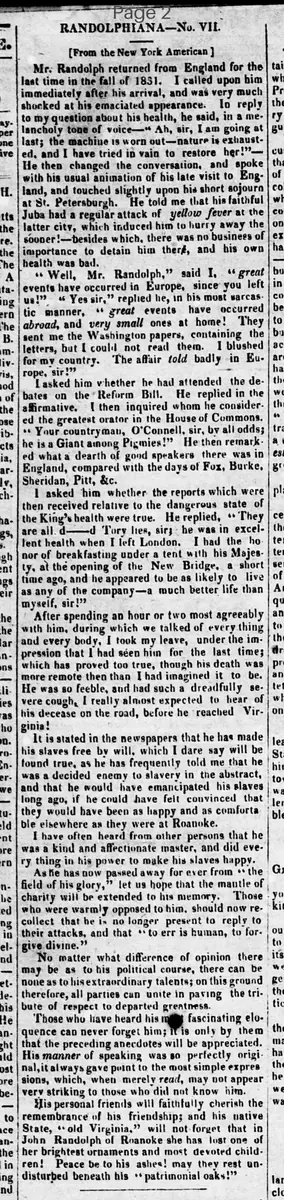
[From the New York American]
Mr. Randolph returned from England for the last time in the fall of 1831. I called upon him immediately after his arrival, and was very much shocked at his emaciated appearance. In reply to my question about his health, he said, in a melancholy tone of voice—"Ah, sir, I am going at last; the machine is worn out—nature is exhausted, and I have tried in vain to restore her!"
He then changed the conversation, and spoke with his usual animation of his late visit to England, and touched slightly upon his short sojourn at St. Petersburgh. He told me that his faithful Juba had a regular attack of yellow fever at the latter city, which induced him to hurry away the sooner!—besides which, there was no business of importance to detain him there, and his own health was bad.
"Well, Mr. Randolph," said I, "great events have occurred in Europe, since you left us!" "Yes sir," replied he, in his most sarcastic manner, "great events have occurred abroad, and very small ones at home! They sent me the Washington papers, containing the letters, but I could not read them. I blushed for my country. The affair told badly in Europe, sir!"
I asked him whether he had attended the debates on the Reform Bill. He replied in the affirmative. I then inquired whom he considered the greatest orator in the House of Commons. "Your countryman, O'Connell, sir, by all odds; he is a Giant among Pigmies!" He then remarked what a dearth of good speakers there was in England, compared with the days of Fox, Burke, Sheridan, Pitt, &c.
I asked him whether the reports which were then received relative to the dangerous state of the King's health were true. He replied, "They are all d—d Tory lies, sir—he was in excellent health when I left London. I had the honor of breakfasting under a tent with his Majesty, at the opening of the New Bridge, a short time ago, and he appeared to be as likely to live as any of the company—a much better life than myself, sir!"
After spending an hour or two most agreeably with him, during which we talked of every thing and every body, I took my leave, under the impression that I had seen him for the last time—which has proved too true, though his death was more remote then than I had imagined it to be. He was so feeble, and had such a dreadfully severe cough. I really almost expected to hear of his decease on the road, before he reached Virginia!
It is stated in the newspapers that he has made his slaves free by will, which I dare say will be found true, as he has frequently told me that he was a decided enemy to slavery in the abstract, and that he would have emancipated his slaves long ago, if he could have felt convinced that they would have been as happy and as comfortable elsewhere as they were at Roanoke.
I have often heard from other persons that he was a kind and affectionate master, and did every thing in his power to make his slaves happy.
As he has now passed away for ever from "the field of his glory," let us hope that the mantle of charity will be extended to his memory. Those who were warmly opposed to him, should now recollect that he is no longer present to reply to their attacks, and that "to err is human, to forgive divine."
No matter what difference of opinion there may be as to his political course, there can be none as to his extraordinary talents; on this ground therefore, all parties can unite in paying the tribute of respect to departed greatness.
Those who have heard his most fascinating eloquence can never forget him; it is only by them that the preceding anecdotes will be appreciated.
His manner of speaking was so perfectly original, it always gave point to the most simple expressions, which, when merely read, may not appear very striking to those who did not know him.
His personal friends will faithfully cherish the remembrance of his friendship; and his native State, "old Virginia," will not forget that in John Randolph of Roanoke she has lost one of her brightest ornaments and most devoted children! Peace be to his ashes! may they rest undisturbed beneath his "patrimonial oaks!"
What sub-type of article is it?
What themes does it cover?
What keywords are associated?
What entities or persons were involved?
Where did it happen?
Story Details
Key Persons
Location
England, St. Petersburgh, Roanoke, Virginia
Event Date
Fall Of 1831
Story Details
Narrator meets frail John Randolph upon his return from England in 1831; they discuss his health decline, travels including Juba's yellow fever in St. Petersburg, European events like Reform Bill debates and King's health; reflections on Randolph's anti-slavery stance, emancipation will, kindness to slaves, eloquence, and lasting legacy.