Thank you for visiting SNEWPapers!
Sign up free
The Rhode Island American, And General Advertiser
Providence, Providence County, Rhode Island
What is this article about?
Quarterly Review extract analyzes Russia's territorial claims on North-West Coast of America, based on discoveries by Russia (1648-1724), Spain (1774-1775), and Britain (Cook, Vancouver). Argues Russia's claim limited to north of 59°; British Northwest Company holds possession southward, rendering Russian Ukase nugatory and aimed at fur trade monopoly.
Clipping
OCR Quality
Full Text
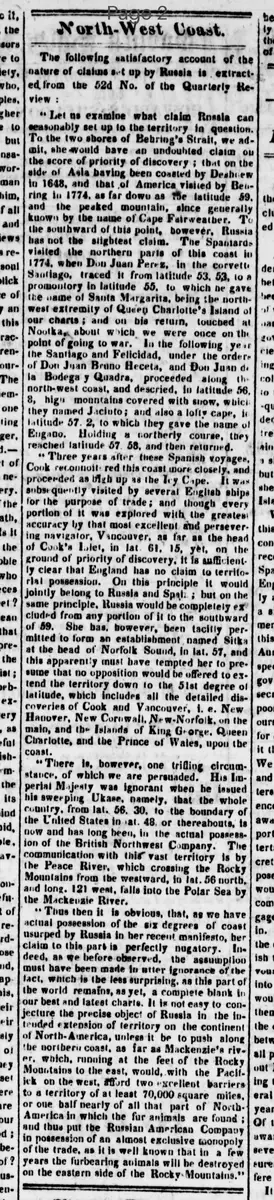
The following satisfactory account of the nature of claims set up by Russia is extracted from the 52d No. of the Quarterly Review :
" Let us examine what claim Russia can seasonably set up to the territory in question. To the two shores of Behring's Strait, we admit, she would have an undoubted claim on the score of priority of discovery ; (but on the side of Asia having been coasted by Deshnew in 1648, and that of America visited by Behring in 1724, as far down as the latitude 59. and the peaked mountain, since generally known by the name of Cape Fairweather. To the southward of this point, however, Russia has not the slightest claim. The Spaniards visited the northern parts of this coast in 1774, when Don Juan Perez, in the Corvetto Santiago, traced it from latitude 53. 53, to a promontory in latitude 55. to which he gave the name of Santa Margarita. being the north-west extremity of Queen Charlotte's Island of our charts; and on his return, touched at Nootka, about which we were once on the point of going to war. In the following year the Santiago and Felicidad, under the orders of Don Juan Bruno Heceta, and Don Juan de la Bodega y Quadra, proceeded along the north-west coast, and descried, in latitude 56 8, high mountains covered with snow, which. they named Jacinto; and also a loft cape, in latitude 57. 2, to which they gave the name of Engano. Holding a northerly course, they reached latitude 57. 58, and then returned.
" Three years after these Spanish voyages, Cook reconnoitred this coast more closely, and proceeded as high up as the Icy Cape. It was subsequently visited by several English ships for the purpose of trade; and though every portion of it was explored with the greatest accuracy by that most excellent and persevering navigator, Vancouver. as far as the head of Cook's Inlet, in lat. 61.' 15, yet. on the ground of priority of discovery. it is sufficiently clear that England has no claim to territorial possession. On this principle it would jointly belong to Russia and Spain; but on the same principle. Russia would be completely excluded from any portion of it to the southward of 59. She has. however, been tacitly permitted to form an establishment named Sitka at the head of Norfolk Sound, in lat. 57, and this apparently must have tempted her to presume that no opposition would be offered to extend the territory down to the 51st degree of latitude, which includes all the detailed discoveries of Cook and Vancouver, i. e. New Hanover, New Cornwall. New-Norfolk. on the main, and the Islands of King George, Queen Charlotte, and the Prince of Wales, upon the coast.
" There is, however, one trifling circumstance, of which we are persuaded. His Imperial Majesty was ignorant when he issued his sweeping Ukase, namely. that the whole country. from lat. 56. 30. to the boundary of the United States in lat. 48. or thereabouts.is now and has long been, in the actual possession of the British Northwest Company. The communication with this vast territory is by the Peace River, which crossing the Rocky Mountains from the westward, in lat. 56 north, and long. 121 west, falls into the Polar Sea by the Mackenzie River. Thus then it is obvious, that, as we have actual possession of the six degrees of coast usurped by Russia in her recent manifesto, her claim to this part is perfectly nugatory. Indeed, as we before observed. the assumption must have been made in utter ignorance of the fact, which is the less surprising, as this part of the world remains, as yet, a complete blank in our best and latest charts. It is not easy to conjecture the precise object of Russia in the intended extension of territory on the continent of North-America, unless it be to push along the northeri coast, as far as Mackenzie's river. which, running at the feet of the Rocky Mountains to the east, would,.with the Pacifick on the west, afford two excellent barriers to a territory of at least 70,000 square miles, or one half nearly of all that part of North. America in which the fur animals are found ; and thus put the Russian American Company in possession of an almost exclusive monopoly of the trade, as it is well known that in a few years the furbearing animals will be destroyed on the eastern side of the Rocky-Mountains."
What sub-type of article is it?
What keywords are associated?
What entities or persons were involved?
Where did it happen?
Foreign News Details
Primary Location
North West Coast
Key Persons
Outcome
russia's claim to territory south of latitude 59 is excluded; british northwest company has actual possession from latitude 56.30 to 48; russian claim is nugatory due to british possession
Event Details
Extract from Quarterly Review No. 52 examines Russia's claims to North-West Coast territory based on priority of discovery. Russia has claim to shores of Behring's Strait from Deshnew in 1648 and Behring in 1724 to latitude 59, but no claim southward. Spaniards explored in 1774-1775 under Perez, Heceta, and Bodega y Quadra. Cook and Vancouver explored further for England. Russia permitted establishment at Sitka in latitude 57, tempting extension to 51st degree. However, British Northwest Company possesses the area from latitude 56.30 to 48 via Peace River and Mackenzie River. Russia's Ukase issued in ignorance of British possession; possible aim to monopolize fur trade.