Thank you for visiting SNEWPapers!
Sign up free
Fowle's New Hampshire Gazette And General Advertiser
Portsmouth, Rockingham County, New Hampshire
What is this article about?
Excerpt from Carver's Travels describing Native American attitudes toward death, funeral orations by chiefs, body preparation, eulogies addressing the deceased, and burial practices, including temporary staging in winter and eventual interment.
Merged-components note: Continuation of the essay on Indian burial practices from Carver's Travels, as the text flows directly from one component to the next with sequential reading order.
Clippings
1 of 2
OCR Quality
Full Text
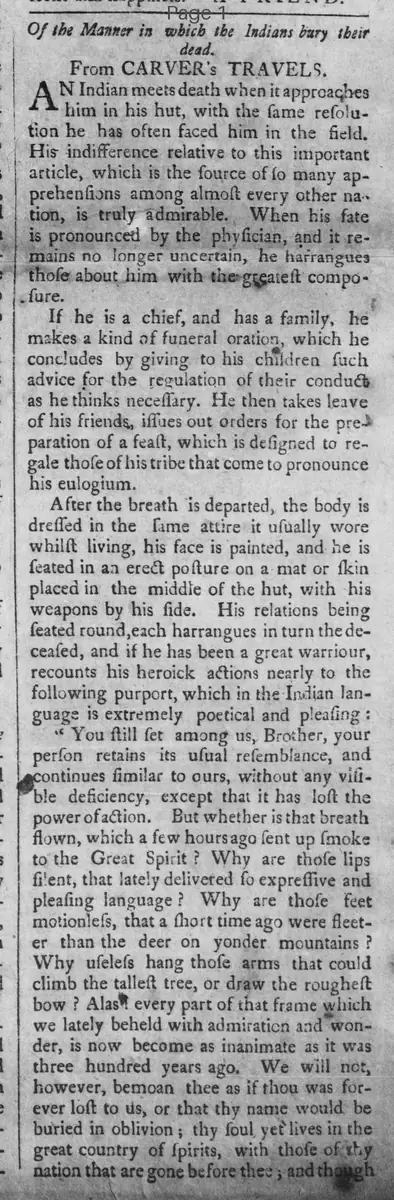
From CARVER's TRAVELS.
An Indian meets death when it approaches him in his hut, with the same resolution he has often faced him in the field.
His indifference relative to this important article, which is the source of so many apprehensions among almost every other nation, is truly admirable. When his fate is pronounced by the physician, and it remains no longer uncertain, he harangues those about him with the greatest composure.
If he is a chief, and has a family, he makes a kind of funeral oration, which he concludes by giving to his children such advice for the regulation of their conduct as he thinks necessary. He then takes leave of his friends, issues out orders for the preparation of a feast, which is designed to regale those of his tribe that come to pronounce his eulogium.
After the breath is departed, the body is dressed in the same attire it usually wore whilst living, his face is painted, and he is seated in an erect posture on a mat or skin placed in the middle of the hut, with his weapons by his side. His relations being seated round, each harangues in turn the deceased, and if he has been a great warrior, recounts his heroick actions nearly to the following purport, which in the Indian language is extremely poetical and pleasing:
"You still sit among us, Brother, your person retains its usual resemblance, and continues similar to ours, without any visible deficiency, except that it has lost the power of action. But whither is that breath flown, which a few hours ago sent up smoke to the Great Spirit? Why are those lips silent, that lately delivered so expressive and pleasing language? Why are those feet motionless, that a short time ago were fleeter than the deer on yonder mountains? Why useless hang those arms that could climb the tallest tree, or draw the stoutest bow? Alas! every part of that frame which we lately beheld with admiration and wonder, is now become as inanimate as it was three hundred years ago. We will not, however, bemoan thee as if thou wast forever lost to us, or that thy name would be buried in oblivion; thy soul yet lives in the great country of spirits, with those of thy nation that are gone before thee; and though we are left behind to struggle with the misfortunes of life, we will not be insensible to thy loss. We are left behind to perpetuate thy fame, we shall one day join thee. Actuated by the respect we bore thee whilst living, we now come to tender to thee the last act of kindness it is in our power to bestow: that thy body might not be neglected on the plain, and become a prey to the beasts of the field, or the fowls of the air, we will take care to lay it with those of thy predecessors who are gone before thee; hoping, at the same time, that thy spirit will feed with their spirits, and be ready to receive ours, when we also shall arrive at the great country of souls."
In short speeches somewhat similar to the above does every chief speak the praises of his departed friend. When they have so done, if they happen to be at a great distance from the place of interment appropriated to their tribe, and the person dies during the winter season, they wrap the body in skins and lay it on a high stage built for that purpose, or on the branches of a large tree, until the spring arrives. They then, after the manner described in my Journal, carry it, together with all those belonging to the same nation, to the general burial-place, where it is interred with some other ceremonies that I could not discover.
What sub-type of article is it?
What themes does it cover?
What keywords are associated?
What entities or persons were involved?
Literary Details
Title
Of The Manner In Which The Indians Bury Their Dead.
Author
From Carver's Travels.
Subject
Indian Burial Customs
Form / Style
Prose Observation From Travel Journal
Key Lines