Thank you for visiting SNEWPapers!
Sign up free
Editorial
July 1, 1820
Daily National Intelligencer
Washington, District Of Columbia
What is this article about?
Editorial responds to criticism of Venezuela's adoption of 'Columbia' as republic name, includes supportive extract from New York American on US citizen nomenclature challenges and future 'American' distinction, announces break from Missouri Question to resume Tariff debate.
Clipping
OCR Quality
98%
Excellent
Full Text
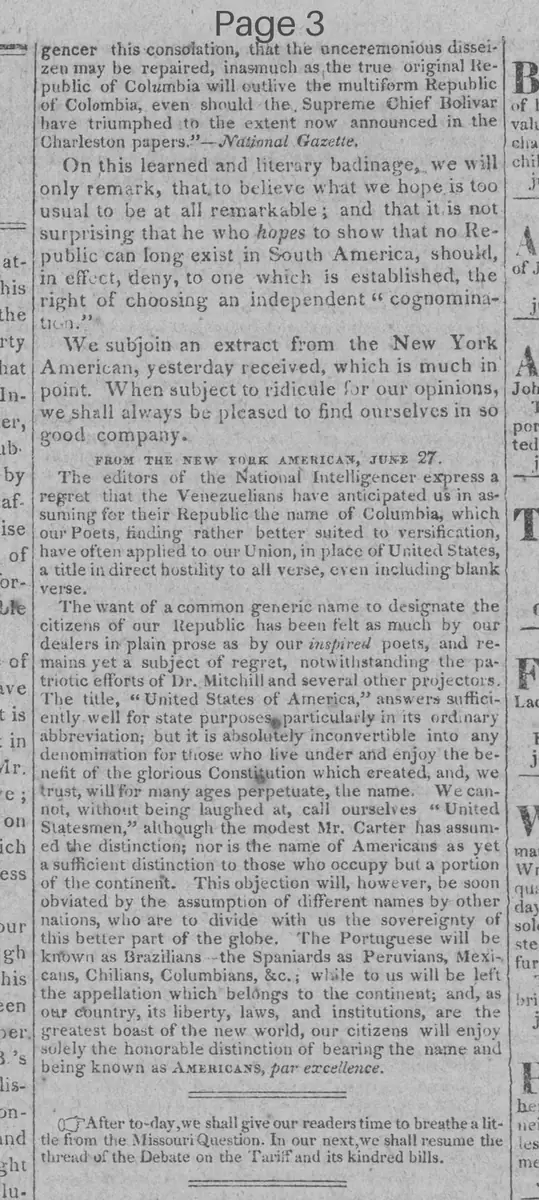
On this learned and literary badinage, we will only remark, that to believe what we hope is too usual to be at all remarkable; and that it is not surprising that he who hopes to show that no Republic can long exist in South America, should, in effect, deny, to one which is established, the right of choosing an independent "cognomination."
We subjoin an extract from the New York American, yesterday received, which is much in point. When subject to ridicule for our opinions, we shall always be pleased to find ourselves in so good company.
FROM THE NEW YORK AMERICAN, JUNE 27.
The editors of the National Intelligencer express a regret that the Venezuelians have anticipated us in assuming for their Republic the name of Columbia, which our Poets, finding rather better suited to versification, have often applied to our Union, in place of United States. a title in direct hostility to all verse, even including blank verse.
The want of a common generic name to designate the citizens of our Republic has been felt as much by our dealers in plain prose as by our inspired poets, and remains yet a subject of regret, notwithstanding the patriotic efforts of Dr. Mitchill and several other projectors.
The title, "United States of America," answers sufficiently well for state purposes particularly in its ordinary abbreviation; but it is absolutely inconvertible into any denomination for those who live under and enjoy the benefit of the glorious Constitution which created, and, we trust, will for many ages perpetuate, the name. We cannot, without being laughed at, call ourselves "United Statesmen," although the modest Mr. Carter has assumed the distinction; nor is the name of Americans as yet a sufficient distinction to those who occupy but a portion of the continent. This objection will, however, be soon obviated by the assumption of different names by other nations, who are to divide with us the sovereignty of this better part of the globe. The Portuguese will be known as Brazilians the Spaniards as Peruvians, Mexicans, Chilians, Columbians. &c.: while to us will be left the appellation which belongs to the continent; and, as our country, its liberty, laws, and institutions, are the greatest boast of the new world, our citizens will enjoy solely the honorable distinction of bearing the name and being known as Americans, par excellence.
After to-day, we shall give our readers time to breathe a little from the Missouri Question. In our next, we shall resume the thread of the Debate on the Tariff and its kindred bills.
We subjoin an extract from the New York American, yesterday received, which is much in point. When subject to ridicule for our opinions, we shall always be pleased to find ourselves in so good company.
FROM THE NEW YORK AMERICAN, JUNE 27.
The editors of the National Intelligencer express a regret that the Venezuelians have anticipated us in assuming for their Republic the name of Columbia, which our Poets, finding rather better suited to versification, have often applied to our Union, in place of United States. a title in direct hostility to all verse, even including blank verse.
The want of a common generic name to designate the citizens of our Republic has been felt as much by our dealers in plain prose as by our inspired poets, and remains yet a subject of regret, notwithstanding the patriotic efforts of Dr. Mitchill and several other projectors.
The title, "United States of America," answers sufficiently well for state purposes particularly in its ordinary abbreviation; but it is absolutely inconvertible into any denomination for those who live under and enjoy the benefit of the glorious Constitution which created, and, we trust, will for many ages perpetuate, the name. We cannot, without being laughed at, call ourselves "United Statesmen," although the modest Mr. Carter has assumed the distinction; nor is the name of Americans as yet a sufficient distinction to those who occupy but a portion of the continent. This objection will, however, be soon obviated by the assumption of different names by other nations, who are to divide with us the sovereignty of this better part of the globe. The Portuguese will be known as Brazilians the Spaniards as Peruvians, Mexicans, Chilians, Columbians. &c.: while to us will be left the appellation which belongs to the continent; and, as our country, its liberty, laws, and institutions, are the greatest boast of the new world, our citizens will enjoy solely the honorable distinction of bearing the name and being known as Americans, par excellence.
After to-day, we shall give our readers time to breathe a little from the Missouri Question. In our next, we shall resume the thread of the Debate on the Tariff and its kindred bills.
What sub-type of article is it?
Foreign Affairs
Partisan Politics
What keywords are associated?
Republic Naming
Columbia
Americans
Venezuela
South America
National Intelligencer
Missouri Question
Tariff Debate
What entities or persons were involved?
National Intelligencer Editors
New York American
Venezuelians
Dr. Mitchill
Mr. Carter
Editorial Details
Primary Topic
Naming Of Venezuelan Republic As Columbia And Us Citizen Nomenclature
Stance / Tone
Defensive And Optimistic Support For Independent Republic Naming
Key Figures
National Intelligencer Editors
New York American
Venezuelians
Dr. Mitchill
Mr. Carter
Key Arguments
Belief In South American Republics Is Common And Not Remarkable
Critics Denying Republics' Right To Choose Names Undermine Their Existence
Us Lacks Suitable Citizen Name Beyond 'United States Of America'
Poets Prefer 'Columbia' For Versification Over 'United States'
Future Distinctions Like 'Brazilians' Will Leave 'Americans' Uniquely For Us Citizens
Us Institutions Justify Exclusive 'American' Appellation