Thank you for visiting SNEWPapers!
Sign up free
The Daily Madisonian
Washington, District Of Columbia
What is this article about?
Senate Committee on Naval Affairs, via Mr. Bayard, reports bill to amend 1835 naval pay act, allowing Secretarial furloughs of unfit officers after three years without consent at half sea pay to enhance service efficiency, contrasting with British retirement system.
Clipping
OCR Quality
Full Text
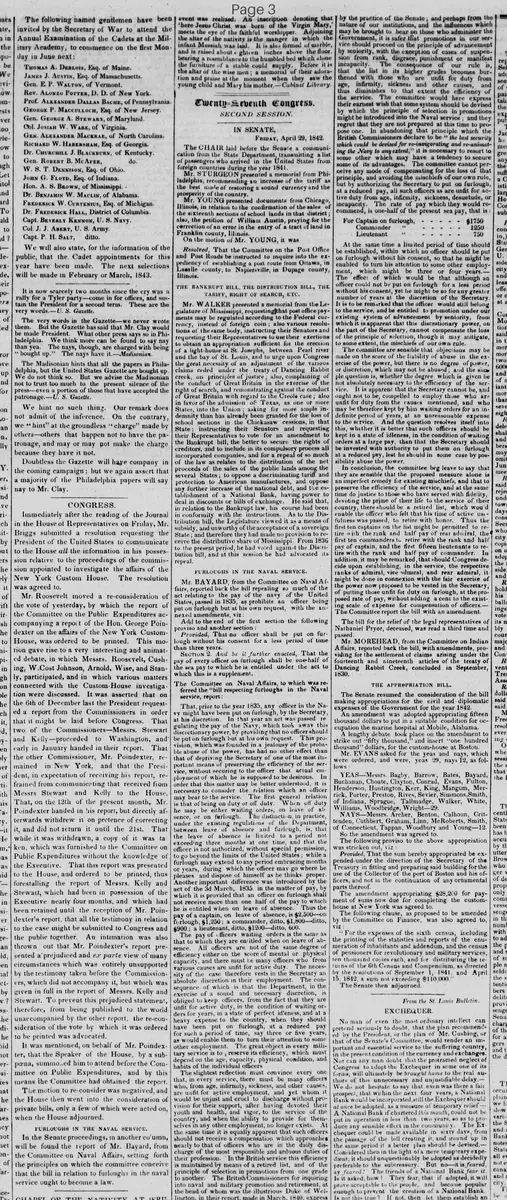
In the Senate proceedings, in another column, will be found the report of Mr. Bayard, from the Committee on Naval Affairs, setting forth the principles on which the committee conceive that the bill in relation to furloughs in the naval service ought to become a law.
Mr. Bayard, from the Committee on Naval Affairs, reported back the bill repealing so much of the act relating to the pay of the navy of the United States, passed in 1835, as prohibits an officer being put on furlough but at his own request, with the annexed amendments, viz:
Add to the end of the first section the following proviso and another section:
Provided, That no officer shall be put on furlough without his consent for a less period of time than three years.
Section 2. And be it further enacted, That the pay of every officer on furlough shall be one-half of the sea pay to which he is entitled under the act to which this is a supplement.
The Committee on Naval Affairs, to which was referred the "bill respecting furloughs in the Naval service, report:
That, prior to the year 1835, any officer in the Navy might have been put on furlough, by the Secretary, at his discretion. In that year an act was passed regulating the pay of the Navy, which took away this discretionary power, by providing that no officer should be put on furlough but at his own request. This provision, which was founded in a jealousy of the probable abuse of the power, has had no other effect than that of depriving the Secretary of one of the most important means of preserving the efficiency of the service, without securing to the officer that actual employment of which he is supposed to be desirous. In order that this matter may be better understood, it is necessary to consider the relation which an officer may bear to the service. The first general relation is that of being on duty or off duty. When off duty he may be either waiting orders, on leave of absence, or on furlough. The distinction, in practice, under the existing regulations of the Department, between leave of absence and furlough, is, that the leave of absence is limited to a period not exceeding three months at one time, and that the officer is not authorized, without special permission, to go beyond the limits of the United States; while a furlough may extend to any period embracing months or years, during which the officer may go where he pleases and dispose of himself as he thinks proper.
Another important difference was introduced by the act of the 3d March, 1835 in the matter of pay, by which it is provided that an officer on furlough shall not receive more than one half of the pay to which he is entitled when on leave of absence. Thus the pay of a captain, on leave of absence, is $2,500—on furlough, $1,250; a commander, ditto, $1,800—ditto, $900; a lieutenant, ditto, $1200—ditto, 600.
The pay of officers waiting orders is the same as that to which they are entitled when on leave of absence. All officers are not of the same degree of efficiency either on the score of mental or physical capacity, and there must be many officers who from various causes are unfit for active duty. The necessity of the case therefore vests in the Secretary an absolute discretion in their employment. The consequence of which is that the Department, in the exercise of a sound and necessary discretion, is obliged to keep officers, from the fact that they are unfit for active duty, in the condition of waiting orders for years, in a state of perfect idleness, and at a heavy expense to the country, when they should have been put on furlough, at a reduced pay for such a period of time, say three or five years, as would enable them to turn their attention to some other employment. The great object in every military service is to preserve its efficiency, which must depend on the age, capacity, physical condition, and habits of the individual officers.
The slightest reflection must convince every one that, in every service, there must be many officers who, from age, infirmity, sickness, and other causes, are unfit for active employment, and yet whom it would be unjust and cruel to discharge without provision for their support, after having devoted their youth and health, and vigor, to the service of the country, and when the ability to provide for themselves in any other employment, no longer exists. At the same time it is equally apparent that such officers should not receive a compensation which approaches nearly to that of officers who are in the daily discharge of the most responsible and arduous duties of their profession. In the British service this efficiency is maintained by means of a retired list, and of the principle of selection in promotions from one grade to another. The British Commissioners for inquiring into naval and military promotion and retirement, at the head of whom was the illustrious Duke of Wellington, in their report, made in March, 1840, express themselves as follows: "Steady and certain employment for the efficient, with a due encouragement of promotion, and sufficient reward for those who may be worn out in the service, from the best foundation upon which the military and naval establishments of this country should be framed." And in another part of the same document record it as their deliberate conviction "that the system of selection offers the best security which could be devised for re-invigorating and re-animating the Navy to any extent which the circumstances of the country might on an emergency render necessary." The British system of naval promotion is one of selection up to the rank of captain, and of advancement by seniority from that rank to be a flag officer, and there cannot be a doubt that it is the true principle on which all promotion should proceed, since all officers are not possessed of the same degree of skill and capacity, and different qualifications and attributes are required in different grades of command. A different rule, however, prevails in our service, under the regulations established by the Department and sanctioned by the practice of the Senate; and perhaps from the nature of our institutions, and the influences which may be brought to bear on those who administer the Government, it is safer that promotions in our service should proceed on the principle of advancement by seniority, with the exception of cases of suspension from rank, disgrace, punishment or manifest incapacity. The consequence of our rule is, that the list in its higher grades becomes burdened with those who are unfit for duty from age, infirmity, sickness and other causes, and thus diminishes to that extent the efficiency of the service. The committee would here express their earnest wish that some system should be devised by which the principle of selection in promotions might be introduced into the Naval service; and they regret that they are not prepared at this time to propose one. In abandoning that principle which the British Commissioners declare to be "the best security which could be devised for re-invigorating and re-animating the Navy to any extent," it is necessary to resort to some other which may have a tendency to secure some of its advantages.
The committee cannot perceive any mode of compensating for the loss of that principle, and avoiding the mischiefs of our own rule, but by authorizing the Secretary to put on furlough, at a reduced pay, all such officers as are unfit for active duty from age, infirmity, sickness, desuetude, or incapacity. The rate of pay which they would recommend, is one-half of the present sea pay, that is:
For Captain on furlough, $1750
Commander 1250
Lieutenant 750
At the same time a limited period of time should be established, within which no officer should be put on furlough without his consent, so that he might be enabled to turn his attention to some other employment, which might be three or four years. The effect of which would be that although an officer could not be put on furlough for a less period without his consent, yet he might be so for any greater number of years at the discretion of the Secretary.
It is to be remarked that the officer would still belong to the service, and be entitled to promotion under our existing system of advancement by seniority, from which it is apparent that this discretionary power, on the part of the Secretary, cannot compensate the loss of the principle of selection, though it may mitigate, to some extent, the mischiefs of our own rule.
The committee are sensible that objections may be made on the score of the liability of abuse in the exercise of the power, but there is no degree of power, or discretion, which may not be abused; and the simple question is, whether the degree which is given be not absolutely necessary to the efficiency of the service. It is apparent that the Secretary cannot be, and ought not to be, compelled to employ those who are unfit for duty from the causes mentioned, and who may be therefore kept by him waiting orders for an indefinite period of years, at an unreasonable expense to the service. And the question resolves itself into this, whether it is better that such officers should be kept in a state of idleness, in the condition of waiting orders at a large pay, than that the Secretary should be invested with authority to put them on furlough at a reduced pay, lest he should in some case by possibility abuse the power.
In conclusion, the committee beg leave to say that they are sensible that the proposed measure alone is an imperfect remedy for existing mischiefs, and that to preserve the efficiency of the service, and at the same time do justice to those who have served with fidelity, devoting the prime of their life to the service of their country, there should be a retired list, which would enable the officer who felt that his time of active usefulness was passed, to retire with honor. Thus the first ten captains on the list might be permitted to retire with the rank and half pay of rear admiral, the first ten commanders to retire with the rank and half pay of captain, and the first fifteen lieutenants to retire with the rank and half pay of commander. In addition, it may be remarked, that should Congress decide upon establishing, in the service, the respective ranks of admiral, vice admiral, and rear admiral, it might be done in connexion with the fair exercise of the power now proposed to be vested in the Secretary, of putting those unfit for duty on furlough, at the proposed rate of pay, without adding a cent to the existing scale of expense for compensation of officers.
The Committee report the bill with an amendment.
What sub-type of article is it?
What keywords are associated?
What entities or persons were involved?
Where did it happen?
Domestic News Details
Primary Location
United States Senate
Key Persons
Outcome
proposed bill amendments to allow secretary to furlough unfit officers without consent after three years at half sea pay: captain $1750, commander $1250, lieutenant $750; aims to preserve naval efficiency without full pay for idle officers.
Event Details
Mr. Bayard reported back a bill repealing 1835 act provisions prohibiting furloughs without officer request, with amendments adding proviso for minimum three-year furlough without consent and half sea pay. Committee report explains historical context, distinctions between leave and furlough, pay differences, issues with unfit officers on waiting orders, comparison to British selection system, and recommends discretionary furloughs for efficiency while retaining seniority promotion.