Thank you for visiting SNEWPapers!
Sign up free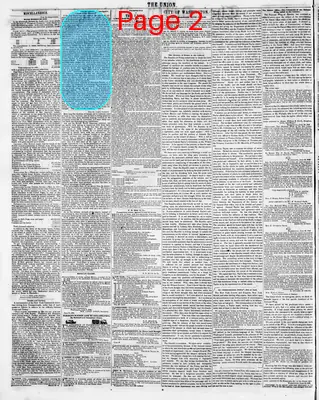
Editorial
June 17, 1849
The Daily Union
Washington, District Of Columbia
What is this article about?
Editorial from Lancaster Intelligencer criticizes President Taylor for betraying his no-party neutrality pledges by appointing Whigs, urging the Democratic Senate to reject such nominations to rebuke the administration and uphold political integrity.
Clipping
OCR Quality
98%
Excellent
Full Text
From the Lancaster (Pa.) Intelligencer,
"Look to the Senate!"
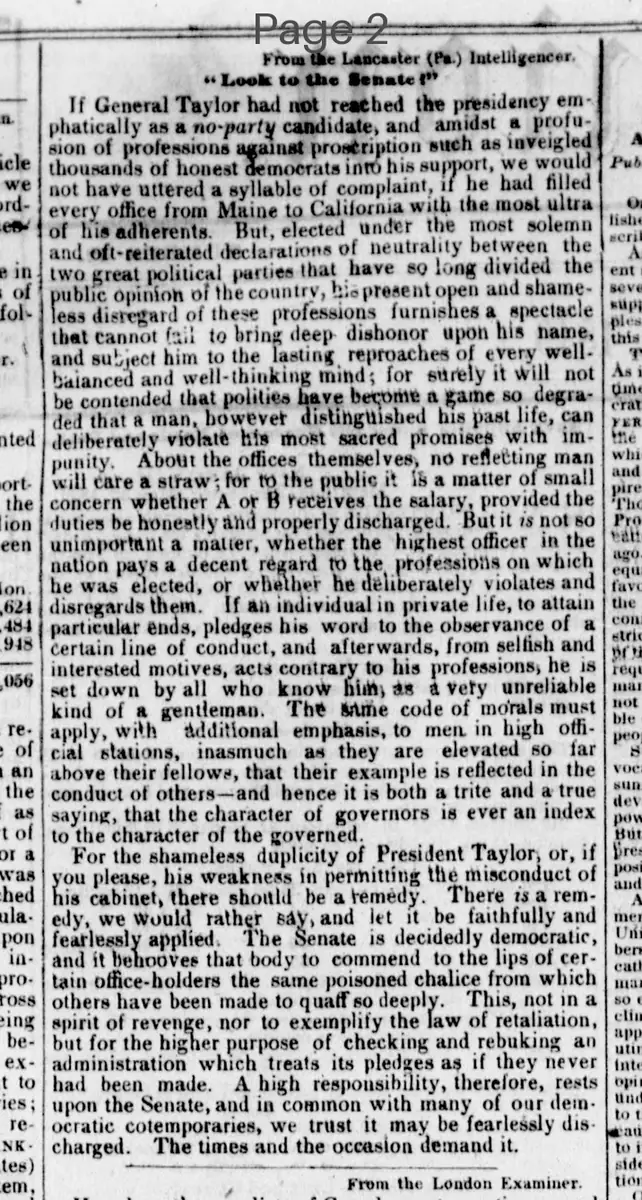
If General Taylor had not reached the presidency emphatically as a no-party candidate, and amidst a profusion of professions against proscription such as inveigled thousands of honest democrats into his support, we would not have uttered a syllable of complaint, if he had filled every office from Maine to California with the most ultra whigs. But, elected under the most solemn and oft-reiterated declarations of neutrality between the two great political parties that have so long divided the public opinion of the country, his present open and shameless disregard of these professions furnishes a spectacle that cannot fail to bring deep dishonor upon his name, and subject him to the lasting reproaches of every well-balanced and well-thinking mind; for surely it will not be contended that politics have become a game so degraded that a man, however distinguished his past life, can deliberately violate his most sacred promises with impunity. About the offices themselves, no reflecting man will care a straw; for to the public it is a matter of small concern whether A or B receives the salary, provided the duties be honestly and properly discharged. "But it is not so unimportant a matter, whether the highest officer in the nation pays a decent regard to the professions on which he was elected, or whether he deliberately violates and disregards them. If an individual in private life, to attain particular ends, pledges his word to the observance of a certain line of conduct, and afterwards, from selfish and interested motives, acts contrary to his professions, he is set down by all who know him as a very unreliable kind of a gentleman. The same code of morals must apply, with additional emphasis, to men in high official stations, inasmuch as they are elevated so far above their fellows, that their example is reflected in the conduct of others—and hence it is both a trite and a true saying, that the character of governors is ever an index to the character of the governed.
For the shameless duplicity of President Taylor, or, if you please, his weakness in permitting the misconduct of his cabinet, there should be a remedy. There is a remedy, we would rather say, and let it be faithfully and fearlessly applied. The Senate is decidedly democratic, and it behooves that body to commend to the lips of certain office-holders the same poisoned chalice from which others have been made to quaff so deeply. This, not in a spirit of revenge, nor to exemplify the law of retaliation, but for the higher purpose of checking and rebuking an administration which treats its pledges as if they never had been made. A high responsibility, therefore, rests upon the Senate, and in common with many of our democratic cotemporaries, we trust it may be fearlessly discharged. The times and the occasion demand it.
"Look to the Senate!"
If General Taylor had not reached the presidency emphatically as a no-party candidate, and amidst a profusion of professions against proscription such as inveigled thousands of honest democrats into his support, we would not have uttered a syllable of complaint, if he had filled every office from Maine to California with the most ultra whigs. But, elected under the most solemn and oft-reiterated declarations of neutrality between the two great political parties that have so long divided the public opinion of the country, his present open and shameless disregard of these professions furnishes a spectacle that cannot fail to bring deep dishonor upon his name, and subject him to the lasting reproaches of every well-balanced and well-thinking mind; for surely it will not be contended that politics have become a game so degraded that a man, however distinguished his past life, can deliberately violate his most sacred promises with impunity. About the offices themselves, no reflecting man will care a straw; for to the public it is a matter of small concern whether A or B receives the salary, provided the duties be honestly and properly discharged. "But it is not so unimportant a matter, whether the highest officer in the nation pays a decent regard to the professions on which he was elected, or whether he deliberately violates and disregards them. If an individual in private life, to attain particular ends, pledges his word to the observance of a certain line of conduct, and afterwards, from selfish and interested motives, acts contrary to his professions, he is set down by all who know him as a very unreliable kind of a gentleman. The same code of morals must apply, with additional emphasis, to men in high official stations, inasmuch as they are elevated so far above their fellows, that their example is reflected in the conduct of others—and hence it is both a trite and a true saying, that the character of governors is ever an index to the character of the governed.
For the shameless duplicity of President Taylor, or, if you please, his weakness in permitting the misconduct of his cabinet, there should be a remedy. There is a remedy, we would rather say, and let it be faithfully and fearlessly applied. The Senate is decidedly democratic, and it behooves that body to commend to the lips of certain office-holders the same poisoned chalice from which others have been made to quaff so deeply. This, not in a spirit of revenge, nor to exemplify the law of retaliation, but for the higher purpose of checking and rebuking an administration which treats its pledges as if they never had been made. A high responsibility, therefore, rests upon the Senate, and in common with many of our democratic cotemporaries, we trust it may be fearlessly discharged. The times and the occasion demand it.
What sub-type of article is it?
Partisan Politics
What keywords are associated?
President Taylor
Political Neutrality
Senate Action
Office Appointments
Democratic Senate
Whig Proscription
Political Promises
What entities or persons were involved?
General Taylor
President Taylor
Senate
Democrats
Whigs
Editorial Details
Primary Topic
Criticism Of President Taylor's Violation Of Political Neutrality
Stance / Tone
Strongly Critical Of Taylor's Administration
Key Figures
General Taylor
President Taylor
Senate
Democrats
Whigs
Key Arguments
Taylor Elected As No Party Candidate With Promises Against Proscription
Filling Offices With Ultra Whigs Disregards Neutrality Professions
Such Violation Brings Dishonor And Reproaches
Politics Not Degraded Enough To Allow Breaking Sacred Promises
Public Unconcerned With Who Gets Offices If Duties Discharged
Highest Officer Must Regard Election Professions
Private Individual Breaking Pledges Seen As Unreliable
Moral Code Applies More To Officials Whose Example Influences Others
Remedy Through Democratic Senate Rejecting Appointments
Not Revenge But To Check Administration Treating Pledges As Unmade