Thank you for visiting SNEWPapers!
Sign up free
Daily National Intelligencer
Washington, District Of Columbia
What is this article about?
Proceedings of the U.S. House of Representatives on Friday, December 31, including referrals of petitions, committee reports, and a debate on a resolution requesting information from the President on causes of U.S. military failures on the northern frontier during the war, which passed 137-13.
Merged-components note: These two components form a continuous report on the proceedings in the House of Representatives regarding the resolution on the conduct of the war.
Clipping
OCR Quality
Full Text
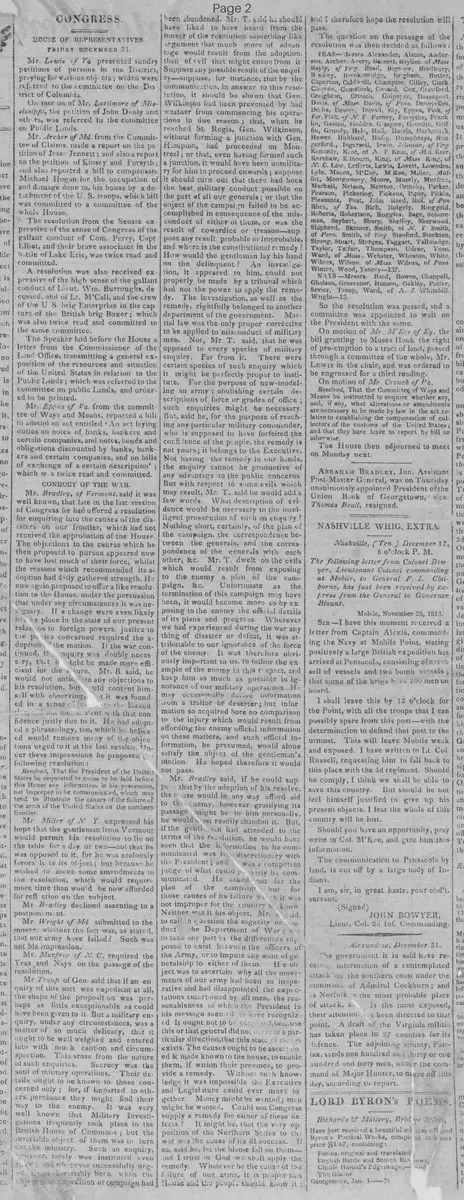
HOUSE OF REPRESENTATIVES
FRIDAY DECEMBER 31.
Mr. Lewis of Va presented sundry petitions of persons in the District, praying for various objects; which were referred to the committee on the District of Columbia.
On motion of Mr. Lattimore of Mississippi, the petition of John Denly and others, was referred to the committee on Public Lands.
Mr. Archer of Md. from the Committee of Claims, made a report on the petition of Jesse Jennett; and also a report on the petition of Kinsey and Forsyth; and also reported a bill to compensate Michael Hogan for the occupation of and damage done to, his house by a detachment of the U. S. troops, which bill was committed to a committee of the whole House.
The resolution from the Senate expressive of the sense of Congress of the gallant conduct of Com. Perry, Capt. Elliot, and their brave associates in the battle of Lake Erie, was twice read and committed.
A resolution was also received expressive of the high sense of the gallant conduct of Lieut. Wm. Burroughs, deceased, and of Lt. M'Call, and the crew of the U S brig Enterprize in the capture of the British brig Boxer: which was also twice read and committed to the same committee.
The Speaker laid before the House a letter from the Commissioner of the Land Office, transmitting a general exposition of the resources and situation of the United States in relation to the Public Lands: which was referred to the committee on public Lands, and ordered to be printed.
Mr. Entwisle of Va. from the committee of Ways and Means, reported a bill to amend an act entitled 'An act laying duties on notes of banks, bankers and certain companies, and notes, bonds and obligations discounted by banks, bankers and certain companies, and on bills of exchange of a certain description'; which was twice read and committed.
CONDUCT OF THE WAR.
Mr. Bradley, of Vermont, said it was well known, that late in the last session of Congress he had offered a resolution for enquiring into the causes of the disasters on our frontier, which had not received the approbation of the House. The objections to the course which he then proposed to pursue appeared now to have lost much of their force, whilst the reasons which recommended its adoption had daily gathered strength. He now again proposed to offer a like resolution to the House, under the persuasion that under any circumstances it was necessary. If a change were even likely to take place in the state of our present relations to foreign powers, justice to the parties concerned required the adoption the motion. If the war continued, the enquiry was doubly necessary, that it might be made more efficient for the future. Mr. B. said, he would not anticipate any objections to his resolution, but would content himself with observing, that it was founded in a sense in the Executive, not inconsistent with that confidence justly due to it. He had adopted a phraseology, too, which he believed would remove many of the objections urged to it at the last session. Under these impressions he proposed following resolution:
Resolved, That the President of the United States be requested to cause to be laid before this House any information in his possession, not improper to be communicated, which may tend to illustrate the causes of the failure of the arms of the United States on the northern frontier.
Mr Miller of N. Y. expressed his hope that the gentleman from Vermont would permit his resolution to lie on the table for a day or two—not that he was opposed to it, for he was zealously favorable to its object; but because he wished to move some amendments to the resolution, which would require more time than would be now afforded for reflection on the subject.
Mr Bradley declined assenting to a postponement.
Mr Wright of Md submitted to the mover, whether the fact was, as stated, that our army have failed? Such was not his impression.
Mr. Murfree of N. C. required the Yeas and Nays on the passage of the resolution.
Mr Troup of Geo. said that if an enquiry of this sort was expedient at all, the shape of the proposition was perhaps as little exceptionable as could have been given to it. But a military enquiry, under any circumstances, was a matter of so much delicacy, that it ought to be well weighed and entered into with much caution and circumspection. This arose from the nature of such enquiries. Secrecy was the soul of military operations. Their details ought to be known to those concerned only; for, if imparted to others, perchance they might find their way to the enemy. It was very well known that Military Investigations frequently took place in the British House of Commons: but the invariable object of them was to turn out the ministry. Such an enquiry, moreover, rarely was instituted even there; and whenever successfully urged invariably been when the object of an expedition or campaign had been abandoned. Mr. T. said he should have liked to have heard from the mover of the resolution something like argument that much more of advantage would result from the adoption, than of evil that might ensue from it. Suppose any possible result of the enquiry--suppose, for instance, that by the communication, in answer to this resolution, it should be shewn that Gen. Wilkinson had been prevented by bad weather from commencing his operations in due season; that, when he reached St. Regis, Gen. Wilkinson, without forming a junction with Gen. Hampton, had proceeded on Montreal; or that, even having formed such a junction, it would have been un-military for him to proceed onwards; suppose it should turn out that there had been the best military conduct possible on the part of all our generals; or that the object of the campaign failed to be accomplished in consequence of the misconduct of either of them, or was the result of cowardice or treason--suppose any result probable or improbable, and where is the constitutional remedy? How would the gentleman lay his hand on the delinquent? An investigation, it appeared to him, could not properly be made by a tribunal which had not the power to apply the remedy. The investigation, as well as the remedy, rightfully belonged to another department of the government. Martial law was the only proper corrective to be applied to misconduct of military men. Not, Mr T. said, that he was opposed to every species of military enquiry. Far from it. There were certain species of such enquiry which it might be perfectly proper to institute. For the purpose of new-modelling an army: abolishing certain descriptions of force or grades of office; such enquiries might be necessary. But, said he, for the purpose of reaching any particular military commander, who is supposed to have forfeited the confidence of the people, the remedy is not yours; it belongs to the Executive. Not having the remedy in our hands, the enquiry cannot be productive of any advantage to the public concerns. But with respect to some evils which may result, Mr. T. said he would add a few words. What description of evidence would be necessary to the intelligent prosecution of such an enquiry? Nothing short, certainly, of the plan of the campaign, the correspondence between the generals, and the correspondence of the generals with each other, &c. Mr. T. dwelt on the evils which would result from exposing to the enemy a plan of the campaign, &c. Unfortunate as the termination of this campaign may have been, it would become more so by exposing to the enemy the official details of its plans and progress. Wherever we had experienced during the war any thing of disaster or defeat, it was attributable to our ignorance of the force of the enemy. It was therefore obviously important to us, to follow the example of the enemy in this respect, and keep him as much as possible in ignorance of our military operations. He may occasionally derive information from a traitor or deserter: but information so acquired bore no comparison to the injury which would result from affording the enemy official information on these matters, and such official information, he presumed, would alone satisfy the object of the gentleman's motion. He hoped therefore it would not pass.
Mr. Bradley said, if he could suppose that by the adoption of his resolve, the House would in any way afford aid to the enemy, however gratifying its passage might be to him personally, he would most readily abandon it. But, if the gentleman had attended to the terms of the resolution, he would have seen that the information to be communicated was in discretionary with the President; and was a competent judge of what could properly be communicated. He asked not for the plan of the campaign but for those causes of its failure which it was not improper for the country to know. Neither was it his object, Mr. B. said, to cast in question the sagacity or conduct of the Department of War; nor to take any part in the differences supposed to exist between the officers of the Army, or to impute any want of generalship to either of them. His object was to ascertain why all the movements of our army had been so inoperative and had disappointed the expectations entertained by all men, the reasonableness of which the President in his message seemed to have recognized. It ought not to be supposed, because this or that general did not move in a particular direction, that this state of things exists. The causes ought to be ascertained & made known to the house, to enable them, if within their province, to provide a remedy. Without such knowledge it was impossible the Executive and Legislature could ever move together. Money might be wanted; men might be wanted. Could not Congress supply a remedy for either of these defects? It might be, that the very opposition of the Northern States to the war was the cause of its ill success. If so, said he, let the blame fall on them— and I trust in God we shall apply the remedy. Whatever be the cause of the failure of our arms, it is proper this House and the people should know it; and therefore hope the resolution will pass.
The question on the passage of the resolution was then decided as follows:
YEAS--Messrs. Alexander, Alston, Anderson, Archer, Avery, Barnett, Baylies, of Mass. Bayly, of Virg. Beall, Bigelow, Bradbury, Bradley, Breckenridge, Brigham, Butler, Caperton, Caldwell, Champion, Cilley, Clark, Clopton, Comstock, Conard, Cox, Crawford, Creighton, Crouch, Culpepper, Davenport, Davis, of Mass. Davis, of Penn. Denoyelles, Desha, Dewey, Duvall, Ely, Eppes, Fisk, of Ver. Fisk, of N. Y Forney, Forsythe, Franklin, Gaston, Geddes, Glasgow, Gourdin, Griffin, Grundy, Hale, Hall, Harris, Hasbrouck, Hawes, Hubbard, Hufty, Humphreys, Hungerford, Ingersoll, Irwin, Johnson, of Virg. Kennedy, Kent, of N. Y. Kent, of Md. Kerr, Kershaw, Kilbourn, King, of Mass King, of N. C. Law, Lefferts, Lewis, Lovett, Lowndes, Lyle, Macon, M'Coy, M'Kee, Miller, Moffitt, Montgomery, Moore, Mosely, Murfree, Markell, Nelson, Newton, Ormsby, Parker, Pearson, Pickering, Pickens, Piper, Pitkin, Pleasants, Post, John Reed, Rea, of Penn. Rhea, of Tenn. Rich, Ridgely, Ringgold, Roberts, Robertson, Ruggles, Sage, Schureman, Seybert, Sharp, Sheffey, Sherwood, Shipherd, Skinner, Smith, of N. Y. Smith of Penn. Smith, of Virg. Stanford, Stockton, Strong, Stuart, Sturges, Taggart, Tallmadge, Taylor, Telfair, Thompson, Udree, Vose, Ward, of Mass. Webster, Wheaton, White, Wilcox, Wilson, of Mass. Wilson, of Penn. Winter, Wood, Yancey--137.
NAYS--Messrs. Bard, Bowen, Chappell, Gholson, Grosvenor, Hanson, Oakley, Potter, Sevier, Troup, Ward, of N. J. Whitehill, Wright--13.
So the resolution was passed, and a committee was appointed to wait on the President with the same.
On motion of Mr. M'Kee of Ky. the bill granting to Moses Hook the right of pre-emption to a tract of land, passed through a committee of the whole, Mr. Lewis in the chair, and was ordered to be engrossed for a third reading.
On motion of Mr. Crouch of Pa.
Resolved, That the Committee of Ways and Means be instructed to enquire whether any, and, if any, what alterations or amendments are necessary to be made by law in the act relative to establishing the compensation of collectors of the customs of the United States; and that they have leave to report by bill or otherwise.
The House then adjourned to meet on Monday next.
What sub-type of article is it?
What keywords are associated?
What entities or persons were involved?
Domestic News Details
Event Date
Friday December 31
Key Persons
Outcome
the resolution requesting information on causes of military failures on the northern frontier passed 137 yeas to 13 nays; a committee was appointed to present it to the president.
Event Details
The House handled petitions and reports from committees on claims, public lands, and ways and means; received Senate resolutions commending naval victories; and debated and passed Mr. Bradley's resolution requesting the President to provide information on causes of U.S. arms failures on the northern frontier, with arguments on necessity, delicacy, and potential remedies.