Thank you for visiting SNEWPapers!
Sign up free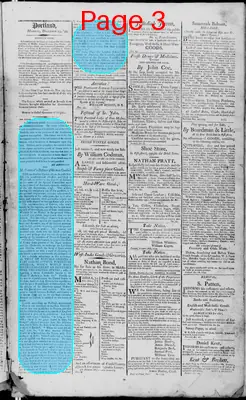
Letter to Editor
December 23, 1799
Jenks's Portland Gazette
Portland, Cumberland County, Maine
What is this article about?
An American urges Mr. Jenks to publish an extract from the Philadelphia Gazette detailing ex-Director Carnot's revelations on the French Directory's plans to 'republicanize' parts of America via territorial exchanges for influence over the United States and to subjugate Holland, warning of French duplicity.
Clipping
OCR Quality
95%
Excellent
Full Text
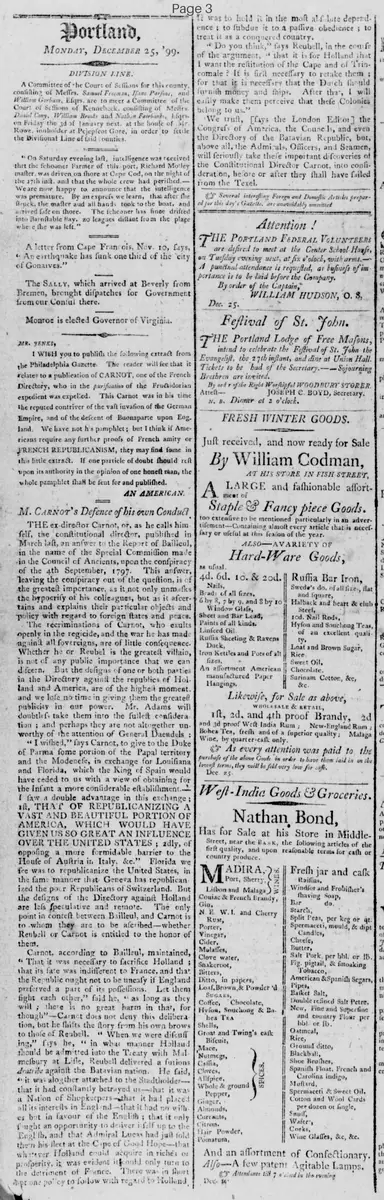
MR. JENKS,
I wish you to publish the following extract from the Philadelphia Gazette. The reader will see that it relates to a publication of CARNOT, one of the French Directory, who in the purification of the Fructidorian expedient was expelled. This Carnot was in his time the reputed contriver of the vast invasion of the German Empire, and of the descent of Buonaparte upon England. We have not his pamphlet: but I think if Americans require any further proofs of French amity or FRENCH REPUBLICANISM, they may find some in this little extract. If one particle of doubt should rest upon its authority in the opinion of one honest man, the whole pamphlet shall be sent for and published.
AN AMERICAN.
M. Carnot's Defence of his own Conduct
THE ex-director Carnot, or as he calls himself, the constitutional director, published in March last, an answer to the Report of Bailleul, in the name of the Special Commission made in the Council of Ancients, upon the conspiracy of the 4th September, 1797. This answer, leaving the conspiracy out of the question, is of the greatest importance, as it not only unmasks the hypocrisy of his colleagues, but as it ascertains and explains their particular objects and policy with regard to foreign states and peace. The recriminations of Carnot, who exults openly in the regicide, and the war he has made against all sovereigns, are of little consequence. Whether he or Reubell is the greatest villain, is not of any public importance that we can discern. But the designs of one or both parties in the Directory against the republics of Holland and America, are of the highest moment, and we lose no time in giving them the greatest publicity in our power. Mr. Adams will doubtless take them into the fullest consideration: and perhaps they are not altogether unworthy of the attention of General Daendels:
'I wished,' says Carnot, 'to give to the Duke of Parma some portion of the Papal territory and the Modenese, in exchange for Louisiana and Florida, which the King of Spain would have ceded to us with a view of obtaining for the Infant a more considerable establishment. I saw a double advantage in this exchange; 1st. THAT OF REPUBLICANIZING A VAST AND BEAUTIFUL PORTION OF AMERICA, WHICH WOULD HAVE GIVEN US SO GREAT AN INFLUENCE OVER THE UNITED STATES; 2dly, of opposing a more formidable barrier to the House of Austria in Italy, &c.' Florida we see was to republicanize the United States, in the same manner that Geneva has republicanized the poor Republicans of Switzerland. But the designs of the Directory against Holland are less speculative and remote. The only point in contest between Bailleul, and Carnot is to whom they are to be ascribed—whether Reubell or Carnot is entitled to the honor of them. Carnot, according to Bailleul, maintained, 'That it was necessary to sacrifice Holland; that its fate was indifferent to France, and that the Republic ought not to be uneasy if England preserved a part of its possessions. Let them fight each other,' said he, 'as long as they will; there is no great harm in that, for though'—Carnot does not deny this deliberation, but he shifts the story from his own brows to those of Reubell. 'When we were discussing,' says he, 'in what manner Holland should be admitted into the Treaty with Malmesbury at Lille, Reubell delivered a seditious diatribe against the Batavian nation. He said, 'it was altogether attached to the Stadtholder—that it had constantly betrayed us—that it was a Nation of Shopkeepers—that it had placed all its interests in England—that it had no wishes but in favour of the English; that it only sought an opportunity to deliver itself up to the English, and that Admiral Lucas had just sold them his fleet at the Cape of Good Hope—that whatever Holland could acquire in riches or prosperity, it was evident it would only turn to the detriment of France. There was in short but one policy to follow with regard to Holland. It was to hold it in the most absolute dependence; to subdue it to a passive obedience; to treat it as a conquered country.' 'Do you think,' says Reubell, in the course of the argument, 'that it is for Holland that I want the restitution of the Cape and of Trincomalee? It is first necessary to retake them: for that it is necessary that the Dutch should furnish money and ships. After that, I will easily make them perceive that these Colonies belong to us.'
We trust, [says the London Editor] the Congress of America, the Councils, and even the Directory of the Batavian Republic, but, above all, the Admirals, Officers, and Seamen, will seriously take these important discoveries of the Constitutional Director Carnot, into consideration, before or after they shall have sailed from the Texel.
I wish you to publish the following extract from the Philadelphia Gazette. The reader will see that it relates to a publication of CARNOT, one of the French Directory, who in the purification of the Fructidorian expedient was expelled. This Carnot was in his time the reputed contriver of the vast invasion of the German Empire, and of the descent of Buonaparte upon England. We have not his pamphlet: but I think if Americans require any further proofs of French amity or FRENCH REPUBLICANISM, they may find some in this little extract. If one particle of doubt should rest upon its authority in the opinion of one honest man, the whole pamphlet shall be sent for and published.
AN AMERICAN.
M. Carnot's Defence of his own Conduct
THE ex-director Carnot, or as he calls himself, the constitutional director, published in March last, an answer to the Report of Bailleul, in the name of the Special Commission made in the Council of Ancients, upon the conspiracy of the 4th September, 1797. This answer, leaving the conspiracy out of the question, is of the greatest importance, as it not only unmasks the hypocrisy of his colleagues, but as it ascertains and explains their particular objects and policy with regard to foreign states and peace. The recriminations of Carnot, who exults openly in the regicide, and the war he has made against all sovereigns, are of little consequence. Whether he or Reubell is the greatest villain, is not of any public importance that we can discern. But the designs of one or both parties in the Directory against the republics of Holland and America, are of the highest moment, and we lose no time in giving them the greatest publicity in our power. Mr. Adams will doubtless take them into the fullest consideration: and perhaps they are not altogether unworthy of the attention of General Daendels:
'I wished,' says Carnot, 'to give to the Duke of Parma some portion of the Papal territory and the Modenese, in exchange for Louisiana and Florida, which the King of Spain would have ceded to us with a view of obtaining for the Infant a more considerable establishment. I saw a double advantage in this exchange; 1st. THAT OF REPUBLICANIZING A VAST AND BEAUTIFUL PORTION OF AMERICA, WHICH WOULD HAVE GIVEN US SO GREAT AN INFLUENCE OVER THE UNITED STATES; 2dly, of opposing a more formidable barrier to the House of Austria in Italy, &c.' Florida we see was to republicanize the United States, in the same manner that Geneva has republicanized the poor Republicans of Switzerland. But the designs of the Directory against Holland are less speculative and remote. The only point in contest between Bailleul, and Carnot is to whom they are to be ascribed—whether Reubell or Carnot is entitled to the honor of them. Carnot, according to Bailleul, maintained, 'That it was necessary to sacrifice Holland; that its fate was indifferent to France, and that the Republic ought not to be uneasy if England preserved a part of its possessions. Let them fight each other,' said he, 'as long as they will; there is no great harm in that, for though'—Carnot does not deny this deliberation, but he shifts the story from his own brows to those of Reubell. 'When we were discussing,' says he, 'in what manner Holland should be admitted into the Treaty with Malmesbury at Lille, Reubell delivered a seditious diatribe against the Batavian nation. He said, 'it was altogether attached to the Stadtholder—that it had constantly betrayed us—that it was a Nation of Shopkeepers—that it had placed all its interests in England—that it had no wishes but in favour of the English; that it only sought an opportunity to deliver itself up to the English, and that Admiral Lucas had just sold them his fleet at the Cape of Good Hope—that whatever Holland could acquire in riches or prosperity, it was evident it would only turn to the detriment of France. There was in short but one policy to follow with regard to Holland. It was to hold it in the most absolute dependence; to subdue it to a passive obedience; to treat it as a conquered country.' 'Do you think,' says Reubell, in the course of the argument, 'that it is for Holland that I want the restitution of the Cape and of Trincomalee? It is first necessary to retake them: for that it is necessary that the Dutch should furnish money and ships. After that, I will easily make them perceive that these Colonies belong to us.'
We trust, [says the London Editor] the Congress of America, the Councils, and even the Directory of the Batavian Republic, but, above all, the Admirals, Officers, and Seamen, will seriously take these important discoveries of the Constitutional Director Carnot, into consideration, before or after they shall have sailed from the Texel.
What sub-type of article is it?
Persuasive
Informative
Political
What themes does it cover?
Politics
Military War
What keywords are associated?
Carnot
French Directory
Republicanism
Louisiana
Florida
Holland
Batavian Republic
American Influence
What entities or persons were involved?
An American
Mr. Jenks
Letter to Editor Details
Author
An American
Recipient
Mr. Jenks
Main Argument
the extract from carnot's pamphlet provides proof of french directory's insincere amity and republican designs to gain influence over the united states by republicanizing portions of america through territorial exchanges, and to dominate holland, urging americans to recognize this threat.
Notable Details
Carnot's Plan To Exchange Papal Territory For Louisiana And Florida To Republicanize America
French Designs To Treat Holland As A Conquered Country
Quotes From Carnot And Reubell On Subjugating Holland
Reference To Mr. Adams And General Daendels