Thank you for visiting SNEWPapers!
Sign up free
Weekly North Carolina Standard
Raleigh, Wake County, North Carolina
What is this article about?
Report from Washington City on August 16, 1856, covering the closing congressional session: progress on appropriation bills without most Kansas riders, presidential vetoes of internal improvements, defense of Ocracoke lights, congressional pay increase, and Democratic rejoicing over North Carolina election victory against Know Nothings.
Clipping
OCR Quality
Full Text
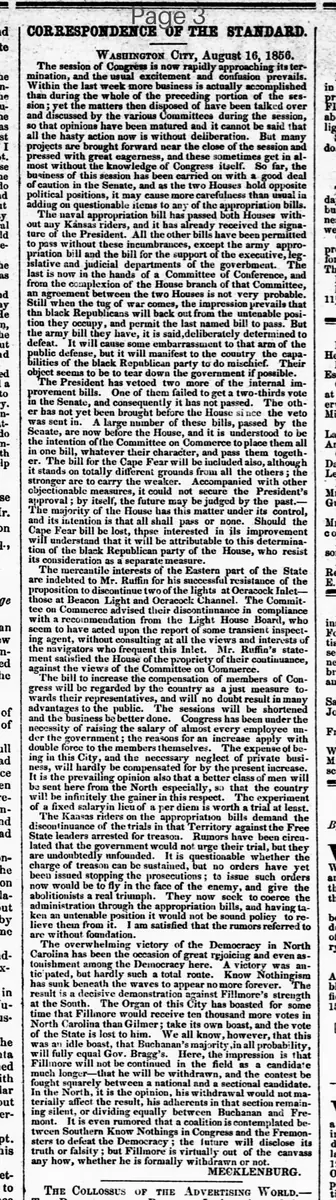
WASHINGTON CITY, August 16. 1856.
The session of Congress is now rapidly approaching its termination, and the usual excitement and confusion prevails.
Within the last week more business is actually accomplished than during the whole of the preceding portion of the session; yet the matters then disposed of have been talked over and discussed by the various Committees during the session, so that opinions have been matured and it cannot be said that all the hasty action now is without deliberation. But many projects are brought forward near the close of the session and pressed with great eagerness. and these sometimes get in almost without the knowledge of Congress itself. So far, the business of this session has been carried on with a good deal of caution in the Senate, and as the two Houses hold opposite political positions, it may cause more carefulness than usual in adding on questionable items to any of the appropriation bills.
The naval appropriation bill has passed both Houses without any Kansas riders, and it has already received the signature of the President. All the other bills have been permitted to pass without these incumbrances, except the army appropriation bill and the bill for the support of the executive, legislative and judicial departments of the government. The last is now in the hands of a Committee of Conference, and from the complexion of the House branch of that Committee, an agreement between the two Houses is not very probable.
Still when the tug of war comes, the impression prevails that the black Republicans will back out from the untenable position they occupy, and permit the last named bill to pass.' But the army bill they have, it is said, deliberately determined to defeat. It will cause some embarrassment to that arm of the public defense, but it will manifest to the country the capabilities of the black Republican party to do mischief. Their object seems to be to tear down the government if possible.
The President has vetoed two more of the internal improvement bills. One of them failed to get a two-thirds vote in the Senate, and consequently it has not passed. The other has not yet been brought before the House since the veto was sent in. A large number of these bills, passed by the Senate, are now before the House, and it is understood to be the intention of the Committee on Commerce to place them all in one bill, whatever their character, and pass them together. The bill for the Cape Fear will be included also, although it stands on totally different grounds from all the others; the stronger are to carry the weaker. Accompanied with other objectionable measures, it could not secure the President's approval; by itself, the future may be judged by the past.
The majority of the House has this matter under its control, and its intention is that all shall pass or none. Should the Cape Fear bill be lost, those interested in its improvement will understand that it will be attributable to this determination of the black Republican party of the House, who resist its consideration as a separate measure.
The mercantile interests of the Eastern part of the State are indebted to Mr. Ruffin for his successful resistance of the proposition to discontinue two of the lights at Ocracoke Inlet—those at Beacon Light and Ocracoke Channel. The Committee on Commerce advised their discontinuance in compliance with a recommendation from the Light House Board, who seem to have acted upon the report of some transient inspecting agent, without consulting at all the views and interests of the navigators who frequent this Inlet. Mr. Ruffin's statement satisfied the House of the propriety of their continuance, against the views of the Committee on Commerce.
The bill to increase the compensation of members of Congress will be regarded by the country as a just measure towards their representatives, and will no doubt result in many advantages to the public. The sessions will be shortened and the business be better done. Congress has been under the necessity of raising the salary of almost every employee under the government; the reasons for an increase apply with double force to the members themselves. The expense of being in this City, and the necessary neglect of private business, will hardly be compensated for by the present increase.
It is the prevailing opinion also that a better class of men will be sent here from the North especially, so that the country will be infinitely the gainer in this respect. The experiment of a fixed salary in lieu of a per diem is worth a trial at least.
The Kansas riders on the appropriation bills demand the discontinuance of the trials in that Territory against the Free State leaders arrested for treason. Rumors have been circulated that the government would not urge their trial, but they are undoubtedly unfounded. It is questionable whether the charge of treason can be sustained, but no orders have yet been issued stopping the prosecutions; to issue such orders now would be to fly in the face of the enemy, and give the abolitionists a real triumph. They now seek to coerce the administration through the appropriation bills, and having taken an untenable position it would not be sound policy to relieve them from it. I am satisfied that the rumors referred to are without foundation.
The overwhelming victory of the Democracy in North Carolina has been the occasion of great rejoicing and even astonishment among the Democracy here. A victory was anticipated, but hardly such a total route. Know Nothingism has sunk beneath the waves to appear no more forever. The result is a decisive demonstration against Fillmore's strength at the South. The Organ of this City has boasted for some time that Fillmore would receive ten thousand more votes in North Carolina than Gilmer; take its own boast, and the vote of the State is lost to him. We all know, however, that this was an idle boast, that Buchanan's majority, in all probability, will fully equal Gov. Bragg's.
Here, the impression is that Fillmore will not be continued in the field as a candidate much longer-that he will be withdrawn, and the contest be fought squarely between a national and a sectional candidate.
In the North, it is the opinion, his withdrawal would not materially affect the result, his adherents in that section remaining silent, or dividing equally between Buchanan and Fremont. It is even rumored that a coalition is contemplated between Southern Know Nothings in Congress and the Fremontsters to defeat the Democracy; the future will disclose its truth or falsity; but Fillmore is virtually out of the canvass any how, whether he is formally withdrawn or not.
MECKLENBURG.
What sub-type of article is it?
What themes does it cover?
What keywords are associated?
What entities or persons were involved?
Letter to Editor Details
Author
Mecklenburg
Recipient
The Standard
Main Argument
reports on the congressional session's end, criticizing republican tactics on appropriation bills with kansas riders, praising democratic successes, and defending ongoing treason trials in kansas while anticipating fillmore's withdrawal from the presidential race.
Notable Details