Thank you for visiting SNEWPapers!
Sign up free
Norfolk Gazette And Publick Ledger
Norfolk, Virginia
What is this article about?
Diplomatic correspondence between British Minister Augustus Foster and US Secretary James Monroe, transmitted by President Madison to Congress on June 4, 1812. Foster provides evidence from Duke of Bassano's March 10 report that French Berlin and Milan decrees remain in force and aggravated, urging US to reject French maritime pretensions and not demand repeal of British Orders in Council without unconditional French repeal. Monroe seeks clarification on British conditions for repeal.
Merged-components note: These components form a single continuous diplomatic correspondence between U.S. and British officials regarding French decrees and British orders in council, spanning multiple columns on page 2.
Clippings
1 of 2
OCR Quality
Full Text
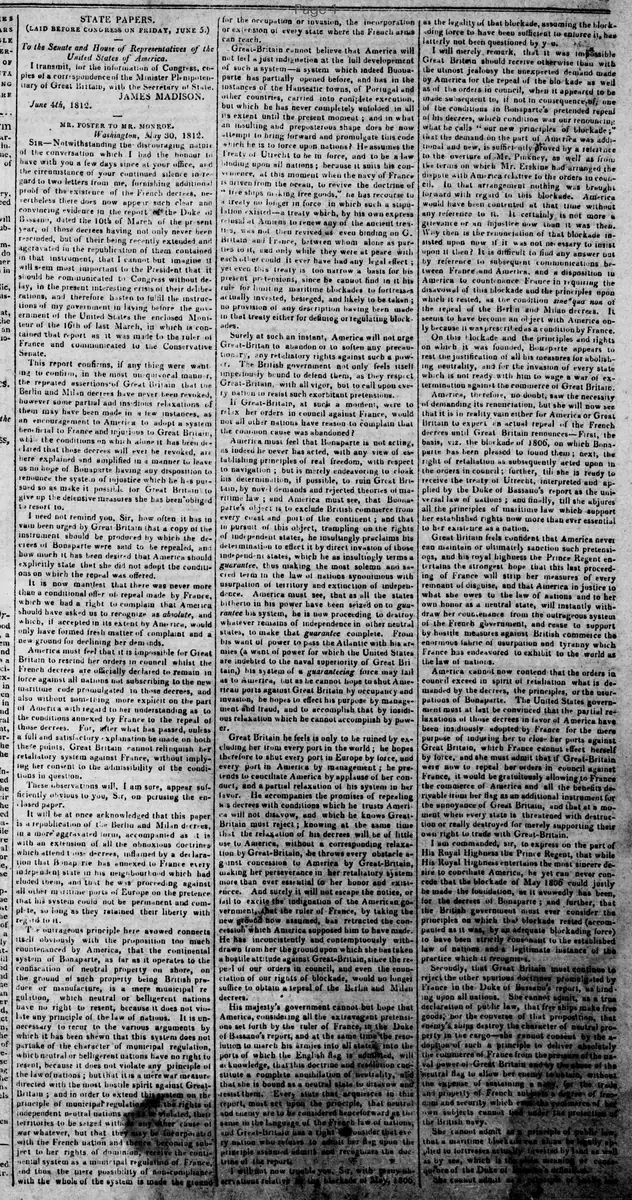
(LAID BEFORE CONGRESS ON FRIDAY, JUNE 5.)
To the Senate and House of Representatives of the United States of America.
I transmit, for the information of Congress, copies of a correspondence of the Minister Plenipotentiary of Great Britain, with the Secretary of State.
JAMES MADISON.
June 4th, 1812.
MR. FOSTER TO MR. MONROE.
Washington, May 30, 1812.
SIR—Notwithstanding the discouraging nature of the conversation which I had the honor to have with you a few days since at your office, and the circumstance of your continued silence in regard to two letters from me, furnishing additional proof of the existence of the French decrees, nevertheless there does now appear such clear and convincing evidence in the report of the Duke of Bassano, dated the 10th of March of the present year, of those decrees having not only never been rescinded, but of their being recently extended and aggravated in the republication of them contained in that instrument, that I cannot but imagine it will seem most important to the President that it should be communicated to Congress without delay, in the present interesting crisis of their deliberations, and therefore hasten to fulfil the instructions of my government in laying before the government of the United States the enclosed Moniteur of the 16th of last March, in which is contained that report as it was made to the ruler of France and communicated to the Conservative Senate.
This report confirms, if anything were wanting to confirm, in the most unequivocal manner, the repeated assertions of Great Britain that the Berlin and Milan decrees have never been revoked, however some partial and insidious relaxations of them may have been made in a few instances, as an encouragement to America to adopt a system beneficial to France and injurious to Great Britain, while the conditions on which alone it has been declared that those decrees will ever be revoked, are here explained and amplified in a manner to leave us no hope of Bonaparte having any disposition to renounce the system of injustice which he has pursued so as to make it possible for Great Britain to give up the defensive measures she has been obliged to resort to.
I need not remind you, Sir, how often it has in vain been urged by Great Britain that a copy of the instrument should be produced by which the decrees of Bonaparte were said to be repealed, and how much it has been desired that America should explicitly state that she did not adopt the conditions on which the repeal was offered.
It is now manifest that there was never more than a conditional offer of repeal made by France, which we had a right to complain that America should have asked us to recognize as absolute, and which, if accepted in its extent by America, would only have formed fresh matter of complaint and a new ground for declining her demands.
America must feel that it is impossible for Great Britain to rescind her orders in council whilst the French decrees are officially declared to remain in force against all nations not subscribing to the new maritime code promulgated in those decrees, and also without something more explicit on the part of America with regard to her understanding as to the conditions annexed by France to the repeal of those decrees. For, after what has passed, unless a full and satisfactory explanation be made on both these points, Great Britain cannot relinquish her retaliatory system against France, without implying her consent to the admissibility of the conditions in question.
These observations will, I am sure, appear sufficiently obvious to you, Sir, on perusing the enclosed paper.
It will be at once acknowledged that this paper is a republication of the Berlin and Milan decrees, in a more aggravated form, accompanied as it is with an extension of all the obnoxious doctrines which attend those decrees, inflamed by a declaration that Bonaparte has annexed to France every independent state in his neighbourhood which had eluded them, and that he was proceeding against all other maritime ports of Europe on the pretence that his system could not be permanent and complete, so long as they retained their liberty with regard to it.
The outrageous principle here avowed connects itself obviously with the proposition too much countenanced by America, that the continental system of Bonaparte, as far as it operates to the confiscation of neutral property on shore, on the ground of such property being British produce or manufacture, is a mere municipal regulation, which neutral or belligerent nations have no right to resent, because it does not violate any principle of the law of nations. It is unnecessary to recur to the various arguments by which it has been shewn that this system does not partake of the character of municipal regulation, which neutral or belligerent nations have no right to resent, because it does not violate any principle of the law of nations; but that it is a mere war measure directed with the most hostile spirit against Great Britain; and in order to extend this system on the principle of municipal regulation the rights of independent neutral nations are violated, their territories to be seized without any cause of war whatever, but that they may be incorporated with the French nation and thence becoming subject to her rights of dominion, receive the continental system as a municipal regulation of France. And thus the mere possibility of non-compliance with the whole of the system is made the ground for the occupation or invasion, the incorporation or expulsion of every state where the French arms can reach.
Great-Britain cannot believe that America will not feel a just indignation at the full development of such a system—a system which indeed Bonaparte has partially opened before, and has in the instances of the Hanseatic towns, of Portugal and other countries, carried into complete execution, but which he has never completely unfolded in all its extent until the present moment; and in what an insulting and preposterous shape does he now attempt to bring forward and promulgate this code which he is to force upon nations? He assumes the Treaty of Utrecht to be in force, and to be a law binding upon all nations; because it suits his convenience, at this moment when the navy of France is driven from the ocean, to revive the doctrine of "free ships make free goods," he has recourse to a treaty no longer in force in which such a stipulation existed—a treaty which, by his own express refusal at Amiens to renew any of the ancient treaties, was not then revived as even binding on G. Britain and France, between whom alone as parties to it, and only while they were at peace with each other could it ever have had any legal effect; yet even this treaty is too narrow a basis for his present pretensions, since he cannot find in it his rule for limiting maritime blockades to fortresses actually invested, besieged, and likely to be taken; no provision of any description having been made in that treaty either for designating or regulating blockades.
Surely at such an instant, America will not urge Great-Britain to abandon or to suspend any precautionary, any retaliatory rights against such a power. The British government not only feels itself imperiously bound to defend them, as they respect Great-Britain, with all vigor, but to call upon every nation to resist such exorbitant pretensions.
If Great-Britain, at such a moment, were to relax her orders in council against France, would not all other nations have reason to complain that the common cause was abandoned?
America must feel that Bonaparte is not acting, as indeed he never has acted, with any view of establishing principles of real freedom, with respect to navigation; but is merely endeavoring to cloak his determination, if possible, to ruin Great Britain, by new demands and rejected theories of maritime law; and America must see, that Bonaparte's object is to exclude British commerce from every coast and port of the continent; and that in pursuit of this object, trampling on the rights of independent states, he insultingly proclaims his determination to effect it by direct invasion of those independent states, which he as insultingly terms a guarantee, thus making the most solemn and sacred term in the law of nations synonymous with usurpation of territory and extinction of independence. America must see, that as all the states hitherto in his power have been seized on to guarantee his system, he is now proceeding to destroy whatever remains of independence in other neutral states, to make that guarantee complete. From his want of power to pass the Atlantic with his armies (a want of power for which the United States are indebted to the naval superiority of Great Britain,) his system of guaranteeing force may fail as to America, but as he cannot hope to shut American ports against Great Britain by occupancy and invasion, he hopes to effect his purpose by management and fraud, and to accomplish that by insidious relaxation which he cannot accomplish by power.
Great Britain he feels is only to be ruined by excluding her from every port in the world; he hopes therefore to shut every port in Europe by force, and every port in America by management; he pretends to conciliate America by applause of her conduct, and a partial relaxation of his system in her favor. He accompanies the promises of repealing his decrees with conditions which he trusts America will not disavow, and which he knows Great-Britain must reject; knowing at the same time that the relaxation of his decrees will be of little use to America, without a corresponding relaxation by Great-Britain, he throws every obstacle against concession to America by Great-Britain, making her perseverance in her retaliatory system more than ever essential to her honor and existence. And surely it will not escape the notice, or fail to excite the indignation of the American government, that the ruler of France, by taking the new ground now assumed, has retracted the concession which America supposed him to have made. He has inconstantly and contemptuously withdrawn from her the ground upon which she has taken a hostile altitude against Great-Britain, since the repeal of our orders in council, and even the enunciation of our rights of blockade, would no longer suffice to obtain a repeal of the Berlin and Milan decrees.
His majesty's government cannot but hope that America, considering all the extravagant pretensions set forth by the ruler of France, in the Duke of Bassano's report, and at the same time the resolution to march his armies into all states into the ports of which the English flag is admitted, will acknowledge, that this doctrine and resolution constitute a complete annihilation of neutrality and that she is bound as a neutral state to disavow and resist them. Every State that acquiesces in this report, must act upon the principle, that neutral and enemy are to be considered henceforth as the same in the language of the French law of nations, and Great Britain has a right to consider that every nation who refuses to admit her flag upon the principle assumed admits and recognizes the doctrine of the report.
I will not now trouble you Sir with as the legality of that blockade, assuming the blockading force to have been sufficient to enforce it, has latterly not been questioned by you.
I will merely remark, that it was impossible Great Britain should receive otherwise than with the utmost jealousy the unexpected demand made by America for the repeal of the blockade as well as of the orders in council, when it appeared to be made subsequent to, if not in consequence of one of the conditions in Bonaparte's pretended repeal of his decrees, which condition was our renouncing what he calls "our new principles of blockade;" that the demand on the part of America was additional and new, is sufficiently proved by a reference to the overture of Mr. Pinkney, as well as from the terms on which Mr. Erskine had arranged the dispute with America relative to the orders in council. In that arrangement nothing was brought forward with regard to this blockade. America would have been contented at that time without any reference to it. It certainly is not more a grievance or an injustice now than it was then.
Why then is the renunciation of that blockade insisted upon now if it was not necessary to insist upon it then? It is difficult to find any answer but by reference to subsequent communications between France and America, and a disposition in America to countenance France in requiring the disavowal of this blockade and the principles upon which it rested, as the condition sine qua non of the repeal of the Berlin and Milan decrees. It seems to have become an object with America only because it was prescribed as a condition by France.
On this blockade and the principles and rights on which it was founded, Bonaparte appears to rest the justification of all his measures for abolishing neutrality, and for the invasion of every state which is not ready with him to wage a war of extermination against the commerce of Great Britain.
America, therefore, no doubt, saw the necessity of demanding its renunciation, but she will now see that it is in reality vain either for America or Great Britain to expect an actual repeal of the French decrees until Great Britain renounces—First, the basis, viz. the blockade of 1806, on which Bonaparte has been pleased to sound them; next, the right of retaliation as subsequently acted upon in the orders in council; further, till she is ready to receive the treaty of Utrecht, interpreted and applied by the Duke of Bassano's report as the universal law of nations; and finally, till she abjures all the principles of maritime law which support her established rights now more than ever essential to her existence as a nation.
Great Britain feels confident that America never can maintain or ultimately sanction such pretensions, and his royal highness the Prince Regent entertains the strongest hope that this last proceeding of France will strip her measures of every remnant of disguise, and that America in justice to what she owes to the law of nations and to her own honor as a neutral state, will instantly withdraw her countenance from the outrageous system of the French government, and cease to support by hostile measures against British commerce the enormous fabric of usurpation and tyranny which France has endeavored to exhibit to the world as the law of nations.
America cannot now contend that the orders in council exceed in spirit of retaliation what is demanded by the decrees, the principles, or the usurpations of Bonaparte. The United States government must at last be convinced that the partial relaxations of those decrees in favor of America have been insidiously adopted by France for the mere purpose of inducing her to close her ports against Great Britain, which France cannot effect herself by force, and she must admit that if Great-Britain were now to repeal her orders in council against France, it would be gratuitously allowing to France the commerce of America and all the benefits derivable from her flag as an additional instrument for the annoyance of Great Britain, and that at a moment when every state is threatened with destruction or really destroyed for merely supporting their own right to trade with Great-Britain.
I am commanded, sir, to express on the part of His Royal Highness the Prince Regent, that while His Royal Highness entertains the most sincere desire to conciliate America, he yet can never concede that the blockade of May 1806 could justly be made the foundation, as it avowedly has been, for the decrees of Bonaparte; and further, that the British government must ever consider the principles on which that blockade rested (accompanied as it was by an adequate blockading force) to have been strictly consonant to the established law of nations and a legitimate instance of the practice which it recognizes.
Secondly, that Great Britain must continue to reject the other spurious doctrines promulgated by France in the Duke of Bassano's report, as binding upon all nations. She cannot admit, as a true declaration of public law, that free ships make free goods, nor the converse of that proposition, that enemy's ships destroy the character of neutral property in the cargo she—cannot consent by the adoption of such a principle to deliver absolutely the commerce of France from the pressure of the naval power of Great Britain and by the use of the neutral flag to allow her enemy to obtain without the expense of sustaining a navy of her own the full enjoyment and security which even French subjects cannot shield under the British navy.
She Cannot admit principles so obviously subversive of the maritime rights of Great Britain, that a maritime blockade so applied to fortresses etc. as by sea, which in consequence of the Duke of She cannot admit
that arms and military stores are alone contraband of war, and that ship timber and naval stores are excluded from that description. Neither can she admit without retaliation that the mere fact of commercial intercourse with British ports and subjects should be made a crime in all nations, and that the arms and decrees of France should be directed to enforce a principle so unjust and unheard of in war.
Great Britain feels that to relinquish her just measures of self-defence and retaliation, would be to surrender the best means of her own preservation and rights, and with them the rights of other nations so long as France maintains and acts upon such principles.
I am commanded to represent to the government of America, that Great Britain feels herself entitled to expect from them an unreserved and candid disclaimer of the right of France to impose on her and on the world the maritime code which has been thus promulgated, and to the penalties of which America is henceforward declared to be liable if she fails to submit herself to its exactions; America cannot, for her own character, any longer temporize on this subject, or delay coming to a distinct explanation with France as well as with Great Britain, if she wishes to clear herself from the imputation of being an abettor of such injustice.
America, as the case now stands, has not a pretence for claiming from Great Britain a repeal of her orders in council. She must recollect that the British government never for a moment countenanced the idea that the repeal of those orders would depend upon any partial or conditional repeal of the decrees of France. What she always avowed was her readiness to rescind her orders in council as soon as France rescinded absolutely and unconditionally her decrees. She could not enter into any other engagement without the grossest injustice to her allies as well as the neutral nations in general, much less could she do so if any special exception was to be granted by France upon conditions utterly subversive of the most important and indisputable maritime rights of the British empire.
America has now a proceeding forced upon her by France, on which, without surrendering any of those principles which she may deem it necessary for her own honor and security to maintain, she may separate herself from the violence and injustice of the enemy. She owes not only to herself to do so; but she is entitled to resent that course of conduct on the part of France which is the only impediment to her obtaining what she desires at the hands of Great Britain, namely, the repeal of the orders in council.
I am authorised to renew to the American government the assurance of his royal highness's anxious desire to meet the wishes of America upon this point, whenever the conduct of the enemy will justify him in so doing.
Whilst America could persuade herself, however erroneously, that the Berlin and Milan decrees had been actually and totally repealed, and that the execution of the engagement made on that condition by the British government had been declined, she might deem it justifiable, as a consequence of such a persuasion, to treat the interest and commerce of France with preference and friendship, and those of Great Britain with hostility—but this delusion is at an end—America now finds the French decrees not only in full force, but pointed with augmented hostility against Great Britain.
Will the government of the United States declare that the measure now taken by France is that repeal of the obnoxious decrees which America expected would lead to the repeal of the British orders in council? Will the American government, unless upon the principle of denying our retaliatory right of blockade, under any imaginable circumstances, declare that there is at this moment a ground upon which the repeal of our orders in council can be pressed upon us; or that the repeal could now be warranted upon any other ground than an express abdication of the right itself, which America well knows, whatever may be our desire to conciliate, is a concession which the British government cannot and will not make.
If this be true, for what purpose can she persevere in her hostile attitude towards Great Britain, and her friendly one towards France? Do the American government really wish to aid France in her attempt to subjugate Great Britain? Does America expect that Great Britain, contending against France, will at the instance of America disarm herself, and submit to the mercy of the opponent?
If both these questions are answered in the negative, upon what ground can she or a moment longer continue the hostile measures against us? The American non-intercourse act was framed upon the express principle of continuing in force against the power, whether France or Great Britain, that should refuse to repeal its respective laws, of which America thought herself entitled to complain; out the repeal contemplated by that act was a bona fide repeal, and not a repeal upon an inadmissible condition, and America can never be justified in continuing to resent against us that failure of repeal which is alone attributable to the insidious policy of the enemy that has for the purpose of embarrassing the discussions interwoven the question of the decrees with the exaction of a relinquishment of almost the whole system of our maritime law.
It is not for the British government to dictate to that of America what ought to be the measure of her just indignation against the ruler of France, or having originated and persevered in a system of lawless violence, to the subversion of neutral rights, which being necessarily retaliated by Great Britain has exposed America, with other neutral states, to losses which the British government has never ceased most sincerely to deplore; America must judge for herself, how much the original injustice of France towards her has been aggravated by the fraudulent professions of relinquishing her decrees by the steps adopted to mislead America, in order to embark her in measures which we trust she never would have taken if she could have foreseen what has now happened; and ultimately by threatening America with her vengeance, as a denationalised state if she does not submit to be the instrument of her designs against Great Britain.
These are considerations for America to weigh; but what we are entitled to claim at her hands as an act not less of policy than justice, is that she should cease to treat Great Britain as an enemy. The prince regent does not desire retrospect when the interests of two countries are so naturally connected by innumerable ties of commerce. It is more consonant to his royal highness's sentiments to contribute to the restoration of harmony and friendly intercourse than to guard against it having been interrupted.
ed. Feeling that nothing has been omitted on his part to relieve America from the inconveniencies to which a novel system of warfare on the part of France unfortunately continues to expose her; and that the present unfriendly relations, which to their mutual prejudice subsists between the two countries, have grown out of a misconception on the part of America both of the conduct and purpose of France: his royal highness considers himself entitled to call upon America to resume her relations of amity with Great Britain. In doing so she will best provide for the interests of her own people; and I am authorised to assure the American government, that although his royal highness, acting in the name and on the behalf of his majesty, can never suffer the fundamental maxims of the British monarchy in matters of maritime right, as consonant to the recognised law of nations, to be prejudiced in his hands, his royal highness will be ready at all times to concert with America, as to their exercise; and so to regulate their application as to combine, as far as may be, the interests of America with the object of effectually retaliating upon France the measure of her own injustice.
I will now terminate this letter by assuring you, Sir, as I can with perfect truth, that the most cordial and sincere desire animates the councils of Great Britain to conciliate America, as far as may be consistent with the principles upon which the preservation of the power and independence of the British monarchy is held essentially to depend, and which cannot be abandoned without throwing her helpless and disarmed into the presence of her adversary.
I have the honor to be with great respect, Sir,
(Signed) AUG. J. FOSTER.
James Monroe, Secretary of State.
[Here follows the French Minister the Duke of Bassano's letter to the Conservative Senate, which we have before published, and is alluded to by Mr. Foster in his letter to Mr. Monroe.]
MR. MONROE TO MR. FOSTER.
Department of State, June 3d, 1812.
SIR—In the letter of May 30th which I had the honour to receive from you on the 1st instant, I perceive a difference in a particular passage of it from a passage on the same subject, in the dispatch from Lord Castlereagh to you, which you were so good as to communicate to me entire, as appears from the tenor of the letter to have been intended by your government. The passage in your letter to which I allude is as follows: "America, as the case now stands, has not a pretence for claiming from Great Britain a repeal of her orders in council. She must recollect that the British government never for a moment countenanced the idea that the repeal of those orders could depend upon any partial or conditional repeal of the decrees of France. What she always avowed was her readiness to rescind her orders in council as soon as France rescinded absolutely and unconditionally her decrees. She could not enter into any other engagement without the grossest injustice to her allies as well as to neutral nations in general; much less could she do so if any special exception was to be granted by France upon conditions utterly subversive of the most important and indisputable maritime rights of the British empire."
According to the tenor of the dispatch of Lord Castlereagh to you, my recollection is, that in stating the condition on which the orders in council were to be repealed, in relation to the United States, it was specified that the decrees of Berlin and Milan must not be repealed singly and specially in relation to the United States, but be repealed also as to all other neutral nations, and that in no less extent of a repeal of the decrees had the British government ever pledged itself to repeal the orders in council.
However susceptible the passage in your letter may be of a construction reconcilable with the import of the dispatch from Lord Castlereagh, yet as a similar phraseology of your government on other occasions has had a construction less extensive; and as it is important, in every respect, that there should be no misunderstanding, or possibility of error, you will excuse me for requesting that you will have the goodness to inform me whether, in any circumstance, my recollection of the import of this passage in Lord Castlereagh's dispatch is inaccurate.
I have the honour, &c.
(Signed) JAMES MONROE.
Aug. J. Foster, &c.
MR. FOSTER TO MR. MONROE.
Washington, June 3, 1812.
Sir—I have received your letter of to-day, requesting an explanation relative to the supposed meaning of a passage in a dispatch from Lord Castlereagh to me that I had the honour to communicate to you confidentially, and I beg leave to state to you that while I conceive it to be very difficult to give an explanation upon a single point in a note of considerable length without referring to the whole context, and also believe it to be altogether irregular to enter into a discussion respecting a communication so entirely informal, yet I have no hesitation in assuring you that my note of May 30 contains the whole substance of the dispatch alluded to.
In the correspondence that will probably take place between us in consequence of the new ground upon which the Duke of Bassano's report has placed the question at issue between our two countries, I shall be extremely happy to enter at full length upon any topic, which you may wish particularly to discuss.
I have the honor to be, &c.
AUG. J. FOSTER.
Hon. J. Monroe, &c.
MR. MONROE TO MR. FOSTER.
Department of State, June 4, 1812.
Sir—I have had the honor to receive your letter of yesterday in reply to mine of the same date.
As the dispatch of Lord Castlereagh was communicated by you to me, in my official character, to be shewn to the President, and was shewn to him accordingly, and as the dispatch expressly authorised such communication to this government, I cannot conceive in what sense such a proceeding could be considered confidential, or how it could be understood, that the executive was to receive one communication for itself, and transmit to Congress another, liable, in the opinion of the executive, to a different or doubtful construction.
I cannot but persuade myself, Sir, that on a reconsideration of the subject you will perceive that there can be no impropriety in compliance with the request contained in my letter of yesterday.
Should I be mistaken in this expectation, I flatter myself that you will see the propriety of freeing your own communication from ambiguity and liability to misconstruction. With a view to this, permit me to enquire whether the passage in your letter, stating the condition on which your government always avowed its readiness to rescind the orders in council, namely, as soon as France rescinded, absolutely and unconditionally, her decrees, includes in its meaning, that the decrees must be rescinded in relation to other neutral nations, as well as to the United States, previous to a repeal of the orders in council in relation to the United States.
I have the honor, &c.
(Signed) JAMES MONROE.
Aug. J. Foster. Esq, &c.
What sub-type of article is it?
What keywords are associated?
What entities or persons were involved?
Where did it happen?
Foreign News Details
Primary Location
France
Event Date
May June 1812
Key Persons
Outcome
ongoing diplomatic tensions; britain refuses to repeal orders in council without unconditional french repeal of decrees; us seeks clarification on british conditions; no resolution, heightening pre-war frictions.
Event Details
British Minister Foster writes to US Secretary Monroe on May 30, 1812, enclosing French Moniteur of March 16 reporting Duke of Bassano's March 10 confirmation that Berlin and Milan decrees remain in force, extended, and aggravated. Foster argues French conditional repeal is invalid, urges US to reject French maritime code and not demand British concessions. Monroe responds June 3 seeking clarification on Castlereagh's dispatch regarding repeal conditions for other neutrals. Foster affirms his letter captures substance. Monroe presses again June 4 for explicit confirmation. President Madison transmits correspondence to Congress June 4 for information amid deliberations.