Thank you for visiting SNEWPapers!
Sign up free
Arkansas State Press
Little Rock, Pulaski County, Arkansas
What is this article about?
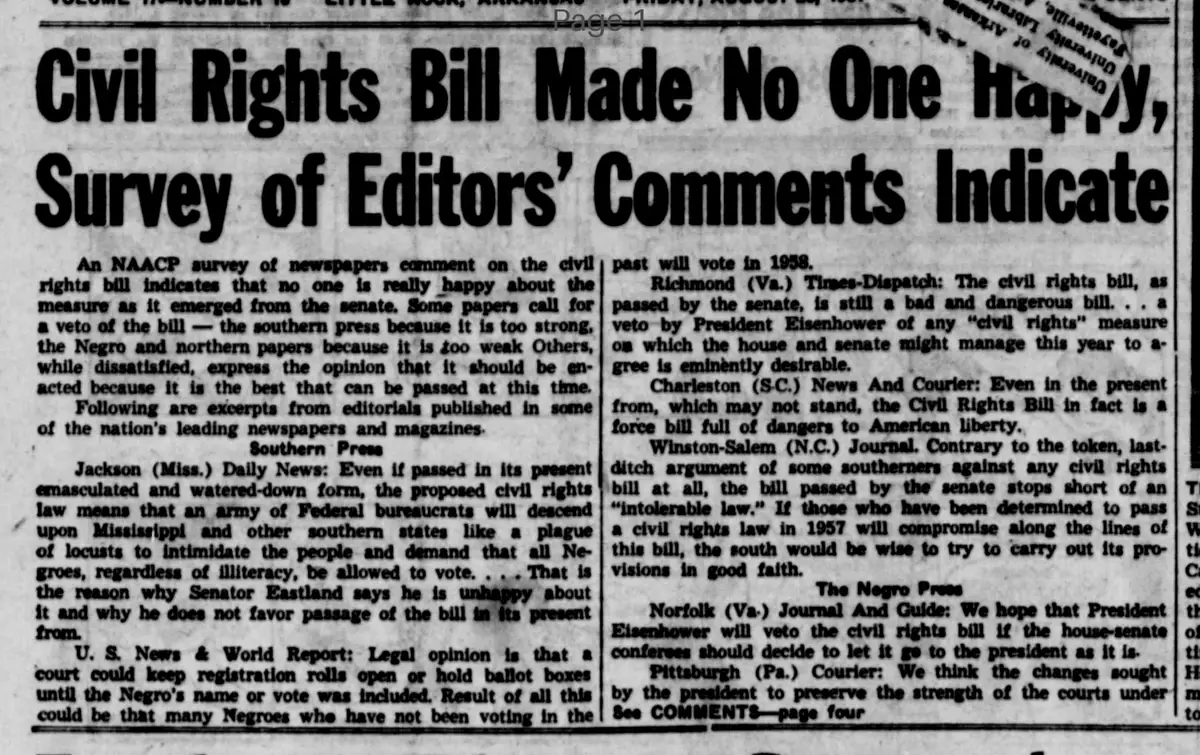
NAACP survey reveals widespread dissatisfaction with the Senate-passed civil rights bill: Southern papers decry it as too strong and seek veto; Black press finds it too weak; Northern outlets are divided, some favoring passage as progress despite flaws. Eisenhower's disappointment noted.
Merged-components note: Merged continuation of civil rights bill story from page 1 to page 4 based on 'See comments page four' indicator and sequential topic on civil rights legislation.
Clippings
1 of 2
OCR Quality
Full Text
Survey of Editors' Comments Indicate
An NAACP survey of newspapers comment on the civil rights bill indicates that no one is really happy about the measure as it emerged from the senate. Some papers call for a veto of the bill - the southern press because it is too strong. the Negro and northern papers because it is too weak Others, while dissatisfied, express the opinion that it should be enacted because it is the best that can be passed at this time.
Following are excerpts from editorials published in some of the nation's leading newspapers and magazines.
Southern Press
Jackson (Miss.) Daily News: Even if passed in its present emasculated and watered-down form, the proposed civil rights law means that an army of Federal bureaucrats will descend upon Mississippi and other southern states like a plague of locusts to intimidate the people and demand that all Negroes, regardless of illiteracy, be allowed to vote. . . . That is the reason why Senator Eastland says he is unhappy about it and why he does not favor passage of the bill in its present form.
U. S. News & World Report: Legal opinion is that a court could keep registration rolls open or hold ballot boxes until the Negro's name or vote was included. Result of all this could be that many Negroes who have not been voting in the past will vote in 1958.
Richmond (Va.) Times-Dispatch: The civil rights bill, as passed by the senate, is still a bad and dangerous bill. . . a veto by President Eisenhower of any "civil rights" measure on which the house and senate might manage this year to agree is eminently desirable.
Charleston (SC.) News And Courier: Even in the present form, which may not stand, the Civil Rights Bill in fact is a force bill full of dangers to American liberty.
Winston-Salem (N.C.) Journal. Contrary to the token, last-ditch argument of some southerners against any civil rights bill at all, the bill passed by the senate stops short of an "intolerable law." If those who have been determined to pass a civil rights law in 1957 will compromise along the lines of this bill, the south would be wise to try to carry out its provisions in good faith.
The Negro Press
Norfolk (Va.) Journal And Guide: We hope that President Eisenhower will veto the civil rights bill if the house-senate conferees should decide to let it go to the president as it is.
Pittsburgh (Pa.) Courier: We think the changes sought by the president to preserve the strength of the courts under
See comments page four
Comments-
(Continued from page one)
other statutes are necessary and wise. However, if such changes are made, we believe the bill should be signed. We do not accept it as the full order for civil rights. It is a civil rights minus bill. But it is unquestionably a step in the right direction. It is a grudging surrender to the demands of the times. These demands are insistent and continuing
Baltimore Afro-American: With the phony jury trial amendment extracted in conference committee, as we hope it will be, this bill though limited solely to voting rights, represents a belated advance - in fact the first such step taken by the congress in 85 long, weary and agonizing years. Certainly it is too important a step to be thwarted by political stalemate.
California Eagle (Los Angeles): Frankly, we think the present senate legislation is worse than no legislation at all because its enactment will tend to keep down agitation for another genuine law. It seems to us that supporters of civil rights legislation would be well advised to vote against it in its present form, as amended by the senate, and that the president ought to veto it if the senate version is sent to him.
New York Amsterdam News: We therefore call on President Eisenhower to veto the bill in any form which it will be placed before him. For no one, no matter how sincere, can make civil rights out of this mess of batter which the congress has mixed up for his signature.
Northern Press
Christian Science Monitor (Boston): The more the senate bill is studied the harder it becomes to oppose it is ineffective . . . Precisely because it would enlist an essential degree of consent we believe the senate bill is strong - in terms of actual effectiveness.
New York Herald Tribune: It would be a severe blow to American prestige and distinct failure of congress to meet its responsibilities if the house of representatives meekly accepted the civil rights bill as amended by the senate. . . From every standpoint including that of its own integrity, the house must do its very best to improve the civil rights bill.
Seattle (Wash.) Post-Intelligencer: The angry disappointment voiced by President Eisenhower at the 51-42 senate vote that killed the heart of the administration's civil rights bill, was justified. . . . While it is true that legal subtleties confused the issue, especially in lay minds like ours, we think the president is right in his position that jury-trial amendment makes right-to-vote protection "largely ineffective" and that "many Americans will continue in effect to be disenfranchised."
New York Times: Let us see what can be done. If the prospective law does not improve an unhappy situation, let us study how that law can be strengthened and improved.
New York Post: In any case the situation has deteriorated to a point that presents only a choice between lesser evils. In the absence of any fighting presidential leadership, there is clearly no prospect of reviving Part III at this juncture; all that remains is the question as to whether a flimsy bill is better than no bill at all. To that question it seems clear that the answer must be yes.
The Nation: Time alone will tell how much the toothless Civil Rights Bill, if President Eisenhower permits it to become law, will help the Negro citizen exercises his rights. But anyone can see right now that, come 1960, it will painfully hurt the Democratic party whose senators, for a variety of reasons, extracted the bill's bite.
What sub-type of article is it?
What keywords are associated?
What entities or persons were involved?
Domestic News Details
Event Date
1957
Key Persons
Event Details
NAACP survey of newspaper editorials on the civil rights bill as passed by the Senate shows dissatisfaction across regions: Southern press views it as too strong and calls for veto; Negro press sees it as too weak and some urge veto; Northern press is mixed, some support enactment as best possible, others want improvements.