Thank you for visiting SNEWPapers!
Sign up free
Fowle's New Hampshire Gazette And General Advertiser
Portsmouth, Rockingham County, New Hampshire
What is this article about?
J. Williams argues in the Political Magazine for resuming trade between British Sugar Colonies in the West Indies and the newly independent American states, emphasizing mutual dependencies on lumber, provisions, and rum, warning of economic harm to England if intercourse is prohibited, and proposing exemptions to foster this union amid competition from French colonies.
Merged-components note: This is a continuation of the article 'The CRISIS of the SUGAR Colonies' from page 1 to page 2, discussing international trade and politics involving British colonies and America. The second component was incorrectly labeled as 'commercial' but fits better as 'foreign_news' overall.
Clippings
1 of 2
OCR Quality
Full Text
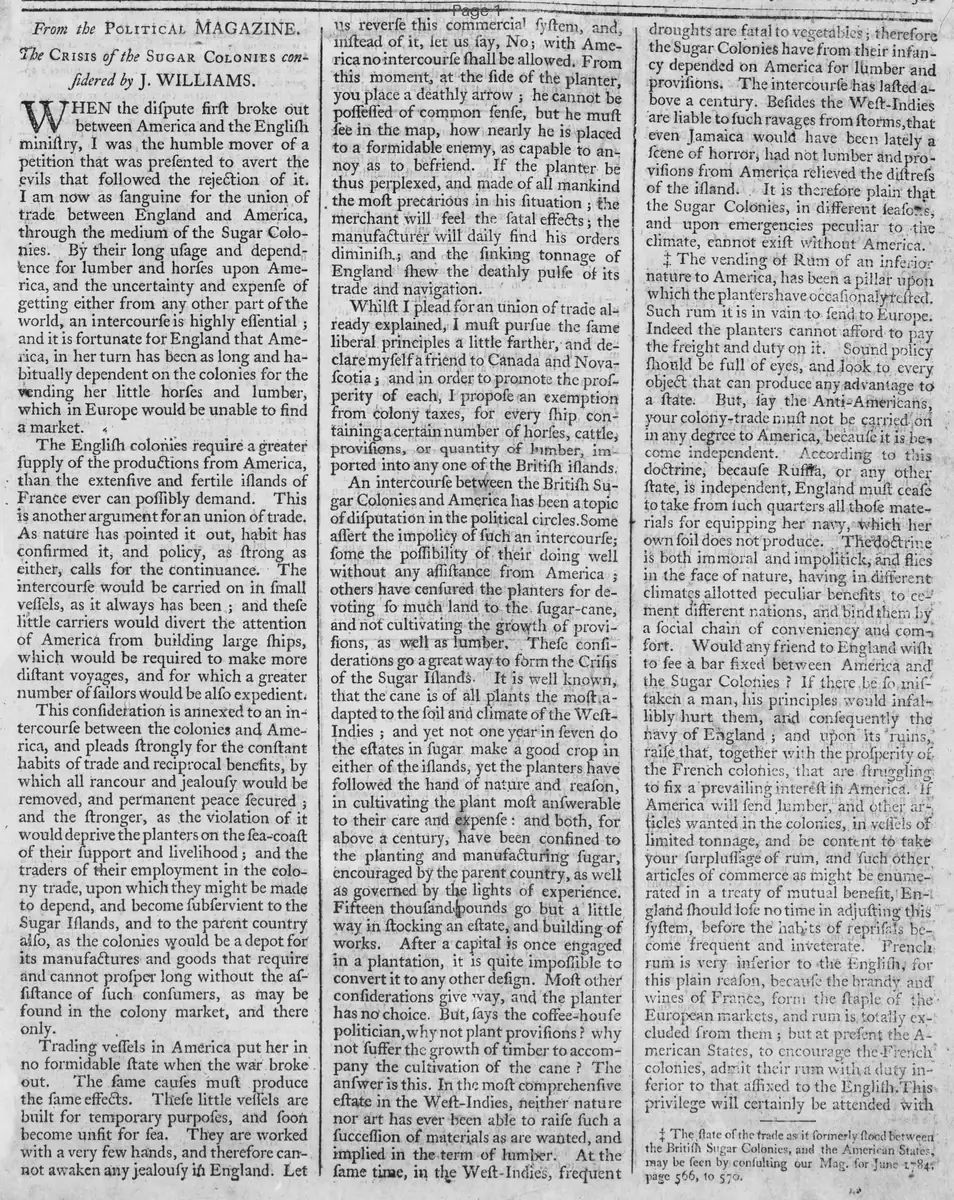
The CRISIS of the SUGAR Colonies considered by J. WILLIAMS.
WHEN the dispute first broke out between America and the English ministry, I was the humble mover of a petition that was presented to avert the evils that followed the rejection of it. I am now as sanguine for the union of trade between England and America, through the medium of the Sugar Colonies. By their long usage and dependence for lumber and horses upon America, and the uncertainty and expense of getting either from any other part of the world, an intercourse is highly essential; and it is fortunate for England that America, in her turn has been as long and habitually dependent on the colonies for the vending her little horses and lumber, which in Europe would be unable to find a market.
The English colonies require a greater supply of the productions from America, than the extensive and fertile islands of France ever can possibly demand. This is another argument for an union of trade. As nature has pointed it out, habit has confirmed it, and policy, as strong as either, calls for the continuance. The intercourse would be carried on in small vessels, as it always has been; and these little carriers would divert the attention of America from building large ships, which would be required to make more distant voyages, and for which a greater number of sailors would be also expedient. This consideration is annexed to an intercourse between the colonies and America, and pleads strongly for the constant habits of trade and reciprocal benefits, by which all rancour and jealousy would be removed, and permanent peace secured; and the stronger, as the violation of it would deprive the planters on the sea-coast of their support and livelihood; and the traders of their employment in the colony trade, upon which they might be made to depend, and become subservient to the Sugar Islands, and to the parent country also, as the colonies would be a depot for its manufactures and goods that require and cannot prosper long without the assistance of such consumers, as may be found in the colony market, and there only.
Trading vessels in America put her in no formidable state when the war broke out. The same causes must produce the same effects. These little vessels are built for temporary purposes, and soon become unfit for sea. They are worked with a very few hands, and therefore cannot awaken any jealousy in England. Let us revere this commercial system, and, instead of it, let us say, No; with America no intercourse shall be allowed. From this moment, at the side of the planter, you place a deathly arrow; he cannot be possessed of common sense, but he must see in the map, how nearly he is placed to a formidable enemy, as capable to annoy as to befriend. If the planter be thus perplexed, and made of all mankind the most precarious in his situation; the merchant will feel the fatal effects; the manufacturer will daily find his orders diminish.; and the sinking tonnage of England shew the deathly pulse of its trade and navigation.
Whilst I plead for an union of trade already explained, I must pursue the same liberal principles a little farther, and declare myself a friend to Canada and Nova-Scotia; and in order to promote the prosperity of each, I propose an exemption from colony taxes, for every ship containing a certain number of horses, cattle, provisions, or quantity of lumber, imported into any one of the British islands: An intercourse between the British Sugar Colonies and America has been a topic of disputation in the political circles. Some assert the impolicy of such an intercourse; some the possibility of their doing well without any assistance from America; others have censured the planters for devoting so much land to the sugar-cane, and not cultivating the growth of provisions, as well as lumber. These considerations go a great way to form the Crisis of the Sugar Islands. It is well known, that the cane is of all plants the most adapted to the soil and climate of the West-Indies; and yet not one year in seven do the estates in sugar make a good crop in either of the islands, yet the planters have followed the hand of nature and reason, in cultivating the plant most answerable to their care and expense: and both, for above a century; have been confined to the planting and manufacturing sugar, encouraged by the parent country, as well as governed by the lights of experience. Fifteen thousand pounds go but a little way in stocking an estate, and building of works. After a capital is once engaged in a plantation, it is quite impossible to convert it to any other design. Most other considerations give way, and the planter has no choice. But, says the coffee-house politician, why not plant provisions? why not suffer the growth of timber to accompany the cultivation of the cane? The answer is this. In the most comprehensive estate in the West-Indies, neither nature nor art has ever been able to raise such a succession of materials as are wanted, and implied in the term of lumber. At the same time, in the West-Indies, frequent droughts are fatal to vegetables; therefore the Sugar Colonies have from their infancy depended on America for lumber and provisions. The intercourse has lasted above a century. Besides the West-Indies are liable to such ravages from storms, that even Jamaica would have been lately a scene of horror, had not lumber and provisions from America relieved the distress of the island. It is therefore plain that the Sugar Colonies, in different seasons; and upon emergencies peculiar to the climate, cannot exist without America.
The vending of Rum of an inferior nature to America, has been a pillar upon which the planters have occasionally rested. Such rum it is in vain to send to Europe. Indeed the planters cannot afford to pay the freight and duty on it. Sound policy should be full of eyes, and look to every object that can produce any advantage to a state. But, say the Anti-Americans, your colony-trade must not be carried on in any degree to America, because it is become independent. According to this doctrine; because Russia, or any other state, is independent, England must cease to take from such quarters all those materials for equipping her navy, which her own soil does not produce. The doctrine is both immoral and impolitic, and flies in the face of nature, having in different climates allotted peculiar benefits to cement different nations, and bind them by a social chain of conveniency and comfort. Would any friend to England wish to see a bar fixed between America and the Sugar Colonies? If there be so mistaken a man, his principles would infallibly hurt them, and consequently the navy of England; and upon its ruins, raise that, together with the prosperity of the French colonies, that are struggling to fix a prevailing interest in America. If America will send lumber, and other articles wanted in the colonies, in vessels of limited tonnage, and be content to take your surplusage of rum, and such other articles of commerce as might be enumerated in a treaty of mutual benefit, England should lose no time in adjusting this system, before the habits of reprisals become frequent and inveterate. French rum is very inferior to the English, for this plain reason, because the brandy and wines of France, form the staple of the European markets, and rum is totally excluded from them: but at present the American States, to encourage the French colonies, admit their rum with a duty inferior to that affixed to the English. This privilege will certainly be attended with
Footnote: The state of the trade as it formerly stood between the British Sugar Colonies, and the American States, may be seen by consulting our Mag. for June 1784; page 566, to 570.
others, unless the care and wisdom of the English legislature seasonably prevent such alarming confederacies to take place against the balance of our trade. The liberal bounties once given by the English to encourage the rice trade, turpentine and other American productions, have ceased, and will be felt by the states very materially. The rice imported since the war, has but paid the expense of its carriage and duties laid on it. America will be glad to repossess the market of England for such and other branches of her commerce. In regard to tobacco, the bargain made with France is too pernicious to the planters to be long preserved: mutual dissatisfaction has arisen: and though Mr. Alexander has been sent out to inspect the tobacco, and keep up the terms of the contract, yet he has by no means been able to please the Farmers-General of France. This is therefore a critical juncture to fix the vibrating state of our own and the American trade. India has had a competent share of legislative regard and attention; Ireland has received singular instances of both. The colonies in the West-Indies now rap at the bosom of England for a share of its wisdom and protection.
What sub-type of article is it?
What keywords are associated?
What entities or persons were involved?
Where did it happen?
Foreign News Details
Primary Location
Sugar Colonies
Key Persons
Event Details
J. Williams argues for resuming trade between British Sugar Colonies and America, highlighting dependencies on lumber, provisions, and rum markets, proposing tax exemptions for imports, and warning of economic decline and French competition if prohibited.