Thank you for visiting SNEWPapers!
Sign up free
Pawtucket Herald, And Independent Inquirer
Pawtucket, Providence County, Rhode Island
What is this article about?
An editorial from the Providence Journal criticizes the new Jackson-supporting newspaper 'Herald' in Rhode Island, arguing against Andrew Jackson's presidential candidacy due to his alleged moral and legal flaws, contrasting him with the virtuous John Quincy Adams, whose only merit is the Battle of New Orleans.
Clipping
OCR Quality
Full Text
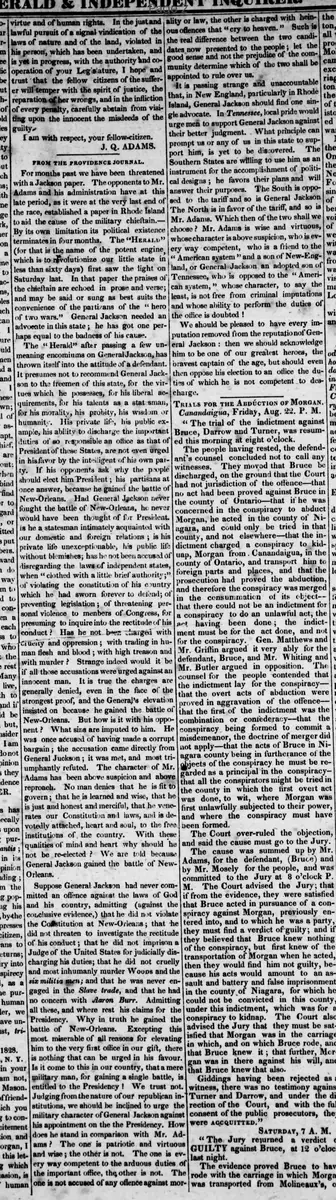
For months past we have been threatened with a Jackson paper. The opponents to Mr. Adams and his administration have at this late period, as it were at the very last end of the race, established a paper in Rhode Island to aid the cause of the military chieftain. By its own limitation its political existence terminates in four months. The "HERALD" (for that is the name of the potent engine which is to revolutionize our little state in less than sixty days) first saw the light on Saturday last. In that paper the praises of the chieftain are echoed in prose and verse; and may be said or sung as best suits the convenience of the partizans of the "hero of two wars."
General Jackson needed an advocate in this state; he has got one perhaps equal to the badness of his cause.
The "Herald" after passing a few unmeaning encomiums on General Jackson, has thrown itself into the attitude of a defendant. It presumes not to recommend General Jackson to the freemen of this state, for the virtues which he possesses, for his liberal acquirements, for his talents as a statesman, for his morality, his probity, his wisdom or humanity. His private life, his public example, his ability to discharge the important duties of so responsible an office as that of President of these States, are not even urged in his favor by the intelligent of his own party. If his opponents ask why the people should elect him President; his partisans at once answer, because he gained the battle of New-Orleans. Had General Jackson never fought the battle of New-Orleans, he never would have been thought of for President.
Is he a statesman intimately acquainted with our domestic and foreign relations; is his private life unexceptionable, his public life without blemishes; has he not been accused of disregarding the laws of independent states, when "clothed with a little brief authority;" of violating the constitution of his country which he had sworn forever to defend; of preventing legislation; of threatening personal violence to members of Congress, for presuming to inquire into the rectitude of his conduct? Has he not been charged with Cruelty and oppression; with trading in human flesh and blood; with high treason and with murder? Strange indeed would it be if all those accusations were urged against an innocent man. It is true the charges are generally denied, even in the face of the strongest proof, and the General's elevation insisted on because he gained the battle of New-Orleans. But how is it with his opponent? What sins are imputed to him. He was once accused of having made a corrupt bargain; the accusation came directly from General Jackson; it was met, and most triumphantly refuted. The character of Mr. Adams has been above suspicion and above reproach. No man denies that he is fit to govern; that he is learned and wise, that he is just and honest and merciful, that he venerates our Constitution and laws, and is devotedly attached, heart and soul, to the republican institutions of the country. With these qualities of mind and heart why should he not be re-elected? We are told because General Jackson gained the battle of New Orleans.
Suppose General Jackson had never committed an offence against the laws of God and his country, admitting (against the conclusive evidence,) that he did not violate the Constitution at New-Orleans; that he did not threaten to investigate the rectitude of his conduct; that he did not imprison a Judge of the United States for judicially discharging his duties; that he did not cruelly and most inhumanly murder Woods and the six militia men; and that he was never engaged in the Slave trade, and that he had no concern with Aaron Burr. Admitting all these, and where rest his claims for the Presidency. Why in truth he gained the battle of New-Orleans. Excepting this most miserable of all reasons for elevating him to the very first office in our gift, there is nothing that can be urged in his favour.
Is it come to this in our country, that a mere military man, for gaining a single battle, is entitled to the Presidency? We trust not. Judging from the nature of our republican institutions, we should be inclined to urge the military character of General Jackson against his appointment on the Presidency. How does he stand in comparison with Mr. Adams? The one is patriotic and virtuous and wise; the other is not. The one is every way competent to the arduous duties of the important office, the other is not. The one is not accused of any offence against morality or law, the other is charged with heinous offences that "cry to heaven." Such is the real difference between the two candidates now presented to the people; let the good sense and not the prejudice of the community determine which of the two shall be appointed to rule over us.
It is passing strange and unaccountable that, in New England, particularly in Rhode Island, General Jackson should find one single advocate. In Tennessee, local pride would urge men to support General Jackson against their better judgment. What principle can prompt us or any of us in this state to support him, is yet to be discovered. The Southern States are willing to use him as an instrument for the accomplishment of political designs; he favors their plans and will answer their purposes. The South is opposed to the tariff and so is General Jackson. The North is in favor of the tariff, and so is Mr. Adams. Which then of the two shall we choose? Mr. Adams is wise and virtuous, whose character is above suspicion, who is every way competent, who is a friend to the "American system" and a son of New-England, or General Jackson an adopted son of Tennessee, who is opposed to the "American system," whose character, to say the least, is not free from criminal imputations and whose ability to perform the duties of the office is doubted!
We should be pleased to have every imputation removed from the reputation of General Jackson: then we should acknowledge him to be one of our greatest heroes, the bravest captain of the age, but should even then oppose his election to an office the duties of which he is not competent to discharge.
What sub-type of article is it?
What themes does it cover?
What keywords are associated?
What entities or persons were involved?
Where did it happen?
Story Details
Key Persons
Location
Rhode Island
Story Details
The Providence Journal editorial denounces the new Jacksonian newspaper 'Herald' for supporting Andrew Jackson's presidential bid solely on his Battle of New Orleans victory, ignoring his alleged crimes like murder, slave trading, and constitutional violations, while praising John Quincy Adams' unblemished character, wisdom, and support for the American system and tariff.