Thank you for visiting SNEWPapers!
Sign up free
Batesville Guard
Batesville, Independence County, Arkansas
What is this article about?
Synopsis of President Chester A. Arthur's final annual message to Congress on December 1, 1885, covering foreign relations, trade treaties, finance reforms, navy reconstruction, postal improvements, and recommendations on various domestic and international issues.
Clipping
OCR Quality
Full Text
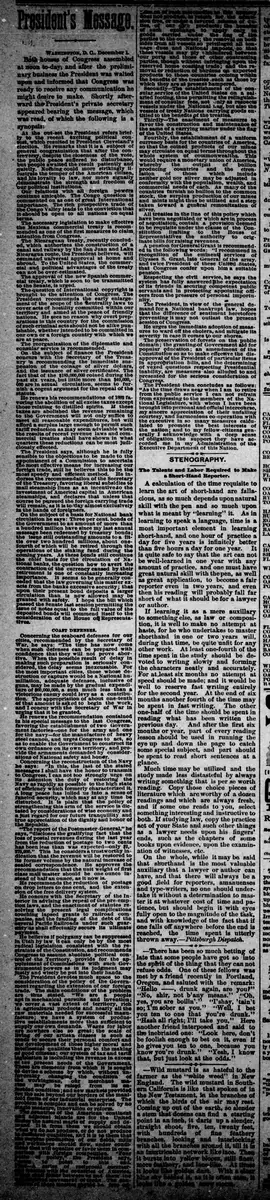
WASHINGTON, D.C., December 1.
Both houses of Congress assembled at noon to-day, and after the preliminary business the President was waited upon and informed that Congress was ready to receive any communication he might desire to make. Shortly afterward the President's private secretary appeared bearing the message, which was read, of which the following is a synopsis:
At the outset the President refers briefly to the recent exciting political contest which resulted in President Cleveland's election. He remarks that it is a subject of general congratulation that after the controversy, despite the closeness of the vote, the public peace suffered no disturbance, but people awaited the result patiently and quietly. Nothing could more strikingly illustrate the temper of the American citizen and his loyalty to law, nor more signally demonstrate the strength and freedom of our political institutions.
Our relations with all foreign powers continue amicable. The Congo question is commented on as one of great international importance. The rich prospective trade of the Congo Valley leads to the conviction that it should be open to all nations on equal terms.
The necessary legislation to make effective the Mexican commercial treaty is recommended as one of the first measures to claim attention from Congress.
The Nicaraguan treaty, recently concluded, which authorizes the construction of canal and railway by the San Juan and Lake Nicaragua route, the President believes, will command universal approval at home and abroad. To the United States, the commercial and political advantages of the treaty cannot be over-estimated.
The approval of the new Spanish commercial treaty, which is soon to be transmitted to the Senate, is urged.
The question of international copyright is brought to the attention of Congress.
The President recommends the early enlargement of the scope of the neutrality laws to cover acts of hostility committed within our territory and aimed at the peace of friendly nations. He sees no reason why overt preparations in this country for the commission of such criminal acts should not be alike punishable, whether intended to be committed in our own or a foreign country with which we are at peace.
The reorganization of the diplomatic and consular service is recommended.
On the subject of finance the President concurs with the Secretary of the Treasury in recommending the immediate suspension of the coinage of silver dollars, and the issuance of silver certificates. The fact that of the $185,000,000 coined during the past six years, but little more than $40,000,000 are in actual circulation, seems to furnish a cogent argument for the repeal of the statute.
He renews his recommendations of last year favoring the abolition of all excise taxes except those relating to distilled spirits.
If these taxes are abolished the revenue remaining to the Government will not only suffice to meet all reasonable expenditures, but will afford a surplus large enough to permit such tariff reduction as may seem advisable when the results of recent revenue laws and commercial treaties shall have shown in what quarters these reductions can be most judiciously effected.
The President says, although he is fully sensible to the objections to be made to the appointment of a Commission to ascertain the most effective means for increasing our foreign trade, still he believes this to be the most speedy and efficient method. He indorses the recommendation of the Secretary of the Treasury, favoring liberal subsidies to mail steamship lines as an incentive to the investment of American capital in American steamships, and declares that unless that course be pursued the foreign carrying trade will remain, as it is to-day, almost exclusively in the hands of foreigners.
On the subject of a basis for national bank circulation he says: Three per cent. bonds of the Government to an amount of more than a hundred million have since my last annual message been redeemed by treasury bonds; the issue still outstanding amounts to a little over two hundred millions, about one-fourth of which will be retired through the operations of the sinking fund during the coming years. As these bonds still continue the chief basis for the circulation of national banks the question how to avert the contraction of the currency caused by their retirement is one of constantly increasing importance. It seems to be generally conceded that the law governing this matter exacts from the banks excessive security; that upon their present bond deposits a larger circulation than is now allowed may be granted with safety.
I hope the bill which passed the Senate last session permitting the issue of notes equal to the full value of the deposited bonds will commend itself to the consideration of the House of Representatives.
COAST DEFENSES.
Concerning the seaboard defenses for our cities, recommended by the Secretary of War, he says: "The time has now come when such defenses can be prepared with confidence that they will not prove abortive. When the possible result of delay in making such preparation is seriously considered, the delay seems inexcusable. For the most important cities, those whose destruction or capture would be a national humiliation, adequate defenses, inclusive of guns, may be made by the gradual expenditure of $60,000,000, a sum much less than a victorious enemy could levy as a contribution. The appropriation of about one-tenth of that amount is asked to begin the work, and I concur with the Secretary of War in urging that it be granted."
He renews the recommendation contained in his special message to the last Congress, favoring the establishment of two government factories--one for the army and one for the navy--for the manufacture of heavy steel cannon, and urges Congress to act, so as to enable the government to construct its own ordnance on its own territory, and provide the armaments demanded by considerations of national safety and honor.
Concerning the reconstruction of the navy he says: "In this, the last of the stated messages I shall have the honor to transmit to Congress, I cannot too strongly urge on its attention the duty of restoring the navy as rapidly as possible to the high state of efficiency which formerly characterized it. A long peace has lulled us into a sense of fancied security, which may at any time be disturbed. It is plain that the policy of strengthening this arm of the service is dictated by considerations of wise economy and just regard for our future tranquillity and true appreciation of the dignity and honor of the Republic."
"The report of the Postmaster-General," he says, "discloses the gratifying fact that the loss of postal revenues during the last year from the reduction of postage to two cents has been less than was expected--only $2,975,000."
This he considers a trustworthy indication that the revenue will be restored to its former volume by the natural increase of sealed correspondence.
He approves the recommendation that the unit weight of first-class mail matter should be one ounce instead of half an ounce, as it now is.
He recommends the reduction of postage on drop letters to one cent, and the extension of the free delivery system.
He concurs with the Secretary of the Interior in advising the repeal of the pre-emption laws, and the enactment of statutes resolving the present legal complications touching lapsed grants to railroad companies, and the funding of the debt of the Northern Pacific railroads under such guaranty as shall effectually secure its ultimate payment.
He believes if polygamy can be suppressed in Utah it can only be by the most radical legislation consistent with the restraints of the Constitution, and recommends Congress to assume absolute political control of the territory, provide for the appointment of commissions with such governmental powers as in its judgment may justly and wisely be put into their hands.
The President devotes much space to the consideration of the policy of the government regarding the extension of our foreign trade. The main conditions of the problem are thus stated:
"We are a people adventurous in mechanical pursuits and invention; we cover a vast extent of territory, rich in agricultural products and nearly limitless in raw materials needed for successful manufacture; we have a system of production so gigantic that after supplying our own demands we can wait with impatience for other countries to take our surplus; wages for labor are perhaps, after all, so great; the trade of our artisans capably in such hands, to secure their personal comfort and the development of those higher moral and intellectual qualities that go to the making of good citizens; our system of taxation (tariff revision including the revenue is excess of present need) of the government. These are elements from which it is sought to devise a scheme by which, without unsettling the condition of the workingman, of the merchant, or of any legitimate pursuit, new markets are provided for the sale beyond our borders, of the manifold product of our industrial enterprise. The problem is complex and can be solved by no single measure, by no one individual or reform.
The countries of the American continent with which we should seek to increase our commercial exchanges are those which hinder trade for the United States by discriminating tariffs and do not produce, or do not produce equivalent quantities, and it is to them that our surplus production of oats, meats, milk and workshops should flow, under conditions duly alike or favorable to them as to foreign competition.
The President says: "The adoption of a system of reciprocal commercial treaties with the countries of America is without doubt between us and them the true policy."
Secondly, the establishment of a maritime service of the United States on an equality with foreign nations, fitting the reins to the establishment of consular fees, not only as respects vessels under the national flag, but also the vessels of treaty nations carrying goods entitled to the benefits of the treaties.
Thirdly--The enactment of measures to favor the construction and maintenance of the same of a carrying marine under the flag of the United States.
Fourthly, the establishment of a uniform currency basis for the countries of America so that the coined products of our mines may circulate on equal terms throughout the whole system of commonwealths. This would require a monetary union of America, whereby the output of bullion producing countries and the circulation of those which include neither gold nor silver may be adjusted in conformity with the population, wealth and commercial needs of each. As many of the countries furnish no bullion to the common stock, the surplus production of our mines and mints might thus be utilized and a step taken toward a general remonetization of silver.
All treaties in the line of this policy which have been negotiated or which are in process of negotiation, contain a provision deemed to be requisite under the clause of the Constitution limiting to the House of Representatives the authority to originate bills for raising revenues.
A pension for General Grant is recommended in the following words: "I recommend in recognition of the eminent services of Ulysses S. Grant, late General of the army and twice President of these United States, that Congress confer upon him a suitable pension."
Respecting the civil service, he says the system has fully answered the expectation of its friends in securing competent public servants and in protecting appointing officers from the pressure of personal importunity.
The President, in view of the general demand for a national bankrupt law, hopes that the difference of sentiment heretofore preventing it may not outlast the present session of Congress.
He urges the immediate adoption of measures to ward off the cholera, and mitigate its severity in case it comes to our shores.
The preservation of forests on the public domain; the granting of government aid for popular education; an amendment of the Constitution so as to make effective the disapproval of the President of particular items in appropriation bills, and the determining of vexed questions respecting presidential inability, are measures also alluded to and presented for the serious consideration of Congress.
The President then concludes as follows:
"As the time draws near when I am to retire from the public service I cannot refrain from expressing to the members of the national legislature, with whom I have been brought into personal and official intercourse, my sincere appreciation of their unfailing courtesy and harmonious co-operation with the executive in so many measures calculated to promote the best interests of the nation; and to my fellow-citizens generally I acknowledge with a deep sense of obligation the support they have accorded me in my administration of the executive department of this nation."
What sub-type of article is it?
What keywords are associated?
What entities or persons were involved?
Where did it happen?
Domestic News Details
Primary Location
Washington, D.C.
Event Date
December 1
Key Persons
Event Details
Synopsis of the President's annual message to Congress, covering topics including foreign relations, commercial treaties with Mexico, Nicaragua, and Spain, neutrality laws, finance reforms like silver coinage suspension and excise tax abolition, national bank circulation, coast defenses, navy reconstruction, postal service improvements, pre-emption laws repeal, Utah polygamy suppression, foreign trade expansion policies, pension for General Grant, civil service, bankrupt law, cholera prevention, forest preservation, education aid, and constitutional amendments.