Thank you for visiting SNEWPapers!
Sign up free
The New Hampshire Gazette And Historical Chronicle
Portsmouth, Greenland, Rockingham County, New Hampshire
What is this article about?
Editorial from New-York, August 22, reports on England's grain crisis with high prices causing starvation despite spoilage and hoarding, then opines on debates over John Wilkes, defending mobs as justified responses to oppression and arguing for popular resistance against tyrannical government.
Merged-components note: Continuation of the same editorial on government, Wilkes, and tyranny; sequential reading order and adjacent bounding boxes indicate single logical unit.
Clipping
OCR Quality
Full Text
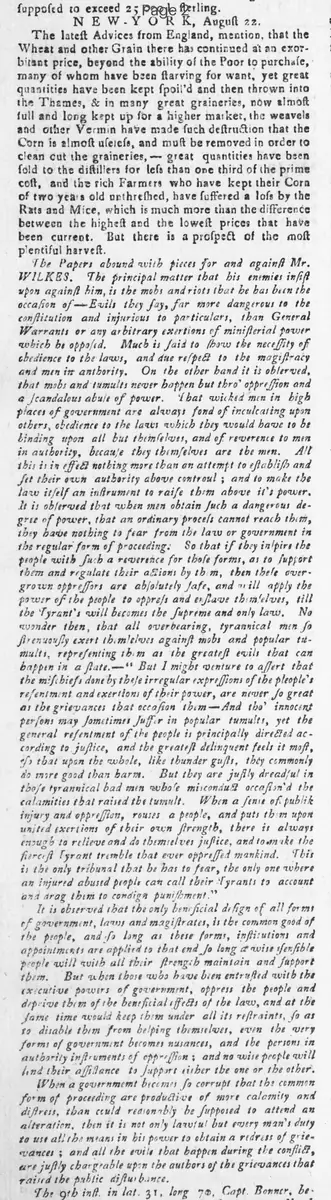
The latest Advices from England, mention that the Wheat and other Grain there has continued at an exorbitant price, beyond the ability of the Poor to purchase, many of whom have been starving for want, yet great quantities have been kept spoiled and then thrown into the Thames, & in many great granaries, now almost full and long kept up for a higher market, the weevils and other Vermin have made such destruction that the Corn is almost useless, and must be removed in order to clean out the granaries,--great quantities have been sold to the distillers for less than one third of the prime cost, and the rich Farmers who have kept their Corn of two years old unthreshed, have suffered a loss by the Rats and Mice, which is much more than the difference between the highest and the lowest prices that have been current. But there is a prospect of the most plentiful harvest.
The Papers abound with pieces for and against Mr. Wilkes. The principal matter that his enemies insist upon against him, is the mobs and riots that he has been the occasion of--Evils they say, far more dangerous to the constitution and injurious to particulars, than General Warrants or any arbitrary exertions of ministerial power which he opposed. Much is said to show the necessity of obedience to the laws, and due respect to the magistracy and men in authority. On the other hand it is observed, that mobs and tumults never happen but thro' oppression and a scandalous abuse of power. That wicked men in high places of government are always fond of inculcating upon others, obedience to the laws which they would have to be binding upon all but themselves, and of reverence to men in authority, because they themselves are the men. All this is in effect nothing more than an attempt to establish and set their own authority above controul; and to make the law itself an instrument to raise them above it's power.
It is observed that when men obtain such a dangerous degree of power, that an ordinary process cannot reach them, they have nothing to fear from the law or government in the regular form of proceeding: So that if they inspire the people with such a reverence for those forms, as to support them and regulate their actions by them, then these over-grown oppressors are absolutely safe, and will apply the power of the people to oppress and enslave themselves, till the Tyrant's will becomes the supreme and only law. No wonder then, that all overbearing, tyrannical men so strenuously exert themselves against mobs and popular tumults, representing them as the greatest evils that can happen in a state.-- But I might venture to assert that the mischiefs done by these irregular expressions of the people's resentment and exertions of their power, are never so great as the grievances that occasion them--And tho' innocent persons may sometimes suffer in popular tumults, yet the general resentment of the people is principally directed according to justice, and the greatest delinquent feels it most.
So that upon the whole, like thunder gusts, they commonly do more good than harm. But they are justly dreadful in those tyrannical bad men whose misconduct occasion'd the calamities that raised the tumult. When a sense of publick injury and oppression, rouses a people, and puts them upon united exertions of their own strength, there is always enough to relieve and do themselves justice, and to make the fiercest Tyrant tremble that ever oppressed mankind. This is the only tribunal that he has to fear, the only one where an injured abused people can call their Tyrants to account and drag them to condign punishment.
It is observed that the only beneficial design of all forms of government, laws and magistrates, is the common good of the people, and so long as these forms, institutions and appointments are applied to that end so long a wise sensible people will use all their strength maintain and support them. But when those who have been entrusted with the executive powers of government, oppress the people and deprive them of the beneficial effects of the law, and at the same time would keep them under all its restraints, so as to disable them from helping themselves, even the very forms of government becomes nuisances, and the persons in authority instruments of oppression: and no wise people will lend their assistance to support either the one or the other.
When a government becomes so corrupt that the common form of proceeding are productive of more calamity and distress, than could reasonably be supposed to attend an alteration, then it is not only lawful but every man's duty to use all the means in his power to obtain a redress of grievances; and all the evils that happen during the conflict, are justly chargeable upon the authors of the grievances that raised the public disturbance.
What sub-type of article is it?
What keywords are associated?
What entities or persons were involved?
Editorial Details
Primary Topic
England's Grain Crisis And Justification Of Popular Resistance To Tyranny
Stance / Tone
Critical Of Economic Hoarding And Governmental Oppression, Supportive Of Mobs Against Tyrants
Key Figures
Key Arguments
- high grain prices cause starvation among the poor despite abundant supply
- hoarding leads to spoilage and losses for farmers
- mobs and riots stem from oppression, not inherent evil
- obedience to laws is preached by the powerful to maintain their unchecked authority
- popular tumults serve as a check on tyrants when regular processes fail
- government forms should be supported only if they serve the common good
- resistance to corrupt government is a duty when it causes more harm than reform