Thank you for visiting SNEWPapers!
Sign up free
Editorial
January 18, 1805
Berkeley And Jefferson Intelligencer
Martinsburg, Berkeley County, Virginia
What is this article about?
An anonymous contributor to the Intelligencer extols the superiority of Christian ethics over heathen philosophy, focusing on the Golden Rule from Matthew 7:12 as a divine precept that promotes personal moral rectitude and societal happiness, urging readers to follow it for eternal reward.
Clipping
OCR Quality
95%
Excellent
Full Text
MONITORIAL
For the INTELLIGENCER.
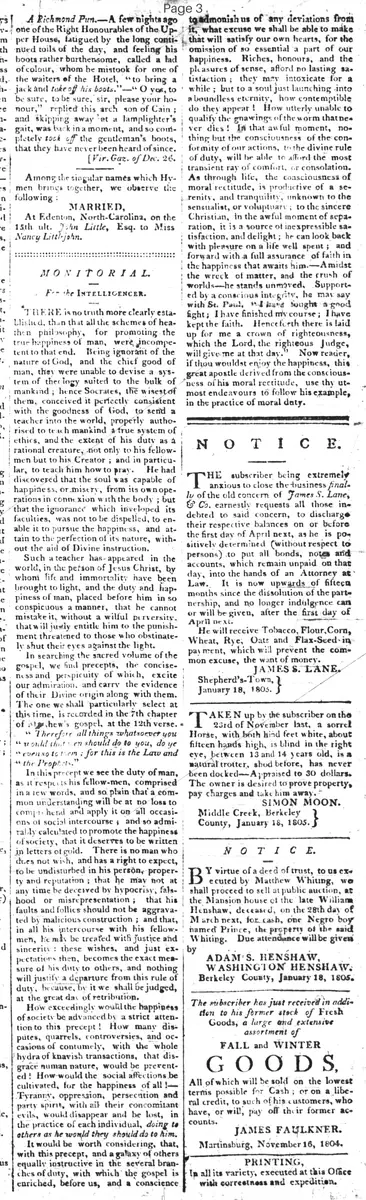
There is no truth more clearly established, than that all the schemes of heathen philosophy, for promoting the true happiness of man, were, incompetent to that end. Being ignorant of the nature of God, and the chief good of man, they were unable to devise a system of theology suited to the bulk of mankind: hence Socrates, the wisest of them, conceived it perfectly consistent with the goodness of God, to send a teacher into the world, properly authorized to teach mankind a true system of ethics, and the extent of his duty as a rational creature, not only to his fellow men but to his Creator; and in particular, to teach him how to pray. He had discovered that the soul was capable of happiness, or misery, from its own operations in connection with the body; but that the ignorance which enveloped its faculties, was not to be dispelled, to enable it to pursue the happiness, and attain to the perfection of its nature, without the aid of Divine instruction.
Such a teacher has appeared in the world, in the person of Jesus Christ, by whom life and immortality have been brought to light, and the duty and happiness of man, placed before him in so conspicuous a manner, that he cannot mistake it, without a wilful perversity, that will justly entitle him to the punishment threatened to those who obstinately shut their eyes against the light.
In searching the sacred volume of the gospel, we find precepts, the conciseness and perspicuity of which, excite our admiration, and carry the evidence of their Divine origin along with them. The one we shall particularly select at this time, is recorded in the 7th chapter of Matthew's gospel, at the 12th verse.
"Therefore all things whatsoever you would that men should do to you, do ye even so to them; for this is the Law and the Prophets."
In this precept we see the duty of man, as it respects his fellow-men, comprised in a few words, and so plain that a common understanding will be at no loss to comprehend and apply it on all occasions of social intercourse; and so admirably calculated to promote the happiness of society, that it deserves to be written in letters of gold. There is no man who does not wish, and has a right to expect, to be undisturbed in his person, property and reputation; that he may not at any time be deceived by hypocrisy, falsehood or misrepresentation; that his faults and follies should not be aggravated by malicious construction; and that, in all his intercourse with his fellow men, he may be treated with justice and sincerity: these wishes, and just expectations then, becomes the exact measure of his duty to others, and nothing will justify a departure from this rule of duty, because, by it we shall be judged, at the great day of retribution.
How exceedingly would the happiness of society be advanced by a strict attention to this precept! How many disputes, quarrels, controversies, and occasions of contumely, with the whole hydra of knavish transactions, that disgrace human nature, would be prevented! How would the social affections be cultivated, for the happiness of all!-- Tyranny, oppression, persecution and party spirit, with all their concomitant evils, would disappear and be lost, in the practice of each individual, doing to others as he would they should do to him.
It would be worth considering, that, with this precept, and a galaxy of others equally instructive in the several branches of duty, with which the gospel is enriched, before us, and a conscience to admonish us of any deviations from it, what excuse we shall be able to make that will satisfy our own hearts, for the omission of so essential a part of our happiness. Riches, honours, and the pleasures of sense, afford no lasting satisfaction: they may intoxicate for a while: but to a soul just launching into a boundless eternity, how contemptible do they appear! How utterly unable to qualify the gnawings of the worm that never dies! In that awful moment, nothing but the consciousness of the conformity of our actions, to the divine rule of duty, will be able to afford the most transient ray of comfort or consolation.
As through life, the consciousness of moral rectitude, is productive of a serenity, and tranquillity, unknown to the sensualist, or voluptuary: to the sincere Christian, in the awful moment of separation, it is a source of inexpressible satisfaction, and delight: he can look back with pleasure on a life well spent; and forward with a full assurance of faith in the happiness that awaits him.--Amidst the wreck of matter, and the crush of worlds---he stands unmoved. Supported by a conscious integrity, he may say with St. Paul, "I have fought a good fight; I have finished my course; I have kept the faith. Henceforth there is laid up for me a crown of righteousness, which the Lord, the righteous Judge, will give me at that day." Now reader, if thou wouldst enjoy the happiness, this great apostle derived from the consciousness of his moral rectitude, use thy utmost endeavours to follow his example, in the practice of moral duty.
For the INTELLIGENCER.
There is no truth more clearly established, than that all the schemes of heathen philosophy, for promoting the true happiness of man, were, incompetent to that end. Being ignorant of the nature of God, and the chief good of man, they were unable to devise a system of theology suited to the bulk of mankind: hence Socrates, the wisest of them, conceived it perfectly consistent with the goodness of God, to send a teacher into the world, properly authorized to teach mankind a true system of ethics, and the extent of his duty as a rational creature, not only to his fellow men but to his Creator; and in particular, to teach him how to pray. He had discovered that the soul was capable of happiness, or misery, from its own operations in connection with the body; but that the ignorance which enveloped its faculties, was not to be dispelled, to enable it to pursue the happiness, and attain to the perfection of its nature, without the aid of Divine instruction.
Such a teacher has appeared in the world, in the person of Jesus Christ, by whom life and immortality have been brought to light, and the duty and happiness of man, placed before him in so conspicuous a manner, that he cannot mistake it, without a wilful perversity, that will justly entitle him to the punishment threatened to those who obstinately shut their eyes against the light.
In searching the sacred volume of the gospel, we find precepts, the conciseness and perspicuity of which, excite our admiration, and carry the evidence of their Divine origin along with them. The one we shall particularly select at this time, is recorded in the 7th chapter of Matthew's gospel, at the 12th verse.
"Therefore all things whatsoever you would that men should do to you, do ye even so to them; for this is the Law and the Prophets."
In this precept we see the duty of man, as it respects his fellow-men, comprised in a few words, and so plain that a common understanding will be at no loss to comprehend and apply it on all occasions of social intercourse; and so admirably calculated to promote the happiness of society, that it deserves to be written in letters of gold. There is no man who does not wish, and has a right to expect, to be undisturbed in his person, property and reputation; that he may not at any time be deceived by hypocrisy, falsehood or misrepresentation; that his faults and follies should not be aggravated by malicious construction; and that, in all his intercourse with his fellow men, he may be treated with justice and sincerity: these wishes, and just expectations then, becomes the exact measure of his duty to others, and nothing will justify a departure from this rule of duty, because, by it we shall be judged, at the great day of retribution.
How exceedingly would the happiness of society be advanced by a strict attention to this precept! How many disputes, quarrels, controversies, and occasions of contumely, with the whole hydra of knavish transactions, that disgrace human nature, would be prevented! How would the social affections be cultivated, for the happiness of all!-- Tyranny, oppression, persecution and party spirit, with all their concomitant evils, would disappear and be lost, in the practice of each individual, doing to others as he would they should do to him.
It would be worth considering, that, with this precept, and a galaxy of others equally instructive in the several branches of duty, with which the gospel is enriched, before us, and a conscience to admonish us of any deviations from it, what excuse we shall be able to make that will satisfy our own hearts, for the omission of so essential a part of our happiness. Riches, honours, and the pleasures of sense, afford no lasting satisfaction: they may intoxicate for a while: but to a soul just launching into a boundless eternity, how contemptible do they appear! How utterly unable to qualify the gnawings of the worm that never dies! In that awful moment, nothing but the consciousness of the conformity of our actions, to the divine rule of duty, will be able to afford the most transient ray of comfort or consolation.
As through life, the consciousness of moral rectitude, is productive of a serenity, and tranquillity, unknown to the sensualist, or voluptuary: to the sincere Christian, in the awful moment of separation, it is a source of inexpressible satisfaction, and delight: he can look back with pleasure on a life well spent; and forward with a full assurance of faith in the happiness that awaits him.--Amidst the wreck of matter, and the crush of worlds---he stands unmoved. Supported by a conscious integrity, he may say with St. Paul, "I have fought a good fight; I have finished my course; I have kept the faith. Henceforth there is laid up for me a crown of righteousness, which the Lord, the righteous Judge, will give me at that day." Now reader, if thou wouldst enjoy the happiness, this great apostle derived from the consciousness of his moral rectitude, use thy utmost endeavours to follow his example, in the practice of moral duty.
What sub-type of article is it?
Moral Or Religious
What keywords are associated?
Golden Rule
Christian Ethics
Moral Duty
Societal Happiness
Divine Instruction
Eternal Reward
What entities or persons were involved?
Socrates
Jesus Christ
St. Paul
Editorial Details
Primary Topic
Exposition Of The Golden Rule From Matthew 7:12
Stance / Tone
Exhortative Promotion Of Christian Moral Duty For Happiness
Key Figures
Socrates
Jesus Christ
St. Paul
Key Arguments
Heathen Philosophy Failed To Promote True Human Happiness Due To Ignorance Of God.
Jesus Christ Revealed True Ethics And Duty To God And Fellow Men.
The Golden Rule Encapsulates Duty To Others In Plain, Applicable Terms.
Adhering To The Golden Rule Prevents Disputes, Tyranny, And Promotes Societal Happiness.
Moral Rectitude Provides Lifelong Serenity And Eternal Consolation Unlike Worldly Pleasures.
Conscious Integrity Allows Facing Death With Assurance, As Exemplified By St. Paul.