Thank you for visiting SNEWPapers!
Sign up free
Literary
February 16, 1838
The Liberator
Boston, Suffolk County, Massachusetts
What is this article about?
In Letter XV of her series on equal rights, Sarah M. Grimké argues that men and women share equal guilt in the biblical Fall, thus equal moral responsibilities. She critiques gender restrictions in religion and education, urges women to claim their rights, participate in reforms like abolition and temperance, and reject unequal treatment.
Clipping
OCR Quality
95%
Excellent
Full Text
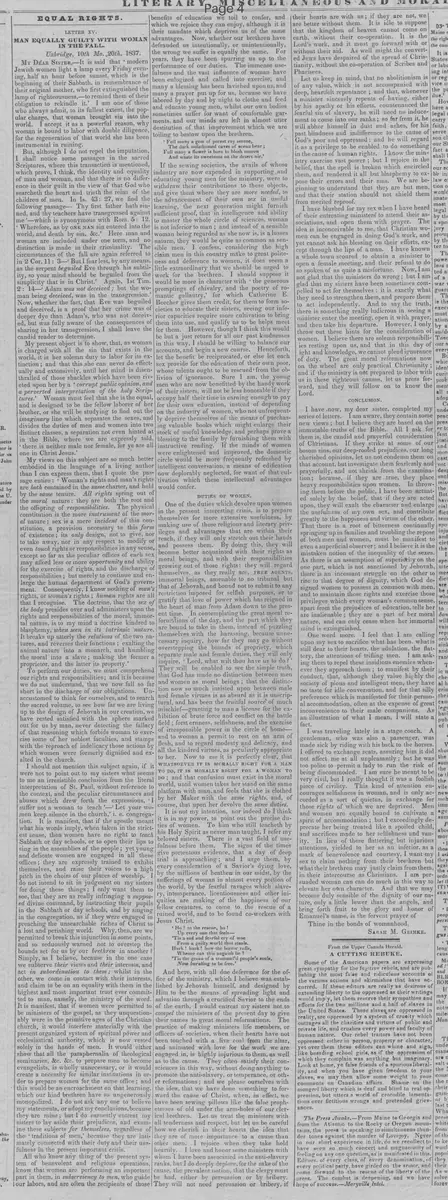
EQUAL RIGHTS.
LETTER XV.
MAN EQUALLY GUILTY WITH WOMAN
IN THE FALL.
Uxbridge, 10th Mo. 20th, 1837.
My DEAR SISTER, It is said that 'modern
Jewish women light a lamp every Friday evening,
half an hour before sunset, which is the
beginning of their Sabbath, in remembrance of
their original mother, who first extinguished the
lamp of righteousness,—to remind them of their
obligation to rekindle it.' I am one of those
who always admit, to its fullest extent, the popular
charge, that woman brought sin into the
world. I accept it as a powerful reason, why
woman is bound to labor with double diligence
for the regeneration of that world she has been
instrumental in ruining.
But, although I do not repel the imputation.
I shall notice some passages in the sacred
Scriptures, where this transaction is mentioned
which prove, I think, the identity and equality
of man and woman, and that there is no difference
in their guilt in the view of that God who
searcheth the heart and trieth the reins of the
children of men. In Is. 43: 27, we find the
following passage— Thy first father hath sinned,
and thy teachers have transgressed against
me'—which is synonymous with Rom. 5: 12.
Wherefore, as by one man sin entered into the
world, and death by sin, &c.' Here man and
woman are included under one term, and no
distinction is made in their criminality. The
circumstances of the fall are again referred to
in 2 Cor. 11: 3. But I fear lest, by any means,
as the serpent beguiled Eve through his subtlety,
so your mind should be beguiled from the
simplicity that is in Christ.' Again, 1st Tim.
2: 14. Adam was not deceived: but the woman
being deceived, was in the transgression.'
Now, whether the fact, that Eve was beguiled
and deceived, is a proof that her crime was of
deeper dye than Adam's, who was not deceived,
but was fully aware of the consequences of
sharing in her transgression, I shall leave the
candid reader to determine.
My present object is to show, that, as woman
is charged with all the sin that exists in the
world, it is her solemn duty to labor for its extinction;
and that this she can never do effectually
and extensively, until her mind is disenthralled
of those shackles which have been riveted upon
her by a corrupt public opinion, and
a perverted interpretation of the holy Scriptures.'
Woman must feel that she is the equal.
and is designed to be the fellow laborer of her
brother, or she will be studying to find out the
imaginary line which separates the sexes, and
divides the duties of men and women into two
distinct classes, a separation not even hinted at
in the Bible, where we are expressly told,
'there is neither male nor female, for ye are all
one in Christ Jesus.'
My views on this subject are so much better
embodied in the language of a living author
than I can express them, that I quote the passage
entire: Woman's rights and man's rights
are both contained in the same charter, and held
by the same tenure. All rights spring out of
the moral nature: they are both the root and
the offspring of responsibilities. The physical
constitution is the mere instrument of the moral
nature; sex is a mere incident of this constitution,
a provision necessary to this form
of existence; its only design, not to give, nor
to take away, nor in any respect to modify or
even touch rights or responsibilities in any sense,
except so far as the peculiar offices of each sex
may afford less or more opportunity and ability
for the exercise of rights, and the discharge of
responsibilities; but merely to continue and enlarge
the human department of God's government.
Consequently, I know nothing of man's
rights, or woman's rights; human rights are all
that I recognise. The doctrine, that the sex of
the body presides over and administers upon the
rights and responsibilities of the moral, immortal
nature, is to my mind a doctrine kindred to
blasphemy, when seen in its intrinsic nature.
It breaks up utterly the relations of the two natures,
and reverses their functions; exalting the
animal nature into a monarch, and humbling
the moral into a slave; making the former a
proprietor, and the latter its property.
To perform our duties, we must comprehend
our rights and responsibilities; and it is because
we do not understand, that we now fall so far
short in the discharge of our obligations. Unaccustomed
to think for ourselves, and to search
the sacred volume, to see how far we are living
up to the design of Jehovah in our creation, we
have rested satisfied with the sphere marked
out for us by man, never detecting the fallacy
of that reasoning which forbids woman to exercise
some of her noblest faculties, and stamps
with the reproach of indelicacy those actions by
which women were formerly dignified and exalted
in the church.
I should not mention this subject again, if it
were not to point out to my sisters what seems
to me an irresistible conclusion from the literal
interpretation of St. Paul, without reference to
the context, and the peculiar circumstances and
abuses which drew forth the expressions, 'I
suffer not a woman to teach'—'Let your women
keep silence in the church,' i. e. congregation.
It is manifest, that if the apostle meant
what his words imply, when taken in the strictest
sense, then women have no right to teach
Sabbath or day schools, or to open their lips to
sing in the assemblies of the people; yet young
and delicate women are engaged in all these
offices; they are expressly trained to exhibit
themselves, and raise their voices to a high
pitch in the choirs of our places of worship. I
do not intend to sit in judgment on my sisters
for doing these things; I only want them to
see, that they are as really infringing a supposed
divine command, by instructing their pupils
in the Sabbath or day schools, and by singing
in the congregation, as if they were engaged in
preaching the unsearchable riches of Christ to
a lost and perishing world. Why, then, are we
permitted to break this injunction in some points.
and so sedulously warned not to overstep the
bounds set for us by our brethren in another?
Simply, as I believe, because in the one case
we subserve their views and their interests, and
act in subordination to them; whilst in the
other, we come in contact with their interests,
and claim to be on an equality with them in the
highest and most important trust ever committed
to man, namely, the ministry of the word.
It is manifest, that if women were permitted to
be ministers of the gospel, as they unquestionably
were in the primitive ages of the Christian
church, it would interfere materially with the
present organized system of spiritual power and
ecclesiastical authority, which is now vested
solely in the hands of men. It would either
show that all the paraphernalia of theological
seminaries, &c. &c. to prepare men to become
evangelists, is wholly unnecessary, or it would
create a necessity for similar institutions in order
to prepare women for the same office; and
this would be an encroachment on that learning
which our blind brethren have so ungenerously
monopolized. I do not ask any one to believe
my statements, or adopt my conclusions, because
they are mine; but I do earnestly entreat my
sisters to lay aside their prejudices, and examine
these subjects for themselves, regardless of
the 'traditions of men,' because they are intimately
connected with their duty and their usefulness
in the present important crisis.
All who know any thing of the present system
of benevolent and religious operations.
know that women are performing an important
part in them, in subserviency to men, who guide
our labors, and are often the recipients of those
benefits of education we toil to confer, and
which we rejoice they can enjoy, although it is
their mandate which deprives us of the same
advantages. Now, whether our brethren have
defrauded us intentionally, or unintentionally.
the wrong we suffer is equally the same. For
years, they have been spurring us up to the
performance of our duties. The immense usefulness
and the vast influence of woman have
been eulogized and called into exercise, and
many a blessing has been lavished upon us, and
many a prayer put up for us, because we have
labored by day and by night to clothe and feed
and educate young men, whilst our own bodies
sometimes suffer for want of comfortable garments,
and our minds are left in almost utter
destitution of that improvement which we are
toiling to bestow upon the brethren.
'Full many a gem of purest ray serene,
The dark unfathomed caves of ocean bear;
Full many a flower is born to blush unseen
And waste its sweetness on the desert air.'
If the sewing societies, the avails of whose
industry are now expended in supporting and
educating young men for the ministry, were to
withdraw their contributions to these objects,
and give them where they are more needed, to
the advancement of their own sex in useful
learning, the next generation might furnish
sufficient proof, that in intelligence and ability
to master the whole circle of sciences, woman
is not inferior to man; and instead of a sensible
woman being regarded as she now is, a lusus
naturae, they would be quite as common as sensible
men. I confess, considering the high
claim men in this country make to great politeness
and deference to women, it does seem a
little extraordinary that we should be urged to
work for the brethren. I should suppose it
would be more in character with the generous
promptings of chivalry, and the poetry of romantic
gallantry,' for which Catherine E.
Beecher gives them credit, for them to form societies
to educate their sisters, seeing our inferior
capacities require more cultivation to bring
them into use, and qualify us to be helps meet
for them. However, though I think this would
be but a just return for all our past kindnesses
in this way, I should be willing to balance our
accounts, and begin a new course. Henceforth,
let the benefit be reciprocated, or else let each
sex provide for the education of their own poor,
whose talents ought to be rescued from the oblivion
of ignorance. Sure I am, the young
men who are now benefitted by the handy work
of their sisters, will not be less honorable if they
occupy half their time in earning enough to pay
for their own education, instead of depending
on the industry of women, who not unfrequently
depelve themselves of the means of purchasing
valuable books which might enlarge their
stock of useful knowledge, and perhaps prove a
blessing to the family by furnishing them with
instructive reading. If the minds of women
were enlightened and improved, the domestic
circle would be more frequently refreshed by
intelligent conversation, a means of edification
now deplorably neglected, for want of that cultivation
which these intellectual advantages
would confer.
One of the duties which devolve upon women
in the present interesting crisis, is to prepare
themselves for more extensive usefulness, by
making use of those religious and literary privileges
and advantages that are within their
reach, if they will only stretch out their hands
and possess them. By doing this, they will
become better acquainted with their rights as
moral beings, and with their responsibilities
growing out of those rights: they will regard
themselves, as they really are, FREE AGENTS,
immortal beings, amenable to no tribunal but
that of Jehovah, and bound not to submit to any
restriction imposed for selfish purposes, or to
gratify that love of power which has reigned in
the heart of man from Adam down to the present
time. In contemplating the great moral reformations
of the day, and the part which they
are bound to take in them, instead of puzzling
themselves with the harassing, because unnecessary
inquiry, how far they may go without
overstepping the bounds of propriety, which
that separate male and female duties, they will only
inquire, 'Lord, what wilt thou have us to do?'
They will be enabled to see the simple truth,
that God has made no distinction between men
and women as moral beings; that the distinction
now so much insisted upon between male
and female virtues is as absurd as it is unscriptural,
and has been the fruitful source of much
mischief—granting to man a license for the exhibition
of brute force and conflict on the battle
field; for sternness, selfishness, and the exercise
of irresponsible power in the circle of home—
and to woman a permit to rest on an arm of
flesh, and to regard modesty and delicacy, and
all the kindred virtues, as peculiarly appropriate
to her. Now to me it is perfectly clear, that
WHATSOEVER IT IS MORALLY RIGHT FOR A MAN
TO DO, IT IS MORALLY RIGHT FOR A WOMAN TO
DO; and that confusion must exist in the moral
world, until woman takes her stand on the same
platform with man, and feels that she is clothed
by her Maker with the same rights, and, of
course, that upon her devolve the same duties.
It is not my intention, nor indeed do I think
it is in my power, to point out the precise duties
of women. To him who still teacheth by
his Holy Spirit as never man taught, I refer my
beloved sisters. There is a vast field of usefulness
before them. The signs of the times
give portentous evidence, that a day of deep
trial is approaching; and I urge them, by
every consideration of a Savior's dying love,
by the millions of heathen in our midst, by the
sufferings of woman in almost every portion of
the world, by the fearful ravages which slavery,
intemperance, licentiousness and other iniquities
are making of the happiness of our
fellow creatures, to come to the rescue of a
ruined world, and to be found co-workers with
Jesus Christ.
Ho! to the rescue, ho!
Up every one that feels—
'Tis a sad and fearful cry of woe
From a guilty world that steals.
Hark! hark! how the horror rolls,
Whence can this anguish be?
Tis the groan of a trammel'd people's souls,
Now bursting to be free.'
And here, with all due deference for the office
of the ministry, which I believe was established
by Jehovah himself, and designed by
Him to be the means of spreading light and
salvation through a crucified Savior to the ends
of the earth, I would entreat my sisters not to
compel the ministers of the present day to give
their names to great moral reformations. The
practice of making ministers life members, or
officers of societies, when their hearts have not
been touched with a live coal from the altar,
and animated with love for the work we are
engaged in, is highly injurious to them, as well
as to the cause. They often satisfy their consciences
in this way, without doing anything to
promote the anti-slavery, or temperance, or other
reformations; and we please ourselves with
the idea, that we have done something to forward
the cause of Christ, when, in effect, we
have been sewing pillows like the false prophetesses
of old under the arm-holes of our clerical
brethren. Let us treat the ministers with
all tenderness and respect, but let us be careful
how we cherish in their hearts the idea that
they are of more importance to a cause than
other men. I rejoice when they take hold
heartily. I love and honor some ministers with
whom I have been associated in the anti-slavery
ranks, but I do deeply deplore, for the sake of the
cause, the prevalent notion, that the clergy must
be had, either by persuasion or by bribery.
They will not need persuasion or bribery, if
their hearts are with us; if they are not, we
are better without them. It is idle to suppose
that the kingdom of heaven cannot come on
the earth, without their co-operation. It is the
Lord's work, and it must go forward with or
without their aid. As well might the converted
Jews have despaired of the spread of Christianity,
without the co-operation of Scribes and
Pharisees.
Let us keep in mind, that no abolitionism is
of any value, which is not accompanied with
deep, heartfelt repentance; and that, whenever
a minister sincerely repents of having, either
by his apathy or his efforts, countenanced the
fearful sin of slavery, he will need no inducement
to come into our ranks; so far from it, he
will abhor himself in dust and ashes, for his
past blindness and indifference to the cause of
God's poor and oppressed: and he will regard
it as a privilege to be enabled to do something
in the cause of human rights. I know the ministry
exercise vast power; but I rejoice in the
belief, that the spell is broken which encircled
them, and rendered it all but blasphemy to expose
their errors and their sins. We are beginning
to understand that they are but men,
and that their station should not shield them
from merited reproof.
I have blushed for my sex when I have heard
of their entreating ministers to attend their associations,
and open them with prayer. The
idea is inconceivable to me, that Christian women
can be engaged in doing God's work, and
yet cannot ask his blessing on their efforts, except
through the lips of a man. I have known
a whole town scoured to obtain a minister to
open a female meeting, and their refusal to do
so spoken of as quite a misfortune. Now, I am
not glad that the ministers do wrong; but I am
glad that my sisters have been sometimes compelled
to act for themselves: it is exactly what
they need to strengthen them, and prepare them
to act independently. And to say the truth.
there is something really ludicrous in seeing a
minister enter the meeting, open it with prayer
and then take his departure. However, I only
throw out these hints for the consideration of
women. I believe there are solemn responsibilities
resting upon us, and that in this day of
light and knowledge, we cannot plead ignorance
of duty. The great moral reformations now
on the wheel are only practical Christianity;
and if the ministry is not prepared to labor with
us in these righteous causes, let us press forward,
and they will follow on to know the
Lord.
CONCLUSION.
I have now, my dear sister, completed my
series of letters. I am aware, they contain some
new views; but I believe they are based on the
immutable truths of the Bible. All I ask for
them is, the candid and prayerful consideration
of Christians. If they strike at some of our
bosom sins, our deep-rooted prejudices, our long
cherished opinions, let us not condemn them on
that account, but investigate them fearlessly and
prayerfully, and not shrink from the examination;
because, if they are true, they place
heavy responsibilities upon women. In throwing
them before the public, I have been actuated
solely by the belief, that if they are acted
upon, they will exalt the character and enlarge
the usefulness of my own sex, and contribute
greatly to the happiness and virtue of the other.
That there is a root of bitterness continually
springing up in families and troubling the repose
of both men and women, must be manifest to
even a superficial observer; and I believe it is the
mistaken notion of the inequality of the sexes.
As there is an assumption of superiority on the
one part, which is not sanctioned by Jehovah,
there is an incessant struggle on the other to
rise to that degree of dignity, which God designed
women to possess in common with men,
and to maintain those rights and exercise those
privileges which every woman's common sense.
apart from the prejudices of education, tells her
are inalienable; they are a part of her moral
nature, and can only cease when her immortal
mind is extinguished.
One word more. I feel that I am calling
upon my sex to sacrifice what has been, what is
still dear to their hearts, the adulation, the flattery,
the attentions of trifling men. I am asking
them to repel these insidious enemies whenever
they approach them; to manifest by their
conduct, that, although they value highly the
society of pious and intelligent men, they have
no taste for idle conversation, and for that silly
preference which is manifested for their personal
accommodation, often at the expense of great
inconvenience to their male companions. As
an illustration of what I mean, I will state a
fact.
I was traveling lately in a stage coach. A
gentleman, who was also a passenger, was
made sick by riding with his back to the horses.
I offered to exchange seats, assuring him it did
not affect me at all unpleasantly; but he was
too polite to permit a lady to run the risk of
being discommoded. I am sure he meant to be
very civil, but I really thought it was a foolish
piece of civility. This kind of attention encourages
selfishness in woman, and is only accorded
as a sort of quietus, in exchange for
those rights of which we are deprived. Men
and women are equally bound to cultivate a
spirit of accommodation; but I exceedingly deprecate
her being treated like a spoiled child.
and sacrifices made to her selfishness and vanity.
In lieu of these flattering but injurious
attentions, yielded to her as an inferior, as a
mark of benevolence and courtesy, I want my
sex to claim nothing from their brethren but
what their brethren may justly claim from them.
in their intercourse as Christians. I am persuaded
woman can do much in this way to
elevate her own character. And that we may
become duly sensible of the dignity of our nature,
only a little lower than the angels, and
bring forth fruit to the glory and honor of
Emanuel's name, is the fervent prayer of
Thine in the bonds of womanhood,
Sarah M. Grimké.
LETTER XV.
MAN EQUALLY GUILTY WITH WOMAN
IN THE FALL.
Uxbridge, 10th Mo. 20th, 1837.
My DEAR SISTER, It is said that 'modern
Jewish women light a lamp every Friday evening,
half an hour before sunset, which is the
beginning of their Sabbath, in remembrance of
their original mother, who first extinguished the
lamp of righteousness,—to remind them of their
obligation to rekindle it.' I am one of those
who always admit, to its fullest extent, the popular
charge, that woman brought sin into the
world. I accept it as a powerful reason, why
woman is bound to labor with double diligence
for the regeneration of that world she has been
instrumental in ruining.
But, although I do not repel the imputation.
I shall notice some passages in the sacred
Scriptures, where this transaction is mentioned
which prove, I think, the identity and equality
of man and woman, and that there is no difference
in their guilt in the view of that God who
searcheth the heart and trieth the reins of the
children of men. In Is. 43: 27, we find the
following passage— Thy first father hath sinned,
and thy teachers have transgressed against
me'—which is synonymous with Rom. 5: 12.
Wherefore, as by one man sin entered into the
world, and death by sin, &c.' Here man and
woman are included under one term, and no
distinction is made in their criminality. The
circumstances of the fall are again referred to
in 2 Cor. 11: 3. But I fear lest, by any means,
as the serpent beguiled Eve through his subtlety,
so your mind should be beguiled from the
simplicity that is in Christ.' Again, 1st Tim.
2: 14. Adam was not deceived: but the woman
being deceived, was in the transgression.'
Now, whether the fact, that Eve was beguiled
and deceived, is a proof that her crime was of
deeper dye than Adam's, who was not deceived,
but was fully aware of the consequences of
sharing in her transgression, I shall leave the
candid reader to determine.
My present object is to show, that, as woman
is charged with all the sin that exists in the
world, it is her solemn duty to labor for its extinction;
and that this she can never do effectually
and extensively, until her mind is disenthralled
of those shackles which have been riveted upon
her by a corrupt public opinion, and
a perverted interpretation of the holy Scriptures.'
Woman must feel that she is the equal.
and is designed to be the fellow laborer of her
brother, or she will be studying to find out the
imaginary line which separates the sexes, and
divides the duties of men and women into two
distinct classes, a separation not even hinted at
in the Bible, where we are expressly told,
'there is neither male nor female, for ye are all
one in Christ Jesus.'
My views on this subject are so much better
embodied in the language of a living author
than I can express them, that I quote the passage
entire: Woman's rights and man's rights
are both contained in the same charter, and held
by the same tenure. All rights spring out of
the moral nature: they are both the root and
the offspring of responsibilities. The physical
constitution is the mere instrument of the moral
nature; sex is a mere incident of this constitution,
a provision necessary to this form
of existence; its only design, not to give, nor
to take away, nor in any respect to modify or
even touch rights or responsibilities in any sense,
except so far as the peculiar offices of each sex
may afford less or more opportunity and ability
for the exercise of rights, and the discharge of
responsibilities; but merely to continue and enlarge
the human department of God's government.
Consequently, I know nothing of man's
rights, or woman's rights; human rights are all
that I recognise. The doctrine, that the sex of
the body presides over and administers upon the
rights and responsibilities of the moral, immortal
nature, is to my mind a doctrine kindred to
blasphemy, when seen in its intrinsic nature.
It breaks up utterly the relations of the two natures,
and reverses their functions; exalting the
animal nature into a monarch, and humbling
the moral into a slave; making the former a
proprietor, and the latter its property.
To perform our duties, we must comprehend
our rights and responsibilities; and it is because
we do not understand, that we now fall so far
short in the discharge of our obligations. Unaccustomed
to think for ourselves, and to search
the sacred volume, to see how far we are living
up to the design of Jehovah in our creation, we
have rested satisfied with the sphere marked
out for us by man, never detecting the fallacy
of that reasoning which forbids woman to exercise
some of her noblest faculties, and stamps
with the reproach of indelicacy those actions by
which women were formerly dignified and exalted
in the church.
I should not mention this subject again, if it
were not to point out to my sisters what seems
to me an irresistible conclusion from the literal
interpretation of St. Paul, without reference to
the context, and the peculiar circumstances and
abuses which drew forth the expressions, 'I
suffer not a woman to teach'—'Let your women
keep silence in the church,' i. e. congregation.
It is manifest, that if the apostle meant
what his words imply, when taken in the strictest
sense, then women have no right to teach
Sabbath or day schools, or to open their lips to
sing in the assemblies of the people; yet young
and delicate women are engaged in all these
offices; they are expressly trained to exhibit
themselves, and raise their voices to a high
pitch in the choirs of our places of worship. I
do not intend to sit in judgment on my sisters
for doing these things; I only want them to
see, that they are as really infringing a supposed
divine command, by instructing their pupils
in the Sabbath or day schools, and by singing
in the congregation, as if they were engaged in
preaching the unsearchable riches of Christ to
a lost and perishing world. Why, then, are we
permitted to break this injunction in some points.
and so sedulously warned not to overstep the
bounds set for us by our brethren in another?
Simply, as I believe, because in the one case
we subserve their views and their interests, and
act in subordination to them; whilst in the
other, we come in contact with their interests,
and claim to be on an equality with them in the
highest and most important trust ever committed
to man, namely, the ministry of the word.
It is manifest, that if women were permitted to
be ministers of the gospel, as they unquestionably
were in the primitive ages of the Christian
church, it would interfere materially with the
present organized system of spiritual power and
ecclesiastical authority, which is now vested
solely in the hands of men. It would either
show that all the paraphernalia of theological
seminaries, &c. &c. to prepare men to become
evangelists, is wholly unnecessary, or it would
create a necessity for similar institutions in order
to prepare women for the same office; and
this would be an encroachment on that learning
which our blind brethren have so ungenerously
monopolized. I do not ask any one to believe
my statements, or adopt my conclusions, because
they are mine; but I do earnestly entreat my
sisters to lay aside their prejudices, and examine
these subjects for themselves, regardless of
the 'traditions of men,' because they are intimately
connected with their duty and their usefulness
in the present important crisis.
All who know any thing of the present system
of benevolent and religious operations.
know that women are performing an important
part in them, in subserviency to men, who guide
our labors, and are often the recipients of those
benefits of education we toil to confer, and
which we rejoice they can enjoy, although it is
their mandate which deprives us of the same
advantages. Now, whether our brethren have
defrauded us intentionally, or unintentionally.
the wrong we suffer is equally the same. For
years, they have been spurring us up to the
performance of our duties. The immense usefulness
and the vast influence of woman have
been eulogized and called into exercise, and
many a blessing has been lavished upon us, and
many a prayer put up for us, because we have
labored by day and by night to clothe and feed
and educate young men, whilst our own bodies
sometimes suffer for want of comfortable garments,
and our minds are left in almost utter
destitution of that improvement which we are
toiling to bestow upon the brethren.
'Full many a gem of purest ray serene,
The dark unfathomed caves of ocean bear;
Full many a flower is born to blush unseen
And waste its sweetness on the desert air.'
If the sewing societies, the avails of whose
industry are now expended in supporting and
educating young men for the ministry, were to
withdraw their contributions to these objects,
and give them where they are more needed, to
the advancement of their own sex in useful
learning, the next generation might furnish
sufficient proof, that in intelligence and ability
to master the whole circle of sciences, woman
is not inferior to man; and instead of a sensible
woman being regarded as she now is, a lusus
naturae, they would be quite as common as sensible
men. I confess, considering the high
claim men in this country make to great politeness
and deference to women, it does seem a
little extraordinary that we should be urged to
work for the brethren. I should suppose it
would be more in character with the generous
promptings of chivalry, and the poetry of romantic
gallantry,' for which Catherine E.
Beecher gives them credit, for them to form societies
to educate their sisters, seeing our inferior
capacities require more cultivation to bring
them into use, and qualify us to be helps meet
for them. However, though I think this would
be but a just return for all our past kindnesses
in this way, I should be willing to balance our
accounts, and begin a new course. Henceforth,
let the benefit be reciprocated, or else let each
sex provide for the education of their own poor,
whose talents ought to be rescued from the oblivion
of ignorance. Sure I am, the young
men who are now benefitted by the handy work
of their sisters, will not be less honorable if they
occupy half their time in earning enough to pay
for their own education, instead of depending
on the industry of women, who not unfrequently
depelve themselves of the means of purchasing
valuable books which might enlarge their
stock of useful knowledge, and perhaps prove a
blessing to the family by furnishing them with
instructive reading. If the minds of women
were enlightened and improved, the domestic
circle would be more frequently refreshed by
intelligent conversation, a means of edification
now deplorably neglected, for want of that cultivation
which these intellectual advantages
would confer.
One of the duties which devolve upon women
in the present interesting crisis, is to prepare
themselves for more extensive usefulness, by
making use of those religious and literary privileges
and advantages that are within their
reach, if they will only stretch out their hands
and possess them. By doing this, they will
become better acquainted with their rights as
moral beings, and with their responsibilities
growing out of those rights: they will regard
themselves, as they really are, FREE AGENTS,
immortal beings, amenable to no tribunal but
that of Jehovah, and bound not to submit to any
restriction imposed for selfish purposes, or to
gratify that love of power which has reigned in
the heart of man from Adam down to the present
time. In contemplating the great moral reformations
of the day, and the part which they
are bound to take in them, instead of puzzling
themselves with the harassing, because unnecessary
inquiry, how far they may go without
overstepping the bounds of propriety, which
that separate male and female duties, they will only
inquire, 'Lord, what wilt thou have us to do?'
They will be enabled to see the simple truth,
that God has made no distinction between men
and women as moral beings; that the distinction
now so much insisted upon between male
and female virtues is as absurd as it is unscriptural,
and has been the fruitful source of much
mischief—granting to man a license for the exhibition
of brute force and conflict on the battle
field; for sternness, selfishness, and the exercise
of irresponsible power in the circle of home—
and to woman a permit to rest on an arm of
flesh, and to regard modesty and delicacy, and
all the kindred virtues, as peculiarly appropriate
to her. Now to me it is perfectly clear, that
WHATSOEVER IT IS MORALLY RIGHT FOR A MAN
TO DO, IT IS MORALLY RIGHT FOR A WOMAN TO
DO; and that confusion must exist in the moral
world, until woman takes her stand on the same
platform with man, and feels that she is clothed
by her Maker with the same rights, and, of
course, that upon her devolve the same duties.
It is not my intention, nor indeed do I think
it is in my power, to point out the precise duties
of women. To him who still teacheth by
his Holy Spirit as never man taught, I refer my
beloved sisters. There is a vast field of usefulness
before them. The signs of the times
give portentous evidence, that a day of deep
trial is approaching; and I urge them, by
every consideration of a Savior's dying love,
by the millions of heathen in our midst, by the
sufferings of woman in almost every portion of
the world, by the fearful ravages which slavery,
intemperance, licentiousness and other iniquities
are making of the happiness of our
fellow creatures, to come to the rescue of a
ruined world, and to be found co-workers with
Jesus Christ.
Ho! to the rescue, ho!
Up every one that feels—
'Tis a sad and fearful cry of woe
From a guilty world that steals.
Hark! hark! how the horror rolls,
Whence can this anguish be?
Tis the groan of a trammel'd people's souls,
Now bursting to be free.'
And here, with all due deference for the office
of the ministry, which I believe was established
by Jehovah himself, and designed by
Him to be the means of spreading light and
salvation through a crucified Savior to the ends
of the earth, I would entreat my sisters not to
compel the ministers of the present day to give
their names to great moral reformations. The
practice of making ministers life members, or
officers of societies, when their hearts have not
been touched with a live coal from the altar,
and animated with love for the work we are
engaged in, is highly injurious to them, as well
as to the cause. They often satisfy their consciences
in this way, without doing anything to
promote the anti-slavery, or temperance, or other
reformations; and we please ourselves with
the idea, that we have done something to forward
the cause of Christ, when, in effect, we
have been sewing pillows like the false prophetesses
of old under the arm-holes of our clerical
brethren. Let us treat the ministers with
all tenderness and respect, but let us be careful
how we cherish in their hearts the idea that
they are of more importance to a cause than
other men. I rejoice when they take hold
heartily. I love and honor some ministers with
whom I have been associated in the anti-slavery
ranks, but I do deeply deplore, for the sake of the
cause, the prevalent notion, that the clergy must
be had, either by persuasion or by bribery.
They will not need persuasion or bribery, if
their hearts are with us; if they are not, we
are better without them. It is idle to suppose
that the kingdom of heaven cannot come on
the earth, without their co-operation. It is the
Lord's work, and it must go forward with or
without their aid. As well might the converted
Jews have despaired of the spread of Christianity,
without the co-operation of Scribes and
Pharisees.
Let us keep in mind, that no abolitionism is
of any value, which is not accompanied with
deep, heartfelt repentance; and that, whenever
a minister sincerely repents of having, either
by his apathy or his efforts, countenanced the
fearful sin of slavery, he will need no inducement
to come into our ranks; so far from it, he
will abhor himself in dust and ashes, for his
past blindness and indifference to the cause of
God's poor and oppressed: and he will regard
it as a privilege to be enabled to do something
in the cause of human rights. I know the ministry
exercise vast power; but I rejoice in the
belief, that the spell is broken which encircled
them, and rendered it all but blasphemy to expose
their errors and their sins. We are beginning
to understand that they are but men,
and that their station should not shield them
from merited reproof.
I have blushed for my sex when I have heard
of their entreating ministers to attend their associations,
and open them with prayer. The
idea is inconceivable to me, that Christian women
can be engaged in doing God's work, and
yet cannot ask his blessing on their efforts, except
through the lips of a man. I have known
a whole town scoured to obtain a minister to
open a female meeting, and their refusal to do
so spoken of as quite a misfortune. Now, I am
not glad that the ministers do wrong; but I am
glad that my sisters have been sometimes compelled
to act for themselves: it is exactly what
they need to strengthen them, and prepare them
to act independently. And to say the truth.
there is something really ludicrous in seeing a
minister enter the meeting, open it with prayer
and then take his departure. However, I only
throw out these hints for the consideration of
women. I believe there are solemn responsibilities
resting upon us, and that in this day of
light and knowledge, we cannot plead ignorance
of duty. The great moral reformations now
on the wheel are only practical Christianity;
and if the ministry is not prepared to labor with
us in these righteous causes, let us press forward,
and they will follow on to know the
Lord.
CONCLUSION.
I have now, my dear sister, completed my
series of letters. I am aware, they contain some
new views; but I believe they are based on the
immutable truths of the Bible. All I ask for
them is, the candid and prayerful consideration
of Christians. If they strike at some of our
bosom sins, our deep-rooted prejudices, our long
cherished opinions, let us not condemn them on
that account, but investigate them fearlessly and
prayerfully, and not shrink from the examination;
because, if they are true, they place
heavy responsibilities upon women. In throwing
them before the public, I have been actuated
solely by the belief, that if they are acted
upon, they will exalt the character and enlarge
the usefulness of my own sex, and contribute
greatly to the happiness and virtue of the other.
That there is a root of bitterness continually
springing up in families and troubling the repose
of both men and women, must be manifest to
even a superficial observer; and I believe it is the
mistaken notion of the inequality of the sexes.
As there is an assumption of superiority on the
one part, which is not sanctioned by Jehovah,
there is an incessant struggle on the other to
rise to that degree of dignity, which God designed
women to possess in common with men,
and to maintain those rights and exercise those
privileges which every woman's common sense.
apart from the prejudices of education, tells her
are inalienable; they are a part of her moral
nature, and can only cease when her immortal
mind is extinguished.
One word more. I feel that I am calling
upon my sex to sacrifice what has been, what is
still dear to their hearts, the adulation, the flattery,
the attentions of trifling men. I am asking
them to repel these insidious enemies whenever
they approach them; to manifest by their
conduct, that, although they value highly the
society of pious and intelligent men, they have
no taste for idle conversation, and for that silly
preference which is manifested for their personal
accommodation, often at the expense of great
inconvenience to their male companions. As
an illustration of what I mean, I will state a
fact.
I was traveling lately in a stage coach. A
gentleman, who was also a passenger, was
made sick by riding with his back to the horses.
I offered to exchange seats, assuring him it did
not affect me at all unpleasantly; but he was
too polite to permit a lady to run the risk of
being discommoded. I am sure he meant to be
very civil, but I really thought it was a foolish
piece of civility. This kind of attention encourages
selfishness in woman, and is only accorded
as a sort of quietus, in exchange for
those rights of which we are deprived. Men
and women are equally bound to cultivate a
spirit of accommodation; but I exceedingly deprecate
her being treated like a spoiled child.
and sacrifices made to her selfishness and vanity.
In lieu of these flattering but injurious
attentions, yielded to her as an inferior, as a
mark of benevolence and courtesy, I want my
sex to claim nothing from their brethren but
what their brethren may justly claim from them.
in their intercourse as Christians. I am persuaded
woman can do much in this way to
elevate her own character. And that we may
become duly sensible of the dignity of our nature,
only a little lower than the angels, and
bring forth fruit to the glory and honor of
Emanuel's name, is the fervent prayer of
Thine in the bonds of womanhood,
Sarah M. Grimké.
What sub-type of article is it?
Epistolary
Essay
What themes does it cover?
Liberty Freedom
Moral Virtue
Religious
What keywords are associated?
Women's Rights
Gender Equality
Biblical Fall
Moral Reform
Religious Duties
Slavery Abolition
Temperance
Female Education
What entities or persons were involved?
Sarah M. Grimké
Literary Details
Title
Letter Xv. Man Equally Guilty With Woman In The Fall.
Author
Sarah M. Grimké
Subject
Advocacy For Women's Moral And Religious Equality With Men, Drawing On Biblical Interpretations And Calls For Reform Participation.
Form / Style
Epistolary Essay Arguing For Gender Equality In Duties And Rights.
Key Lines
Thy First Father Hath Sinned, And Thy Teachers Have Transgressed Against Me
There Is Neither Male Nor Female, For Ye Are All One In Christ Jesus.
Whatsoever It Is Morally Right For A Man To Do, It Is Morally Right For A Woman To Do;
Woman Must Feel That She Is The Equal. And Is Designed To Be The Fellow Laborer Of Her Brother,
Ho! To The Rescue, Ho! Up Every One That Feels— 'Tis A Sad And Fearful Cry Of Woe From A Guilty World That Steals.